Three major firms – MEO, NOS, and (increasingly) Vonage – serve the telecommunications market in Portugal. All those “extras” that come bundled in your telecommunications package: Wifi Internet + TV + landline telephone + mobile phone with given data? Study your contract carefully for caveats and exceptions! MEO, for instance doesn’t charge you for calls from mobile phones (whose first digit is “9”) to either other mobiles or landlines in Portugal … but call a mobile from your landline (whose first digit is “2” here), and you’ll be charged. (In Spain, landlines begin with a “9” and mobile phone numbers with a “6.”) If you’re somewhere with free WiFi available, be sure to connect to it on your mobile phone. And outside the country, where the EU has decreed that telecommunications, too, are to be “without borders” … they are and they’re not—with plenty of “ifs,” “ands” and “buts.” Know your restrictions and tariffs before using your mobile for handling calls or ^/downloading data elsewhere.
Attaching timers to certain electrical devices – electric waters heaters, for one – is a convenient, practical, cost-effective way to limit energy consumption … and reduce your electricity bills!
Coin-chained supermarket carts cut down the clutter and damage caused by shopping carts abandoned, helter-skelter, in parking lots. Are you listening, Walmart and grocery stores? Learn from responsible retailers!
Is Dawn your preferred dish-washing detergent? Sorry, but no Fairy or store brand can compare. And Dawn, by and large, isn’t available in Spain or Portugal.
Feeling “comfortable” navigating all those roundabouts, deciphering international road signs, practicing roadway rules and etiquette, can be daunting when dealing with drivers who are daredevils or laggards. Please, use your turn signals and stay in the appropriate lane!
Regarding the sensitive subject of bathroom hygiene, let’s just say that the paper here isn’t what Charmin would have us crave.
Bureaucracy is almost an art form in both Spain and Portugal.
When using a credit card and you’re given the option to pay either in euros or dollars, always choose euros. The savings can be substantial! If your Multibanco or ATM also offers this option with debit card withdrawals, choose euros over whatever conversion rate and currency exchange amount presented. Jot down the amount (in dollars) shown on the screen to be deducted from your account … then, after opting for euros, go online to see how much has been deducted from your bank account. Yesterday, the Multibanco ATM wanted to charge us $123.46 to withdraw 100 euros. Our bank deducted only $113.87 for the transaction.
Looking at a house to buy? Don’t neglect to check out the roof carefully—not just the condition of the exterior tiles (cracks and breaks often lead to water infiltration), but the supports – beams and trusses – in the attic (sótão) as well. The best supports are made of concrete or galvanized steel; wooden supports are susceptible to wood-boring insects (like termites and carpenter ants) that eat the insides of those wooden beams, leaving them hollow and unable to support the weight of the roof—especially during heavy rains.
Mold and mildew are frequent problems in Portugal and Spain, especially in typical houses not built to today’s standards. Especially when the wetter, windier, cooler weather sets in. A few suggestions for dealing with it: (1) Be sure your property can breathe. It needs “vents” that let air in and out. (2) Periodically, move things away from the walls–headboards of beds, clothing hanging from a rod next to the wall, even artwork. Be sure to give a good scrubbing with any of the products recommended to remove mold and mildew. (3) Keep your eyes closed when applying these noxious chemicals topically … but keep them open for what our UK friends refer to as the “damp.” Even if it’s not dark in color, wetness (damp) on your ceilings and walls means that water is somehow — somewhere — getting in. You need to track it down and secure it from entering. (4) Use those humidifiers. We have a large house, with four dehumidifiers going–one (without a window or vent) dedicated to the bathroom and shower. The dehumidifiers have made a major difference. (5) As tempting as it might be after opening those windows and letting in fresh — but C-O-L-D — air, be frugal with your heating appliances. Electricity is quite expensive here!
Shared here are personal observations, experiences, and happenstance that actually occurred to us as we moved from the USA to begin a new life in Portugal and Spain. Collected and compiled in EXPAT: Leaving the USA for Good, the book is available in hardcover, paperback, and eBook editions from Amazon and most online booksellers.
Processing…
Success! You're on the list.
Whoops! There was an error and we couldn't process your subscription. Please reload the page and try again.
Among Portugal’s extraordinary pleasures are its amazing panoramas, extraordinary places, and breathtaking vistas that can be enjoyed in a day trip.
From Algarve to Nazaré, people along the coast head to the Atlantic for a change of pace and a respite on the beach.
On the other side of the country, closer to its Iberian border, others cross into Spain along spiraling roads, with little villages dotting the way. Suddenly, we’re in another country … with different foods, related culture, and a somewhat “sister” language.
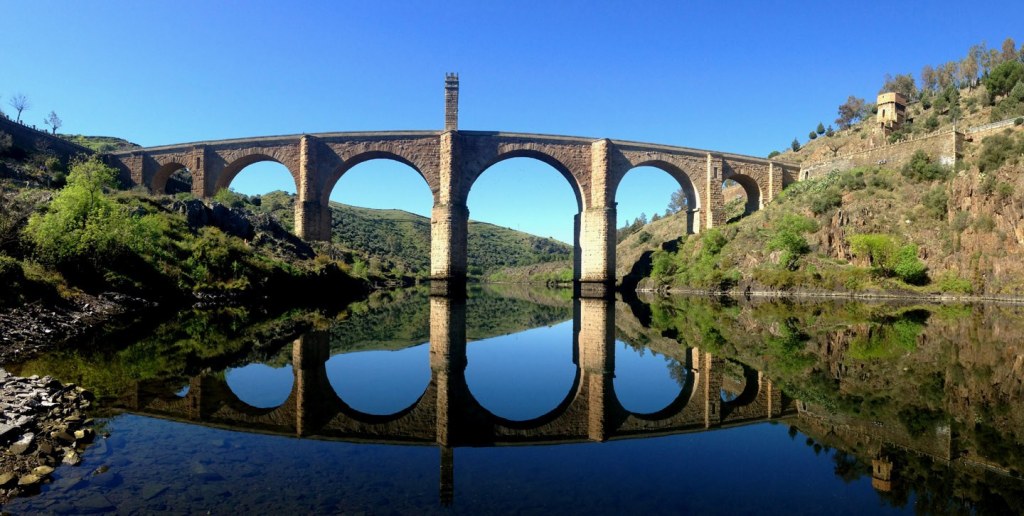
We frequently travel into Spain on Sundays through Idanha a Nova and Segura, crossing a Roman bridge and aqueduct to enter Spain several kilometers before Alcántara. Apart from a few restaurants, a tourist trap or two, mini-mercado, and pharmacy, there’s not much else at this border town. For that, you’ll need to drive another 40 kms or so.
The food, however, is quite good at the area’s three restaurants: Kantara (the most expensive), Kantara Al Saif, and Gundin (our favorite). Gundin’s €11.00 Menu del Día provides the best gazpacho I’ve enjoyed. Except for the bread (Spain doesn’t come close to Portugal’s bread), the other two dishes are also quite tasty.
This time, though, we headed farther north – through Penamacor – to visit Valverde del Fresno for its Thursday market. The town is 16 kms from the Portugal border which, in turn, is 16 kms from Penamacor.
While we looked forward to a Spanish meal, we were on a special mission this trip: shopping for stuff at prices cheaper than in Portugal.
Textiles!
The irony is that thick, plush, absorbent, 100% cotton towels tagged with “Made in Portugal” labels cost half the price in Spain. Same for linens—from sheet sets to table cloths and coverlets.
That’s the good news. The bad?
Regardless of mattress size – including “king” and “queen” – Spanish sheet sets contain only three pieces: a top sheet, bottom sheet, and pillow case—each almost the same size. For some reason unbeknown to us (or any salespeople), the Spaniards have humongous pillows—measuring almost 200 cms across! We, however, have two pillows … each about 75 cms wide.
So, despite the higher cost, we buy our sheets and pillow cases in Portugal, where the larger size sets come standard with two matching pillow cases. (And, no, the label doesn’t say “Made in Spain.”)
Our favorite place to shop for such textile goods is the Monday market in Fundão. It’s massive! In fact, our next expat get-together will be a trip to Fundão’s Monday market, followed by a fixed-price (€9.95) buffet lunch at the city’s Principe da Beira hotel.
Anyway, I’ve digressed …
Fait accompli: We purchased our towels and took time to poke about the town, which is bigger and much more typically Spanish than Alcántara. We’d forgotten that it’s an hour later in Spain than Portugal, so most of the shops were closing … and restaurants were filling.
Tapas. We wanted tapas!
In Olvera, our Spanish hometown, as in most of Andalucía – southern Spain – menus offer meals in three sizes: tapas, media (half) ración, and a full dish (ración). Not here in Extremadura. Patrons and wait staff at restaurant after restaurant explained to us that tapas weren’t available … but complimentary “pinchos” were served with the drinks.
In southern Spain, pinchos are a type of tapa—they’re anything served on a skewer. Here to the north, in Extremadura, pinchos refer to a small, tasty dish provided gratis that accompanies your beverage.
We ate at Restaurante Casa Laura. With 120 “excellent” TripAdvisor reviews – four times more than the closest competition – we soon understood why: the food is to die for there. We began with some beer accompanied by a small dish of pinchos, potatoes mixed with egg and pieces of chorizo in a carmel sauce. Yum-mo! The cool gazpacho soup was good (enough), followed by meatballs in a thick and rich tomato sauce for me and cod (bacalao) with nary a single bone for Russ. The pièce de résistance, however, was dessert: dreamy-creamy cheesecake.
Total tab for our lunch, including tip, was twenty-seven euros (€27), somewhat pricier than what we’ve paid in Alcántara. But well worth it! Everyone working at the restaurant was super friendly and all made a point of stopping by our table to be sure we were satisfied.
Heading back across the windy roads surrounded by a lush, distinctly parceled landscape, it occurred to us how different the topography of Spain is in some ways from Portugal’s.
The two countries are close enough to be kissing cousins, but remnants of historical bitterness and jealousies remain between them. That’s truly a shame, since they’re so convenient and complementary.
It’s good to see Portuguese people visiting Spain … and vice-versa.
Throughout the Castelo Branco district’s tantalizing come-hithers, we’ve come across many Spanish tourists taking day trips into Portugal.
Turnabout is surely fair play for us to sightsee and go shopping in Spain!
Shared here are personal observations, experiences, and happenstance that actually occurred to us as we moved from the USA to begin a new life in Portugal and Spain. Collected and compiled in EXPAT: Leaving the USA for Good, the book is available in hardcover, paperback, and eBook editions from Amazon and most online booksellers.
Processing…
Success! You're on the list.
Whoops! There was an error and we couldn't process your subscription. Please reload the page and try again.
I will always admire Canada and respect the Canadian social contract with its people. But I wouldn’t want to live there. Wisconsin has been cold enough for us. Delving into international retirement trends, we learned that many Canadians owned property in Mexico, where they retreated, if possible, to escape the blustery cold.
So, we looked into Mexico as a potential retirement haven. But the stories about traveling through Mexico – especially around towns near the U.S. border – were chilling in a different way: the fear factor. Americans inadvertently (but sometimes deliberately) had been targets of drug cartels and other criminals in the country.
We considered the Lake Chapala and Ajiic areas outside Guadalajara – known for its “ideal climate” and the number of English-speaking expats residing there – but these places, not far from Mexico’s second largest city, also became headlines when Americans were found murdered there.
“They were in the wrong place at the wrong time,” explained people quoted in the news stories. “They should have known better: You don’t go out here alone at night … especially to certain places. You travel only on the major highways and roads. Don’t wander around. You learn that, to stay safe, it’s wise to live in a gated community.”
That wasn’t what we wanted; our dream included late-night strolls along cobble stone streets of old towns with lots of lanes and paths.
Mexico’s Yucatán peninsula – home to cruise ships calling on expansive, intentionally constructed resort destinations like Cancún, Cozumel, and Playa del Carmen – advertised itself as Mexico’s “safest place to be.” Rather than these tourist traps featuring all-inclusive vacations and panhandlers shilling free meals at luxurious spots in exchange for touring the premises and listening to pitches on the benefits of buying their time-shares, we decided to take a close look at the historic city of Mérida and its nearby beaches—especially Progreso.
It’s hot there. Very hot. Hot and humid and buggy.
We stayed in a charming little hotel in downtown Mérida, on a small street not far from the city’s market. With Walmart, Costco, Home Depot, Office Max, and other U.S. brands, we felt “at home,” although stifled by the climate if not put off by the language.
But Mérida wasn’t where we wanted to be—even its own people looked to escape the oppressive heat by heading to the beaches, not even an hour’s drive away. We headed there, too.
We went there to look at “Big Blue,” a property in Progreso, just two blocks from the Gulf of Mexico beach. The stately building boasted five big bedrooms, five full baths, a separate “casita” with its own facilities, and a heart-shaped swimming pool … all enclosed and private. We’d seen it listed online by more than one property agent based in Mérida, although one seemed to be more familiar with the property and the Canadian family that was selling it. It had been on the market for a while, the agent informed us, and the owners were “motivated” to sell it.
“What does that mean?” we asked. “Come down and look at it,” replied the agent. “I’ve spoken with the sellers and feel sure that they’ll sell it to you for $10,000 less than their asking price.”
The house was truly awesome. But it needed work. And furnishings. Especially if it were to become the bed and breakfast we envisioned. How much would it cost us to have the repairs and updates made, with so many trades – electrical, masonry, plumbing, carpentry – involved? What would we pay for all the new appliances – air conditioners, a commercial kitchen, all the usual suspects – that needed upgrading? And what kind of estimate would be appropriate for the furnishings, especially comfortable new bedrooms and mattresses?
We made an offer—exactly what the agent told us the owners would accept. Leaving later that morning, we waited at the airport for a response, laptops opened and WiFi on. Just before boarding, we received the news: “Sorry. The owners changed their minds. They’ll sell you the house … but want the full asking price.”
Six years on the market. We offered what was recommended before we flew down to check out the property and Progreso. But, now, it didn’t feel right. If we were misled about the acceptable price for the property, what else might be mistaken?
More importantly, where should we consider next?
I engaged all my contacts and connections in seeking a church seeking a pastor. Preferably a Spanish-speaking pastor. Like the patriarch Abraham long ago before me, I felt a tugging at my spirit urging me to move on to a place whose Spirit would call.
That’s when I came across this mission statement from an international church in Panama serving all people, but especially English and Spanish speakers, which was looking for a new lead pastor: “To be a bridge of cooperation and understanding among religious groups of all faiths; of acceptance of others regardless of social class, race, gender, or sexual orientation; between all of God’s children, mirroring and practicing the love God has for us; of freedom in the study of religion, the interpretation, and the practice of faith; and for God’s love in a troubled world, expressing a generosity of spirit to all those in need.”
Now, that sounded like a perfect fit in terms of my personal beliefs.
I submitted a letter of application, along with my CV, via email.
Within days of completing and submitting the application materials requested, I heard back from the pastoral search committee: “We would like to schedule an interview this coming Monday. Any chance we can hold it at 7pm or 8pm CST?” It would be an hour conversation.
The plot was thickening, but what did we really know about living in Panama? Our only experience with the country was a cruise ship excursion through Panama City, culminating on a boat that would take us through the fabled Panama Canal. But what would it be like to live there? What was its quality of life and cost of living? Even closer to the equator than Jacksonville, Florida, or Progreso and Mérida, Mexico, how hot and humid would the climate be there?
Panama is very, very hot and very, very humid. It is also very expensive, especially the areas around the church. How much would it cost us to move there—including our three dogs? Would the church help defray some of these costs? When did they expect me to start? How long would it take for us to sell our house and our cars? Would the church pay for Russ to join me for a week or so to do house-hunting while I was being oriented to the church? Ultimately, there were more questions than answers forthcoming. And those answers that were provided indicated that the move would be more difficult than either Russ or I had anticipated.
Sadly, I turned down the offer. But I continue to use this church’s mission statement as an example of what I believe a church should be.
We were beginning to become indoctrinated to the “expat” community and decided to consider the possibilities offered by two other countries in South and Central America: Ecuador and Nicaragua.
During a year in high school, Russ’s family had hosted an exchange student from Ecuador. More recently, we were hearing increasingly good things about expat life in this country: Relatively low crime, a large and active expat community, extremely generous homes at very affordable prices, and quite a comfortable climate … even in Cuenca, a beautiful colonial city high up in the mountains, where many expats have settled.
In Ecuador, you can enjoy some of the lowest prices in Latin America on everything from groceries to real estate and domestic help. A couple could easily live a modest lifestyle on as little as U.S. $1,200 per month, including rent. With less money needed for housing and utilities, retirees have the flexibility to travel and pursue other dreams. Inexpensive transportation is readily available and makes getting around the rest of the country a breeze.
Ecuador also offers great benefits to its senior residents, with discounts as high as 50% on things like international airfare and entertainment.
Many expats who retire to Ecuador find themselves extremely pleased with the country’s medical system, particularly with the quality of care they receive. Most doctors speak English, and many trained in the U.S. Hospitals are excellent and equipped with state-of-the-art technology. Best of all is the cost: Health care can run anywhere from half to one-tenth the cost for the same services in the U.S.
Yes, we’d certainly think about Ecuador.
But we also were being tickled by Nicaragua, especially Lake Granada, a freshwater lake and the largest in Central America. The lake drains to the Caribbean Sea via the San Juan River, making its lakeside city an Atlantic port, although Granada (as well as the entire lake) is closer to the Pacific Ocean geographically.
Other parts of Nicaragua can get disturbingly hot, but Granada and its lake are quite comfortable and its real estate is altogether reasonable.
“Life here [in Granada] has been good to us,” shared one retiree from the USA who was active in one of the Nicaragua online expat groups we had joined. “What you really need to think about is what you will do when you get here. Successful expats reinvent their lives and do things that they have always wanted to do. We do some volunteer work, are active in our church, and pursue interests we didn’t have time for in our former life. We also travel a great deal. Central America is a great place to see. The availability in stores is great, although imported food is expensive. We have found most of what we want. We go to Managua once a month for groceries and to have a fun time,” reported this Granada expat. But another expat living in Nicaragua had these words of warning about Granada:
“You can live here very well on whatever income you have. We live in a middle class neighborhood for a fraction of what it would cost in the U.S. or Canada. Our neighborhood is very safe, our neighbors are friendly and watch out for us, but you must practice common sense. Most of the crime is opportunistic and, if you are walking home drunk and talking on your iPhone at midnight, expect to invite trouble. We also avoid heavy tourist areas like La Calzada, which are magnets for crime. Be just as careful of expats as Nicas. Don’t trust anyone you meet in a bar. Get to know people before you get too friendly.”
Good advice. For everyone, no matter where.
While we had heard through the grapevine that “Nica” was the next best place to invest – because China was planning to spend lots of money building a canal there that would beat Panama’s – there was just something about Nicaragua that made us uneasy. Maybe it was its history. Or, perhaps, it was because of El Salvador, Honduras, and (to a degree) even Costa Rica, its current neighbors, whose citizens were among the “immigrants” fleeing their countries to live in the United States. Whatever the cause of our hesitancy, neither Nicaragua or Ecuador, nor Mexico and Panama, felt right for us to retire there.
None of these places had our names on their welcome mats.
Shared here are personal observations, experiences, and happenstance that actually occurred to us as we moved from the USA to begin a new life in Portugal and Spain. Collected and compiled in EXPAT: Leaving the USA for Good, the book is available in hardcover, paperback, and eBook editions from Amazon and most online booksellers.
Processing…
Success! You're on the list.
Whoops! There was an error and we couldn't process your subscription. Please reload the page and try again.
Friends often ask us, “How much does it cost to live in Portugal and Spain?” while other folks already living here are curious about how much they spend compares with what others are spending each month.
After some initial major, one-time outlays that aren’t recurring, we have been able to determine our monthly living expenses and budget what it costs us to live in Iberia.
Hopefully this will prove helpful to some of you.
When evaluating and comparing our expenses to yours, please consider that: (1) We live in relatively lower-cost areas of Portugal (a small village in the Castelo Branco and Elvas metropoles … not Lisbon, Porto, the Algarve, etc.) and Spain (Olvera, a “pueblo blanco” in Andalucí); (2) Without a mortgage or car payments, we are relatively debt-free; (3) We don’t live on a quinta or off the land. In fact, we have no land at all … just a good-size property with nine good-sized rooms in Castelo Branco, and “halfway” house between our properties in Portugal and Spain, and — of course — our get-away house in Olvera; and (4) the budget below reflects our monthly expenses for maintaining all three properties. (From the proceeds of the sale of our Sturgeon Bay, Wisconsin, house — about $150,000 — we were able to purchase, fix up, upgrade, and furnish the three houses.)
Here are our monthly budget expenditures:
€200 Electricity €50 Water €100 Petrol/Gasoline for the Vehicle €125 High-Speed Internet/TV/Telephones at all three properties €30 Property Taxes €10 Vehicle Taxes €150 Comprehensive Health Insurance for Two (aged 74 and 59) €50 Insurance: Car (€25)/Properties (€25) €500 Food: Groceries & Restaurants €110 Miscellaneous/Contingencies (Unbudgeted)
Less than €1,400 Monthly Budgeted Expenses
That’s just about US $1,550 per month (based on the current exchange rate).
Shared here are personal observations, experiences, and happenstance that actually occurred to us as we moved from the USA to begin a new life in Portugal and Spain. Collected and compiled in EXPAT: Leaving the USA for Good, the book is available in hardcover, paperback, and eBook editions from Amazon and most online booksellers.
Processing…
Success! You're on the list.
Whoops! There was an error and we couldn't process your subscription. Please reload the page and try again.
Portugal and Spain, we believe, offer something for every person, family, lifestyle, orientation, age group, budget, and taste.
There are those who choose to cultivate culture, teas, restaurants, and museum outings while living in major cities or their suburbs nearby … while others have come here to dig in the dirt, retrenching their roots.
Whether – like Eva Gabor in Green Acres – you prefer big city bustle, or an area with expats and river beaches, historic surroundings, life in a typical village, or living on lots of land, they’re all here.
But along with “location, location, location,” comes the price …
… particularly in a world that is discovering Portugal’s beauty and bounty, gobbling up properties primarily for investment purposes.
Not everyone buying, of course, is affluent or big bucks investors. Plenty of people are attracted to Iberia because of its surplus of “habitable” properties in the €40K-€75K price range. You’ll find plenty of them in Portugal’s central regions and along its Spanish border.
Spanish and Portuguese people refer to their age-old properties on the market for €25K-€40K as “antigas”; but Americans partial to this style of antiquities consider them “primitives.”
For even less than €25K, you can find and rebuild a “ruina.” or even a “quinta” (farm).
But not near Lisbon, Algarve, or Porto. Or Coimbra, for that matter.
One reason the visa application process can be so exasperating is the need to find suitable housing. That’s the beginning of your challenges. Once you arrive and set about daily living with all of its obligations and commitments, you begin to realize the vital importance of a resourceful online community such as this one. After all, into each life, some rain will fall.
For us, the rains related to our location.
Who knew about home inspections, often referred to as “surveys?” Not us. Had we been cautioned to arrange for a professional appraisal of our property, we surely would have done so. Property inspections, surveys, and appraisals may be commonplace in more upscale markets; but in Castelo Branco and Elvas, you’d probably end up relying on your local handyman or a neighbor’s friend (who works in construction) for an assessment. Again, that’s if you even knew to ask for one.
Then, there’s something most people do ask about: health care!
Just because you purchase the best insurance available, doesn’t mean you’ll necessarily have access to quality health care when and where you need it. Your insurance coverage is only as good as the physicians in its local network. Despite being metropolitan areas, few (if any) English-speaking doctors practice in Castelo Branco or Elvas … let alone Olvera, Spain. So, to discuss what’s hurting you with words that are understood, forget about family doctors, general practitioners, and internal medicine specialists.
They’re few and far between in the heart of these cities.
Our health insurance company sent us a list of thirteen providers. We discovered that three no longer are here … three are dentists, not doctors … four are laboratories, not doctors … and one single doctor is listed four separate times: as a generalist, family physician, internal medicine specialist, and gastroenterologist. He’s the one we saw … but he was often inaccessible: never available when we needed him, his staff referring us, instead, to the public hospital’s emergency room.
(Or, we could wait, with an appointment to see him eight days later.)
On another front, who knew what role an attorney should play in one’s move from the USA to Portugal? Along with all the legal work involved in your property’s transfer, should she serve as a surrogate, obtaining your NIF? Be there with you to open a bank account … arrange to have the utilities put in your name … and help you decide which level or type of service will best serve your needs and purposes? Do you expect her to order, organize, and oversee property inspections for you? Or, for that matter, defend you and your interests if what you get isn’t what you’d seen and agreed to in the contract?
Definitely, these are questions that require counsel and consultation.
Those with more disposable income (than ours, at least) may seek to benefit from customized services that handle everything for them. Good for them! If we had had the wherewithal, we would have taken advantage of such turnkey services, too (although I’m reminded that responsible people often urge us to do whatever we can personally, employing the “professionals” only when categorically necessary).
There are limitations to living in a “small” town, village, or area—even one as big as Castelo Branco (Lousa), Elvas (Vila Boim), and Olvera (Spain).
All things considered, there’s good news and bad.
The cost of living here is lower here. There’s less of a wait, swifter service, friendlier bureaucrats, and quicker turnaround times for all those vital services handled by SEF, IMT, and Finanças in the smaller towns and cities within the interior regions of Spain and Portugal.
Along with advocates, specialists, and property inspectors, the expert medical care we couldn’t find in our immediately vicinity is available just 30 minutes or so away.
The bad news is that the quantity and quality of professional services are still sadly lacking. But, who’s going to tell you that before buying?
Through my personal “stories,” I have tried to recount what we experienced in our move from the USA and transition to life here in Portugal and Spain. Some, more experienced and wiser at international maneuvers such as ours, may feel as though I’ve been overly dramatic, too often prone (perhaps) to problems, hardships, and misfortunes.
Maybe so. We’ve had our measure of dangling dilemmas.
What I share here with you isn’t published as “tales of woe,” but recaps of experiences that really happened to us.
Sometimes, because we didn’t know how to navigate, manipulate, and/or play the “system” … and other times, simply because of bad luck. Or, because where we live, options – even foods! –elsewhere available, just aren’t here (yet).
I’m not complaining or questioning our decision to buy in Castelo Branco or Elvas, with their easier access to our home away from home in Spain. We’ve made friends with many other expats and local Portuguese here.
No … it’s more of that wistful, yearning emotion the Portuguese know so well as “saudade.”
All those “who knew” questions? More important is learning how to anticipate and resolve these matters in advance. How do we effectively prepare for life’s (trivial) pursuits in a welcoming but “foreign” land?
It boils down to knowing what we don’t know – but need to – in terms of unfounded or unrealistic expectations and the real facts of life here. For better and/or worse, you then deal with the outcomes.
Especially if you‘re charmed where you live, despite its shortcomings.
That’s one of the beauties and benefits of Facebook communities like this one. Yes, with so many “newcomers,” it’s sometimes frustrating for long-timers to see the same posts, comments, questions and answers published over and again.
By sharing this series of anecdotes, we hope that you can avoid some of the pitfalls which have tripped and frustrated us. We’re not seeking sympathy (empathy, perhaps). But I do hope to avoid snarky smugness from those lurking, eager to snarl and pounce.
Shared here are personal observations, experiences, and happenstance that actually occurred to us as we moved from the USA to begin a new life in Portugal and Spain. Collected and compiled in EXPAT: Leaving the USA for Good, the book is available in hardcover, paperback, and eBook editions from Amazon and most online booksellers.
Processing…
Success! You're on the list.
Whoops! There was an error and we couldn't process your subscription. Please reload the page and try again.
Among our daily devotions to a lifestyle we’d all but forgotten back in the USA are a number of people-oriented practices in Portugal and Spain that underscore our different orientations and lifestyles, as well as how we pack and parcel our time.
Here are a few observations based on life in our Portuguese village and small Spanish town:
Food isn’t fast or full of preservatives, but enjoyed slowly, sans extra embellishments or a plethora of added attractions. If and when a bit more richness is desired, mayonnaise – yes, even on hamburgers and fries! – or lemon juice are among the condiments of choice, although ketchup and mustard are always available. And, in Portugal, Piri Piri!
Fish and seafood (like shrimp!) are served intact with their shells, heads, eyes, and legs … to be removed by us at the table. Bones, fat, and gristle aren’t surgically extracted for eating convenience or epicurean pleasure. We deal with them.
“Juice” often comes in little cardboard containers found on the store’s shelves, not refrigerated sections. After opening, it’s then kept cold in the fridge.
Coffee is much bolder here … “half-and-half” doesn’t flavor or temper it … café con leche may be translated as “coffee with milk,” but not the way we Americans think of coffee with cream or half+half… and black coffee is “café sólo” (coffee only), not “café negro” (coffee colored black).
Beer or wine can be cheaper than water, while so-called “soft drinks” (colas, etc.) are the most expensive beverages.
Before Covid-19, “take-out” was an attribute few Portuguese and Spanish could fathom. Either one enjoys a meal out somewhere … or you stay at home, cooking and eating. Sometimes, with friends!
We walk more than drive, deriving the benefits of exercise while scoping our surroundings.
Traffic signals (lights) in towns and villages are few and far between–roundabouts determine our directions and destinations. But when entering a town on its main thoroughfare, respect the “Velocidad Controlada” signs: Go just a smidgen faster than the speed limit and you’ll trigger the traffic light to turn from green to red. You’d best stop!
Plumbing, though effective and efficient, is rather wimpy by American standards.
Water “softeners” and such contrivances are foreign extravagances. Similarly, there’s hardly any HVAC – central heating and air conditioning – here in the villages and small towns. Space heaters and room air conditioners (inverters) do the job when and where needed.
Windows without screens remain wide open—despite the flies, bees, and other flying insects that invade our sanctuaries … beaded curtains allow air to flow in through the doorways.
Currency, the electric kind, comes in just one potency (220 v), regardless of what it’s powering.
Corner grocery stores and food “stands” still do exist … and are essential. They’re where many people shop daily for their comestibles, rather than trekking to the big box stores in industrial malls and shopping centers.
People, not machines, do the work and heavy lifting.
For some, these observations may seem silly and semantic; others, however, will see how our own lives, perhaps, can be a bit sterile and antiseptic. Even a week spent in a sedate Spanish town or pure Portuguese village reminds us that it’s not just about a slower and more sedate approach to life, but sometimes a simpler yet more sensible one as well.
Shared here are personal observations, experiences, and happenstance that actually occurred to us as we moved from the USA to begin a new life in Portugal and Spain. Collected and compiled in EXPAT: Leaving the USA for Good, the book is available in hardcover, paperback, and eBook editions from Amazon and most online booksellers.
Processing…
Success! You're on the list.
Whoops! There was an error and we couldn't process your subscription. Please reload the page and try again.
“The people of Portugal don’t judge a person’s sexual orientation but, rather, his or her character,” a wise woman said to me.
As hate crimes continue to escalate in the USA and same-sex marriage, though now the law of the land there, faces renewed opposition and denials by government representatives, I am reminded of yet another reason why we love Portugal and Spain.
Sexual orientation and gender identity don’t appear to be issues here.
How ironic that two of the most “Catholic” countries in the world – Portugal and Spain – have been in the forefront of recognizing both civil and human rights, regardless of the church’s official teaching and position.
In fact, the entire nomenclature – the words we use to identify and call this or that – takes a bit getting used to and understanding on this side of the pond.
Take “partner,” for instance. Despite its business associations and financial connections, it’s my own preferred word to describe a relationship in which we share the substance of our lives together.
Evidently, others feel the same way, too.
We’ve met more married couples here who refer to their spouses as “partners,” rather than husband or wife. The same goes for committed couples who, but for common law, aren’t technically married.
And, although I advocate gender-neutral vocabulary whenever possible (and practical), “spouse” simply doesn’t convey that warm-and-fuzzy feeling as does “partner” (or husband and wife, for that matter).
“Mate” can also be gender-neutral, but no longer implies what it did. Once upon a time – for many Americans, at least – one’s mate referred to one of a pair. Like socks or matching earrings. A sexual connection was often implied or inferred when referring to someone as one’s mate. Not anymore: Now, especially among Brits, “mate” is more commonly used as a familiar form of address—as in “friend” or “buddy.”
Attraction, like emotion, is legitimate but not logical … less a product of the mind than what abides in our hormones and hearts. So, whatever term of endearment – partner, spouse, mate, husband, wife – you’re most comfortable with when referring to that special companion in your life is yours to choose and use.
Yet, how does that play out among the Spanish and Portuguese, who refer to their intimate relationships as “esposo” and “esposa” (husband and wife, in both languages), but “marido” and “mujer” (“mulher” in Portuguese)?
The man is a husband in both countries; but the wife is referred to as “my woman.” Both countries are rather progressive, yet with remnants of provincial sexism and property ownership.
What’s more, do the same standards hold true for the Portuguese people and Spaniards today? Look around: Depending on where you live, the answers may vary. Or maybe they won’t.
You’ll need to get to know your neighbors better.
Which is how it should be, anyway.
But don’t interfere!
# # # # # # # # # # # # # # #
Shared here are personal observations, experiences, and happenstance that actually occurred to us as we moved from the USA to begin a new life in Portugal and Spain. Collected and compiled in EXPAT: Leaving the USA for Good, the book is available in hardcover, paperback, and eBook editions from Amazon and most online booksellers.
Processing…
Success! You're on the list.
Whoops! There was an error and we couldn't process your subscription. Please reload the page and try again.
In Acts 10:34-43, Peter announces that God’s amazing grace is on the move, breaking down traditional boundaries (and barriers) between the Jews and the nations (gentiles).
Through his encounter with Cornelius, Peter comes to realize that “God shows no partiality” … but in every nation (albeit geographical, cultural, or social), anyone who fears God and does what is right is accepted by God.
WOW: God shows no partiality!
Think about how that statement challenges and undermines our tendency to confine God to the comfortable categories of our own “religion” or religious beliefs.
Consider Cornelius:Why might God have chosen him and his household to be the first gentile converts to Christianity?
From Scriptural accounts, we know that he’s a centurion, a notable leader of Roman soldiers. He’s described as “God-fearing,” someone who loves the Lord, prays regularly, and helps the poor. We’re told that he even built a synagogue for the Jews. We even know that he lives in Caesaria, was part of the Italian regiment, and that his entire “household” – kinfolk, friends, and servants – worshiped God.
Given the time, place, and Cornelius’s position, this was truly radical!
Even more radical, though, is that I believe Cornelius is the same man referred to either as “a centurion” or “the centurion” whom we’ve met elsewhere in the Gospels.
In Matthew and Luke, we’re told that, at the crucifixion of Jesus, “When the centurion and others keeping watch over Jesus saw … what took place, they were filled with awe and said, ‘Truly this was the Son of God!’” (Matthew 27:54). Luke (23:47) adds, “When the centurion saw what had taken place, he praised God and said, ‘Certainly this man was innocent!’”
I suspect this centurion was Cornelius, paying his last respects to the extraordinary man and teacher who earlier had healed his servant.
Frankly, I believe that the centurion we’re introduced to in Matthew and Luke was Cornelius. Remember the story about the centurion who sought Jesus to heal his servant “who was dear to him”?
Let’s take a look:
<< Luke 7 >> World English Bible1 After he had finished speaking in the hearing of the people, he entered into Capernaum. 2 A certain centurion’s servant, who was dear to him, was sick and at the point of death. 3 When he heard about Jesus, he sent to him elders of the Jews, asking him to come and save his servant. 4 When they came to Jesus, they begged him earnestly, saying, “He is worthy for you to do this for him, 5 for he loves our nation, and he built our synagogue for us.” 6 Jesus went with them. When he was now not far from the house, the centurion sent friends to him, saying to him, “Lord, don’t trouble yourself, for I am not worthy for you to come under my roof. 7 Therefore I didn’t even think myself worthy to come to you; but say the word, and my servant will be healed. 8 For I also am a man placed under authority, having under myself soldiers. I tell this one, ‘Go!’ and he goes; and to another, ‘Come!’ and he comes; and to my servant, ‘Do this,’ and he does it.” 9 When Jesus heard these things, he marveled at him, and turned and said to the multitude who followed him, “I tell you, I have not found such great faith, no, not in Israel.” 10 Those who were sent, returning to the house, found that the servant who had been sick was well.
The story as told in Matthew’s Gospel is pretty much the same … except that the centurion, himself, personally approaches Jesus rather than sending others on his behalf.
In either case, many people – including Bible scholars who have analyzed the words “dear to him” in this passage – believe there was a very special relationship, a deep, loving relationship, between the centurion and his servant. And I believe it was this special love that touched Jesus’ heart and motivated him to reach out and heal the man’s servant.
(Not to mention, accept the relationship between the centurion and his servant!)
If you were an exalted soldier of rank and power, respected by your own people, would you beseech help from a wandering rabbi of a foreign religion for a mere servant of yours? Would you forsake your own god or gods and humble yourself in front of the supposedly ignorant natives who were your subjects, just to cure someone who worked for you?
Not likely! Not if you were a Roman Centurion. You would not, could not, risk the ridicule … even if you were in love with another man, as was often the custom among Roman men such as this at the time.
As the centurion made his way toward Jesus, I’m sure he was concerned that Jesus, like other Jewish rabbis, would condemn his “dear” relationship. But he probably decided that if Jesus was able to heal his lover, he was also able to see through any lies or deception.
In response to the centurion’s love and his honesty, Jesus said without reservation: “Then I will come and heal him.”
The centurion replied there is no need, that Jesus’ word was sufficient.
Instead of Jesus saying, “he is healed … go and sin no more,” as he did to the adulterous woman, he said, “I have not found faith this great anywhere in Israel,” and held Cornelius up as a man of real faith.
It’s apparent to me that the Lord was already working in Cornelius’ life, preparing him for the events which would occur to him and his household in Acts chapter ten.
Rather than debate and explain those “clobber verses” we so often hear, I claim this Scriptural account as an affirming one.
For centuries, the church has insisted that loving, homosexual people are nowhere to be found in the Bible and, certainly, never presented in a positive light. Many Christians refuse to believe that God would include a positive story about a manly centurion who loves another person of the same sex.
I believe that our Creator is doing a new thing today … revealing another dimension to what it means to be loved and accepted by God.
A wild and winsome force, God’s love still can win over the hearts of centurions like Cornelius. It says, “Bah-humbug” to the conventional categories of who’s deemed “in” and who’s cast “out.” It eats with sinners, washes the feet of ordinary men, associates with prostitutes and other people of ill repute, and upholds loving one’s enemies as a commanding new norm.
Processing…
Success! You're on the list.
Whoops! There was an error and we couldn't process your subscription. Please reload the page and try again.
Misty water-colored mem’ries of the way we were …”
I’m beyond 70-years-old now. Not young; truly a “senior” citizen! At best, my body is 70% of what it was and I’m functioning with about 70% of that “gray matter” cooperating consistently. But age does give one perspective, a remembrance of things past … when disagreements were resolved diplomatically and debts of all kinds were repaid with dignity.
Honestly …
I do miss my homeland. At least, how the USA used to be.
“Scattered pictures of the smiles we left behind
Smiles we gave to one another forthe way we were …”
Wherever we lived – in Jacksonville (Duval County), Florida, the country’s most expansive geographical area … Racine and Sturgeon Bay, Wisconsin, where the bitter-sweet cold weather warmed the hearts of friendships kindled and kept glowing … or Staunton, Virginia, verily a Queen City – we were family and friends, neighbors and community.
Sadly, that sense of “community” has changed: People we’d considered friends, now disenfranchise us because trust has become a matter of convenience and compromise. That’s what hurts most when reminiscing about our lives in the United States of America: It’s been broken and divided now.
“Can it be that it was all so simple then
Or has time rewritten every line…”
Cutting the umbilical cord with our homeland, we’re grateful to the two countries that welcomed and adopted us—Portugal and Spain.
In Portugal, we reclaimed our souls; Spain enlivens our spirits.
We’ve learned that less can be more and more can be less—especially when bundling up and wearing layers in the watery cold that pervades those thick (but uninsulated) concrete walls of our village house. So, we’re miserly about the rooms where the heating or cooling is turned on … and are adjusting to leaving spaces with mechanically controlled climates, passing through those where the temperature soars and/or plunges. Electricity adds up quickly and the bills can be mind-boggling. You learn to compromise and do lots with less. Similarly, with gasoline costing almost €1.50 per liter, we pay about six euros (almost U.S. $8.00) for a gallon here. Apart from thinking twice about whether a drive is “necessary” or recreational, we’ve learned that walking really is the most convenient way to get around our village. For those longer trips into the city, there’s the bus (two blocks away) which comes and goes throughout the day. Roundtrip transport: six euros or so.
That two-hour “lunch” between 1:00 and 3:00 in Portugal? It’s to relax and enjoy. Spain’s “siesta” is even longer … but you get used to stores closing and reopening again later, between 5:00 and 8:00 daily, and adjust your routine accordingly.
Everyone benefits!
What you see is what you get in Portuguese villages and Spanish towns. What you don’t get is pretension and attitude. There’s little or no need to keep up with the Joãs or Juanas.
The good things in life – bread, soup, wine – are readily available and absurdly cheap … but the best things – crystal blue skies, accessible health care, the inherent decency of people, church bells telling times rather than us running to stop watches – are priceless.
“So it’s the laughter we will remember
Whenever we remember the way we were.”
Shared here are personal observations, experiences, and happenstance that actually occurred to us as we moved from the USA to begin a new life in Portugal and Spain. Collected and compiled in EXPAT: Leaving the USA for Good, the book is available in hardcover, paperback, and eBook editions from Amazon and most online booksellers.
Processing…
Success! You're on the list.
Whoops! There was an error and we couldn't process your subscription. Please reload the page and try again.
Two struggles are ongoing simultaneously: The battle to contain and eradicate the Covid-19 virus, which has taken the lives of so many; and the Black Lives Matter movement, which appears to be making some inroads to challenging 400+ years of systemic racism and injustice.
Perhaps nowhere do these dual dynamics converge more today than in the higher contagion rates, suffering, and death of African-American communities … which tend to be poorer, inadequately equipped, and less healthy to begin with than the predominantly white suburbs.
I am white and privileged, so what right – if any – do I have to comment on this? None! Other than to share my own, personal opinions.
Unquestionably, slavery and its ensuing racism are our shame and national sin. For far too long, we’ve nodded in recognition of the unfairness and inequalities our corporate culture and people of privilege have hoisted on those born with brown or black skin.
Now, it seems that real, across-the-board efforts are being made to bring this darkness to light, exposing national and international complicity in keeping poor people down.
Sometimes, in an effort to overcome and make amends for the errors of our past, however, we can become poor judges and juries of our present. Time and culture have a way of turning such that today we laugh at what, not that long ago, appeared normal and civilized.
In the late 1800s, Missouri newspaper editor Chris L. Rutt decided to name his brand of self-rising flour after “Aunt Jemima,” a song performed by minstrel actors. A former slave named Nancy Green was later hired to portray Aunt Jemima as a “mammy” a caricature that depicts female slaves as smiling, happy homemakers for white families.
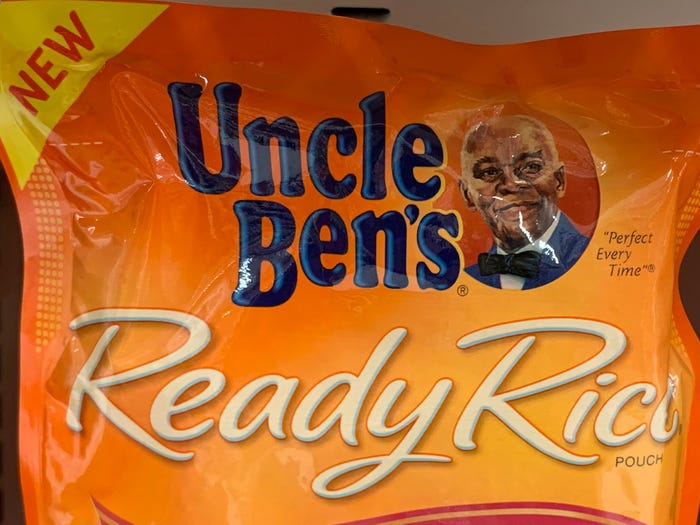
Quaker Oats, a subsidiary of PepsiCo, announced that it will retire its Aunt Jemima brand of syrup and pancake mix, saying the company recognizes that “Aunt Jemima’s origins are based on a racial stereotype.” Hours after Quaker Oats announced it was changing its Aunt Jemima logo, Mars, which makes the boxed rice product “Uncle Ben’s,” said it plans to change the product’s “brand identity.”
Uncle Ben’s, a rice and grains company, adopted its brand name and logo in 1946. According to the company’s website, the name “Uncle Ben” is that of a Black Texan rice farmer and the image is of a Black Chicago chef and waiter named Frank Brown.
Syrup and pancake-mix company Mrs. Butterworth’s adopted the personality of “Mrs. Butterworth” in 1961.
For years, the shape of Mrs. Butterworth’s syrup bottles has been a point of contention. “Critics have long associated the shape of the Mrs. Butterworth’s bottle with the mammy, a caricature of black women as subservient to white people,” one critic wrote.
Conagra Brands, parent company of Mrs. Butterworth’s syrup and pancake mixes, released a statement saying that they have started a review of the brand and packaging: “The Mrs. Butterworth’s brand, including its syrup packaging, is intended to evoke the images of a loving grandmother. We stand in solidarity with our Black and Brown communities and we can see that our packaging may be interpreted in a way that is wholly inconsistent with our values,” they said.
Land O’Lakes (butter) recently changed the packaging for its consumer products to remove the image of a Native American woman with a feather in her hair. The change was implemented ahead of the company’s 100th anniversary. The new packaging is very similar to the original, save for the removal of the Native American woman. It also added the phrase “farmer-owned” above the Land O’Lakes name.
Originally a sexy banana, the Chiquita brand’s mascot is now a sexy banana seller. She wears a Carmen-Miranda-esque fruit hat that gives an exotic and idealized image of the tropics. Other companies, too, have appropriated idealized women to represent their iconoclastic brands: Betty Crocker (whose image has been updated many times), Mrs. Paul, Maybelline, Helena Rubenstein, Estee Lauder, and (of course), the bevvy of beauties tantalizing Victoria’s Secret.
Remember the Frito Bandito? Speaking broken English and robbing unsuspecting bystanders, the Frito Bandito was an armed Mexican conman with a disheveled look and a gold tooth. Responding to pressure from the Mexican American Anti-Defamation Committee, the snack-food giant cleaned up Frito Bandito’s look. But combed hair and a friendlier expression didn’t quite cut it. Similarly, a battle rages about inappropriate stereotypes implied or inferred by the original packaging of Eskimo pies.
Now we have Goya products whose Hispanic products don’t need a stereotypical icon—they’re personally endorsed by Ivanka Trump and her father in the White House.
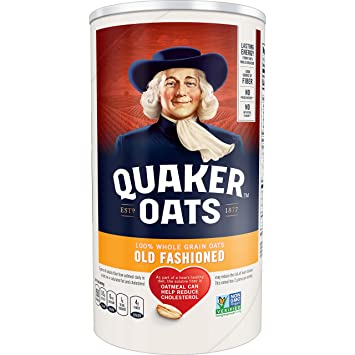
Sometimes, I suspect, we take ourselves and our imaging a bit too seriously. Demarcation must be drawn between “marketing,” which seeks to promote an organization’s products (or services) and “public relations,” whose purpose is to promote the organization itself. Are people demanding that the Quaker Oat Company remove the picture of the Quaker because it is exploiting a religious minority? When and where will it stop?
Separating the brands from their figureheads – if not the stereotypes – has long been the purview of American television.
Amos ‘n’ Andy, an American radio and television sitcom set in Harlem, the historic center of Afro-American culture in New York City, was cancelled by The Columbia Broadcasting System (CBS) network after a national boycott led by the National Association for the Advancement of Colored People (NAACP).
Beulah was an American sistuation comedy series that ran on CBS Radio from 1945 to 1954, and on ABC Television from 1950 to 1953. The show is notable for being the first sitcom to star an African American actress, for being ABC TV’s first hit situation comedy, and the first hit TV sitcom without a laugh track. When actress Hattie McDaniel took over the role on November 24, 1947, she earned $1000 a week for the first season, doubled the ratings of the original series and pleased the NAACP which was elated to see a historic first: a black woman as the star of a network radio program. In 1950, Roland Reed Productions adapted the property into a TV situation comedy for ABC, and the Beulah TV show ran for three seasons, Tuesday nights at 7:30 ET from October 3, 1950, to September 22, 1953. Most of the comedy in the series derived from the fact that Beulah, referred to as “the queen of the kitchen,” had the ability to solve problems that her employers couldn’t. Other characters included Beulah’s boyfriend, Bill Jackson, a handyman constantly proposing marriage, and Oriole, a befuddled maid for the family next door. Like the contemporaneous Amos and Andy, Beulah came under attack from many critics, including the NAACP, which accused the show of supporting stereotypical depictions of black characters with Beulah viewed as a stereotypical “mammy” similar to Aunt Jemima.
I often wonder whether whites and blacks viewed Amos and Andy through the same or different lenses. Did white viewers find themselves laughing with or at these simple people? Was Amos and Andy little more than Laurel and Hardy in blackface for them? As for blacks, did they accept the series because it reflected the significance of humor in the African-American experience?
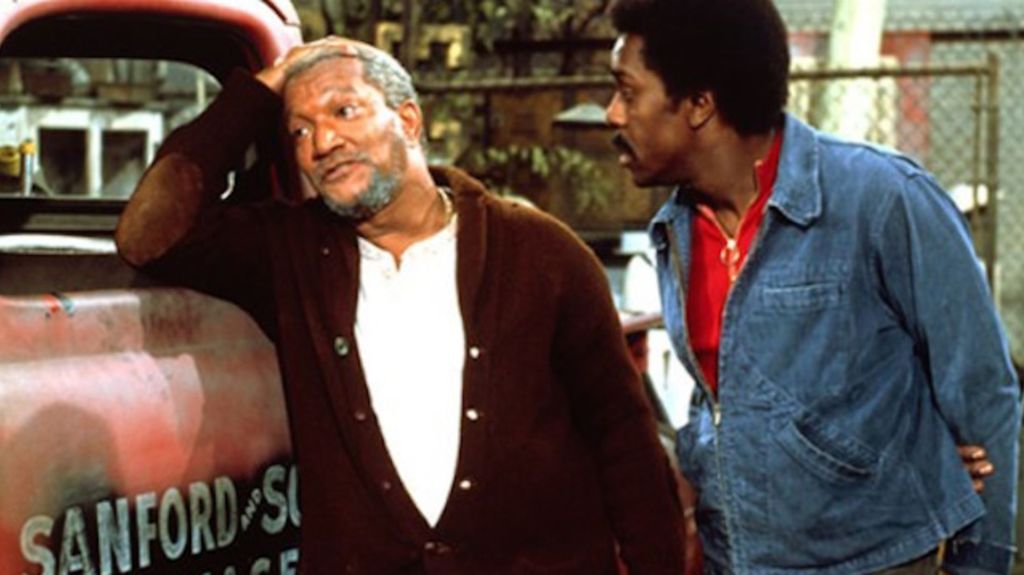
Sanford and Son was a black version of All in the Family. Widower Fred Sanford was as bigoted and ignorant as Archie. His son, Lamont, like Mike, was oriented to middle-class standards. He was embarrassed by his father’s behavior. George, the father in The Jeffersons, although a businessman, fit the same mold as Archie and Fred, namely, loud and bigoted. In the episode “Once a Friend,” George Jefferson learns that his old Army buddy Eddie is now a transgender woman named Edie (Veronica Redd).
Pinky Lee and Billy Crystal in Soap. Paul Linde, a character actor with a distinctively campy and snarky persona that often poked fun at his barely closeted homosexuality, was well known for his roles as Uncle Arthur on Bewitched, the befuddled father Harry MacAfee in Bye Bye Birdie, and as a regular “center square” panelist on The Hollywood Squares. Lynde regularly topped audience polls of most-liked TV stars. Speaking of most liked TV stars, let’s give a nod to Ellen DeGeneris. “The Puppy Episode,” a two-part episode of her Ellen sitcom, detailed lead character Ellen Morgan’s realization that she is a lesbian and her coming out.
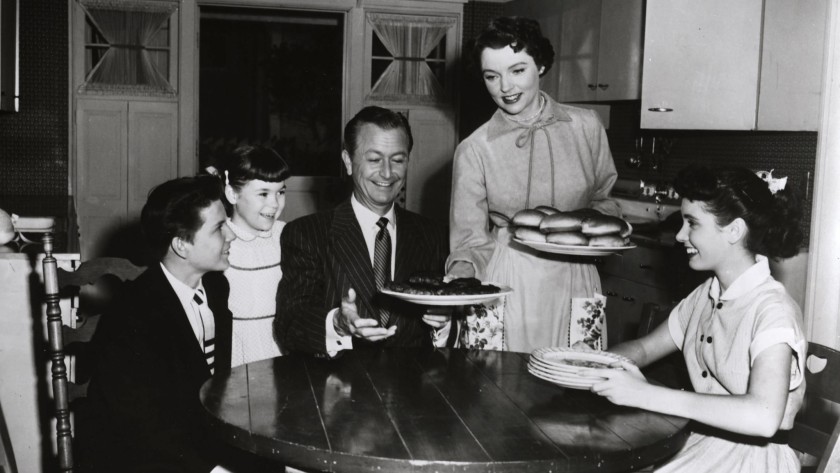
What about shows that depicted women and mothers in subservient roles to men: Father Knows Best? Ozzie and Harriet? I Married Joan? My Little Margie? I Love Lucy? December Bride? June Cleaver in Leave it to Beaver? Even Charlie’s Angels?Donna Reed was the first show to focus on the mother instead of the father. Later series increasingly empowered women: Police Woman, That Girl, Maude, Murphy Brown, Carole Burnett, Mary Tyler Moore, Julia, Roseanne, The Golden Girls, Designing Women, Sex and the City, and myriad others.
What about programs with Indians named “Tonto” (fool, dumb, ignorant) as in the Lone Ranger and other gunslinger westerns. On Wagon Train, frontier scout Flint McCullough and a longtime Sioux Indian friend reunite; but trouble is brewing as the Cheyenne are on the warpath and in their way is Fort Hastings, an old flame of his, and her new Army Captain fiancé. The Cisco Kid was an American Western TV series starring Duncan Renaldo in the title role and Leo Carrillo as his jovial sidekick, Pancho. Cisco and Pancho technically were desperados, wanted for unspecified crimes, but instead viewed by the poor as Robin Hood figures who assisted the downtrodden when law enforcement officers proved corrupt or unwilling to help. Sound familiar today?
What stereotype images did The Beverly Hillbillies provide of, well, Appalachian hillbillies and the rich folks who tried to show them a new and better way of living? Meanwhile, white working-class men were reduced to Homer, Archie, Fred, and Ralph.
Chester, the father on The Life of Riley, was continually concocting schemes to help his family. Attempting to fix a school election so his daughter would win, he succeeded only in embarrassing her. His incessant failures were expressed in his closing line for each episode: “What a revoltin’ development this is!”
The main characters in The Honeymooners lived in a bare Brooklyn apartment with few amenities. Consequently, husband Ralph was obsessed with success and modest affluence, at which he constantly schemed but invariably failed. He wanted to afford simple comforts such as a television for his wife, Alice. He tried get-rich-quick schemes, such as marketing what he thought was Alice’s homemade sauce, only to learn it was dog food. Alice always quipped, “I told you so.” Alice’s logic and sarcasm invariably bested Ralph in arguments, which typically ended with Ralph saying, in angry frustration, “Just you wait, Alice, one of these days, pow, right in the kisser.”
For that matter, remember the lame-brained antics of policemen Toody and Moldoon on Car 54 Where Are You? featuring the misadventures of two of New York’s finest in the 53rd precinct in the Bronx. Toody, the short, stocky and dim-witted one, either saves the day or messes things up, much to the chagrin of Muldoon, the tall, lanky and smart one.
Regarding the Russians, who can forget Boris and Natasha, foils for Rocky and Bullwinkle? Natasha is a spy for the fictional country of Pottsylvania, and takes orders from the nation’s leader, Fearless Leader. Natasha usually serves as an accomplice to fellow spy Boris Badenov.
And Howdy Doody, that quintessential children’s favorite featuring such characters as Buffalo Bob Smith, Princess SummerFall WinterSpring Chief Thunderthud, Clarabell, and Mister Bluster.
In his book Television in Black-and-White America: Race and National Identity (University Press of Kansas), Rensselaer Polytechnic Institute Professor Alan Nadel argues that the medium in the 1950s and ’60s deepened racial divisions by offering an intentionally skewed version of reality.
It was, quite literally, a whitewash: “Television was the place where one found definitively normal families,” Nadel writes, “and no black children were to be found in that excessively normal world.”
Perhaps the 1998 movie Pleasantville best sums up our love-hate relationship with these TV shows from our formative years.
David Wagner is a Nineties kid with a Fifties addiction. He’s hooked on reruns of a classic television show called “Pleasantville,” set in a simple place where everyone is swell and perky, “confrontation” is a dirty word and life is pleasingly pleasant. Addicted to this utopian world, David immerses himself in “Pleasantville” as an innocent escape from the trouble-plagued real world that he must share with his ultra-hip, totally popular twin sister, Jennifer. But one evening, life takes a bizarre twist when a peculiar repairman gives him a strange remote control, which zaps David and his sister straight into Pleasantville. All the repressed desires of life in the Fifties begin to boil up through the people of Pleasantville, changing their lives in strange and wonderful ways that none of them had even dared to dream of, until they were visited by two kids from the real world.
In these increasingly difficult times, where we are confronting an out-of-control virus and our ghosts from the past, a simple place where everyone is swell and perky, confrontation is a dirty word, and life is pleasingly pleasant, the simple black-and-white of our past – no matter how stereotyped or distorted – gives us some small comfort.
I am not talking about statues or monuments purposefully built to honor and memorialize those who, historically, have done us wrong.
We can’t erase history … but we can learn from — and appreciate — its social dimensions and cultural context.
Which is why Black Lives Matter. And Brown. Asians and Immigrants, as well.
Because we still have a lot to learn!
Rev. Bruce H. Joffe, Ph.D., is a retired professor and pastor probing the intersections ofmedia, religion, gender, international living, and allied cultural norms.
Processing…
Success! You're on the list.
Whoops! There was an error and we couldn't process your subscription. Please reload the page and try again.



























 "Exactly!"