
Dealing with Portuguese Debt (Collectors)

Time and again, debt collector Intrum has proven its operations to be unethical and, possibly, even illegal.

Myriad complaints against the company frequently highlight aggressive debt recovery tactics and administrative errors.

Complaints about Intrum and its tactics are found on multiple platforms:

In the Livro de Reclamações: https://portaldaqueixa.com/brands/intrum-justitia-servicos-de-gestao-e-recuperacao-de-credito/complaints

On Deco Proteste: https://www.deco.proteste.pt/reclamar/empresas/intrum-portugal/87C498E1-928B2A617

On TrustPilot: https://www.trustpilot.com/review/intrum.pt?languages=all

On Reddit: https://www.reddit.com/r/PortugalExpats/comments/1tqvsqq/has_anyone_dealt_with_intrum/

Consumers frequently report receiving relentless phone calls and text messages regarding old or unrecognized debts, sometimes stretching back over a decade. They complain that Intrum attempts to collect legally expired or prescribed debts, often using intimidating language.

Multiple reviews mention being dunned for amounts that were already paid, settled, or cleared through legal agreements. Customers describe unhelpful or rude support staff when trying to resolve discrepancies, alongside difficulty getting through to the operator.

After parting ways with MEO (another consumer complaint accumulator), I was glad my ordeal with this oversize telecommunications provider was over and done with. I had copies of emails from MEO responding to my earlier complaints through Deco Proteste and the Livro de Reclamações about being unable to cancel my contract following its required “loyalty” period. MEO’s emails confirmed that my contract had been cancelled, all of its equipment returned, and that I owed nothing on my account.

Months later, however, I began to receive daily debtor letters from collection agency Intrum, threatening to make my life miserable if I didn’t respond to their messages sent using WhatsApp.

It should be noted that their messages were marked “No Reply” and that it was impossible to reach Intrum staffers on the phone number provided despite 20-plus rings, let alone to reach anyone who could speak English.

So, again I turned to the Livro de Reclamações and Deco Proteste, where I registered complaints online.

Intrum’s rebuttal to my complaints had been repeated over and again to others in a boilerplate note stating, in essence, “Don’t blame us … we’re just the messengers,” an unethical, inaccurate, irresponsible, and totally inaccurate response.

Neither factual nor forthcoming, Intrum neglected to reveal its role in this matter: Is it really representing MEO, or has it purchased MEO’s debt portfolio? If the latter, Intrum is actually the owner–not the agent.

Intrum acts as a debt buyer, purchasing massive portfolios of non-performing loans, utility bills, and telecom accounts (termed carteiras de malparado) from companies like MEO, NOS, banks, and utilities for a small percentage of the actual debt amount (often 5 to 10 cents on the euro). Once bought, the debt legally belongs to Intrum. MEO has already written it off as a loss and wiped their hands of it. If Intrum buys a €500 debt for €25 and manages to scare or pressure the consumer into paying the full €500 (or even a discounted €200 settlement), they make a massive return on investment.

In other cases, usually involving more recent debts (under 6 months old), Intrum is hired by MEO or other firms to serve as an external collections department. In this scenario, MEO still owns the debt, and Intrum earns a commission fee for successfully recovering the past-due payment.

The point, however, was moot in my case, as I’d already proven that I didn’t owe anyone anything.

Documented by correspondence from MEO which accompanied my complaint, any issues the telecommunications giant had had with me were already resolved—including all bills (faturas) paid.

My complaint wasn’t with MEO; it was with Intrum and its messages. Based on questionable and unsubstantiated data presumably provided by its clients (MEO, in my case), Intrum repeatedly threatened, harassed, and intimidated me using privileged, private information (i.e., my telephone number) to bombard me with objectionable SPAM.

I have appealed again to the competent authorities through Portugal’s official complaints portal, asking that Intrum be sanctioned for its abuses and repeated violations of consumer protection.

Handling a debt collection agency like Intrum Portugal requires a calm, documented, and cautious approach. Here are the most effective tips to manage their contacts and protect your rights:

Shift Everything to Writing

Avoid discussing details over the phone. Verbal agreements are difficult to prove, and debt collectors may use high-pressure tactics. Instruct the agency to send all communications, payment proposals, and debt breakdowns via email or registered letter (Carta Registada com Aviso de Receção). State your stance clearly. Use a simple phrase like: “I will only communicate regarding this matter in writing. Please send the complete breakdown of this alleged debt to my email/address.”

Demand Formal Proof of the Debt

Never make a partial or full payment just to get them to stop them from contacting you. In Portugal, making a payment can be legally interpreted as an acknowledgement of the debt, which resets the legal clock.

Under Portuguese law, you have the right to know exactly where the debt originates. Demand copies of the original contract, the last outstanding invoice, and the formal document showing that the original creditor assigned (sold) the debt to Intrum.

Check for “Prescription” (Legal Expiry)

In Portugal, many common consumer debts have very short expiration periods (prescription). So, verify the age: If the creditor does not legally demand payment within this window, they lose the right to collect it.

Know the timelines

> 6 months: Water, electricity, gas, and telecommunications (internet/phone) bills.

> 2 years: Services provided by commercial entities or educational institutions.

> 5 years: Alimony, rent, or interest on loans.

If the debt is past these limits, Intrum cannot legally force you to pay. However, prescription does not happen automatically—you must formally invoke it. Send them a registered letter or email stating that the alleged debt is prescribed under Portuguese law.

Know Your Privacy Rights (RGPD)

Debt collectors cannot call you at unreasonable hours, contact your workplace, or disclose your situation to family members or neighbors. Harassment is illegal here.

If they are calling a number you never gave to the original creditor, or if the calls are excessive, you can explicitly state that they are violating your data privacy rights under GDPR (RGPD) and demand they cease phone contact. In other words, revoke consent.

Create a Log

Document every interaction. Keep a record of the dates, times, emails and phone numbers Intrum uses to call you. Save all messages. Don’t delete any SMS, WhatsApp messages, or emails they send, as these can serve as evidence if you need to file a formal complaint.

Contact Them Directly

Send the debt collection agency a letter from your personal email so you have a digital time-stamp. If possible, ask for a read receipt. Contac t Intrum at this email: info.pt@intrum.com

If they do not reply to the email or continue harassing you, send your complaint via Carta Registada com Aviso de Receção (Registered Letter with Acknowledgement of Receipt) to their official Lisbon address:
Alameda dos Oceanos, 59 – Edifício Espace, Piso 1, Bloco 2 A/B – Parque das Nações 1990-207 Lisboa, Portugal. Keep the postal receipt.

Businesses are expected to operate in good faith. Through its actions, Intrum has proven its culpability.

If I weren’t a foreigner with legal and fiscal residency in Portugal, I would take Intrum to court and invite all others who have been inflicted by its indignities to join me in what’s known as a “class action suit.”

Intrum would never know what had hit them!

Food for Thought

It’s said that in these parts of the Alentejo, the best porco preto (“black pork”) is served in a town named Arronches, not far from Portalegre. We’ve come to love the sweet and savory taste of this pork … when well prepared. If not, it’s just another Portuguese dish.

Arronches is about 45 minutes from our home in Vila Boim, Elvas. We’ve passed by the place when visiting friends who live in the nearby village of Assumar; but we’ve never been to Arronches.

Today we went.

During this time of the year, many villages, towns, and cities in Portugal hold their own special ferias–holiday fairs. Somewhere online I’d seen that Arronches would be celebrating this weekend.

“Want to go?” I asked Russ earlier this week.

“Sure!” he replied. “Let’s see if we can finally find a good restaurant to try the porco preto.”

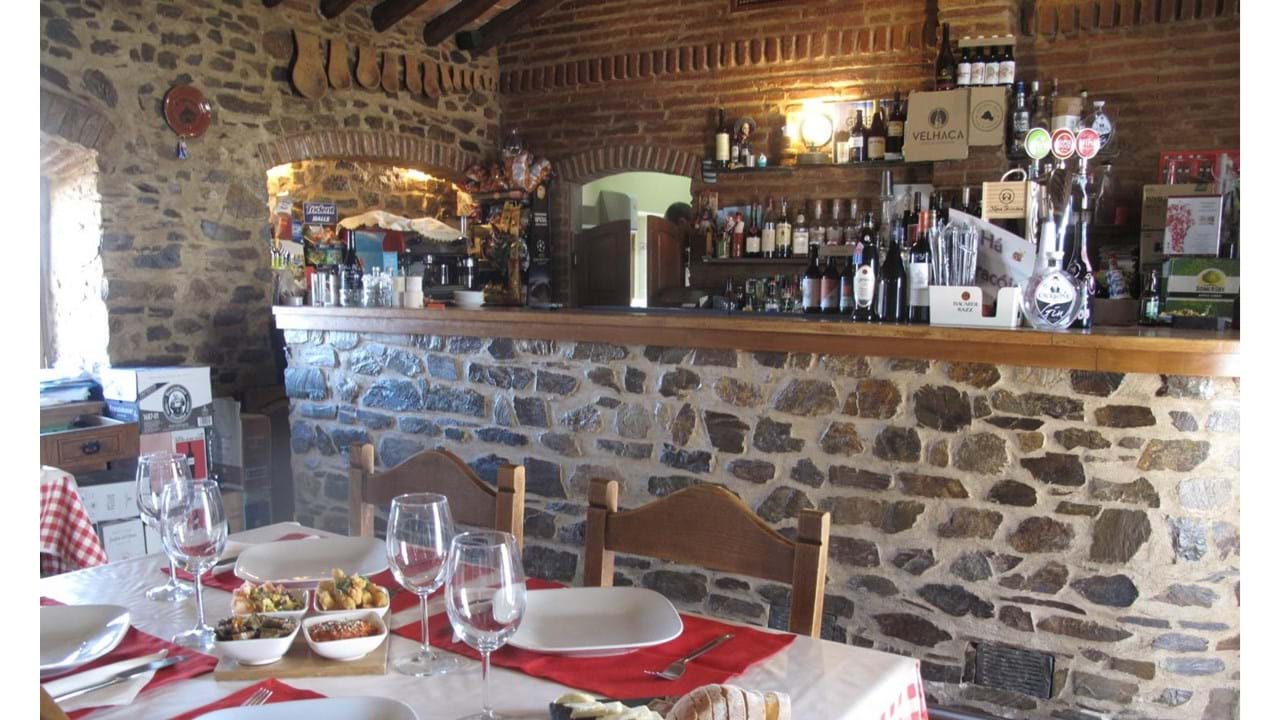
I searched on TripAdvisor and a bunch of other sites dedicated to recommending restaurants. On every single one of them, A Cabana (The Cabin) came up as #1 … with hundreds of 5★ and far fewer 4★ reviews. Its atmosphere was described as “romantic” (we found it charming and adorable) with prices ranging from € (Facebook) to €€-€€€ (TripAdvisor). Based on our tab, I’d say TripAdvisor is more accurate. In a way, the digs reminded me of a restaurant with the same name (The Cabin) on the outskirts of Sturgeon Bay, WI.

A Cabana doesn’t have its own website, but it does have a Facebook page. On Thursday, I messaged them to make a reservation for the two of us at 1:30 PM (13:30) on Saturday. We figured that would give us enough time to visit the fair and then eat a hearty meal early enough. Within five minutes — I kid you not! — I had a response: “combinado!” (confirmed).

Unless you’re an expat or immigrant living in Portugal, you can’t understand how unusual (even rare!) it is to receive a reply to one’s email or message here. The Portuguese tend to ignore them. You’re better off telephoning or stopping by.

Two thumbs up for A Cabana!

We arrived in Arronches at about 11:45 (AM), only to find ourselves lost in space. GPS and Google Maps were no help. Russ thought that the fair would be held in the “campo” (countryside), while I distinctly remember reading something about it being held in a pavilion. Before going around the bends another time, I asked Russ to pull off so that I could ask a local for information.

“Isn’t today a holiday in Arronches? Where can we find the fair grounds?” I asked a gentle giant of a man with a beard who nodded “yes” and pointed down the road … “Just continue going down this street until you come to he,” he said.

Russ turned to me before driving down the street to tell me, “He looks familiar. I think he might be the chef at A Cabana.”

Driving downhill, we finally approached the site. Amazing–there was plenty of parking! Very unusual in Portugal … especially when something of general interest is happening.

We soon understood why:

The only activity occurring at the fairgrounds when we arrived was a sheep competition. Nothing else. Not even the dozens of stalls selling food and souvenirs were open, let alone live music. It all would begin later that evening.

“What do you want to do?” Russ asked me.

“Let’s go to the restaurant and see if they’ll take us earlier,” I suggested. “That way, we can get an earlier start on doing some shopping we’d planned at E LeClerc, along with filling the car with GPL (liquefied gas) and washing it.

A bunch of people of all ages were already queuing up outside the restaurant, whose front door was open but nobody was inside. I approached the owner-chef-waiter — who, indeed, was the helpful man who’d given us directions earlier! — and asked if we could change our reservation to now rather than later. “Of course,” he said, pointing to the first of four tables for four. Behind them, in a row against the back wall, all of the tables were pulled together to accommodate 22 people … including those waiting outside, and then some.

“We understand that you make the best porco preto in town,” I told him while we both were standing in front of the chalk board where the menu was written.

He smiled broadly and recommended both the “secretos” (secrets) plate for €20 and the “plumas” (feathers) dish for €23. We ordered one of each, which came with salads and the best fried potatoes (“crisps,” per our British friends) we’d had in a while–super thin yet crispy, without any soggy orphans left behind. To go with our food, I had (two) glasses of tinto wine and Russ had (two) steins of beer.

It suddenly occurred to me that the maitre d was responding to my questions in Spanish, not Portuguese, although I was doing my best to speak coherent Portuguese. ¿No é portugues? (aren’t you Portuguese?) I asked him. “Sim, claro” (Yes, of course), he replied. “Then, why are you talking Spanish to me?” I asked in Portuguese. “I thought you were Spanish, he grinned.” It must have been my accent, One lesson I’ve learned since living in this western part of Iberia is always to speak Portuguese … to never initiate a conversation in Spanish, assuming the Portuguese understand it.

Anyway, everything was delicious!

The food, the service, the atmosphere were all extraordinary. (We personally preferred the plumas — cut thickly, parts cooked medium, others medium-rare to perfection — over the secretos.)

Of special note to us — who spend two months in Portugal and one month in Spain — was how relatively quiet and civilized the table of 22 behind us was. In Spain, you’d never be able to hear yourself think with that many people clustered together.

Our bill came to less than sixty euros. Although I tend to cringe when food here in Portugal costs that much, I reminded myself that we’d be gone from the USA for six years already. Who knew how much a meal like this would cost in a place like Sturgeon Bay?

Probably lots more.

Whatever …

It was well worth it!

P.S. If you plan to eat at A Cabina, remember to bring cash. The restaurant doesn’t accept plastic — credit or debit cards — although it does honor MB Way.

Pastor, professor, publisher, and journalist Bruce H. Joffe is an award-winning author of magazine features, academic research, journal articles, self-help manuals, and newspaper stories. His nine books deal with international (intercultural) living, progressive theology, gender studies, “social” politics, our vulnerabilities, marketing, and the media. 

Processing…
Success! You're on the list.

The System Is Broken

When even Portuguese officials complain publicly about the “broken system” and tell you that it’s “impossible” to schedule an appointment online, by phone, or in person — yet recommend that you show up at the local AIMA office and storm the gates — you know that the problem is dire and probably unfixable.

I’m referring, of course, to AIMA, SEF, and SIGA (they’re all culprits in the conspiracy) … and getting your residency visa renewed.

We’ve lived in Portugal for over six years now, arriving when D7 residency visas were issued for one year … renewed for two … and then renewed again for two, before one could get “permanent” residency (a misnomer, as it’s only good for five years) or even apply for citizenship, if so desired.

During our tenure here, residency changed from 1+2+2 to 2+3 and we were caught betwixt and between, as our last residency was for three years (not two) … requiring us to wait an extra year (totaling six) before applying to renew our residency.

HAH! If it weren’t so serious, the foibles, facts, and fables told about trying to get an appointment with SEF’s current iteration (AIMA) would be the stuff bureaucratic boondoggles are laughed about.

We had tried ourselves through SIGA, Portugal’s official scheduling “app” for all the country’s often overlapping agencies and entities. That led us down a rabbit hole since, when searching by agency, neither AIMA (nor SEF) appear … and, when searching by purpose or keyword (“residency renewal”), we’re taken to Registros where the only real option is to select renewal of citizen, not residency, cards. Once you enter the requested data, however, a pull-down menu magically appears … allowing you to indicate that the purpose of your appointment is specifically residency renewal. When we appeared at the designated place and time, we had to wait almost an hour, only to be told by quite frustrated clerks that, no, they couldn’t renew our residency there … we’d have to go to either Portalegre or Évora. It was then and there that we were told by the frustrated bureaucrats that the system was broken and nothing worked now as regards to renewing one’s residency.

Ultimately, we hired a lawyer (lawyers, we were told had better access to the system) to make an appointment for us. She did. Scheduled for 24 January 2024, officialemail notification showed that our residency renewals would be for two “cases” (i.e., people). The next day, nonetheless, we received a cancellation notice–no reason given. Later that day, another email arrived confirming a new date: 31 January, a week later than originally scheduled.

When we arrived and our number was called, the attendant insisted that only one of us — me — was on the “list.” And my spouse? “Reschedule!” we were told. We called our attorney while seated opposite our interrogator and she spoke directly to him. Back and forth, back and forth, they argued in Portuguese … him finally handing me the phone. “He could handle you both, if he wanted to,” she told me. “He doesn’t want to. So, you’ll be processed now and I will try to schedule another appointment for your partner.”

Again, that was on 31 January.

My better half still doesn’t have an appointment, although our residency expired several months ago. And, despite being told that I’d receive my new residency card within 60 days, it’s been 90 already … and I’m still waiting, my proof of processing and payment in hand.

Is it any wonder that people are protesting, demonstrating in front of AIMA’s headquarters in Lisbon? (https://www.theportugalnews.com/…/immigrants-to…/88011)

Meanwhile, “The Portuguese Agency for Integration, Migrations and Asylum (AIMA) has said that it needs around one and a half years to resolve 350,000 pending residency applications filed by foreigners until 2025. (https://www.linkedin.com/…/portugal-wont-able-process…)

It will be 2025 before AIMA resolves the 350,000 pending residency applications? What about all the new visas being granted? Are they still good for four months only? How long will it take AIMA to get around to them?

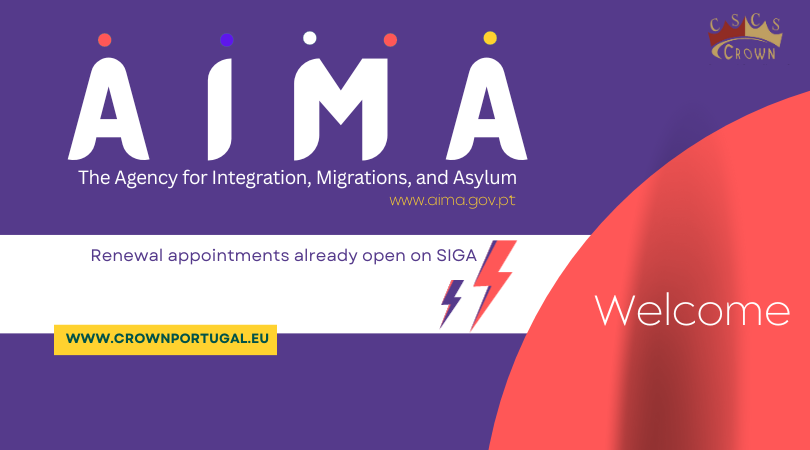
May be a graphic of text that says "aSaS CROWN ROWN AIMA A A The Agency for Integration, Migrations, and Asylum wwww. aima.gov.pt Renewal appointments already open on SIGA WWW.CROWNPORTUGALEU Welcome"

Pastor, professor, publisher, and journalist Bruce H. Joffe is the award-winning author of magazine features, academic research, journal articles, self-help manuals, and newspaper bylines. His eight books deal with international (intercultural) living, interfaith theology, gender studies, “social” politics, marketing, and the media.

Processing…
Success! You're on the list.