
A Victim of Internet Thieves

The name on her Portuguese bank account is “Lucilla Sous.” On the Certificate of Delivery for the car I purchased from her online, she’s identified as Fernandes Da Silva Câtia. And according to her Facebook profile — which shows that she moved with her family from Barcelos in Braga (Portugal) to Valence, Rhone-Alpes (France) in January this year — she goes by Catia Vanessa Rego Barbosa.

No matter.

Spanish and Portuguese people, especially, are given and take on any number of names. In our *correspondence, I just called her Vanessa.

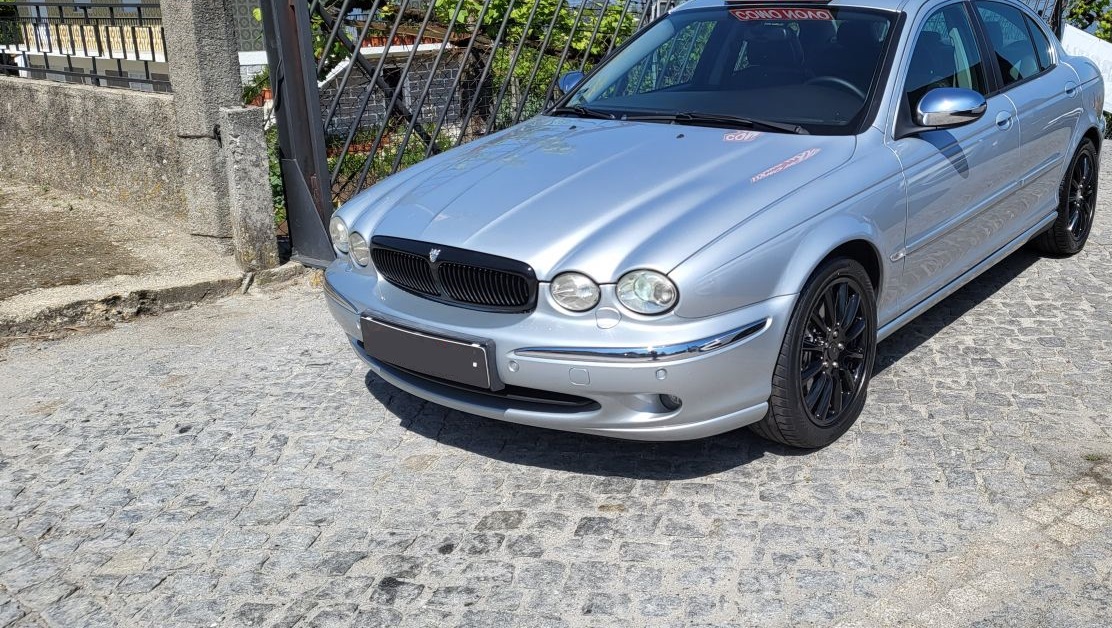
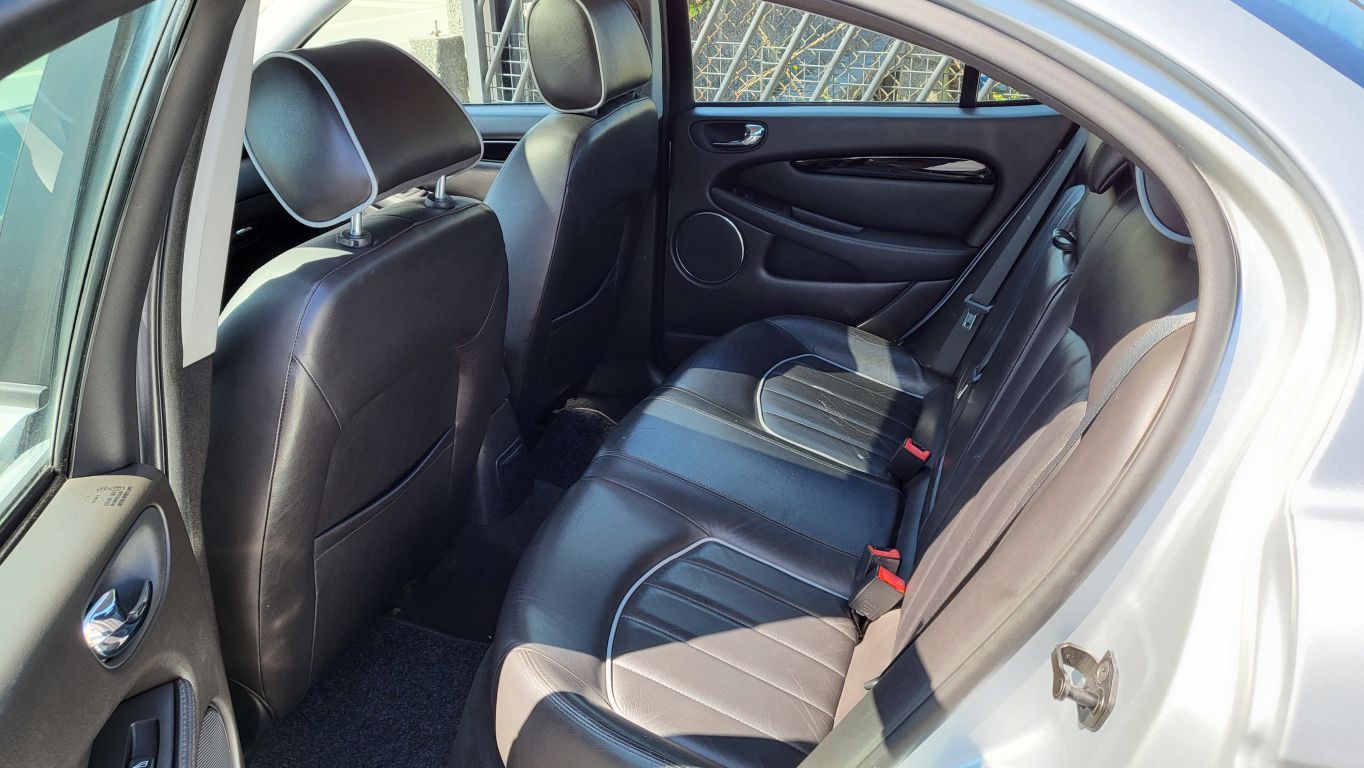
I first contacted her late in July 2023 for more information about a car she had listed for sale. It was advertised on a number of sites, which, by now, had been scrubbed. But the ad is still listed here. It’s a 2008 X-Type Jaguar 2.2 diesel with about 203,500 miles on the odometer, not bad for a 15-year-old car in the European Union. And this one was loaded: GPS Navigation, leather seats, moon roof, front and rear parking sensors, leather upholstery, heated seats, sports suspension … literally everything available in that model and year. As can be seen in the top photo above, the car was said to be “Como Novo” … like new.

This was to be a “new” toy for an old man (me), who had been infatuated with the sexy Jaguar X-Type (2004-2008 models) I had owned — new and used — between 2004 and 2017 while living in the USA. Unlike the American versions which came with all wheel drive, large V6 (3.0) gasoline engines and muscular “leapers” on their “bonnets,” the EU versions were mainly diesel, front wheel drive, and unadorned with machismo. Produced on the east side of the pond between 2001 and 2009, the gas (petrol) version was known to be a gas-guzzler, while the diesel engines were stronger, lasted longer, got far better mileage, and — strange as it seems — emitted less carbon into the atmosphere. Introduced in in mid-2005, the 2.2 diesel engine was superior in many ways to the smaller 2.0, according to reviews.
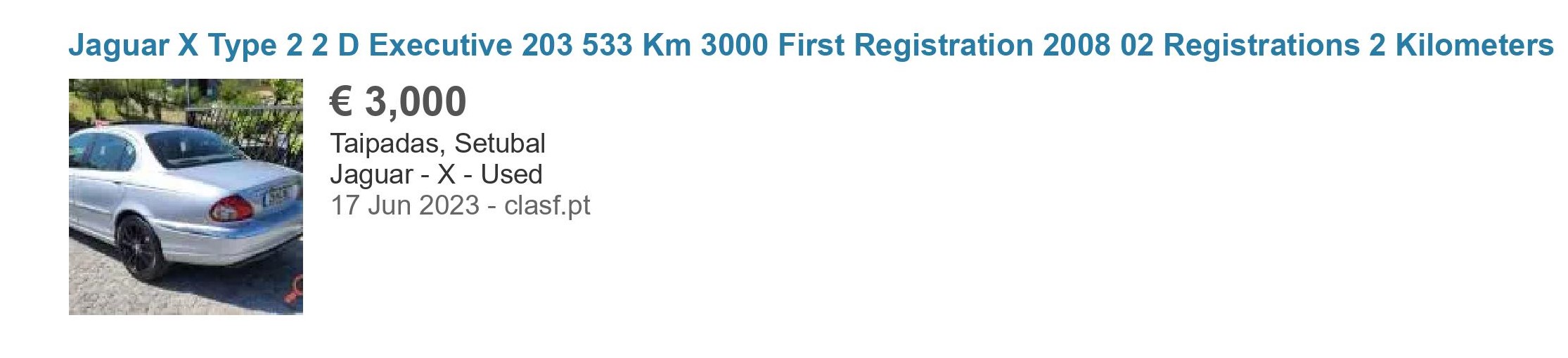
I had done my homework and knew that the advertised price of €3,000 for a car of this description was extraordinary; people in Jaguar X-Type groups couldn’t believe it and suggested I buy it and then flip it for twice the price.

If it’s too good to be true, trust me: it probably is!

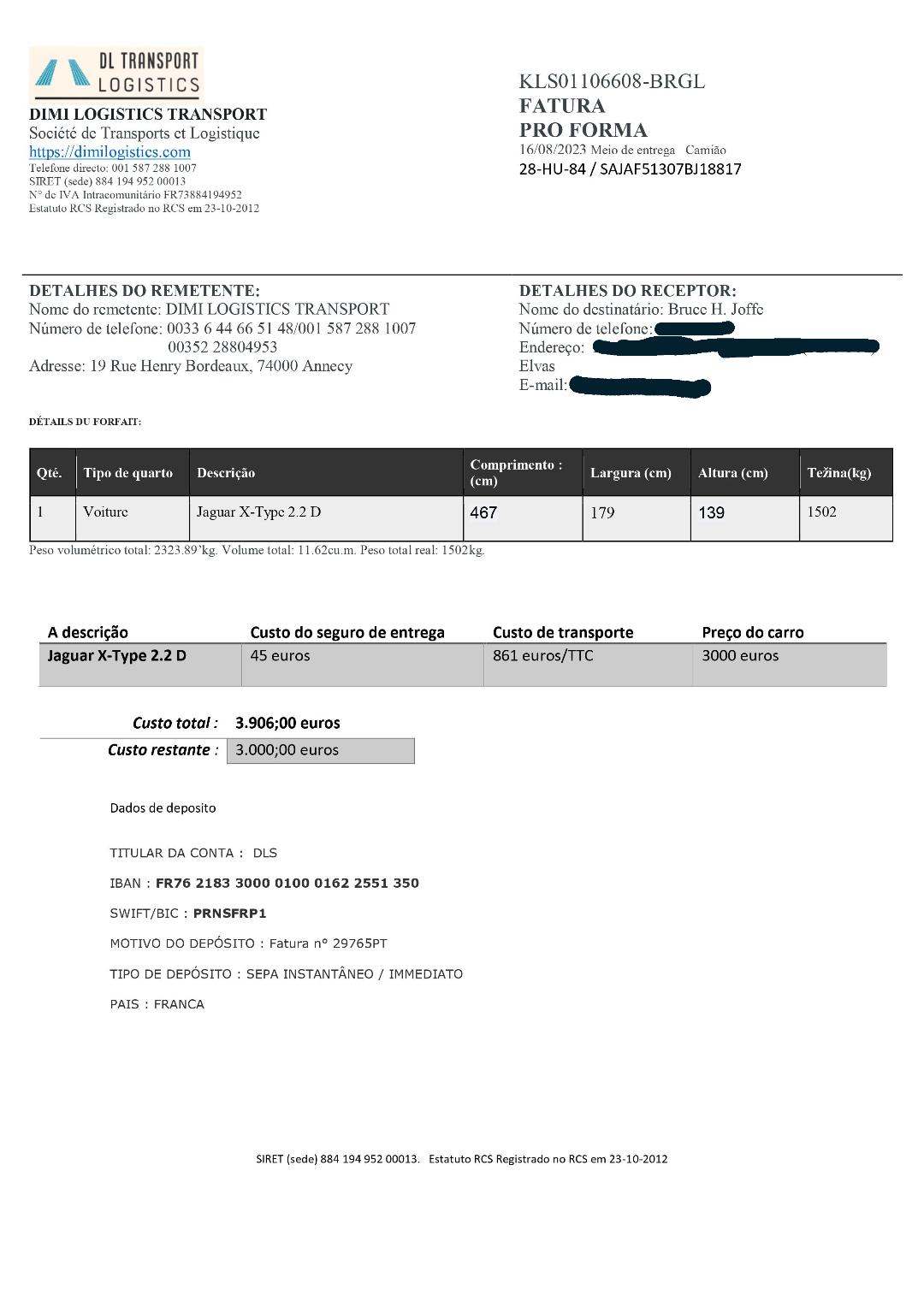
Vanessa said that the car had been in storage since they moved to France and no longer had any need or use for it. She wanted a quick sale which she believed would be difficult, as the car would need to be transported from France to Portugal (where the car was still registered and had nine months left before its next required inspection) at extra cost: €906, which she would split with a buyer.

The storage agent/transporter also went by several names: On their website, the name is DL Transport Logistics, although their URL is dimilogistics.com. Their French bureau is headquartered at 4th avenue, C Saint-Denis, but the office I would be dealing with is elsewhere in France—at 19 Rue Henry Bordeaux, 74000 Annecy. The company also has an office in Luxembourg. Stamped on documents I received from it was DIMI Logistics Transport, although they referred to themselves as DLT. So did I.

From everything on their website, they appeared to be legit. No bad reviews (I searched) and a robust series of services.

Then, again, what did I know? Although I could understand and reply to emails with Vanessa in Portuguese, I had abandoned any French more than 50 years ago and needed to rely on Google Translate with a bit of tweaking to communicate with DL Transport Logistics.

On 15 August, I agreed to purchase the car and transferred €1,453 to Vanessa (aka Lucilla Sous). We agreed €1,000 would be a deposit on the €3,000 car and she’d transfer €453 to the delivery agent as my half of the transport fees to bring the car from France.

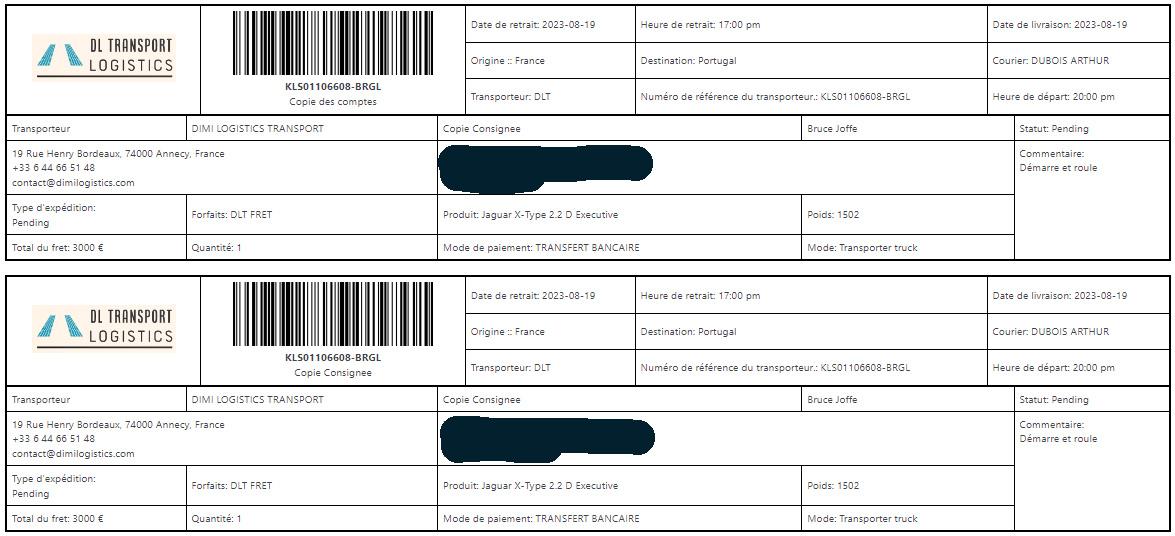
The next day (16 August), I received a flurry of documents from DLT, four in all: delivery information, a transport form, a delivery contract/guarantee, and – of course – an invoice. The documents informed me when the car would leave the facility, when it would arrive at my home, how it would be transported (by truck), the driver’s name, terms and conditions. Buried somewhere in the fine print was a statement that an additional €3,000 deposit, refundable three (3) days after the car was delivered, must be paid before the car could leave. Search as I did, I couldn’t find it.

I emailed Vanessa about this.

“Yes,” she agreed. “It’s additional insurance … for the truck, or the car, or the driver, or the person who’d be accompanying the driver. I’ve already transferred my €1,000 to DLT.” Vanessa insisted it would be better – and quicker – if I transferred the €2,00 to her for immediate transfer to DLT. “That way,” she proposed, “you won’t have to pay anything more when the car arrives. It will be yours.”

No, I demurred, I’d rather stick to our original agreement. So, on 16 August, I transferred €2,000 via immediate payment, as required, to DLT.
“The car will be delivered to your home on 19/08/2023 at 16:30,” said the email I received from DLT. “The order has already been given to the courier in charge of ordering this car for delivery. In accordance with the method chosen by the sender, the transport company takes a guarantor in the car to the agreed address. The courier will depart on 16/08/2023 at 18:45 (French time) and we will progressively inform you of your journey so that you become available to receive the car.”

My delivery, however, was cancelled the next day. Neither DLT nor Vanessa informed me of this; I learned about it through my bank online: DLT had refunded €2,000 to my account.

Responding to my “what happened?” email, Vanessa said, “Since yesterday we have a problem with the transport company that I am trying to resolve with my husband. We are doing everything in our power to resolve the situation and the transport company will continue with the delivery. So, don’t worry!”

But the weekend intervened.

On Monday, 21 August, I heard again from Vanessa. Insisting that the matters between her and DLT had been resolved, she stated that it would be best and most expedient for me to send her the €2,000 deposit, which she would transfer immediately to DLT. DLT agreed. But I refused. Instead, I sent €2,000 a second time to DLT via immediate transfer.

That same evening (21 August), the delivery was again cancelled by DLT. Again, I wasn’t told about the cancellation, but learned about it from the refund to my bank account. This time, however, there were differing accounts about what had happened.

According to DLT, the car had been stopped at the border between Spain and France because Vanessa had seven unpaid fines and tickets.

“Normally, I would forward messages from the carrier to you,” wrote Vanessa. “But the situation does not concern you. The car was stopped at the France-Spain border, and I have an unpaid fine that I must pay before the car is released. This is not the shipping company’s fault or your fault. But … I will resolve the situation. I hope you understand.” The next day (Sunday), she added, “I already fixed the problem. Tomorrow, the carrier will pick up the car and continue the delivery. I have resolved the situation and I think you will have the car tomorrow or Tuesday at the latest.”

Strange. What government agencies work on Sundays … or Saturdays, for that matter? Where was the courier and why was he to pick up my car the next day? Where was the car? And why was the car stopped and inspected when it was supposed to be inside a truck?

An hour later that Sunday, Vanessa sent me another email: “They (DLT) required (a) deposit to make an express delivery. It’s just an additional 78 euros. I will pay tomorrow morning. As they are late, they offered express delivery so the car (would be) delivered quickly.”

That was in addition to the €2,000 deposit which I would need to send DLT for a third time.

Once, shame on you; twice, shame on me! DLT had already refunded my €2,000 deposits–twice, which instilled a sort of confidence in me.

I exchanged a series of emails with Vanessa the following morning, notifying her that I no longer wanted the car. I said I didn’t trust her. She pleaded with me to finalize the purchase and had the transport company contact me to assure me that all was well. And again, I was told by DLT and Vanessa that the delivery would be expedited – and move forward – if I sent the €2,000 to her for immediate transfer to DMI. Still, I refused. This time, DLT gave me a Spanish account and IBAN in the name of Ribeiro Sampaio SC (a Portuguese, not Spanish, spelling) they told me was theirs to transfer the €2,000 deposit … which I did.

I didn’t hear from Vanessa again, but on Tuesday, 22 August, I received a series of email notifications from DLT:

“The driver is not in possession of the delivery document; the act of delivery will be sent to you at 6 p.m. by email. The driver will start in a few minutes. After his departure the delivery time will be given to you. But the driver will drive a maximum of 9 hours.” (12:44 PM)

“The estimated time for delivery to your home is 7 hours 54 minutes. The driver has already left. Thanks.” (1:33 PM).

“Can you suggest hotels near you?” (3:26 PM)

“The driver has just crossed the Portuguese border. He will take an hour’s rest before continuing on his merry way.” (5:22 PM)

• At 6:58 PM, I asked, “Where is he in Portugal please? I’m trying to visualize the route he’s following.

“One moment please…” came the reply at 7:01 PM. “About 1 km from the Quintanilha border. He’ll be back on the road in a few minutes.”

• “That’s about 5 hours to us in Vila Boim,” I replied at 8:10 PM. “Do you still intend to deliver the car tonight? Should I stay awake and wait…or will you deliver the car tomorrow?”

“There are two hours left for the driver to come to your home,” came the reply at 11:28 PM. But the time it is it will pass tomorrow before 9am. Stay connected …”

• At 10:09 AM Wednesday, the car hadn’t arrived. I sent this email: “I’m starting to worry.”

• The reply came at 10:21 AM: “Good morning. The road police just stopped the car this morning for unpaid tickets. We are currently resolving the problem with Madame Vanessa. You can go to place and check with your own eyes if you want because the car is already on Portuguese territory. Please wait …”

None of this made sense anymore—if it ever did! Wasn’t the transporter stopped days earlier at the France-Spain border for traffic violations Vanessa hadn’t paid? Did she have unpaid tickets both in France and Portugal? Why was the truck stopped again and inspected … with the vehicle’s information conveyed to the authorities, anyway? As alarming as all this seemed, it was complicated by a second email from the driver:

“Your car should be delivered,” I was informed eight hours later at 6:23 PM. “The driver didn’t quickly leave his hotel today; we had trouble sending him money and doing some repairs on the car. Two tires are worn and have been changed. Repair times and the time it takes for banks to receive transfers affect the delivery time. This is the car that the driver drives from the Spanish border to Portugal. The tires are probably worn.”

The pieces began tumbling together. My car hadn’t been transported by truck, as contracted. Instead, it was driven more than 1,500 miles … which I never would have agreed to, given that the car already had 203,500 kms on its odometer. Who knows what had happened to it enroute from France to Portugal? Besides, the company’s own transport document listed “transporter truck” as its mode of transportation!

I had been duped. A victim of Internet thievery … in this case, conspiracy between the seller of an automobile and a transport agent determined to defraud me. I never did receive the car. Nor did either Vanessa or DLT reply to any of my emails. I was out €3,453.

Hindsight is always 20/20, especially when you want and anticipate something so eagerly. Senses dulled, you’re not fully aware of what’s happening. Or isn’t. Or shouldn’t be.

Neither Mme Vanessa nor DL Transport Logistics know me. They have no idea the lengths I will go to see them brought to justice. Already, my attorney in Portugal has been advised. And I’ve made initial contact with police departments in Portugal, France, and the European Union that specialize in Internet crimes.

Hopefully, you’ll never be conned by Internet crime. If you suspect that you have, please bypass those sponsored ads that come up first in Google searches. Despite their promises, some of them can make a bad thing even worse. Instead, be sure to keep careful records, to contact your lawyer, and to touch base with your local police.

If you’ve been swindled on the Internet, you can also start the complaints process online.

In Portugal, Safe Communities Portugal recommends this link: https://www.safecommunitiesportugal.com/report-a-crime-online/swindle-deception

Another Portugal site for reporting cybercrime: https://en.ministeriopublico.pt/en/contato/cybercrime-office

In France, use this link:  https://www.service-public.fr/particuliers/vosdroits/R19620

In the European Union: https://www.europol.europa.eu/operations-services-and-innovation/services-support/joint-cybercrime-action-taskforce

Vanessa and DL Transport have been copied on this report … so that they will know what’s happening when they receive visits from the police.

*I have all correspondence, notices, and documentation referred to herein.

Bruce H. Joffe is publisher and creative director of Portugal Living Magazine.

Processing…
Success! You're on the list.

Rule of Law v. Law of Rulers

Passed by Congress June 13, 1866, and ratified July 9, 1868, the 3rd section of the US Constitution’s 14th Amendment appears as unambiguous today as when it was written:

No person shall be a Senator or Representative in Congress, or elector of President and Vice-President, or hold any office, civil or military, under the United States, or under any State, who, having previously taken an oath, as a member of Congress, or as an officer of the United States, or as a member of any State legislature, or as an executive or judicial officer of any State, to support the Constitution of the United States, shall have engaged in insurrection or rebellion against the same, or given aid or comfort to the enemies thereof. But Congress may by a vote of two-thirds of each House, remove such disability.

Look carefully and reread the first (very long) sentence.

It makes no hint or mention that any elected official who has sworn to protect the Constitution of the United States must be criminally convicted of insurrection. Rather, the words state that those who “shall have engaged in insurrection or rebellion against the same, or given aid or comfort to the enemies thereof …”

Nonetheless, therein lies the crux of debate about what this means today.

Constitutional scholars – both academic and judicial – have researched and studied this clause dutifully, especially in recent years.

A law review article claiming that Donald Trump is automatically disqualified from holding elected office is getting attention in large part because it was written by two conservative, originalist law professors, William Baude and Michael Stokes Paulsen, who argue that Trump should be excluded from ballots for giving aid to an “insurrection or rebellion” in violation of Section 3 of the 14th Amendment.

The Washington Post questioned the validity of the scholars’ thesis: “… although Baude and Paulsen’s originalism is honest and conscientious, originalists outside of academia typically won’t apply their originalism if it leads to a result at odds with their conservatism. Second, there is precedent that contradicts their argument — precedent the scholars dismiss because they say it contradicts the original meaning of Section 3.”

When the 14th Amendment was drafted after the Civil War, the original meaning of Section 3 was that anyone who previously held public office and then rebelled against the US government should be automatically barred from office unless two-thirds of Congress made an exception. This constitutional provision is law and requires no further action by Congress to implement it, the article says. Courts can and should apply it, but we don’t need to wait for them to do so. Any government official, state or federal, whose duty it is to apply the Constitution must obey Section 3. It follows, the authors say, that the state officials who set the ballots for the primaries and general elections should exclude Trump. If he wants to fight that in court, he can. But there’s no need for the officials to await a judicial determination.

“To state this argument is to see why it won’t be followed by state officials,” argued the Washington Post in an opinion piece published on August 20, 2023. “Was the Jan. 6 attack on the Capitol an ‘insurrection’? Did Trump participate or give aid and comfort to the ‘enemies’ of the Constitution under Section 3? These are contentious questions of constitutional interpretation.”

From Trump’s second impeachment to his fourth criminal indictment and his very own words, I believe the answers to the Post’s questions are irrefutable:

Apart from the evidence, the case against Donald Trump engaging in insurrection is clear even by his own words.

According to CNN, Trump called for the termination of the Constitution to overturn the 2020 election and reinstate him to power in a continuation of his election denialism and pushing of fringe conspiracy theories:

“Do you throw the Presidential Election Results of 2020 OUT and declare the RIGHTFUL WINNER, or do you have a NEW ELECTION? A Massive Fraud of this type and magnitude allows for the termination of all rules, regulations, and articles, even those found in the Constitution,” Trump blasted in a post on his Truth Social network and accused “Big Tech” of working closely with Democrats. “Our great ‘Founders’ did not want, and would not condone, False & Fraudulent Elections!”

Trump falsely cited election fraud as a reason to terminate the Constitution, after Elon Musk released information about Twitter’s role in limiting access to a story about Hunter Biden, says Axios.

The irony, huh?

White House spokesman Andrew Bates said that Trump’s remarks are “anathema to the soul of our nation and should be universally condemned.”

“You cannot only love America when you win,” Bates declared. “The American Constitution is a sacrosanct document that for over 200 years has guaranteed that freedom and the rule of law prevail in our great country. The Constitution brings the American people together – regardless of party – and elected leaders swear to uphold it. It’s the ultimate monument to all of the Americans who have given their lives to defeat self-serving despots that abused their power and trampled on fundamental rights.”

Republican Rep. Liz Cheney of Wyoming, an outspoken Trump critic, denounced the former president’s Truth Social statement. Cheney, who served as vice chair of the House select committee investigating the January 6, 2021, attack on the US Capitol, tweeted that, “Donald Trump believes we should terminate ‘all rules, regulations and articles, even those found in the Constitution’ to overturn the 2020 election. That was his view on 1/6 and remains his view today. No honest person can now deny that Trump is an enemy of the Constitution.”

Trump expressed support for the rioters behind the deadly January 6, 2021, attack on the US Capitol, saying in a video played during a fundraiser that, “People have been treated unconstitutionally in my opinion and very, very unfairly, and we’re going to get to the bottom of it.” Further, in a September 2022 interview, Trump said he was “financially supporting” some January 6 defendants and promised he would issue pardons and a government apology to those being prosecuted if he were re-elected.

In the aftermath of the events of January 6, 2021, in and around the U.S. Capitol, there have been calls for accountability for those who participated, as well as for those who may have helped instigate it. The breach of the Capitol resulted in numerous injuries, multiple deaths, and significant property damage. It also delayed Congress’s constitutional duty of certifying electoral votes for President-elect Joseph Biden and caused Capitol Police and other law enforcement personnel to evacuate the Vice President and Members of Congress from the House and Senate floors to safer locations. Some observers, historians, and other commentators are wondering whether the Disqualification Clause of the Fourteenth Amendment might provide a mechanism to disqualify individuals who participated in or encouraged the siege, including former and sitting government officials, from holding office.

“Invocation of the Disqualification Clause raises a number of novel legal questions involving the activities that could trigger disqualification, the offices to which disqualification might apply, and the mechanisms to enforce disqualification,” reports the Congressional Research Service. “The clause has been seldom used, and the few times it has been used in the past mainly arose out of the Civil War—a very different context from the events of January 6. It is therefore unclear to what extent historical precedents provide useful guidance for its application to the events of January 6. This Legal Sidebar describes the Disqualification Clause, explains to whom it might apply and what activities could incur a bar on holding office, and discusses possible mechanisms to implement it.”

The same Congressional Research Service report states, “Section 3 of the Fourteenth Amendment does not expressly require a criminal conviction, and historically, one was not necessary” and indicates that, “Section 3 does not expressly provide a procedure for its implementation other than Section 5’s general authority of Congress “to enforce [the Fourteenth Amendment] by appropriate legislation.”

There might be multiple ways Congress could enforce the Disqualification Clause, including relying on federal criminal prosecution for insurrection and treason, allowing private civil enforcement through writs of quo warranto or other procedures, enacting legislation establishing general procedures for adjudicating disqualification under Section 3, or for identifying specific disqualified individuals, or measures by the House or Senate to exclude or expel individuals from their respective houses.

In the June 7, 2022 issue of Lawfare, Roger Parloff, a Washington, DC-based journalist who was the main legal correspondent at Fortune magazine for 12 years, writes: “It’s extremely likely that at least one of those election officials will find Trump disqualified under Section 3.” Parloff continues, “There is actually a disquietingly strong case at this point that Trump should be disqualified under Section 3 as a factual matter. I say ‘disquietingly’ because the prospect of seeing his name blocked from the ballot in at least some states — though certainly not in others — gives pause in terms of both the violence it might unleash among his followers and the chaos it could bring to the 2024 presidential election. Still, the prospect of his returning to power, notwithstanding all the evidence of his having incited the Capitol insurrection, is even more disquieting.

“The decisions about whether Trump’s name can appear on the presidential ballot will be made, in the first instance, by 51 different secretaries of state. It’s extremely likely that at least one of those election officials — perhaps quite a few — will find Trump disqualified under Section 3. And that will usher in a truly unprecedented and volatile situation,” concludes Parloff.

Mechanisms to implement Section 3 of the 14th Amendment purportedly involve the secretaries of state in each of the 50 states and “territories” where people vote in the USA. The secretaries of state must approve all candidates who appear on the ballot. A single “nay” can – and will – trigger a constitutional crisis, as the election cannot proceed without the approval of all eligible voters.

The case will immediately be presented to the U.S. Supreme Court for adjudication. With three Trump-appointed associate justices, SCOTUS is heavily conservative (6 to 3).

Unfortunately, the media – mainstream and “(un)social” – have paid but mere and passing attention to Article 3 of the 14th Amendment, preferring, instead, to cover the ever-widening web of intrigue surrounding Donald Trump and his supporters from before the 2020 election to today and beyond. In effect, it’s been a case of the spider (Trump) to the flies (the media).

Back in 1964, Canadian communication theorist Marshall McLuhan coined the “Medium is the message” phrase, contending that a message could be construed by any of three ways: (1) The content of the message, per se, could be construed as the message—i.e., it is what it is and says what it means; (2) The messenger, himself or herself, can personify the message incarnate—witness such charismatic personalities as Oprah Winfrey, Michelle and Barack Obama, Hitler, Winston Churchill, John F. Kennedy, and Donald Trump. What they’re saying is secondary to the people, themselves, who are saying it; and (3) The medium is the message in that what’s most important to a message being received and re/acted upon isn’t what’s being said or by whom, but where—on Fox News or MSNBC, on Rachel Madow or Tucker Carlson, in the New York Times or New York Post, on Facebook or Truth Social.

For Section 3 of the 14th Amendment to become the message even before the general election, it’s up to us to use all the media at our disposal: posts on Facebook, YouTube, Twitter, Instagram, LinkedIn, and others … letters written to the editors of the New York Times, Boston Globe, USA Today, Washington Post, Los Angeles Times, and our local newspapers … emails, faxes, and telephone messages sent to our legislators and justices … feedback and questions sent via the websites of cable news shows and anchors, streaming services, and radio speakers.

There’s a lot of rage in this country at a lot of things, so much so that newscaster Howard Beale’s cry in the 1976 film Network, “I’m as mad as hell and I’m not going to take this anymore!” has become a kind of national mantra.  

The Dow goes up. The Dow goes down. Today it’s up. Everybody is smiling. Everybody is happy. Great. Maybe I’m wrong. I don’t think I am, but maybe I am. I think people understand that with all of the spending and the uncertainty from government, we are far from standing on solid ground. But the media seem to be painting a picture of anyone who is worried enough to prepare for the future as crazy. Call them crazy. I’m crazy. You’re crazy. We’re all crazy together.

Bruce Joffe is publisher and creative director of Portugal Living Magazine.
Processing…
Success! You're on the list.

A “Single Market” European Union?

Not with All These Trade Barriers!

The European Union aims to enable EU citizens – and legal residents – to study, live, shop, work, and retire in any EU country while enjoying products from all over Europe. To accomplish this, it ensures the free movement of goods, services, capital, and persons in a single EU internal market.

Sounds like a great idea!

By removing technical, legal, and bureaucratic barriers, the EU also allows people to trade and do business freely in this “single market.”

That’s all well and good. But moving beyond principles to practice, let’s see if and how this market actually works. To simplify matters, we’ll consider just two EU members – Portugal and Spain – and one item to be traded: vehicles.

According to the EU’s Competition Commissioner Mario Monti:

More competition in car distribution leads to lower prices. By finally tearing down remaining obstacles to cross-border vehicle purchases, consumers will make use of the full potential of the single market for car purchases.”

The above quote referred to new EU laws effective October 2003 that would make car sales more competitive throughout member nations.

Even before then, no dealers could be prevented from supplying cars to consumers from abroad, allowing them to make cross-border purchases.

The Commission’s twice-yearly car price report consistently revealed major differences in car prices between EU Member States. A study published for the Commission concluded that the differences couldn’t be totally explained by differences in tax levels.

So, why can’t I buy a car in Spain and register it in Portugal?

Theoretically, I should be able to …

But it just doesn’t work that way.

Let’s begin with buying the car. I’m a legal and fiscal resident of Portugal who wants to buy a car in Spain because there’s a much larger pool of competitive vehicles to choose from there and – bottom line – the prices are substantially lower for cars new and used in Spain than in Portugal.

What does Spain require of people to buy cars in its country? Can I really buy a car in Spain if I’m a non-resident foreigner? The good news is that non-residents can indeed purchase a car in Spain, regardless of their nationality.

Spanish law allows “foreigners” to own a car in Spain. You don’t need to be a resident in Spain to buy a car a Spain, whether new or second-hand, but you will be required to provide proof of address, even if this address is for less than six months of the year. Foreigners who don’t hold Spanish residency cards must present an identity document from their country of origin, if they are citizens of member states of the Agreement on the European Economic Area (EEA) … or a passport or certificate of nationality if they are citizens of third-party countries. It also stipulates that they must provide proof of address in Spain by any of the following documents: empadronamiento (certificate of residency from the municipality where you live full-time or on vacation), or house deeds, or a lease contract. Also required is a Tax Identification Number (NIE).

For those who own property in Spain, this shouldn’t be a problem as an NIE is prerequisite to making any major purchase—i.e., cars and homes. Nonetheless, unless you claim Spain as your fiscal and legal residency, you shouldn’t register as a padrón at your local town hall in Spain because doing so can subject you to Spanish taxes that you shouldn’t be paying!

Do I need a padrón certificate to purchase a vehicle?

“This is a question that continually crops up on our Facebook group page, owning to misinformation from personnel at many vehicle dealerships,” reports Citizens Advice Bureau Spain, a registered charity and Spanish Non-Profit/NPO/ONG organization (Registration nº 11253). “Nonresidents should not be registered on the padrón (unless habitual residents of a town in Spain). Nonresidents, many who own holiday homes here, are entitled to purchase a car … and many do. They are not registered on the padrón. What is needed to purchase a vehicle is your ID—such as passport or ID card and an NIE number. The padrón is a census and could have tax implications for those registering. By being inscribed on the register, you are stating that you reside in Spain.”

Maybe so. But reread the words above carefully: what’s referred to here is buying a car in Spain … not registering it in Spain. Yes, we can buy cars in Spain, but the country won’t let us register, drive, and maintain them there with Spanish plates unless we have Spanish residency. Otherwise, we can buy a car in Spain but register it in our country of residence. In Portugal, for instance, that takes lots of money (especially if the car is less than 15-years-old and you need to pay 23% IVA), time, and patience with the bureaucracy.

Okay, let’s take all this pomp and circumstance and see how or if it works.

I already checked the market for second-hand cars in Portugal online. I found one in Spain that matches what I’m looking for, Virtually the same car – make, model, mileage, year, condition, options, etc. – costs twice the price in Portugal than Spain. So, I send the dealer an email from Portugal saying I want to buy the car. Included as attachments are copies of my passport, NIE, deed to my house in Spain, utility bills, and my Portuguese residency.

The dealer in Spain, however, balks … insisting that I must provide a copy of my padrón from Olvera, the town where our getaway home in Spain is located. I send him a link to the Citizens Advice Bureau declaration, which I translate to Spanish. He refuses to budge, continuing to insist that I must send him a padrón I don’t have. We engage in emails back and forth as I research and report on the issue using Google with Spanish prompts.

Meanwhile, I am engaged in another herculean endeavor: trying to secure insurance for the car so I can drive it. I first contact the insurance agency in Portugal that’s issued insurance on our other car, health, and houses. “We’re sorry, Bruce,” says my agent. “We cannot insure cars that aren’t registered in Portugal. You must obtain Spanish insurance until your car is inspected and registered in Portugal.”

Okay, I think. No problem. I’ll contact the Spanish agency that insures our little pied a terre in Spain. I email our agent, explaining the situation, and attaching a copy of our original insurance policy issued more than five years ago when we bought our first car in Portugal. I also attach copies of the last two year’s renewal bills. Considering that we pay €400 per year in Portugal for comprehensive coverage of a new 2022 Dacia Duster, I’m blown away when our agent in Spain replies with an insurance proposal of €1,263 (per year!) on a 2008 car that would be driven only occasionally. This, from an agency that saved us almost €300 per year on our home and property insurance. The agent tells me that she will contact her superiors and try to do better. She comes back with several offers, all way too much.

Next, I use Google to search for “Seguros baratos para coches en España”–cheap vehicle insurance in Spain. Up pops a list of more than a dozen companies, all with websites and all with online premium simulators after answering a few simple questions. One by one, I visit the companies online and complete their questionnaires. I’m amazed at the results returned, ranging from €240 to about €500 per year. I breathe a sigh of relief: I can get insurance at a reasonable price in Spain to cover my car until I can get it registered in Portugal.

Except, I can’t …

Although the rates look great in their proposals, when I try to purchase the insurance, a few other questions appear: Approximately how many kms. do I estimate putting on the car each year? Will the car be used for business or pleasure? Will I be using it to commute back and forth to work? Is there anyone in my household under the age of 26 who will be driving the car? How long have I had vehicle insurance in effect—from less than one year to more than four? And, finally, what are the last five (5) digits of my current insurance policy?

Diligently, I answer the questions. But suddenly, a new rate is proposed … double or triple the original cost! Six different companies offered me reasonable rates. I went back to my saved proposals and tried to buy insurance from each. Same set of questions to answer, same result from each. Why, I wondered? What’s the problem here?

Turns out the culprit is those last five digits entered from my current insurance policy: They’re from Portugal and aren’t recognized in Spain.

One of the European Union’s comprehensive single market ambitions is what it says about insurance, specifically addressed in DIRECTIVE 2009/138/EC:

(2) “In order to facilitate the taking-up and pursuit of the activities of insurance and reinsurance, it is necessary to eliminate the most serious differences between the laws of the Member States as regards the rules to which insurance and reinsurance undertakings are subject. A legal framework should therefore be provided for insurance and reinsurance undertakings to conduct insurance business throughout the internal market, thus making it easier for insurance and reinsurance undertakings with head offices in the Community to cover risks and commitments situated therein.”

(11) “Since this Directive constitutes an essential instrument for the achievement of the internal market, insurance and reinsurance undertakings authorised in their home Member States should be allowed to pursue, throughout the Community, any or all of their activities by establishing branches or by providing services. It is therefore appropriate to bring about such harmonisation as is necessary and sufficient to achieve the mutual recognition of authorisations and supervisory systems, and thus a single authorisation which is valid throughout the Community and which allows the supervision of an undertaking to be carried out by the home Member State.”

(16) “The main objective of insurance and reinsurance regulation and supervision is the adequate protection of policy holders and beneficiaries. The term beneficiary is intended to cover any natural or legal person who is entitled to a right under an insurance contract. Financial stability and fair and stable markets are other objectives of insurance and reinsurance regulation and supervision which should also be taken into account but should not undermine the main objective.”

In other words, to benefit consumers, insurance companies in member states should cooperate with each other (and their respective states) to facilitate insurance transactions between one member state and another.

Quite a noble objective!

But this 2009 directive isn’t operating 14 years later (2023).

Meanwhile, the car dealership steadfastly refuses to sell me the car without a padrón. Even if I can find a comparable car from a more compliant seller, I still face the challenge of insuring it. To be honest, I now have in hand a document from my Portuguese insurance agency stating that I have had vehicle insurance with them for more than five years, and that I have had no accidents or claims during this time. Hopefully, this document will override the disconnect between the last five numbers of my Portuguese insurance in Spain.

Yet, assuming I could buy a car and have it insured in Spain, that doesn’t account for all I must do to register the car in Portugal.

First, I must have the car inspected by an authorized Portuguese vehicle inspection center. Cost: about €75. Second, I need to go to a customs agency and explain – perhaps in Portuguese – that I want to register my car in Portugal. They will give me a vehicle customs declaration (DAV) form to fill it out and then wait for a response, which usually takes the form of a vehicle tax (ISV), as well as Portugal’s 23% IVA. Cost for my €5,000 car: about €1,250. (In Portugal, the tax value depends on various factors like the level of CO2 emissions produced or the age of the car. I may be exempted from paying IVA only if the car has been in my name for at least six months prior to moving to Portugal; and I must have lived in the country the car is from for at least six months.) I must order a “Certificate of Compliance” from the car manufacturer’s licensed agent to document that the car meets Portugal’s (EU) standards. Cost: about €300. Within 60 days of being issued the Vehicle Customs Declaration, I need to go to an IMT counter with all the supporting paperwork and ask for Single Vehicle Documentation, kind of an identity card for my vehicle. I will also have to bring it to yet another institution, the automobile registry office, to complete the registration process after paying all the fees and taxes. But, first, IMT will need to have my Certificate of Compliance (COC) “homologated,” meaning that my car and its technical characteristics really match the technical characteristics stated in the COC. Supposedly, I will get the homologation after “some days” and, equally amazing, the process is free of charge!

I’m here to tell you that it just ain’t happening …

The European Union operates with the best of intentions. But let’s not forget that the road to perdition is paved with good intentions.

Ultimately, I spent about €3,000 more to buy my second-hand car in Portugal, where it already was registered. There were no taxes to pay, just a form to fill out and about €50 in IMT fees.

Bruce H. Joffe is publisher and creative director of Portugal Living Magazine.

Processing…
Success! You're on the list.