
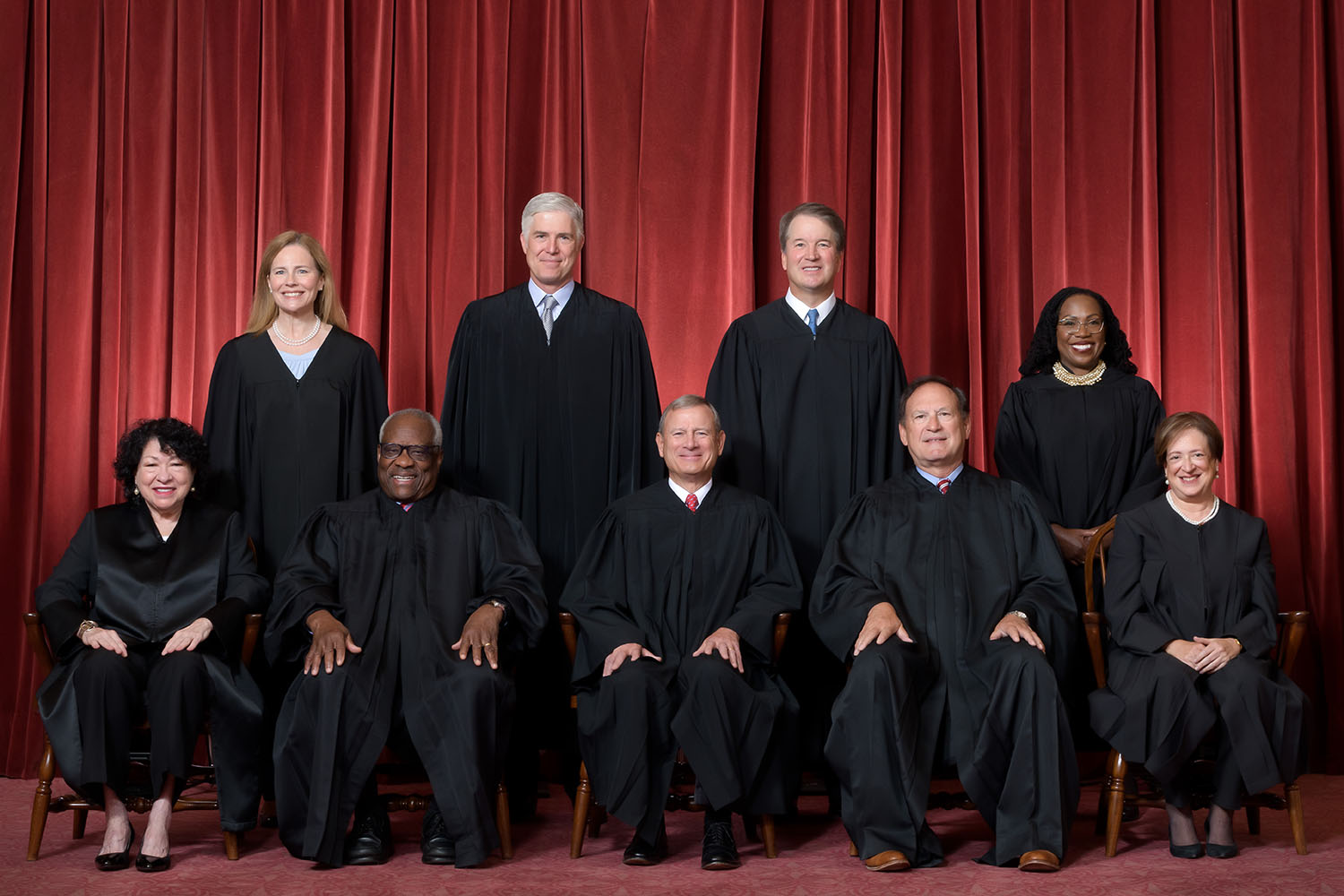
I am especially concerned about the growth and reach of the US Supreme Court (SCOTUS) into politics and other matters which the Founders had no intention for the Court to meddle. Unlike the balance of power allegorized by a troika, the merging and morphing of the USA’s three branches of government into an increasingly ultra-right orientation is dangerous to our civil rights and the Constitution. Especially when the highest court in the land is integrally involved.
Last week it was revealed that Justice Samuel Alito had, at two of his homes, flown flags associated with the “Stop the Steal” movement. The movement falsely asserts that the 2020 presidential election was stolen from Trump (by) Joe Biden, editorialized HuffPost Politics.
Barring other explanations, it would seem to be a clear conflict to the justice’s mandate to be — or at least appear — impartial and unbiased. Justices have certainly recused themselves from cases for less. But Alito has made no moves to suggest that he would bow out of the ruling on either relevant case, the newspaper continued.
And of course, this follows last year’s spate of stories suggesting that some justices had acted unethically, accepting lavish gifts and vacations from conservative influencers. Alito and Clarence Thomas, in particular, admitted to attending luxury vacations on billionaires’ dimes, which they defended by citing court disclosure guidelines that say personal hospitality from friends is permitted. Public disapproval prompted the high court to adopt new and clearer ethics guidelines — though they still lack an enforcement mechanism.
When put all together, HuffPost concluded, it’s hard to shake the feeling that the justices are now just doing what they please, secure in the knowledge that no one has the power, or the will, to enforce any consequences for them.
Can SCOTUS be stopped? Are there any limits to the powers it exercises? Can it, legally, be overruled?
Yes!
Here are some of the potential reins on the US Supreme Court:
> SCOTUS can reconsider and overturn previous rulings it has made, as in its recent Dobbs decision … and many others.
> When the Supreme Court rules on a constitutional issue, its decisions can be altered by the rarely used procedure of constitutional amendment or by a new ruling of the Court. However, when the Court interprets a statute, new legislative action can be taken.
> According to the League of Women Voters, with enough political will and a willing President, it is within Congress’ authority to limit the US Supreme Court’s power by restricting what type of appeals it can accept. Theoretically, Congress could therefore limit the Court’s ability to restrict or remove certain fundamental rights by preventing it from hearing cases about them in the first place.
> Given the unlikelihood of an admission of impropriety from any Supreme Court justice, a more extreme avenue available to lawmakers who would seek to hold them accountable for compromising the neutrality and legitimacy of the court: impeachment. Over the country’s history, 15 federal judges have been impeached, and eight removed from office; others resigned in the wake of scandal instead. So one thing, at least, is clear: Unlike for presidents, there is ample precedent for firing federal judges via impeachment. Article III states that these judges “hold their office during good behavior,” which means they have a lifetime appointment, except under very limited circumstances. Article III judges can be removed from office through impeachment by the House of Representatives and conviction by the Senate. The only Justice to be impeached was Justice Samuel Chase in 1805.
> The Constitution limits the Court to dealing with “Cases” and “Controversies.” John Jay, the first Chief Justice, clarified this restraint early in the Court’s history by declining to advise President George Washington on the constitutional implications of a proposed foreign policy decision. The Court does not give advisory opinions; rather, its function is limited only to deciding specific cases.
> Although the Court’s decisions cannot be appealed to any authority (as it is the final judicial arbiter in the United States on matters of federal law), the Court may consider appeals from the highest state courts or from federal appellate courts.
It is this last measure that most intrigues me. More than one newscaster’s panels have mentioned — merely mentioned, without going into any real detail — that it is within the power of a “coalition” of lower courts to question and arbitrate the roles played and decisions made by SCOTUS.
I, for one, would love to learn more about this!
The unique position of the Supreme Court stems, in large part, from the deep commitment of the American people to the Rule of Law and to constitutional government. The United States has demonstrated an unprecedented determination to preserve and protect its written Constitution, thereby providing the American “experiment in democracy” with the oldest written Constitution still in force.
Pastor, professor, publisher, and journalist Bruce H. Joffe is the award-winning author of magazine features, academic research, journal articles, self-help manuals, and newspaper bylines. His eight books deal with international (intercultural) living, interfaith theology, gender studies, “social” politics, marketing, and the media.

 "Exactly!"