Unknown's avatar

About Pastor Bruce

Church pastor, communications professor, and nonprofit executive, Pastor Bruce H. Joffe has amassed an extensive array of journalism, scholarship, and management experience. He has taught no-nonsense public relations, media, and marketing courses at The American University, George Mason University, Mary Baldwin College, Carthage College, and Kaplan College. As president and creative director of a metropolitan Washington, DC, public relations firm, he helped to manage the reputation of his clients for more than 20 years by creating promotional materials and metrics for large corporations and local businesses to use in their branding efforts, while positioning nonprofits to raise the bar on the resources and awareness they need to make a real difference. Academically, Joffe´s most recent focus has been Media and Gender Studies. Through research and publications, he continues to explore the relationship between gender, the media, and cultural norms--including organized religion. Ordained by the International Council of Community Churches and the Progressive Christian Alliance, Pastor Bruce considers himself a progressive Christian who believes that God is love and that loving God means having compassion and forgiveness towards others. Joffe is the author of numerous magazine features, academic research, professional journal articles, and newspaper byliners. His books include The Scapegoat; A Hint of Homosexuality? 'Gay' and Homoerotic Imagery in American Print Advertising; Square Peg in a Round Hole; Personal PR: Public Relations and Marketing Tips that Work to Your Advantage; The Facebook Gospel: Social Media and the Good News; My Name Is Heretic: Reforming the Church, from Guts to Glory; and Expat: Leaving the USA for Good. Since moving from the USA to Portugal and Spain in 2018, he's written EXPAT: Leaving the USA for Good ... and Spanish Towns, Portuguese Villages: A Journal for Expats and Immigrants. His latest book was published in June 2024--VULNERABLE: Why We Fear and Hurt So Much.

Why Aunt Jemima’s Life Matters

Two struggles are ongoing simultaneously: The battle to contain and eradicate the Covid-19 virus, which has taken the lives of so many; and the Black Lives Matter movement, which appears to be making some inroads to challenging 400+ years of systemic racism and injustice.

Perhaps nowhere do these dual dynamics converge more today than in the higher contagion rates, suffering, and death of African-American communities … which tend to be poorer, inadequately equipped, and less healthy to begin with than the predominantly white suburbs.

I am white and privileged, so what right – if any – do I have to comment on this? None! Other than to share my own, personal opinions.

Unquestionably, slavery and its ensuing racism are our shame and national sin. For far too long, we’ve nodded in recognition of the unfairness and inequalities our corporate culture and people of privilege have hoisted on those born with brown or black skin.

Now, it seems that real, across-the-board efforts are being made to bring this darkness to light, exposing national and international complicity in keeping poor people down.

Sometimes, in an effort to overcome and make amends for the errors of our past, however, we can become poor judges and juries of our present. Time and culture have a way of turning such that today we laugh at what, not that long ago, appeared normal and civilized.

In the late 1800s, Missouri newspaper editor Chris L. Rutt decided to name his brand of self-rising flour after “Aunt Jemima,” a song performed by minstrel actors. A former slave named Nancy Green was later hired to portray Aunt Jemima as a “mammy” a caricature that depicts female slaves as smiling, happy homemakers for white families.

Quaker Oats, a subsidiary of PepsiCo, announced that it will retire its Aunt Jemima brand of syrup and pancake mix, saying the company recognizes that “Aunt Jemima’s origins are based on a racial stereotype.” Hours after Quaker Oats announced it was changing its Aunt Jemima logo, Mars, which makes the boxed rice product “Uncle Ben’s,” said it plans to change the product’s “brand identity.”
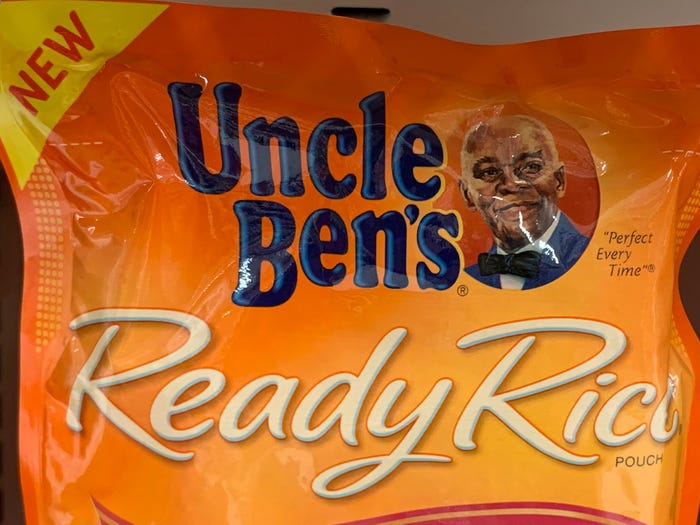
Uncle Ben’s, a rice and grains company, adopted its brand name and logo in 1946. According to the company’s website, the name “Uncle Ben” is that of a Black Texan rice farmer and the image is of a Black Chicago chef and waiter named Frank Brown.

Syrup and pancake-mix company Mrs. Butterworth’s adopted the personality of “Mrs. Butterworth” in 1961.
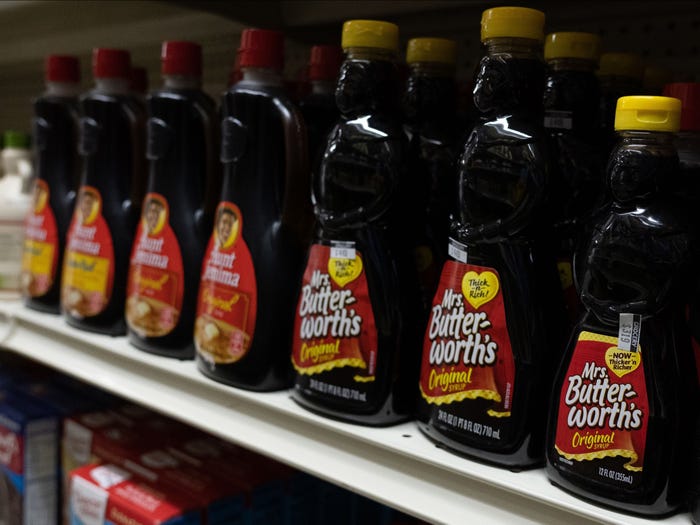
For years, the shape of Mrs. Butterworth’s syrup bottles has been a point of contention. “Critics have long associated the shape of the Mrs. Butterworth’s bottle with the mammy, a caricature of black women as subservient to white people,” one critic wrote.

Conagra Brands, parent company of Mrs. Butterworth’s syrup and pancake mixes, released a statement saying that they have started a review of the brand and packaging: “The Mrs. Butterworth’s brand, including its syrup packaging, is intended to evoke the images of a loving grandmother. We stand in solidarity with our Black and Brown communities and we can see that our packaging may be interpreted in a way that is wholly inconsistent with our values,” they said.
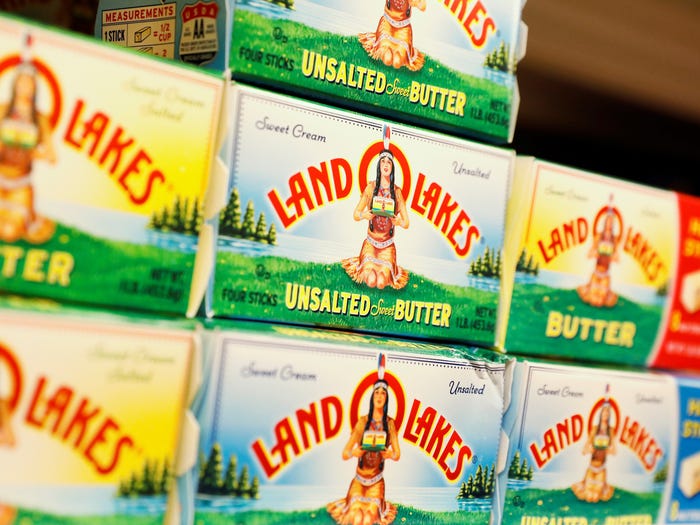
Land O’Lakes (butter) recently changed the packaging for its consumer products to remove the image of a Native American woman with a feather in her hair. The change was implemented ahead of the company’s 100th anniversary. The new packaging is very similar to the original, save for the removal of the Native American woman. It also added the phrase “farmer-owned” above the Land O’Lakes name.

Originally a sexy banana, the Chiquita brand’s mascot is now a sexy banana seller. She wears a Carmen-Miranda-esque fruit hat that gives an exotic and idealized image of the tropics. Other companies, too, have appropriated idealized women to represent their iconoclastic brands: Betty Crocker (whose image has been updated many times), Mrs. Paul, Maybelline, Helena Rubenstein, Estee Lauder, and (of course), the bevvy of beauties tantalizing Victoria’s Secret.
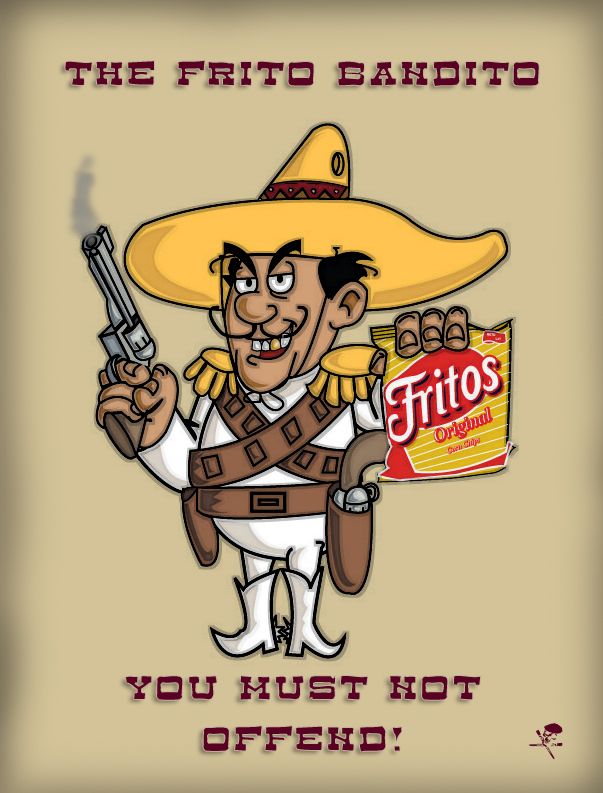
Remember the Frito Bandito? Speaking broken English and robbing unsuspecting bystanders, the Frito Bandito was an armed Mexican conman with a disheveled look and a gold tooth. Responding to pressure from the Mexican American Anti-Defamation Committee, the snack-food giant cleaned up Frito Bandito’s look. But combed hair and a friendlier expression didn’t quite cut it. Similarly, a battle rages about inappropriate stereotypes implied or inferred by the original packaging of Eskimo pies.

Now we have Goya products whose Hispanic products don’t need a stereotypical icon—they’re personally endorsed by Ivanka Trump and her father in the White House.

Sometimes, I suspect, we take ourselves and our imaging a bit too seriously. Demarcation must be drawn between “marketing,” which seeks to promote an organization’s products (or services) and “public relations,” whose purpose is to promote the organization itself. Are people demanding that the Quaker Oat Company remove the picture of the Quaker because it is exploiting a religious minority? When and where will it stop?
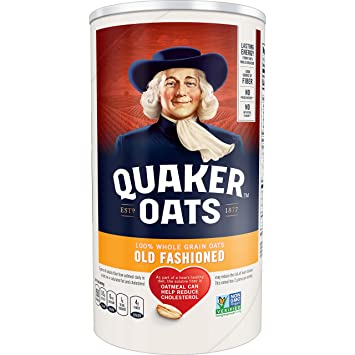
Separating the brands from their figureheads – if not the stereotypes – has long been the purview of American television.
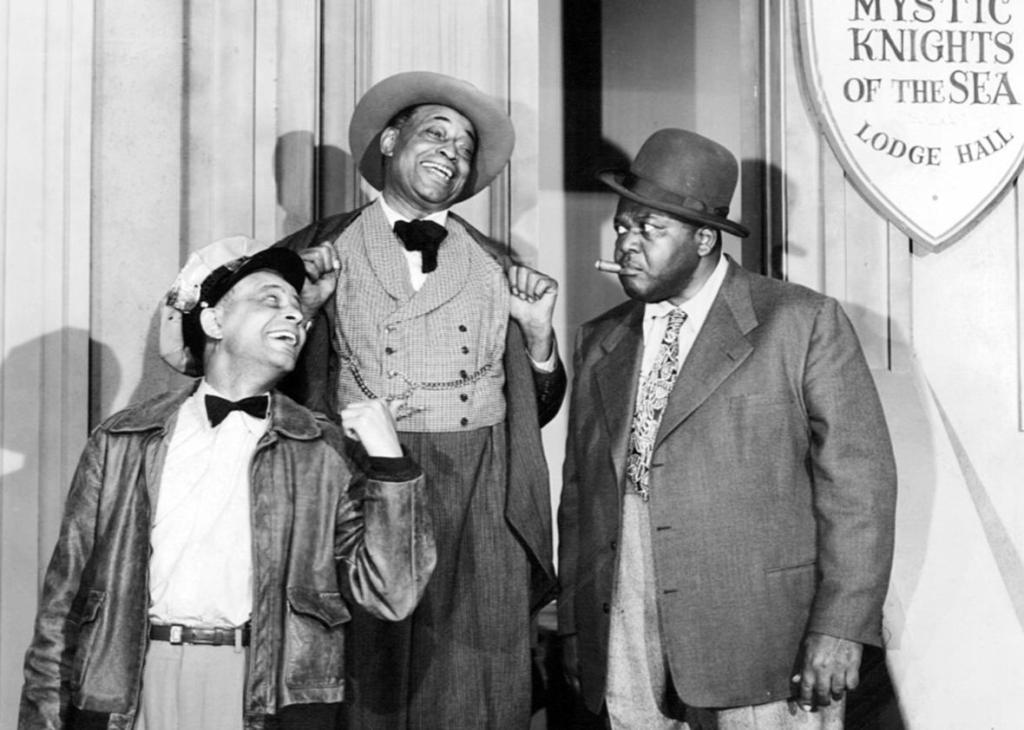
Amos ‘n’ Andy, an American radio and television sitcom set in Harlem, the historic center of Afro-American culture in New York City, was cancelled by The Columbia Broadcasting System (CBS) network after a national boycott led by the National Association for the Advancement of Colored People (NAACP).
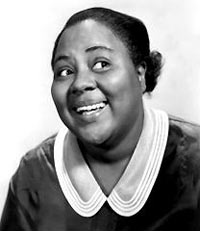
Beulah was an American sistuation comedy series that ran on CBS Radio from 1945 to 1954, and on ABC Television from 1950 to 1953. The show is notable for being the first sitcom to star an African American actress, for being ABC TV’s first hit situation comedy, and the first hit TV sitcom without a laugh track. When actress Hattie McDaniel took over the role on November 24, 1947, she earned $1000 a week for the first season, doubled the ratings of the original series and pleased the NAACP which was elated to see a historic first: a black woman as the star of a network radio program. In 1950, Roland Reed Productions adapted the property into a TV situation comedy for ABC, and the Beulah TV show ran for three seasons, Tuesday nights at 7:30 ET from October 3, 1950, to September 22, 1953. Most of the comedy in the series derived from the fact that Beulah, referred to as “the queen of the kitchen,” had the ability to solve problems that her employers couldn’t. Other characters included Beulah’s boyfriend, Bill Jackson, a handyman constantly proposing marriage, and Oriole, a befuddled maid for the family next door. Like the contemporaneous Amos and Andy, Beulah came under attack from many critics, including the NAACP, which accused the show of supporting stereotypical depictions of black characters with Beulah viewed as a stereotypical “mammy” similar to Aunt Jemima.

I often wonder whether whites and blacks viewed Amos and Andy through the same or different lenses. Did white viewers find themselves laughing with or at these simple people? Was Amos and Andy little more than Laurel and Hardy in blackface for them? As for blacks, did they accept the series because it reflected the significance of humor in the African-American experience?
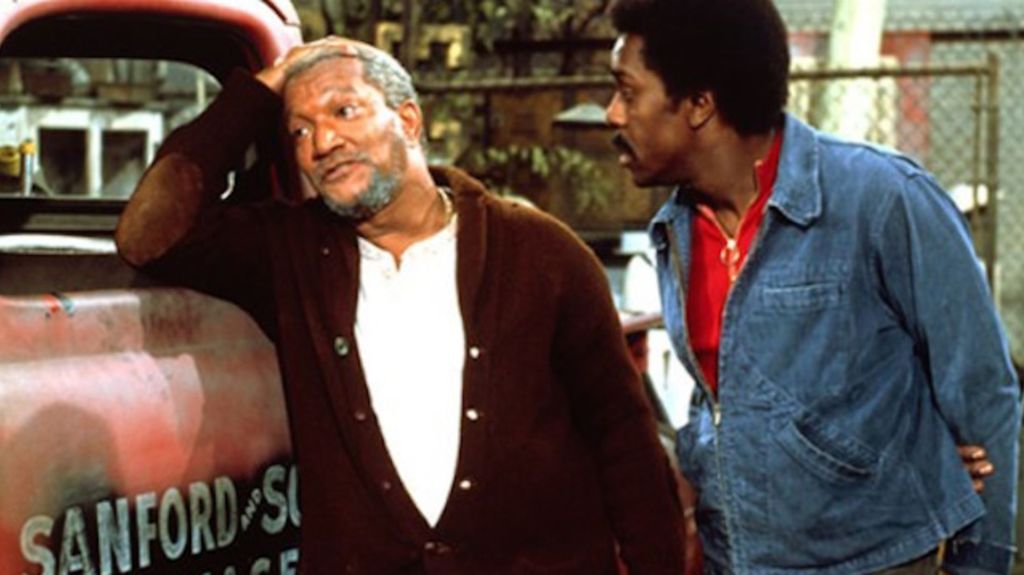
Sanford and Son was a black version of All in the Family. Widower Fred Sanford was as bigoted and ignorant as Archie. His son, Lamont, like Mike, was oriented to middle-class standards. He was embarrassed by his father’s behavior. George, the father in The Jeffersons, although a businessman, fit the same mold as Archie and Fred, namely, loud and bigoted. In the episode “Once a Friend,” George Jefferson learns that his old Army buddy Eddie is now a transgender woman named Edie (Veronica Redd).
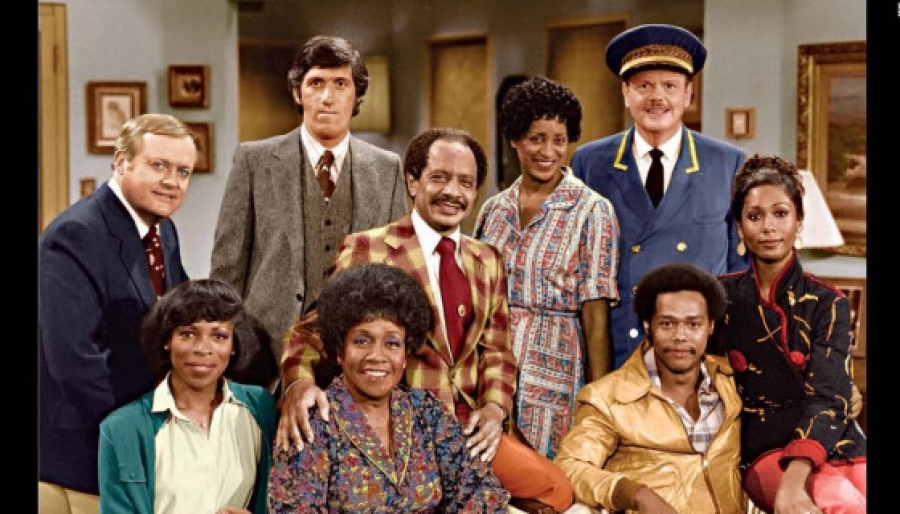
Pinky Lee and Billy Crystal in Soap. Paul Linde, a character actor with a distinctively campy and snarky persona that often poked fun at his barely closeted homosexuality, was well known for his roles as Uncle Arthur on Bewitched, the befuddled father Harry MacAfee in Bye Bye Birdie, and as a regular “center square” panelist on The Hollywood Squares. Lynde regularly topped audience polls of most-liked TV stars. Speaking of most liked TV stars, let’s give a nod to Ellen DeGeneris. “The Puppy Episode,” a two-part episode of her Ellen sitcom, detailed lead character Ellen Morgan’s realization that she is a lesbian and her coming out.

What about shows that depicted women and mothers in subservient roles to men: Father Knows Best? Ozzie and Harriet? I Married Joan? My Little Margie? I Love Lucy? December Bride? June Cleaver in Leave it to Beaver? Even Charlie’s Angels? Donna Reed was the first show to focus on the mother instead of the father. Later series increasingly empowered women: Police Woman, That Girl, Maude, Murphy Brown, Carole Burnett, Mary Tyler Moore, Julia, Roseanne, The Golden Girls, Designing Women, Sex and the City, and myriad others.
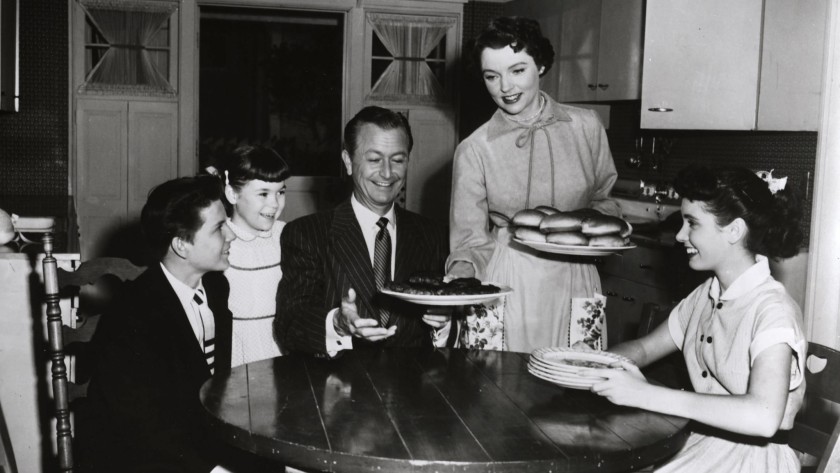
What about programs with Indians named “Tonto” (fool, dumb, ignorant) as in the Lone Ranger and other gunslinger westerns. On Wagon Train, frontier scout Flint McCullough and a longtime Sioux Indian friend reunite; but trouble is brewing as the Cheyenne are on the warpath and in their way is Fort Hastings, an old flame of his, and her new Army Captain fiancé. The Cisco Kid was an American Western TV series starring Duncan Renaldo in the title role and Leo Carrillo as his jovial sidekick, Pancho. Cisco and Pancho technically were desperados, wanted for unspecified crimes, but instead viewed by the poor as Robin Hood figures who assisted the downtrodden when law enforcement officers proved corrupt or unwilling to help. Sound familiar today?

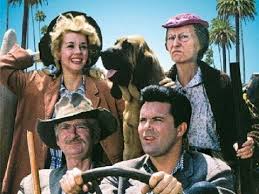
What stereotype images did The Beverly Hillbillies provide of, well, Appalachian hillbillies and the rich folks who tried to show them a new and better way of living? Meanwhile, white working-class men were reduced to Homer, Archie, Fred, and Ralph.
Chester, the father on The Life of Riley, was continually concocting schemes to help his family. Attempting to fix a school election so his daughter would win, he succeeded only in embarrassing her. His incessant failures were expressed in his closing line for each episode: “What a revoltin’ development this is!”

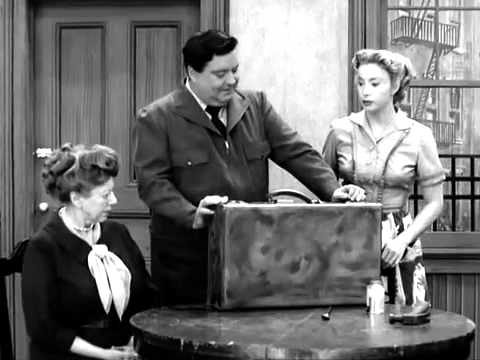
The main characters in The Honeymooners lived in a bare Brooklyn apartment with few amenities. Consequently, husband Ralph was obsessed with success and modest affluence, at which he constantly schemed but invariably failed. He wanted to afford simple comforts such as a television for his wife, Alice. He tried get-rich-quick schemes, such as marketing what he thought was Alice’s homemade sauce, only to learn it was dog food. Alice always quipped, “I told you so.” Alice’s logic and sarcasm invariably bested Ralph in arguments, which typically ended with Ralph saying, in angry frustration, “Just you wait, Alice, one of these days, pow, right in the kisser.”
For that matter, remember the lame-brained antics of policemen Toody and Moldoon on Car 54 Where Are You? featuring the misadventures of two of New York’s finest in the 53rd precinct in the Bronx. Toody, the short, stocky and dim-witted one, either saves the day or messes things up, much to the chagrin of Muldoon, the tall, lanky and smart one.

Regarding the Russians, who can forget Boris and Natasha, foils for Rocky and Bullwinkle? Natasha is a spy for the fictional country of Pottsylvania, and takes orders from the nation’s leader, Fearless Leader. Natasha usually serves as an accomplice to fellow spy Boris Badenov.

And Howdy Doody, that quintessential children’s favorite featuring such characters as Buffalo Bob Smith, Princess SummerFall WinterSpring Chief Thunderthud, Clarabell, and Mister Bluster.

In his book Television in Black-and-White America: Race and National Identity (University Press of Kansas), Rensselaer Polytechnic Institute Professor Alan Nadel argues that the medium in the 1950s and ’60s deepened racial divisions by offering an intentionally skewed version of reality.

It was, quite literally, a whitewash: “Television was the place where one found definitively normal families,” Nadel writes, “and no black children were to be found in that excessively normal world.”

Perhaps the 1998 movie Pleasantville best sums up our love-hate relationship with these TV shows from our formative years.
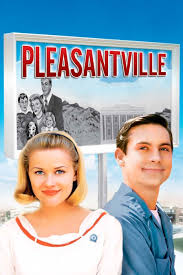
David Wagner is a Nineties kid with a Fifties addiction. He’s hooked on reruns of a classic television show called “Pleasantville,” set in a simple place where everyone is swell and perky, “confrontation” is a dirty word and life is pleasingly pleasant. Addicted to this utopian world, David immerses himself in “Pleasantville” as an innocent escape from the trouble-plagued real world that he must share with his ultra-hip, totally popular twin sister, Jennifer. But one evening, life takes a bizarre twist when a peculiar repairman gives him a strange remote control, which zaps David and his sister straight into Pleasantville. All the repressed desires of life in the Fifties begin to boil up through the people of Pleasantville, changing their lives in strange and wonderful ways that none of them had even dared to dream of, until they were visited by two kids from the real world.

In these increasingly difficult times, where we are confronting an out-of-control virus and our ghosts from the past, a simple place where everyone is swell and perky, confrontation is a dirty word, and life is pleasingly pleasant, the simple black-and-white of our past – no matter how stereotyped or distorted – gives us some small comfort.

I am not talking about statues or monuments purposefully built to honor and memorialize those who, historically, have done us wrong.

We can’t erase history … but we can learn from — and appreciate — its social dimensions and cultural context.

Which is why Black Lives Matter. And Brown. Asians and Immigrants, as well.

Because we still have a lot to learn!

Rev. Bruce H. Joffe, Ph.D., is a retired professor and pastor probing the intersections of media, religion, gender, international living, and allied cultural norms.


Processing…
Success! You're on the list.


Househunters International: Portugal

“You guys really should consider Portugal,” our neighbors Linda and Russ in Sturgeon Bay, Wisconsin, urged us. “We love it there. We own some property just outside a small town, Alpedrinha, and we’ll be moving there – for good! – in February, next year.”

It all looks so simple on HGTV—buying a house in another country.

Trust me: it isn’t!

Sure, it’s fun to see what’s for sale elsewhere and explore international properties online and via the telly. But putting your “boots on the ground” and confirming that what you see represented in all those come-hither Internet snapshots is actually what you’ll be getting can be a real eye-opener. The fun stops and the headaches begin once you make an offer … and it’s accepted.

Why? Take closing costs, for instance.

Apart from any deposit or down payment, in Spain the transaction can cost you about 20% above and beyond the purchase price to cover transfer taxes, lawyer and Notario charges, and an assortment of administrative fees. So, a relatively inexpensive property purchased for 50,000 Euros,would cost about another 10K in € to legally own it.

Still relatively inexpensive, all things considered.

Friends told us that “settlement” costs in Portugal are much lower … and, indeed, they are!

Take purchase and transfer taxes on a property: In Spain, one now pays 8% of the property’s value (its selling price) in taxes. While Portugal has several taxes that can accompany a property’s purchase, if you’re married and the place is your first and primary residence in Portugal, you’ll pay only 0.8% in taxes on the purchase.

That’s ten times the savings (vs. Spain’s), just in taxes!

And Portugal grants most newcomer residents the first three years of ownership tax-free. If you fill out the forms— correctly and on time.

The lower costs to purchase property is one benefit of buying Portugal. The friendly, simpatico, but saudade Portuguese people is another. The history, the magnificent topography, the exquisite monuments, memorials, castles, and cobble stone streets of intimate towns and villages are yet others. Not only is Portugal’s cost of living lower than that in many other countries, but its quality of life is high. Plus, Portugal consistently ranks among the five most peaceful countries in the world, as well as one of the most welcoming.

All told, we made several trips to look at and evaluate properties in Portugal. We stayed in cozy little hotels and inns, wandering around through their towns and cities. We attended seminars for people considering a move to Portugal or already living there. We narrowed our choices and looked at houses in in the Coimbra and Castelo Branco areas.

We found what we were looking for in Lousa – not to be confused with Lousã! – a small village about 20 minutes outside the city of Castelo Branco, with cobble stone streets and a church whose bells chimed as a heart beat, punctuating the daily rhythm of life there.

Because of its proximity to Spain, the privacy of its separate guest quarters with en suite, and the potential of opening some sort of eatery in the property’s former cafe, we purchased the property shown to us by a property agent using the flashlight of his phone. The next day, when we returned to “tour” the town, we met the owner: a lovely, little old lady who communicated with us in a polyglot of Portuguese, Spanish, and (especially) French.

Despite her honesty and answers to our questions, we’ve learned some invaluable lessons about buying property in Portugal. First and foremost, always have your property inspected and its condition evaluated by a qualified professional. If you’ve seen the place online first and gotten excited about it, remember, too, that pictures and descriptions supplied by property agents are a classic case of “what you see isn’t (necessarily) what you get!”.

So, get a second opinion.

Thanks to our lawyer, Liliana Solipa, who represented us through our power of attorney, we were assigned fiscal numbers (NIFs), the property was purchased and put in our names, a bank account opened, the water and electricity turned on again.

That’s when we decided to take advantage of a special sale offered by the airlines and spend a November week in our “new” Portugal home.

With keys in hand and hand on the front door handle, we quickly discovered how much work the place really needed after having been vacant and closed up for more than five years.

OMG!

I’ll save that for another story.

Shared here are personal observations, experiences, and happenstance that actually occurred to us as we moved from the USA to begin a new life in Portugal and Spain. Collected and compiled in EXPAT: Leaving the USA for Good, the book is available in hardcover, paperback, and eBook editions from Amazon and most online booksellers.

Processing…
Success! You're on the list.

Sunday Sermon, 02/08/2020

Confronting Our Core Beliefs:
How We Feel When Presented with New Ideas

http://theoatmeal.com/comics/believe

Processing…
Success! You're on the list.

Murphy and Me

“Anything that can go wrong, will go wrong.”

That’s Murphy’s Law.

Named after Capt. Edward A. Murphy, an engineer working on a project designed to see how much sudden deceleration a person can stand in a crash, Murphy’s Law and its corollaries explain why sh*t happens and causes the angst in our lives.

Like this, for example:

We purchased a 2012 Ford S-Max from a dealer’s lot in Cascais (two hours from where we live in Portugal) with the standard, required, one-year guarantee.

Soon, both the “Engine Malfunction” and “Traction Control” warning lights came on, as the minivan lost almost all power.

Murphy’s Corollary #1: “Whenever you set out to do something, something else must be done first.”

We pulled off to the side and searched the manual downloaded earlier to our mobile (after discovering the printed manual in the glove box was purely in Portuguese. Even the diagrams!). In English, we read that the instrument cluster warning symbols alerted us to “stop driving and seek immediate assistance from a properly trained technician.”

Immediately, we eased the car into a nearby underground parking area and left it there, locked.

Friends drove us home.

Murphy’s Corollary #2: “Nothing is as easy as it looks.”

Not knowing anything about the technicalities and legalities that govern guarantees provided by (commercial) dealers selling used vehicles here in Portugal, we went online and Googled the Internet.

It didn’t take long to discover some interesting information on an official European Union “Your Europe” website page. The link is below.

“Q: If the product is defective, who is responsible for putting things right? A: The seller, even for purchases made on an internet platform.”

Yeah, right.

Murphy’s Corollary #3: “Everything takes longer than you think.”

It was Saturday. Both the auto dealership and our insurance agency were closed. Wouldn’t the weekend be when people had time to go shopping for cars and need insurance if they bought one?

Weird, huh? Welcome to Portugal!

We waited until Monday, then contacted the dealership in Cascais … our insurance agent … a towing company … the local Ford dealership to alert them we’d be bringing the vehicle to them for diagnosis … the area’s only rental car agency … and a taxi company, to pick us up and drive us around to all these places in Castelo Branco.

Murphy’s Corollary #4: “If there is a possibility of several things going wrong, the one that will cause the most damage will be the one to go wrong.”

Later that day, the Ford technician contacted us with disturbing news: All four fuel injectors need to be replaced, at a cost of €1,500-€2,000. He attached an analysis and cost estimate to the email.

Murphy’s Corollary #5: “Left to themselves, things tend to go from bad to worse.”

We sent the report to the dealer who sold us and guaranteed the S-Max. We waited and waited for a reply. The dealer insisted that the repairs be made in Cascais … and that we arrange to have the vehicle towed there.

But the insurance company balked at towing it such a great distance.

Meanwhile, from the Ford dealership, we learned of other problems: When the mechanic opened the hood, he poked around and said to us, “The motor has rust. This is not good.” He could offer no assurance that we wouldn’t experience even more problems down the road.

Murphy’s Corollary #6: “If everything seems to be going well, you have obviously overlooked something.”

We contacted Cascais again, reviewing our experiences with the dealer and vehicle since purchasing it. Among them:

The day after we got it, the air conditioner wouldn’t work. Dealer said it was working when he drove the car to us. But a mechanic found only 10% of the “gas” necessary for the air conditioner to function. We paid €100 for the air conditioning system to be filled with gas and recharged.

Murphy’s Corollary #7: “Nature always sides with the hidden flaw.”

We believe we’d been sold a defective vehicle.

Deliberately, perhaps.

After the sale, the dealer certainly wasn’t cooperative. In fact, we hadn’t even received our legal ownership papers for the S-Max!

If there are lessons to be learned here, I’d caution: (1) Be very careful when purchasing a car if the dealer isn’t a reputable, full-service dealership; (2) Never purchase a used vehicle until it’s been inspected by a qualified, objective mechanic; and (3) Buy a vehicle as close to home as possible.

We certainly appreciate all the ideas, input, opinions, and feedback received from concerned folks via Facebook.

So, add this corollary to Murphy’s law: “Post a problem on Facebook and people will *Like* something that’s terrible, comment with advice and admonishments, attribute any mistakes in what they’ve written to auto-correct, and insist that you’ve written too much.”

“Much ado about nothing?”

That’s William Shakespeare, not Murphy.

But between Murphy and me, the Bard never purchased a used car in Portugal!

europa.eu/youreurope/citizens/consumers/shopping/guarantees-returns/portugal/index_en.htm?fbclid=IwAR3whE93SFTqJLv1CRJpHkNMWuiGf–WBhuoJgPkp0qeVupNK3zXayUYz_Y

From EXPAT: Leaving the USA for Good. Available in hardcover, paperback, and ebook formats, please order your copies today from Amazon … or your preferred online bookseller.

Processing…
Success! You're on the list.

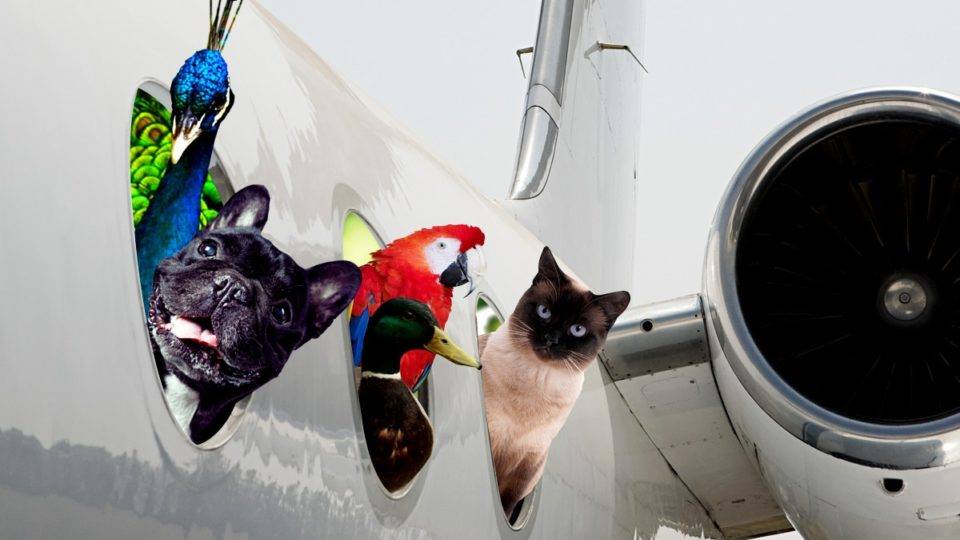
Pets on Planes

“If they can’t come with us, we’re not going,” my partner and I agreed: If our three Miniature Schnauzers – our children, now that our biological one was grown – couldn’t travel with us and be allowed entry into the EU, we wouldn’t follow our hearts and minds to Portugal and Spain … much as we were distraught and disillusioned with what has been happening in the United States.

That meant not only would we expect our dogs to fly in the cabin with us – not the cargo hold – for all three flights from Green Bay, Wisconsin, to Madrid, Spain … but it also presumed that they would be allowed to pass through Immigration in Spain and then into Portugal without any beastly requirements.

Bringing our furry family members with us would become the most complex and frustrating part of making a new home on the other side of the big pond.

The “kids,” as we refer to them, had lived with us in Florida, Wisconsin, and Virginia. But whenever we traveled to our vacation bolt in southern Spain, we’d leave them at home with carefully vetted pet-sitters.

Now, our future depended on them being there with us.

Fortunately, due to our own personal maladies, the dogs were qualified as “service” animals with the airlines. Unfortunately, there are three of them and only two of us.

American Airlines was the only carrier that would allow two people to bring three designated service dogs aboard … and that was only after (working with our travel agent) we completed their forms, had medical testimonies vouchsafed by our doctors and submitted to the airlines, and were interrogated in telephone interviews by airline officials.

We qualified and our dogs were approved to travel with us!

But that just covered their transportation. Getting them into the European Union was another matter that would require entirely different documents and protocols.

They’re called “pet passports” in the EU. But they’re issued only once you’re inside the EU. Emigrating from the United States, one needs to complete a reasonable facsimile – an official EU Health Certificate – specific to the language and place of entry. For us, that was Spanish, as our entry to the EU would be through Madrid’s Barajas airport.

The eight-page bilingual document, requiring a separate 22-page set of instructions for completing it, attests that each of the named and described dogs has received a state-of-the-art microchip (manufacturer’s name and number identified) followed by a new rabies shot (with batch number and effective dates identified). It had to be filled out by a USDA-accredited veterinarian and then certified by the appropriate United States Department of Agriculture office in our state.

Was our vet USDA-accredited?

“Darned if I know,” Dr. Randy laughed. “I’m certified by the American Veterinary Association and by the Wisconsin Veterinary Association. Does that count?”

Nope. He had to be USDA-accredited.

Try finding the USDA office in your state specifically charged with handling documentation for pets traveling abroad. It took us two weeks through a variety of sources and referrals to find that USDA office in Madison, Wisconsin.

The amiable USDA rep who helped us deal with the process confirmed that Dr. Randy was, in fact, USDA-accredited and advised us to have him inject the microchips and rabies shots between three and four weeks before we traveled, and to go back and have him sign all the paperwork ten days before leaving. We were then to send the docs via overnight mail from our city to the USDA’s office in Madison ($50) and to enclose a postage-paid return overnight envelope (another $50) so that, theoretically, we’d have them in hand a week before our travel. Apart from the vet costs, we’d need to pay the USDA’s $38 certification fee.

Signed, sealed, and delivered!

Our dogs were ready to enter the European Union, traveling with us as passengers aboard our American Airlines flights.


We arrived early the next morning in Madrid, not knowing who – or where – we’d be asked to show the dogs’ docs. Not the customs agent who stamped our passports. Nor the immigration agent whose station we needed to pass through after retrieving our luggage.

Just as we were about to leave the airport building for the rental car area, a man dashed out of an adjoining vestibule. “The paperwork, please, for the dogs,” he asked in Spanish.

We handed over our new, eight pages of documentation.

He looked only at one page, bypassing every sheet of paper with the dates and signatures and certifications. Of interest to him only were the microchips, which he waved over each dog with a wand to confirm that the numbers listed on our papers agreed with the numbers shown on the wand.

They did.

It was a long, complicated, and exacting trip that lasted some 18 hours with our dogs.

Would we do it all over again if the need be?

You bet we would!

How can you begin a new life in another country without your “family” … even if they’ve got four legs and fur?

Considering traveling with your pets on a plane? Here are links to the pet policies of several airlines that fly directly between the USA and Portugal or Spain:


American Airlines:
www.aa.com/i18n/travel-info/special-assistance/pets.jsp

Delta Airlines:
www.delta.com/eu/en/pet-travel/overview

United Airlines:
www.united.com/ual/en/us/fly/travel/animals.html

British Airways:
www.britishairways.com/…/travel-assist…/travelling-with-pets

Iberia Airlines:
www.iberia.com/us/fly-with-iberia/pets/

TAP Air Portugal:
www.flytap.com/en-us/travelling-with-animals/pets

Shared here are personal observations, experiences, and happenstance that actually occurred to us as we moved from the USA to begin a new life in Portugal and Spain. Collected and compiled in EXPAT: Leaving the USA for Good, the book is available in hardcover, paperback, and eBook editions from Amazon and most online booksellers.

Processing…
Success! You're on the list.

Férias for the French

It’s common knowledge that Paris and much of France shuts down for vacation in August.

What’s not that well-known is that many French people head to Spain and Portugal, where they visit their “poor” cousins, friends, and family members while enjoying down-home Portuguese and Spanish hospitality.

In other words, “férias!”

Throughout the month of August, those of us living in central Portugal cannot help but be bombarded by ubiquitous brightly-colored plastic bags hanging everywhere, imprinted with too many letters too small to read while driving, announcing this town’s férias … or that one’s.

Suddenly, little villages and larger towns are where it’s happening … with overpriced food cooked and eaten with flies al fresco, beer by the barrel or bottle, and second-string singers who – though advertised as famous – appear in our own little hamlets to entertain us.

Observes the Rev. António Vitalino in Reconquista, Beira Baixa’s regional religious newspaper, “Infelizmente não é apenas por causa da sua condiçao de ser peregrine, que o ser humano se desloca do torrã e do país onde nasceu. Mas também devido a guerras, a perseguições, a cataclismos e à fome.”*

Father Vitalino obviously overlooked or forgot about the férias!

Assuming, of course, that fires don’t disrupt the festivities, the férias change everything … for better and worse, beginning with the people. Overcapacity indulging is what turns community “festas” into férias.

Joyous occasions though these celebrations can be, they bring along with them troubles … and trash.Trash bins that barely can contain their own disposables now overflow, unable to close. More refuse in plastic bags continues to be added and placed on top of and next to the bins, where cats and dogs roaming the streets rip them open and feast of their entrails … leaving tracks of thrown-away food and decayed vittles throughout the village.

“Land mines” multiply, as an influx of immigrant dogs and cats that accompany adults and children are let loose to litter on our streets.

Capillaries barely capable of carrying – or accommodating – vehicles to begin with are suddenly overwhelmed beyond capacity. Cars are left wherever: in the middle of streets, at roundabouts and intersections, double- and triple-parked, anywhere and everywhere.

No room at the inn? Forget the inn. There’s no room for the locals at their own coffee shops and bars, a sacrilege greater than sin.

Hobbit houses otherwise abandoned the rest of the year are brimming, bulging, and bursting at their seams with visitors and far-away families. Adolescents aged from barely double-digits to teenagers and young adults – people who should know better – go carousing noisily through the streets at very early morning hours, while their elders desperately try to rest and sleep. There’s plenty of noise-making at these férias. From the babble of voices around communal tables, eating and drinking … to the spine-chilling feedback of rebellious sound amplifiers … too-late hijinks of intoxicated youngsters weaving their way through our streets … and the firecrackers, a bit too dangerous for these times of ferocious fires.

Just as férias can be good for one’s soul and community spirit, it’s also quite healthy to bypass the hustle-bustle for calm and tranquility.

Needless to say, this year is quite different.

Maybe for their own good — and ours — people will stay put?

*“Unfortunately it is not only because of their pilgrim condition that the human being moves from the torrent and the country where he was born. But also because of wars, persecution, cataclysms and famine.”

# # # # # # # # # # # # # # #

Shared here are personal observations, experiences, and happenstance that actually occurred to us as we moved from the USA to begin a new life in Portugal and Spain. Collected and compiled in EXPAT: Leaving the USA for Good, the book is available in hardcover, paperback, and eBook editions from Amazon and most online booksellers.

Processing…
Success! You're on the list.

Doors, Not Walls

With all due respect to Jim Morrison, I’m not talking about his band here – which would certainly disclose my age – but, rather, those substrates that create openings into buildings, rooms, and/or vehicles.

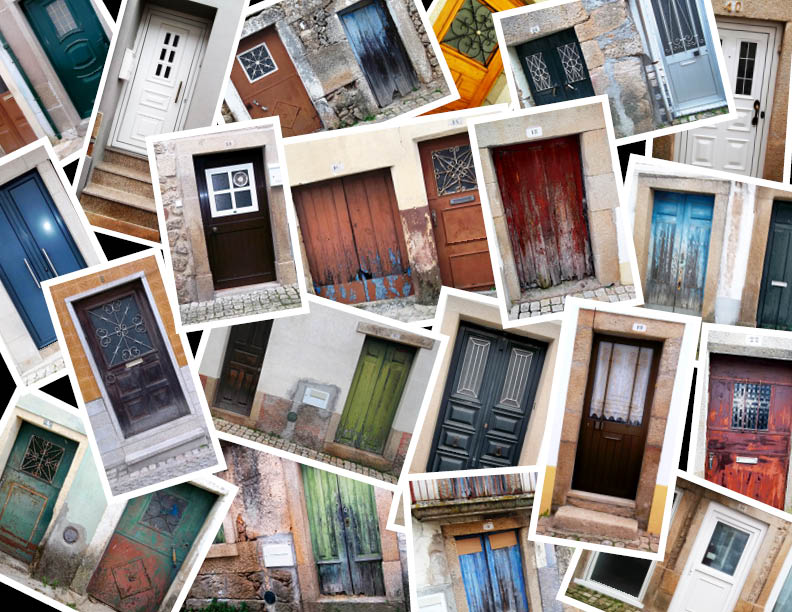
Photos of doors found in our small Portuguese village (Lousa, Castelo Branco)

I’m referring to property doors—the doors to houses in Portuguese villages and Spanish towns. (Not those in Door County, Wisconsin, where we lived before moving here to Castelo Branco’s Lousa from the USA.)

The diversity in size, shape, color, composition, construction, height, and materials (and whether they have windows and/or screens) makes me think about our former “melting pot” nation now divided by walls.

Doors usually are made of a sturdy, hard-to-break substance (such as wood or metal), but sometimes consist of a frame into which windows or screens can be fitted. Often attached by hinges to a frame, doors make entering or leaving a building (especially) easier to manage.

Often, doors have locking mechanisms to ensure that only some people can open them. Devices such as knockers or bells enable people outside to announce their presence and summon someone to come and open the door for them … or give them permission to open and enter.

Apart from access into and out of a space, doors tend to ensure privacy, preventing unwanted attention from outsiders. Doors separate spaces with different functions. They allow light to pass through (or not) … control ventilation, more effectively heating or cooling the interiors … block out the noise … and impede fires from spreading.

Doors also have aesthetic, symbolic, and ritualistic purposes.

To be given the key to a door can signify a change in one’s status from outsider to insider. Doors frequently appear in the arts with allegorical or metaphorical importance:

They’re portents of change.

As I walk our dogs past a hodgepodge of doors diverse and distinct by any measure – no matter how close they are, one to another – I can’t help but wonder what’s behind these doors? Who lives there: the boy or girl next door? Why is this door so different from a neighboring one? Is anything specious going on behind all those closed doors?

Please, leave the door open and don’t shut me out … let me get a leg or foot in it, at least. Even if it’s the back door (or a revolving one).

I realize that doors are much more than metaphors, since they serve security purposes: Doors let us in and usher others out. They provide the ability to look and see who wants to enter, before we open up and permit people to come in. When it’s their time to leave, we hope the door won’t hit them on the way out.

Useful, functional, and practical planes of engineering, doors delight us with linguistic and literary allusions: Opportunity comes knocking at our door, We can open any door – even creaking doors (which hang there the longest) – and, hopefully, not find ourselves at death’s door.

Who wants to be dead as a door nail, anyway?

People may insist on beating a path to my door, even if I’ve asked them not to darken it again. But, build a better mousetrap, and everyone will be here, including the wolf.

Doors, not walls.

Because, when one door closes, another one opens.

Which is why I’m convinced that the world needs more of them.

And that it’s time to close the door on this ramble.

Shared here are personal observations, experiences, and happenstance that actually occurred to us as we moved from the USA to begin a new life in Portugal and Spain. Collected and compiled in EXPAT: Leaving the USA for Good, the book is available in hardcover, paperback, and eBook editions from Amazon and most online booksellers.

Processing…
Success! You're on the list.

Dirty Water and Other Cravings

Undoubtedly, I’m going to be crucified for my confessions here, so be my guest … skip to the end of this piece … and give it your best shot.

“What do you miss most from the USA?” I’m frequently asked.

That’s changed quite a bit since living in Portugal and Spain almost four years; but, originally, leading my list was American-style coffee.

You know: what the locals, especially, refer to as “dirty water.”

Coffee is almost a religion in Portugal; but unlike religion, it’s worshiped daily here. Both the Portuguese and Spanish are addicted to their bold beverage, which they drink from early in the morning until late at night. From black Espresso Intenso to Ristretto Ardenza, the consistency of Iberian coffee seemed more like motor oil to me than the “pish” water we Americans drink and consider caffeine.

No, I wasn’t looking for that over-priced, sugary, syrupy Starbucks stuff that’s more like make-believe ice cream dressed up as coffee, but something more akin to my mellow-morning-medium-roast-breakfast-blend: Folgers, Maxwell House, Chock Full O’Nuts, even Costco’s Kirkland brand.

Anything but “instant.”

Along with the coffee, I yearned for my Keurig coffee maker. Nescafé (clutching my pearls!) makes something like it, known as “Dolce Gusto,” but it’s just not the same. Besides, the polluting plastic pods (Nescafé produces them for the Dolce Gusto) are more java-jolting than Green Mountain’s, whose name, at least, implies environmentally-friendly.

So, we ditched the Dolce and, little by little, I adjusted to Portuguese (and Spanish) coffee. Actually, there are some “flavors” and brands that I really appreciate … even more than the American stuff I’ve abandoned. Especially the Sical blend. By the numbers, I guess I prefer those deemed 5, 6, or 7. Beyond that, the brews are too bitter and brash for my taste.

Having satisfied my need for a morning pick-me-up, what I miss most from the USA — apart from some people — is food.

Topping the chart is a real New York City Carnegie Deli-style sandwich piled high with spicy pastrami on rye bread with a shmear of mustard, some creamy cole slaw, a sour pickle, and cheese cake that adds pounds to your waistline just by admiring it. (Carnegie’s has closed, but similar fare has been available at Katz’s Delicatessen—since 1888!)

Oh, for Nathan’s “Coney Island” all-beef hot dogs heaped high with sauerkraut and plenty of mustard on a bun. Heck, given those turd-like specimens swimming about in slimy water that are sold in the stores here, I’d be happy with Hebrew National or even Ball Park franks.

Freshly-made bagels – even “plain” ones not already in plastic bags – though onion, garlic, cinnamon raison, asiago cheese, and “everything” bagels would be heaven sent … if they were more easily accessible across the Iberian peninsula.

And steaks! Hunger-hunkering slabs of beef, perfectly cut with just the right amount of fat. Filet Mignon. Porterhouse. Rib Eye. Strip steak, flank steak, even top sirloin! But, please, not those strange cuts of meat butchered in too many Portuguese churrasqueira restaurants.

I wonder whether those Kansas City mail order steak houses deliver to Portugal?

Other favorite foods that are hopefully hiding on shelves somewhere around these parts are a wide(r) variety and selection of salad dressings – not just mayonnaise, olive oil, and vinegar, along with a token “ranch” – and Tabasco-style hot sauces (anything but Piri-Piri!) for Bloody Marys and Sunday brunches. Add a dash of red (hot) pepper flakes to the list!

Yes, yes, yes, I know: Much of this stuff is available in Lisbon and Porto, Madrid and Barcelona, and other expat ghettos. Or online. But we live in more rural areas, where it’s just not available or to be found.

Restaurants, too, I miss.

Hey, we have a food court with pepperoni pizza and foot-long, all beef hot dogs at the Costco in Sevilla … and Swedish meatballs are plentiful at Ikea.

But, what I wouldn’t give for a Tex-Mex restaurant’s multi-page menu featuring variations on the taco and tortilla themes! They’re probably there in the larger, more tourist-oriented cities. But what about Thai restaurants? Where are they hiding, apart from on the back pages of our Chinese restaurant menus? Speaking of Asian food, a Japanese restaurant couldn’t hurt. Heck, sometimes I even grow nostalgic for IHOPs (although rumor has it their menu has changed from stacks of flapjacks and waffles to burgers and pizza), Baskin-Robbins, and Dunkin’ Donuts–which I just came across in my local Continente.

It’s not that some of this stuff isn’t available here … just daring to be found. Expensive, too, at times. But we don’t live along the coast where Lisbon, Porto, and Algarve cater to the appetites of English-speaking expats and immigrants. Yes, I know that many if not most of these delicacies can be found in these big cities, along with wonderful supermarkets like Aldi and the Corte Inglés.

They’re just not here, where we live, or within driving distance.

Lest anyone worry, rest assured that we’re doing fine – really well – with what we do have here. And what we don’t have? We probably don’t need it, anyway. We’re still newbies, who are adjusting. Especially to all those flies attracted by food eaten al fresco!

After all, we do have with the coffee.

Despite being serious business in Portugal and Spain – an amphetamine and aphrodisiac of the gods to some – to me, coffee is just a morning beverage that’s sometimes enjoyed at the end of a good meal.

Blasphemy! Sacrilege! Heresy!

Now, let the carnage continue.

Shared here are personal observations, experiences, and happenstance that actually occurred to us as we moved from the USA to begin a new life in Portugal and Spain. Collected and compiled in EXPAT: Leaving the USA for Good, the book is available in hardcover, paperback, and eBook editions from Amazon and most online booksellers.

Processing…
Success! You're on the list.

Sunday Sermon: 26/07/2020

‘How much are you selling the eggs for?’ the rich woman asked.

The old seller replied, ‘Twenty-five cents an egg, Madam.’

The old seller replied, ‘Come take them at the price you want. Maybe, this is a good beginning because I have not been able to sell even a single egg today.’

She said to him, ‘I will take 6 eggs for $1.25 or I will leave.’

She took the eggs and walked away feeling she had won. She got into her fancy car and went to a posh restaurant with her friend. There, she and her friend, ordered whatever they liked. They ate a little and left a lot of what they ordered. Then she went to pay the bill: $45.00 She gave $50.00 and told the owner of the restaurant to keep the change.

This incident might have been not unusual for the restaurant owner, but very painful to the poor egg seller.

The point is:

Why do we always need to show that we have the power when we buy from the needy? And why are we generous to those who don’t need our generosity?

I once read somewhere:

‘My father used to buy simple goods from poor people at rather high prices, even though he did not need them. Sometimes he even paid extra for them. I was curious about this and asked him why he did this? My father replied, “It is a charity wrapped with dignity, my child”.’

ººººººººººººººººººººººººººººººººººººººººººººººººººººººººººººººººººººººººº

Without a prescribed religious service or liturgy, People of Faith Online Congregation has no creeds, confessions, or collections … no pulpits, pews, or processionals … no altar calls, prosperity preaching, damnation-orientation, celestial choirs, books that we worship, or “holier-than-thou” critics.

Instead, we’re a home-based, nondenominational online congregation that’s spiritual rather than religious, organic over organizational, personal beyond institutional, here-and-now oriented instead of hereafter.

From Portugal and Spain, we gather online to consider and celebrate the sacred journeys of our lives. All are welcomed, appreciated, and affirmed … no matter where in the world you are located!

Whether you’ve attended church (but feel alienated), or if you’d enjoy meeting other wayfarers seeking this type of progressive spiritual experience, please join us and other progressive people of faith. Here’s the link to our group on Facebook:

www.facebook.com/groups/FaithCommunityOnline

Processing…
Success! You're on the list.

Franchising Tapas

When I was a younger man with more vim and vigor, earning more than my mere Social Security income, I seriously considered opening a franchised restaurant in Sturgeon Bay (Door County), Wisconsin.

Not another burger bunker, taco take-out, chicken coop, or sandwich shack. We had plenty of those already …

Analyzing the market for what might make a successful enterprise, I believed that a Noodles and Company franchise – combining various pastas, sauces, and toppings in a mishmash of Italian, Thai, Chinese, American, and Vegetarian dishes – could be a winning recipe.

Fast food, savored slowly or gobbled quickly, at an affordable price!

We left Wisconsin for the European Union before nogging the noodles; but I remain convinced that an eatery like this could be quite profitable, catering to the consumers’ tastes.

Living in Spain and a Portugal border town, I now suspect that tapas may be the next big (little) global franchise for foodies.

Moreover, we could have umpteen variations on the theme: tapas españolas, tapas americanas, tapas francesas, tapas italianas, et al.

Tapas tend to be popular wherever they’re served and already are available in many places. My point here is that somewhere, some entrepreneur or fast food chain looking to expand, sometime soon, will recognize the commercial potential for franchising them … eliminating their unique tastes and variations on the theme by reducing them to their lowest common denominators.

Tapas aren’t particularly made for “take-out.” They’re more of a social experience in a sit-down together environment.

Tapas are:

Delicious. Satisfying every taste bud, tapas are smaller-sized versions of almost everything on the full-size menu. They typically come with a basket of bread (and/or breadsticks), olives, a side salad and/or chips (fries)

Healthy. Nutritionists and dieticians will attest that, not only are tapas a “balanced” meal, but their serving size portions are the amount we, ideally, should be eating at each sitting.

Social. Tapas are meant to be shared. Everyone around the table orders one or two, with enough to be shared around the table. Folks get to sample different dishes and discuss their observations over gossip and glad-handing.

Inexpensive. Away from the big cities, tapas typically range from €1.50 to €3.00 per serving (averaging about €2.50). And that includes all the extras: bread, small side salad and/or fries, olives, and other hors d’ouevres. With wine and beer costing less than water or soft drinks, add another euro or so for each beverage. Total bill for two tapas to share, two more tapas to be enjoyed independently, and two drinks per person: less than fifteen euros.

Diverse. Nearly everything on the complete menu is available as a tapa. Eat one or more of the same tapa – it’s also available in a double-size portion (“media ración”) or a full-size plate (ración) – or sample several goodies to delight.

Experiential. How often do we get to try something different, something we may find delicious (or not), by sampling it in a smaller size at a bottom-line price? From meats and poultry to fish and seafood, cheeses and wraps or soups and salads, tapa economics are as incalculable as their substance and variations!

And, since we all deserve a break today, tapas allow us to eat fresh, make it great, and have the food our way.

Now, that’s thinking outside the bun!

Shared here are personal observations, experiences, and happenstance that actually occurred to us as we moved from the USA to begin a new life in Portugal and Spain. Collected and compiled in EXPAT: Leaving the USA for Good, the book is available in hardcover, paperback, and eBook editions from Amazon and most online booksellers.

Processing…
Success! You're on the list.