Unknown's avatar

About Pastor Bruce

Church pastor, communications professor, and nonprofit executive, Pastor Bruce H. Joffe has amassed an extensive array of journalism, scholarship, and management experience. He has taught no-nonsense public relations, media, and marketing courses at The American University, George Mason University, Mary Baldwin College, Carthage College, and Kaplan College. As president and creative director of a metropolitan Washington, DC, public relations firm, he helped to manage the reputation of his clients for more than 20 years by creating promotional materials and metrics for large corporations and local businesses to use in their branding efforts, while positioning nonprofits to raise the bar on the resources and awareness they need to make a real difference. Academically, Joffe´s most recent focus has been Media and Gender Studies. Through research and publications, he continues to explore the relationship between gender, the media, and cultural norms--including organized religion. Ordained by the International Council of Community Churches and the Progressive Christian Alliance, Pastor Bruce considers himself a progressive Christian who believes that God is love and that loving God means having compassion and forgiveness towards others. Joffe is the author of numerous magazine features, academic research, professional journal articles, and newspaper byliners. His books include The Scapegoat; A Hint of Homosexuality? 'Gay' and Homoerotic Imagery in American Print Advertising; Square Peg in a Round Hole; Personal PR: Public Relations and Marketing Tips that Work to Your Advantage; The Facebook Gospel: Social Media and the Good News; My Name Is Heretic: Reforming the Church, from Guts to Glory; and Expat: Leaving the USA for Good. Since moving from the USA to Portugal and Spain in 2018, he's written EXPAT: Leaving the USA for Good ... and Spanish Towns, Portuguese Villages: A Journal for Expats and Immigrants. His latest book was published in June 2024--VULNERABLE: Why We Fear and Hurt So Much.

Brinkmanship

“… World War Three”

One can’t tune into a newscast or read a journalist report about the situation in Ukraine growing more deadly daily, without hearing these three words mentioned—usually in the context of why NATO (and the USA) cannot risk the wrath of Putin by participating in a “no fly” zone over Ukraine air space.

The assumption is that the Russian leader will interpret any involvement or interference in his war as aggressive, escalating the stakes to nuclear levels.

Obviously, none of us wants to die or be crippled by chemical and/or biological warfare, a nuclear conflagration, or a despot czar laying siege to all that we value and hold sacred.

How well I remember the nail-biting, nerve-frazzling “Take shelter!” drills in public schools during the Cuban missile crisis of the early 1960s.

Many of us believed that the world was about to end.

But, despite Kruschchev’s rhetoric and shoe-banging tantrums that “We will bury you!” we stood our ground. And our naval fleet refused to budge, as brinkmanship brought us to the edge of nuclear annihilation.

Earlier, in response to Hitler’s heinous war crimes and the massacre and mutilation of six million Jewish people, the words “Never again!” echoed around the globe. Never again would the world – governments, religions, businesses – stand by and not get involved as the Holocaust took place around and among the nations of Europe.

How quickly we forget …

Maybe, though, we’ll remember Barry McGuire’s words from this 1965 ballad:

Don’t you understand what I’m trying to say?
Can’t you feel the fear that I’m feeling today?
If the button is pushed, there’s no running away
There’ll be no one to save with the world in a grave
Take a look around you boy, it’s bound to scare you, boy

But you tell me over and over and over again, my friend
Ah, you don’t believe we’re on the eve of destruction

Reporters, generals, and analysts are quick to remind us of the 2014 siege of Ukraine by the Russians:

Russia formally incorporated Crimea as two Russian federal subjects—the Republic of Crimea and the federal city of Sevastopol on 18 March 2014. Following the annexation, Russia escalated its military presence on the peninsula and leveraged nuclear threats to solidify the new status quo on the ground.

But the same experts neglect to tell earlier “russification” of the Ukraine efforts.

In the “Manifesto to the Ukrainian People with an Ultimatum to the Central Rada,” drafted by Lenin, Trotsky and Stalin, the Bolshevik leaders made a paradoxical statement simultaneously recognizing the right of the Ukrainian people to self-determination and denying it in the name of the revolution.

Lacking strength in Ukraine, Lenin sent Russian military units to Kyiv. In January 1918, troops began their advance and, in early February, seized the capital of the Ukrainian People’s Republic by firing 15,000 artillery units on the city. After seizing the city, Russian troops shot people on the streets of Kyiv for using the Ukrainian language.

Today, Russia once again is devouring Ukraine as the world watches and takes humanitarian actions, supplying the country with back door armaments and ammunition. Still, despite its good intentions, NATO nations refuse to put boots on the ground, planes in the air, or their own borders at risk.

For fear of Putin’s retribution.

We’re back, again, at the infamous Cuban missile crisis … although, this time, we’re not soloists: We’re with NATO now. And we’re not the only “super power” (i.e., equipped with a nuclear arsenal) involved. France has the bomb, as does the United Kingdom. So, too, does Israel—even though, despite location, it’s not a member of the North American Treaty Organization. Will China risk its revolutionary status by supporting Russia, or will its leaders prefer a more cautious approach, enabling China to partake in the plunders?

Even historically “neutral” countries like Portugal, Switzerland, and Norway realize the stakes and are quick to open their doors to refugees with one hand, while sending troops and weaponry to the fringes of the battle zones.

Have we lost our honor, our way of life, our values, over the past 60 years since our brigade faced off against Russia in our own backyard? Are the world’s other billionaires afraid of stepping on the toes of the oligarchs and setting off nuclear missiles?

One of those multiple retired generals who serves as an adviser and consultant to CNN made a powerful point the other day: Russia isn’t the only one capable of seizing the world–not through its nuclear intimidation, but through the power of shutting us off to its energy supplies. Think about the leaders of Saudi Arabia and Venezuela, for instance. Autocrats like Putin! Or, for that matter, countries intent on nuclear arms races – like North Korea and Iran – that must be confronted and subdued.

Is Vladimir Putin willing to escalate his war beyond conventional troops, armor, and artillery? Is he so bloodthirsty that, isolated, he’s determined not to capitulate … to continue invading other lands and reaping the spoils of war … despite the determination and concentration of power aligned against him?

Sanctions certainly have their place and can work to disarm Russia economically—down the road. But for now, the powers-that-be allowing Putin to have his way either aren’t concerned about their own welfare or are blinded to the reality of brothers killing brothers through Russian propaganda and disinformation.

Watching the “Breaking News! Breaking News!” battle hymn of the republic, I believe that we must take a gamble and prove our muster and muscle against the Putins of the world.

Damned if you do, damned – even more – if you don’t.

Bruce Joffe is publisher and creative director of Portugal Living Magazine. You can read the current issue and subscribe — free, no charge! — at https://portugallivingmagazine.com/our-current-issue/.

Processing…
Success! You're on the list.

Born Again?

Like so much else in the Bible and the important matters that Jesus talks about, being “born again” may be a metaphor … though a metaphor that is essential to the Christian testament, indeed to the Christian experience.

If I were creating a college curriculum for Christians, I might call my foundational course “Christianity 101: Being Born Again.”

Unfortunately, the term has been given a bad rap and held hostage by evangelical, fundamentalist and conservative Christians; so we tend to cringe a bit, preferring to stay away from talking about it.

But we need to.

Conservative Christians have had a near monopoly on what many people refer to as “born again language” and culture … populated by terms like fallen, sinner, altar calls, and saved … to reciting a string of words as a given formula.  You know what I’m talking about:

 Heavenly Father, have mercy on me, a sinner. I believe in you and that your word is true. I believe that Jesus Christ is the Son of the living God and that he died on the cross so that I may now have forgiveness for my sins and eternal life. I know that without you in my heart my life is meaningless.”  Next, we add a bunch of our particular brand of dogma and doctrine.  And then we say: “I give you my life and ask you to take full control from this moment on; I pray this in the name of Jesus Christ.”

In Charismatic and Pentecostal circles, being born again is further complicated to mean receiving the gifts of the Spirit … especially as evidenced by speaking in tongues, if not being “slain in the Spirit.”

In addition, most of us have known at least one person who was born again in a remarkably unattractive way—practicing a rigid kind of religious righteousness, judgmentalism, and imposing strict boundaries between an “in-group” of acceptable Christians and all others.

I remember some of the churches I attended in my earlier years as a Christian, where certain places of worship were referred to positively, passionately, as “believing” churches, while most mainstream churches were summarily dismissed as not valid to be called Christian.

And yet, there is something special about being born again. 

Rightly understood, being born again is a fulfilling and comprehensive notion, one that we – and all – need to reclaim.

The theme of the story about Nicodemus and Jesus from the third chapter of John’s gospel is rich in metaphor and symbolism.  We’ll focus on verses 3-7 because they explain why being born again or born anew is so vitally important:

“In reply, Jesus declared, ‘I tell you the truth, no one can see the kingdom of God unless he is born again … no one can enter the kingdom of God unless he is born of water and the Spirit.  Flesh gives birth to flesh, but the Spirit gives birth to spirit.  You should not be surprised at my saying, ‘You must be born again.’”

The idea of being born again of the Spirit is not new, nor did it end with these words of Jesus. One of my own personal favorites is the prophecy found in Jeremiah 31:

31 “The days are coming,” declares the LORD, “when I will make a new covenant with the people of Israel and with the people of Judah … 33 “This is the covenant I will make with the people of Israel after that time,” declares the LORD. “I will put my law in their minds and write it on their hearts. I will be their God, and they will be my people. 34 No longer will they teach their neighbor, or say to one another, ‘Know the LORD,’ because they will all know me, from the least of them to the greatest,” declares the LORD. “For I will forgive their wickedness and will remember their sins no more.”

 Later, in I Peter 1:3, we read:

Blessed be the LORD God who has invited us to be born again to a living hope through the resurrection of Jesus Christ.”

But, let’s return to Nicodemus: a Pharisee who had dedicated his life to keeping the rules and regulations of the Old Covenant, a man totally committed to serving God in the only ways that seemed right to him.

Not only was Nicodemus a Pharisee, he was also a member of the Sanhedrin, the ruling body or supreme court of the Jews at the time.

So, what on earth was someone like Nicodemus doing coming to Jesus?  Was he out to trap Jesus into saying something controversial?  Was he gathering evidence? 

No, I don’t think so …

Nicodemus came in the dark, looking for light.  There’s one of our metaphors!  He starts the conversation with a compliment:  “Teacher,” he says to Jesus, “we all know that God has sent you to teach us.  Your miraculous signs are proof enough that God is with you.”

But Jesus brushes aside the compliment to get to the heart of his message: It’s not external signs that are important, he tells Nicodemus; it’s what happens inside a person’s heart … and that has to be such a profound change that it can only be described as being “born again.”

These two Greek words can be translated three different ways.  And they have been, in different translations of the Bible where, in some versions, the words are “born again,” in others, “born anew,” and yet in others, “born from above.”  What’s more, all three are valid!  It’s one of those concepts that can’t be contained accurately in English and retain its full meaning.

What is its full meaning?  The words mean a radical and complete change … it can mean “again,” in the sense of a second or third or fourth time … and it can mean “from above,” and therefore from God.

When we try to bring all these meanings together, to get a sense of what Jesus was trying to say to Nicodemus, we essentially have Jesus saying that there is a fundamental change that happens to someone who experiences and enters into the Kingdom of God.  Something happens deep inside, in the soul, in the heart of that person, which can only be described as being reborn … and there’s nothing of self in this because it comes from the grace and power of God.

Like all of us, Nicodemus was a man who saw the need for change – and wanted to change – but he couldn’t change himself.  It’s a problem that has plagued humanity from the earliest pages of the Bible.  Nicodemus came to Jesus knowing that there was something lacking in his life. Jesus saw the root of the problem and told him what was needed.  It was too radical for Nicodemus, so he clutched at straws: “I just don’t understand how it works,” he seems to say.

Here Jesus does what he often does: He takes pictures from everyday life and uses them to open people’s eyes to the truth.  I’ve referred to pictures like this, before, as metaphors.

“See the wind,” Jesus says to Nicodemus.  “You’ve seen trees flattened by it, or leaves blown by its gusts. You may not understand the physics of what you see, but the effects are plain to see.  It’s like that with the Spirit, too. You may not know how it works, but the effects are plain to see in lives that have been changed.”

Today, Jesus may have referred to television, a computer, or the Internet instead of the wind. Do most of us know how they work?  Probably not.  Do we understand the technology behind their incredible power?  No, we don’t.  But that doesn’t matter … because the effects of what television, computers, and the Internet do are so obvious.

We may not understand the full implications of Jesus’ words when he talks about flesh giving birth to flesh and the Spirit giving birth to spirit … but we can see the effect of this spiritual rebirth in the lives of Christians who have experienced it!

One commentator explained it this way: “The unanswerable argument for Christianity is the Christian life.”  A changed lifeA life focused from the inside out rather than the outside in.

Children instinctively accept their relationship to God because they haven’t been conditioned by society’s rules, norms, and expectations.  As we grow conditioned to seek popularity, achievement, affluence, authority, in the world, we’re increasingly controlled by society, living from the outside in rather than by the Spirit of God from the inside out.  We’re increasingly separated from God as our self-concern, our self-preoccupation, intensifies. It’s what I think of as “the fall.”

Jesus concludes his conversation with Nicodemus with a warning: “I’ve tried to make things simple for you to understand,” says Jesus.  “I’ve spoken to you of earthly things and you do not believe; how, then, will you believe if I speak of heavenly things?  If you can’t see what I’m getting at from your everyday life, how in the world are you ever going to understand the deeper, spiritual things?”

Alas, Nicodemus just doesn’t get it. He’s a literalist. “How can anyone be born after having grown old?  Can one enter a second time into the mother’s womb and be born?” 

Nicodemus is still clueless.

The point of this classic text is clear: What Nicodemus needs is a spiritual rebirth, an internal rebirth, a personal transformation.  It’s what we all need.  Because, at the heart of the Gospel, is the mystery of God’s compelling grace, love, and redemption. 

There’s a very serious message here, I believe, for us:  Faith isn’t something you can understand by discussion, argument, reading or listening to sermons … it’s something that has to be experienced. 

To be born again, born anew, or born from above aren’t alien concepts that belong to the “happy-clappy” brigade of Pentecostals.  No, no, no!  This is fundamental change, a metamorphosis, a continuing transformation in our lives, a constant reformation of dying to the self that the world tells us we are, and being resurrected into the spiritual person that God has created us to be: in relationship to our Creator and all of creation. 

To be born again means dying to an old way of being and being born into a new way of being … dying to an old identity and being born into a new one centered in the sacred.

It’s a process, not a formula … a continuing cycle that we need to go through again and again, rather than saying the words of the “Sinner’s Prayer” and being done with it.

Being born again is the road of return from our spiritual exile, the way to recover our true selves, the path to beginning to live our lives God’s way rather than ours, the exodus from our individual and collective selfishness to the freedom from that bondage.

Most importantly, being born again is intentional; although we can’t make it happen, we can help it along.  That’s why so many sermons about being born again often end with an altar call, an invitation to realize our limitations, turn from our evil ways, and to ask God to take over by acknowledging Jesus as the way we want to live.

No, I’m not going to do that.  But I am going to ask you to bow your heads as I end this message with a prayer:

Our God and Creator, all the riches of life in your Kingdom are ours if we will but open up our lives, our hearts, our minds, and our souls to the new life that you would have us live. Open our hearts to the need for renewal and rebirth. 

Processing…
Success! You're on the list.

Brotherly Betrayals

What is it about brothers that we can learn from those familiar Bible stories?

● Cain and Abel showed us anger and resentment, blood on our hands;

● Jacob and Esau foretold greed and deception, taking what’s not ours;

● Joseph’s brothers sold him into servitude among strangers because of jealousy and bitterness;

● Abraham and Lot enlightened us to the value of land, the potential of negotiation, the importance of hospitality, and the dangers of looking back.

And, now, we have Russia’s aggression, war, and genocide against Ukraine: Gog and Magog?

Our first instinct is to cry out, “God, help us!” But God, thus far, hasn’t intervened. Maybe later, perhaps. Let’s remember that God gave us freewill and self-determination, a choice between good and evil.

You know what we chose.

Adam and Eve put people (themselves) before God, blaming others for their own lack of righteousness: “The woman made me eat it,” whined Adam. “The serpent beguiled me, and I did eat,” replied Eve.

Ever since, the trajectory of mankind’s path may already have been determined.

Lord, forgive us and – through your spirit which abides in us – enable and equip us, please, to humble ourselves.

Bruce Joffe is publisher and creative director of Portugal Living Magazine. You can read the current issue and subscribe — at no charge! — online here: https://portugallivingmagazine.com/our-current-issue/

Processing…
Success! You're on the list.

Between a Rock and a Hard Place

It’s those seemingly little frustrations while living in Portugal or Spain that can make you angry and disgruntled, wanting or needing to rant.

Like going to the dentist.

I’m not referring to being treated by the dentist, which sometimes can be painful, but the whole series of complex procedures involved. Especially if you have dental insurance.

It had been a while since we’d had our teeth and gums cleaned, and wanted to check that off our bucket list. Cleaner teeth are easier to wrap your tongue around and actually feel smoother after brushing.

Our dentist, mind you, is great … it’s the bureaucracy, finger-pointing, and “not my responsibility” attitude involved. Plus, of course, all the time waiting.

Step #1—We log on to our insurance company’s network of affiliated providers, choosing “Dental” rather than “Medical,” “Well Being,” or “Hospitals” from the options. With the pull-down menus, we select our province, district, concelho, and specialty (general dentistry).

Step #2—We’re delighted to find that the clinic where our medical doctor practices tops of the list of three area providers that accept our insurance.

Step #3—Appointments are made, rescheduled, rescheduled again, and rescheduled once more. Internal matters at the clinic, you know.

Step #4—We show up on time (the scheduled hour, not the Portuguese one), check in with the receptionist, fill out a couple of forms, and wait for about 45 minutes before I’m called – the first patient in a full waiting room – into the dentist’s office. My partner will have to wait.

Step #5—The dentist and I exchange small talk as I’m seated in the curvy horror chair with all those awful attachments. Turns out, he’s just recently relocated to Portugal from Cuba. I feel somewhat better, knowing that, whatever else may be wrong in Cuba, its health care is known to be outstanding. The receptionist is role-playing dental assistant now, getting everything ready for the dentist (and me). She speaks Portuguese, not English or Spanish; the dentist can speak Portuguese, but prefers talking to me in Spanish. Throughout my 15-minute cleaning, he speaks Spanish into my right ear, while she speaks Portuguese into my left. Apart from all the head movements and rotations required, my head is spinning from trying to sort the two languages spoken simultaneously into my orifices. The cleaning completed, I’m told to rinse out my mouth with the water in the paper cup held by one of the chair’s many tentacles. I’m escorted back to the waiting room. It’s my partner’s turn now.

Step #6—As Russ undergoes an intensely long cleaning, I attempt to deal with a very flustered man seated in the receptionist chair, trying to find and/or organize records and documents scattered all around him. I hand him my insurance card, telling him to save us both time by billing of our cleanings so we can leave as soon as Russ is finished. After pecking at the computer, he pulls out binders full of papers and folders full of files. Nowhere can he find what he’s looking for. He picks up the phone and uses the intercom button to summon the receptionist (aka dental assistant) up front. Speaking a mile a minute in rapid-fire Portuguese, she returns to the dentist as the man behind the desk turns to me. “We don’t accept this insurance,” he says. Fortunately, I have printed out the dentists covered by our insurance plan, pointing out the clinic at the top of the list. He shakes his head, obviously at his wit’s end. “I’m sorry,” he shrugs in Portuguese. I hand him my Portuguese debit card and pay the 80 euros — @ 40€ per cleaning – figuring I’ll take the matter up with my insurance representative. Russ comes up front saying, “The dentist can’t do a full cleaning … my teeth are too tartared. We’ve got to come back.” We leave and head home.

Step #7—As soon as we’re home, I send an email to my insurance representative, explaining what had happened and asking him to, please, deal with it for us. Knowing all too well that it would be a while before receiving a response, I take care of some business and then return to the clinic the next day with Russ. He is seen by the dentist immediately.

Step #8—Half an hour later, Russ is back in the reception area. Turns out he has had more than a dental cleaning, but a tooth extraction as well. I don’t bring up the matter of insurance with the receptionist (last night’s dental assistant); I just hand her our debit card . At this point, I have three invoices and three receipts documenting my payments. We’ve paid €120 out of pocket to the clinic.

Step #9—Back home, I look to see if my insurance rep has responded. He hasn’t. I scan copies of the dental invoices and receipts, attaching them to the earlier message I had sent. I await his reply, I repeat.

Step #10—He replies, stating that the dental clinic is, indeed, a member of the insurance provider’s network. He attaches a file from the clinic showing all the insurance coverages it accepts. Ours isn’t there; but the rep says that our insurance company is part of another insurance company which is listed. “You will need to resolve this with the clinic,” he says, matter-of-factly. “The problem is with them, not with us.”

Step #11—We return the next morning to the clinic, assuming that – with insurance documents in hand – everything will be easy-peasy and we’ll be refunded our payments on the spot. Yeah, right. According to the very sweet receptionist, maybe four or five years ago, with a different dentist, the clinic accepted the “other” insurance (the one our insurance company alluded to) … but certainly not – ever! – ours. Who knew that insurance follows the doctor (or dentist), not the clinic? I hand her the email from my insurance agent and ask if she would be so kind as to call him while I stand there. She does, arguing with him over the phone for about twenty minutes. Smiling at me, she then says everything has been taken care of and that I should have a nice afternoon. “So, who is going to reimburse me the €120 I paid?” I ask her. “You’ll have to talk to your insurance agent about that,” she replies.

Step #12—Home again, I check my emails once more. Still no response from my insurance agent. I send him a new email asking him how this can be resolved: I’m between a rock and a hard place, out €120 because the dental clinic insists it’s not affiliated with my insurance provider and my insurance agent claims that it is. Really pissed at this point, I end my email reminding the agent that the signature line of his email shows his title as “Client Customer Service” and that customer service means more than paying bills and processing payments.

Step #13—Not much later, I receive the agent’s response: “Thank you for your email. Regarding the insurance company’s dental obligations, our agreement with the dental clinic is done through the company I mentioned,” he begins. “According to the clinic’s website, they have an agreement for dental treatments with that company—see the clinic’s insurance agreements on its website. As you can easily confirm, we provided you the same information that is mentioned in ours and the clinic´s records … which is that the clinic belongs to our dental network.”

God grant me the serenity to accept the things I cannot change, courage to change the things I can, and wisdom to know the difference.

##End of Rant##

Bruce Joffe is publisher and creative director of Portugal Living Magazine. You can read the current issue and subscribe, without cost, online: https://portugallivingmagazine.com/our-current-issue/

Processing…
Success! You're on the list.

What If It Were Portugal?

MANUEL DE ALMEIDA/LUSA

Oliver Alexander, a Danish businessman working in a beachfront apartment in southern Portugal, is watching war play out more than 2,000 miles away in something like real time.

With Twitter on his computer and Telegram on his phone, a flood of videos allow him to identify Russian tanks rolling over Ukrainian bridges and Russian helicopter gunships blasting away at a Ukrainian airport.

Yet for all the visuals surging across the Internet, Alexander is unsure whether they are helping most people understand events in far-off battlefields. The intensity and immediacy of social media are creating a new kind of fog of war, in which information and disinformation are continuously entangled with each other—clarifying and confusing in almost equal measure.

Alexander has become an expert at seeing the often-subtle differences between Russian and Ukrainian tanks and weaponry. He’s learned to identify key Ukrainian landmarks. Most of all, he’s learned to study the latest videos for clues to what’s happening on the ground, while ignoring the written or spoken commentary he says is often misleading.

–Craig Timberg and Drew Harwell, The Washington Post

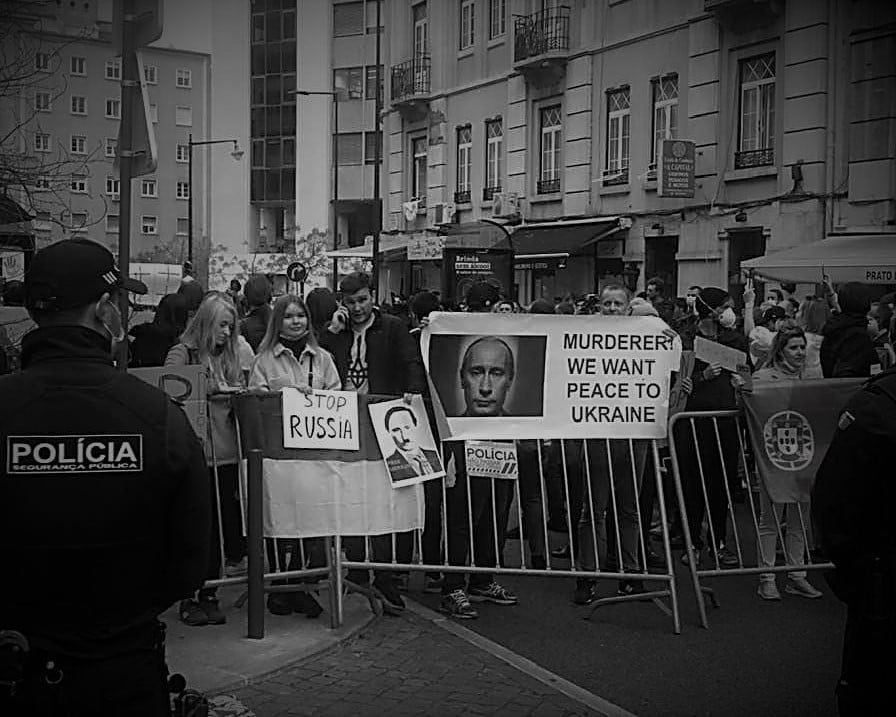
In a protest against Russian President Vladimir Putin, the Association of Ukrainians in Portugal organized a demonstration in three key points of the country: Lisbon, Porto, and Vilamoura. In Lisbon, about 100 people voiced their anger and called for an end to the conflict in Ukraine and a return to peace.

“Our Ukrainian brethren here in Portugal objected to Putin’s aggression against Ukraine – a peaceful, democratic, sovereign nation – and, in front of the Russian Embassy in Lisbon, objected to the increased threats their homeland has been suffering at the hand of the ruthless tyrant next door.”

Spanish and Portuguese officials called for Europe to co-operate more closely on managing energy supplies after major producer Russia’s invasion of Ukraine heightened fears of disruption, noted The Globe and Mail (UK) newspaper.

“Unlike many European countries, which, in total, relies on Russia for 40 percent of its gas, neither country on the Iberian Peninsula counts Russia among its main providers.”

Portuguese Prime Minister Antonio Costa said that the Portuguese deep-water port of Sines – the closest European port to the United States – has the “infrastructure to host and export natural gas to Europe.” Costa told those attending a news conference that this would allow for energy imports from the United States and Africa.

Like Ukraine, Portugal is a peaceful, progressive, and democratic nation. While it doesn’t share a border with Russian (or anywhere close), Portugal’s strategic position as the westernmost country in Europe, whose coastline abuts the Atlantic Ocean, makes it a strategic target for the Russian expansionist who wants to rule over the world.

The uncertainty over the sense in perpetuating dependency on the Russian gas that flows into Europe will ultimately return focus on the long-held American dream of shipping endless container loads of liquified natural gas (LGN) into Europe through the Alentejo coastal town of Sines. The USA’s ambassador to Portugal during the Trump regime was intent on forging this deal: a pipeline running from Sines into Spain, over the Pyrenees into France.

“Global dependence upon oil, gas, and coal is not only accelerating environmental catastrophe,” commented George A. Polisner in response to a Portugal Living Magazine Facebook post. “It transforms wealth to criminals, racketeers, and those who profit from planetary harm.”

Portugal presents itself as an international technology center open to foreign investment. Located at the southwestern tip of Europe, the diminutive nation is a strategic crossroads to Africa and the Americas, featuring a great quality of life, excellent infrastructure, and high levels of security, political stability, and sustainability.

Is it any wonder, then, that more than 550 German companies operate in Portugal, where they find a well-educated, multi-lingual workforce of problem-solvers with an appetite for innovation in engineering and research?

Unless otherwise contradicted, Portugal currently represents no threat to Russia, nothing more than, perhaps, a thorn in Putin’s side:

• According to Spokesperson Ned Price, USA Deputy Secretary of State Wendy Sherman spoke with Portuguese MFA Political Director Rui Vinhas. Sherman and Vinahs condemned Russia’s “premeditated, unprovoked, and unjustified attack” against Ukraine in violation of international law. They underscored their commitment to imposing – together with like-minded partners – swift, coordinated, and severe costs for Russia’s actions. The Secretary and Ambassador agreed on the urgent need for all members of the international community to condemn this attack in the strongest possible terms, to stand shoulder-to-shoulder with Ukraine, and to raise their voices against “blatant rejection of the fundamental principles of international peace and security.”

• Former member of the European Parliament Ana Gomes asked the Portuguese government to sanction Roman Abramovich and withdraw his Portuguese citizenship. “Gomes published several tweets on the pretext of golden visas granted to Russian citizens in Portugal, reported The Portugal News. She tweeted: “We wait for @antoniocostapm to publish a list of ALL #VistosGold beneficiaries and resident family members so that we can be sure that we are not giving national and European protection to more mafiosi, kleptocrats, oligarchs, etc.”

• Russia says that Portugal has extradited Stepan Furman, a “notorious criminal figure,” to Moscow for being a “thief-in-law,” the highest title in the criminal world’s hierarchy in the former Soviet Union, alleges North.Realities. According to the Russian Interior Ministry, the probe against the 58-year-old Furman, known among criminal groups as Stepan Murmansky, was launched in 2019 right after being a “thief-in-law” was criminalized in Russia that year. The ministry said that Portugal was the first European nation that had extradited a criminal wanted in Russia on the simple charge of holding the title. The U.S. Treasury Department’s Office of Foreign Assets Contral (OFAC) describes the thieves-in-law as a “Eurasian crime syndicate that has been linked to a long list of illicit activity across the globe,” saying that the syndicate poses a threat to the United States and its allies.

Russia and Portugal established diplomatic relations in the last quarter of the 18th century. Since that time, they experienced natural periods of rise and fall. Russia and Portugal are not comparable on many parameters: size of territory, population and workforce, the volume of economy, etc. In its turn, the Portuguese nation also can boast of considerable achievements.

Political or ideological considerations have always dominated in bilateral relations, which, for a long time, have prevented building cooperation in accordance with strategic interests.

The membership of Portugal in NATO and accession to the European Communities in 1986 obliged Lisbon to form its relations with Moscow in line with overall negotiation processes of these international associations and with an eye on the partners’ position.

In certain periods, this fact made it difficult to engage in a constructive dialogue, forcing both sides to see each other through the prism of global confrontation between two hostile social and political systems.

At the same time, there has never been acute, intractable disagreements or open conflicts between the two countries. High-level visits and the ruling elites’ interest degree were of great importance for the development of the bilateral relations. In this respect, the period of 1990s and 2000s belonged to the most fruitful. The legal base of cooperation was expanded, important treaties were signed, an exchange of the heads of state visits took place during this time. However, in years following the global financial and economic crisis, Russia–Portugal political relations stalled, later hampered by the consequences of the Ukrainian crisis and the sanctions war. 

N. Yakovleva (2017)
World Economy and International Relations (Monthly Journal of IMEMO)
(Founded by the Russian Academy of Sciences. IMEMO is a non-profit organization which acts within the Charter of the Russian Academy of Sciences.)

Bruce Joffe is publisher and creative director of Portugal Living Magazine, the country’s only English language, full-spectrum magazine. Read our current issue and subscribe — for free! — at: https://portugallivingmagazine.com/our-current-issue/

Processing…
Success! You're on the list.

War and Peace in the Global Village

Photo: Militarytimes.com

Back in 1964, Canadian educator and communication theorist Marshall McLuhan coined an expression to forever be associated with his name:

“The medium is the message.”

McLuhan maintained that the forms and methods (the “media”) used to communicate information have a significant impact on the messages they deliver. He argued that modern electronic communications would have far-reaching sociological, aesthetic, and philosophical consequences, to the point of actually altering the ways in which we expose, experience, and exploit the world.

Yet, the medium is the message cannot stand alone; it must be understood as part of a communication paradigm.

In its simplest form, “communication” is what happens when a sender (or source) delivers a message to a receiver. The plot thickens, however, when two essential ingredients – encoding and decoding – are added to the recipe, each of which has a tremendous impact on the flavor and taste of the message.

To communicate such that a message is understood, reacted to, and action taken (or not), that message must move from being an idea to a message by translating or “encoding” what the sender is thinking into words and images sent to the receiver.  For his or her part, the receiver must “decode” or decipher the message to be understood.

It’s quite complex when the sender’s assumed meaning of words, images, and actions aren’t the same as the receiver’s. Think about the differences between connotation and denotation. Or, for that matter, the challenge of translating words and expressions from one language to another. Though we might use words which are technically correct according to our culture, background, and experience, they may come across as something entirely different to another person in a different time, place, and/or society.

For instance, the Bible. Or the Constitution of the United States.

Experts are relied upon to adjudge the current meaning of words and phrases used back when these documents were created. We cannot assume that their meaning is stagnant or unchanging from then to now, there to here.

It is here that Marshall McLuhan’s theories must stand the test of time.

McLuhan focuses on the role, purpose, and meaning of the message itself—one of the three components of communication—downplaying the other two.

According to McLuhan, a “message” may comprise one of three elements:

The person or people involved. Think of Jesus, Hitler, Stalin, Churchill, Oprah, Franco, Trump, FDR, JFK, MLK, Fidel Castro, the Queen. For the Portuguese, especially, Amalia Rodrigues … who embodied the essence of fado which, in turn, defined the people she sang about—and others similarly aligned. It doesn’t matter what they were saying or how and where, as such people (and others) were the word or message incarnate.

The medium. Newspapers, magazines, radio, television, blogs, the Internet. CNN or Fox News. The New York Times and The Daily News. Google, Facebook, Snapchat, Instagram, Twitter, TikTok, YouTube, LinkedIn. McLuhan believed that real communication occurred by neither the persons involved nor the composition of the message. It all depends on the medium involved, he held. Fox News fans will eagerly dispute what’s being said on CNN or MSNBC, just as vice-versa is valid. Those who rely on the New York Times or Washington Post aren’t receptive to the same information if brought to them by the New York Post, The Sun, or tacky tabloids. What Rachel Maddow or Tucker Carlson and Sean Hannity report is acknowledged or dismissed, depending on their fans. Misinformation, disinformation, and malinformation further cloud a medium’s message, which is why so many have abandoned the mainstream media in favor of the players, platforms, and banners that cater to their own viewpoints. Welcome to the world of pandering podcasts and YouTube channels.

The message. Forget about the people and the medium, say some. They’re but extensions at best, complications at worst. The message is the message. Period. End of story. Except, as those in marketing have known forever, it’s not about trains but transportation. It’s not about clothing, but how we feel. It’s not about perfume or cologne, but allure. Most of the money spent on creating and delivering messages boils down to human wants and needs, no matter how healthy and humane or dismal and depressing: Lust. Greed. Gluttony. Fear. Thrift. Anger. Hatred. Love. Compassion. Comprehension. Prejudice. Greed. Gluttony. Selfishness. Strength. Weakness. Nationalism. Tribalism. Territorialism. Imperialism. Capitalism. Democracy. Socialism. Communism. And the list goes on …

Which brings us to today.

Today’s big issue is focused on Ukraine. What’s the intrinsic message? The people: Putin and Biden, basically. The media: Breaking news, breaking news, breaking news. (Turn down the noise and clutter, please!) The overt messages: A nation’s sovereignty must be sacrosanct and never allowed to be invaded; or, perilous forces are getting too close for comfort and we have every right to self-preservation.

Take any issue and ask yourselves what’s the overt – and covert – messages implied: Climate change. Equal rights. Black lives (Asian, Jewish, Muslim, Women’s, LGBT, et al) matter. Poverty. Human trafficking. Police brutality. Social injustice. Fiscal policy. Party politics. Pandemics. Whatever …

It’s enough to make one’s head spin and stomach churn.

That’s one of the aspects so meaningful to our lives here in Portugal and Spain. We’re able to go about our daily lives, dealing with the bureaucracy and tuning out the noise and news. Sure, we can access them through television, high-speed Internet, and mobile devices. But why? Whether on a patch of land or village row house and café on the town square, we’ve adjusted ourselves to a less complex life in a simple but satisfying country.

Perhaps we’re fools, feeling safe(r) and more secure. So what? After all, there’s always amanhã and mañana.

Walter Cronkite, the kindly father of TV newscasting, used to lament that his biggest challenge was to determine what wouldn’t air on his nightly, 30-minute newscasts. Because, back in the day, if it wasn’t part of Uncle Walt’s message, it wasn’t news or worth worrying about.

And, that’s the way it was … and ought to be again.

Processing…
Success! You're on the list.

Bruce Joffe is publisher and creative director of Portugal Living Magazine. You can read its current issue and subscribe — for free! — online: https://portugallivingmagazine.com/our-current-issue/

Shoo, Fly

They’re back.

Already.

And it’s still only early spring.

Maybe they never really left?

I’m talking about flies, gnats, buzzy buggers, and hovering hoodwinks. Not to mention ‘squitos, dive-bombers, and flying ants.

They land on our food, swim in our drinks, nest down our drainpipes, lodge in our eyes, sing trebling love songs in our ears.

And no matter how we try, we can’t get rid of them.

Invest what you will in window fly screens, swatters, battery-operated boomerangs, electric gizmos or gadgets that zap them, hang sticky strips that grab and hold them, or buy old-fashioned “natural” aerosols that claim to remove them in an environmentally friendly way.

The only sure-fire way to get rid of them – one at a time – is to have someone as talented as my partner, Russ, around. (Except, perhaps for David and his Goliath slingshot, I’ve yet to meet anyone else who can precisely target flies with rubber bands, hit them with bullseye precision, and watch them drop. One of these days I am going to shoot a video of his perfect aim and conquests, then post it on YouTube or submit the vid to America’s Got Talent.)

Like cockroaches and rodents, the swarming wings of insect brigades — or even an errant fly out of season — refuse to surrender. Ever notice how the bigger (older?) ones don’t have the get-up-and-go of the smaller, swaggering, bolder ones? The latter always seem to get away, staying around to tease us again and again. Their fatter friends are easier to smash as they languish lazily on a windowpane, drawer, or refrigerator door.

Heaven help us when those invasive Asian tiger mosquitos descend!

Of all the places we lived before Portugal and Spain, only West Virginia came close to the number of flying demons and little lady bugs – Japanese beetles – that committed collective hari-kari on the inside tracks of our sliding doors. What a stink, sweeping them up or emptying the vacuum cleaner bags. Mountain folk wisdom was to hang a clear plastic bag full of water on your entry door. That would keep them out. Curiously, it often did.

But not here in Iberia, where they’re everywhere we want to be. Basically, our choices boil down to being oblivious and ignoring them, as the natives do (even when the darned nasties are crawling all over their skin). Aren’t you tempted, honestly, to reach out and smack that litter bugger crawling up and down the cheeks of the person sitting opposite you, his or her tearful sweat creating swimming pools for flies?

If you can’t – or won’t – learn to live with them, you’ll need to live without them. You know what that means …

In my role as a public relations executive, one of our accounts was a homeopathic bug spray company that promised to do away with the bugs harmlessly and recycle them back into the earth. Their packaging and cans were idyllic—using pastel colors and lyrical wording to make shoppers feel less guilty about destroying the predators. But, despite all good intentions, customers weren’t buying it. My job was to find out why. We used focus groups. Here’s what we learned: When it comes to killing these stealthy pests, people bypass the pretty cans in grocery store aisles and head for the skull and crossbones, instead.

RAID: KILLS BUGS DEAD!

That’s the message most consumers like me want to hear.

Because bugs make themselves at home with us (not contributing to the mortgage or rent) in our kitchens and dining rooms, or – worse – our bedrooms and bathrooms. Can there be anything more annoying than sitting down to take a wiz or do a #2 … only to discover that you’ve got insatiable company in the loo? Or, for that matter, more satisfying than smashing their innards out with a magazine, newspaper, advertising flyer, or paperback book in hand before taking care of your business?

Except for a mention, I’m not planning to discuss the flying bombasts that cling for dear life to our car grilles, mirrors, bumpers, and painted surfaces. Florida calls them “love bugs,” probably because they love to hug and kiss these objects of our desire … leaving their residues behind to clog the namesake lattices and bumpers of our vehicles and ruin the luster of extra-cost metallic paints with their kindred clusters.

Shoo Fly, Don’t Bother Me is *a minstrel show song from the 1860s that has remained popular since that time. It was sung by soldiers during the Spanish–American War of 1898, when flies and the yellow fever mosquito were a serious enemy.

I’ve got news for *Wikipedia: they still are.

Whether in Portugal or Spain, this American is tempted to scream these words in his war against the flying, hovering whizzes from hell, marauders that would make me their prey:

Shoo fly, don’t bother me!!!

Bruce Joffe is Publisher and Creative Director of Portugal Living Magazine. You can read the magazine’s current issue online and subscribe at no charge:  https://portugallivingmagazine.com/our-current-issue/

Processing…
Success! You're on the list.

Welcome to Portugal Living Magazine

With the steady increase of Americans and other English-speakers in Portugal, it became evident — while living in the country’s interior — that news and commentary was focused on one region (the Algarve) with nods to Lisbon and Porto … and presuming that all English-speakers here are British.

Something more than fragmented Facebook groups and online “expat” forums was needed to cover stories of interest throughout all areas of Portugal to people residing here or in the process of relocating to Portugal … from the UK, USA, Canada, Australia, Ireland, Belgium, South Africa, and other English language countries.

That’s why we created Portugal Living Magazine.

Layering a variety of engaging features, integrated departments, continuing columns, commentary, photos, and original artwork, Portugal Living Magazine presents a wide variety of stories about people and places, invaluable information, and answers to questions about living happily in Portugal.


Offering free digital subscriptions and promoting a national community orientation for expats and immigrants, Portugal Living Magazine took root and flourished. In addition to growing issues from 48 to 70 pages, the magazine hosts this popular Facebook Page, a website, and a new YouTube channel.

Different in content and purposes than Facebook groups and online forums, Portugal Living Magazine is delivered directly to subscriber email inboxes. Our Facebook Page is updated daily with dozens of news stories and a wealth of irresistible pictures, while our website includes everything from current and future issues to blog posts, linked resources, and advertising or sponsorship information. Our YouTube channel with original content premieres 1 February.


Read our current issue and subscribe at no cost–for all future one. Complete past issues are also posted on our website, as is a peek at upcoming issues. Some of the best blog posts about Portugal living are conveniently grouped on our website. Adverting data and details, links grouped categorically to indispensable resources from our sponsors and supporters, and complete contact information for reaching us are all on Portugal Living Magazine’s website.

Our continuing commitment is to provide free subscriptions to everyone who wants to read Portugal Living Magazine, with advertising covering the publishing costs of production and distribution. Alas, we’re not there yet. Deficit spending has been funded from the pockets of our founder.

We’ve created ways that you can help: Our Patreon page encourages donors to contribute one, three, or eight euros monthly. Prefer to make a one-time gift? Deposit it directly to our bank account at this IBAN: PT50.0036.0136.99100034067.63.

Felicidades from our team to you and your loved ones!

Upcoming

Bruce H. Joffe
Publisher/Creative Director

Processing…
Success! You're on the list.

Of Prophets and Poets

Much of what I like most about the King James Version is the beauty inherent to its prose. Whether Psalms, Proverbs, Peter and Paul, or Prophets, I almost always find the version’s way of saying things – even when (mostly) inaccurate—poetic. Which version of the 23rd psalm can compare with the beauty and eloquence of the King James?

My undergraduate education was at the University of Madrid, during the days when Francisco Franco reigned. The world was a frightful place with Vietnam, Watergate, civil rights marches and riots, assassinations of beloved leaders, Khrushchev banging his shoe on a table at the United Nations while threatening “We will bury you!” and campus crusades ending in pools of blood.

In Franco’s Spain, however, the armed civil guard stood sentry on every street … ready to shoot first and (not) ask questions later. Especially when it came to students—university students—who were considered radical rabble-rousers causing trouble.

Young and old, many of us took up the arts for solace—playing music, painting, writing—to quell the anguish in our souls.

Some 50 years ago, I worried these words out in Spanish:

O, mi dolorosa verdad que evade los ojos …

Te buscaba entre las espinas de la vida.

¿Es que has muerto en un siglo cortísimo?

O, que, ya vives,

pudriéndote cada dia?

Roughly translated, my words mourned about the search for a painful and elusive truth, asking if it had died in a short, bygone era … or whether it still lived, albeit diseased and decaying, every day.

I think of my Spanish poem often these days.

Somehow, it seems even more relevant now than then.

Processing…
Success! You're on the list.

Algorithmea

I wish I could find a doctor to treat – and fix – my algorithmea in the same way s/he deals with my allergies and arthritis.

Here in Portugal and Spain, that usually means a medical consult followed by lab tests, more consults, and meds.

If only it were so easy dealing with the algorithms causing my algorithmea!

Like the “Bogie Man” and “El Coco,” they’re invisible (to me, at least), yet have taken hold of my life. Sarting with Facebook:

I realize that every single bit of data about my personal profile – age, income, locations, friends, preferences, politics, education, what I like (or don’t) and follow – is mixed and mingled by Facebook’s manipulations. So, whatever I see on my feed is custom-tailored for me. And, perish the thought that I click on a “sponsored” link! Within minutes, I’m deluged with ads for similar services or products that last for days. Sometimes after a hiatus, they return to haunt me again.

The good news, I guess, is that I’m only receiving promotional messages which, supposedly, will interest me, instead of other junk scattered through the great commercial diaspora.

(The bad news, of course, is that I’m not interested. If I want to buy something or learn more about it, chances are that I’ll be more responsive to my own Google searches than anything that Facebook sends my way.)

Which brings up another symptom of my algorithmea:

I am absolutely certain that these pillars of the Internet’s most powerful platforms collude somewhere in back rooms filled with smoke and mirrors, shaking hands and hand-me-downs of yours truly.

What makes me suspect this conspiracy of complicity against little, old me? Simple! No matter which “social” medium – Amazon, YouTube, LinkedIn or even so-called customer service websites that supposedly provide price comparisons and reviews for whatever I want in my geographical area, they’re almost instantly followed, cloak-and-dagger, by successive posts on Facebook. Heck, even weather channel sites are involved. Whenever I check on the forecasts, wouldn’t you know it that appropriate clothing and accessories for the climate crises appear, ipso facto, on my Facebook feed.

Amazon is just as bad. It keeps records and reminds me of what I bought (when), acknowledging my (good) tastes and encouraging me to reorder. And if I don’t want to, because I’m looking for something else? Presto: Amazon provides slews of suggestions. Next visit, it anticipates my needs and wants, recommending that I take a look-see at the products it recommends. To think, this bazaar, the whole enchilada, started as an online bookstore!

Netflix knows what I like to watch on the screen and is always there – even when the action is paused for a potty break – to recommend others it presumes I will like. Gee, how I miss my school librarian who got to know me and my favorites (genres, authors, styles) before doling out book recommendations.

Maybe it all started with radio?

Pandora, a subscription-based music streaming service owned by Sirius XM Holdings, was founded in 2000 (as Savage Beast Technologies) focusing on recommendations based on the “Music Genome Project” — a means of classifying individual songs by musical traits. The service originally launched in the consumer market as an Internet radio service, which would generate personalized channels based on these traits and songs liked by the user. In 2017, the service launched Pandora Premium, an on-demand version of the service more in line with its competitors: Spotify,YouTube Music, AccuRadio, and a bunch of others that allow you to choose a constant stream of music based on your favorite singers, styles or genres, or even topics.

Let’s say I want to hear Christmas music. Even “Jingle Bells,” despite its huge number of versions and singers. All fine and good. Of course, my one or two cringe-worthy crooners play repeatedly, over and again. Is there a way I can further fine tune my settings so that I get Christmas music including Jingle Bells—except for when performed by Singer X (and Y and Z)?

It’s not just online that I’m plagued by algorithmea.

Consider my car. In addition to telling me when my fuel or tire pressure is running low, it also warns me when it thinks I should up-shift, slow down, correct course, and/or if I’m getting too close to something behind (or before) me. It decides when to turn on my windshield wipers — even if there’s no rain or condensation – and fog lights. I have no desire whatsoever for a self-parking (or -driving) car. Lord, have mercy!

Nor do I want a refrigerator that probes the condition of its contents and informs me of what foods are rotten and should be tossed. Or, somehow, knows what I’m running low on and creates a shopping list for me—complete with suggested menus.

Please don’t misunderstand: I do appreciate, even value, some features of certain “smart” appliances. For instance, my washing machine and dryer. It’s good to know that they’ll compensate for the weight of my load and adjust water levels, spin speeds, and drying time as needed.

“I think; therefore I am” was the end of the search Descartes conducted for a statement that could not be doubted. He found that he could not doubt that he himself existed, as he was the one doing the doubting in the first place. In Latin (the language in which Descartes wrote), the phrase is “Cogito, ergo sum.”

Nowadays, I no longer need to think, as algorithms crunch my data, analyze the findings, and direct my paths accordingly.

“I input, therefore I am output” may be our new mantra.

Processing…
Success! You're on the list.