For Better and for Worse …

Partner, mate, significant other, other half (or better) all are words we commonly use to connote a special commitment between two people who have chosen to pursue a life together.

But for those seeking the state’s full and complicit recognition of their relationship, only marriage will do. For better or for worse, it’s a status laden with directives handed down from on high by religious orders, civil authorities, and public policies.

And while marriage is a sacred trust, a “sacrament,” as some churches call it, peculiarities portuguêsas and eccentricities españolas make it a miracle that expat marriages even occur on the Iberia peninsula.

In countries like Spain and Portugal, those wanting to wed have two choices: A Catholic Marriage. Or a civil (secular) one.

Everything else is an afterthought.

To be binding under Portuguese law, if you want to have a “religious” wedding but don’t follow the Catholic faith, you’ll first need to undergo a civil ceremony. Meanwhile, residency restrictions and administrative formalities governing civil ceremonies sway many American expats or foreign nationals to go the route of a religious ceremony in Spain.

To qualify for a civil ceremony, at least one of you must be a Spanish citizen or a legal resident for two years prior to the wedding day. Other options are to get married elsewhere and have your wedding ceremony blessed in Spain … or to cross the border into Gibraltar, where conjugal requirements are less stringent.

Jewish, Islamic, and Protestant wedding ceremonies are legally recognized in Spain; and, unlike Portugal, a civil marriage is not required a priori to one conducted outside the Catholic faith.

The Portugal Civil Registry Code, as does its Spanish counterpart, has specific requirements one must satisfy to be married:

• You must be at least 18-years old—with parental consent, however, you can marry if you’re 16 or 17;

• The bride and groom must not be related;

• You need to request a license from a Civil Registrar Office in Portugal or Spain, and indicate whether the marriage will be performed under civil codes or religious beliefs;

• There’s a waiting period while the announcement of your intention to marry is posted and made available for the public to comment; and

• Portugal wedding ceremonies must be in Portuguese, with at least two witnesses watching (language isn’t an issue in Spain, where only one witness who’s not related is required).

Under U.S. law, diplomats and consular officers are not permitted to perform marriages, nor can they be performed on the premises of U.S. embassies or consulates.

Same-sex marriages have been allowed in Portugal since 2010 and offer equal rights to the couple regarding property, taxes, and inheritance … since 2016, married couples of the same sex can adopt and foster children. (Spain legalized same-sex marriage in 2005, along with its adoption rights.)

While there are no residency requirements to get married in Portugal, one of you must be in the country a minimum of thirty (30) days before notice of your proposed marriage can be given.

The marriage route is long and tedious in both Spain and Portugal, usually taking a minimum of four weeks just to process an application. After you have received approval to get married, the wedding can then be arranged … as long as it takes place within three months.

Documents must be obtained and presented to the Civil Registry where the wedding will occur, as well as taken with you on your wedding day to the place where you will marry. The documents must be original, either endorsed with an Apostille or authenticated by a licensed Notary Public. Official translations undertaken by authorized agencies must accompany all these documents if they’re not in Portuguese or Spanish:

• Certified birth certificates issued within six months;

• Passports (and/or residence permits);

• A “Certificate of No Impediment” (except for British nationals) from the local registry office in your Portuguese town or at an embassy for a civil wedding, or by a parish priest for a Catholic one. This document can’t be issued by the U.S. Embassy, as, “no such document or governmental authority exists to issue it,” explains the U.S. Department of State. “However,” it notes, “you can execute a statement of eligibility to marry at the U.S. Embassy in Lisbon before a consular officer and present it to the Civil Registry office.” Similarly, “No document equivalent to Spain’s Fe de Solteria y Vida (Certificate of Existence and Civil Status) exists in the United States.” According to the State Department, “Spanish authorities will accept a sworn statement from a U.S. citizen, affirming that he/she is single and free to marry, executed before a U.S. Consular Officer”;

• Proof of residency, a Spanish town hall certificate attesting that you’ve lived in the area at least two years. Although that isn’t required to marry in Portugal, you should be able to prove that you’ve been in the country at least 30 days prior to the marriage;

• Final divorce papers, if applicable, apostilled and translated into Portuguese or Spanish within the last six months. If your marriage wasn’t canonically annulled, you cannot be married in the Catholic church in either country;

• If applicable, the death certificate of your prior spouse, translated and apostilled within the last six months.

Want to be married in a Roman Catholic church? You also will need to provide official copies of your baptismal certificate.

Legal marriages contracted abroad generally are valid everywhere. Regardless of your residency status, if you’re a “foreigner” in Portugal or Spain, though, remember to register the marriage with the country’s consulate and with the local Civil Registry where you’re now living.

An “interdenominational” pastor, I have been asked to officiate at weddings in Spain and Portugal.

One was a recommitment ceremony celebrating 30 years of marriage; another was a repeat performance of nuptials conducted days earlier in another country. Technically, both of these marriages already had taken place and, therefore, were recognized in Spain and Portugal.

So, there was no question about my pastoral propriety to pronounce the couples lawfully married.

Not that it mattered: It was pure pomp and circumstance for the “newlyweds,” who wanted a ceremony to share their joy with others who couldn’t be present to participate at the first, faraway wedding.

Standing before God as we witnessed and affirmed the sanctity of their marriages, it made no difference what the government thought or said. We were responding to a higher authority, seeking a blessing to live happily ever after.

Shared here are personal observations, experiences, and happenstance that actually occurred to us as we moved from the USA to begin a new life in Portugal and Spain. Collected and compiled in EXPAT: Leaving the USA for Good, the book is available in hardcover, paperback, and eBook editions from Amazon and most online booksellers.


Processing…
Success! You're on the list.

Channeling Andy Rooney: Breaking Bad for the Greater Good

I’m going to get some flak-back on this post … because I believe that good manners are preferable to bad.

Common courtesy and proper protocols transcend cultures and/or countries. No matter where you are or what language you speak, correct conduct is always appropriate and appreciated.

Why, then, do some people ignore “etiquette,” alienating, antagonizing, or offending others? Is it deliberate or incidental?


As a child, weren’t you taught to cover your mouth when you cough and your nose when you sneeze—especially in public?

Queuing at the supermarket or grocery store, I am shocked by how many people cough or sneeze without covering their faces while standing over food. And by people who work in restaurants, where they cough or sneeze – without covering up – when dispensing beverages or handling food!

It’s a matter of respecting personal places and private spaces.

Whether breaking into line out of turn, cutting someone off on the road, denying right of way to pedestrians at cross walks, or invading those sacrosanct spaces immediately surrounding us, it’s self-serving behavior rather than observing conventions for the greater good.

Some people shower or bathe regularly. Others don’t. Some brush their teeth and practice good personal hygiene. Others don’t. Some people apply deodorant. Others don’t. Some smoke. Others don’t. Some people douse themselves in perfume or cologne. Others don’t.

Whether you do or don’t is your choice. But, please, be considerate of mine.

The same can be said of our pets: If you have dogs and cats, especially, please pick up after them and dispose of their waste. Simply opening the door to let pets roam the streets, do their business outside, and then return home is irresponsible. Your home may be clean, but who wants to step in feces … or have our dogs contaminated by it? Sickening to see and worse to smell, it’s a public health hazard.

Driving aggressively, carelessly, and/or inconsiderately also violates the rules of acceptable behavior. Recklessly speeding down the narrow streets of our villages – especially with a cigarette in one hand and cell phone in the other – makes it harder to stop and control a vehicle if/when something unexpected or unforeseen should be presented. On the other hand, we’ve been taught to drive in the right lane and use the left only for passing. So, why stay in the left lane driving 60 kms/h in a 90 kms/h zone? I’m told there’s no specific law here against tailgating (despite all the warning signs); but please stay off my butt. Planning to exit the roundabout or roadway? Again, you need to be where you belong … rather than drifting across in front of us and nearly causing an accident. That little lever (usually) attached to the left side of your steering wheel? It’s called a directional signal for a purpose: to alert others of the direction you’ll be taking or changing. Use it! And, granted that some parking spaces are smaller or tighter than others—even in public shopping centers. But, that doesn’t give anyone the right to park haphazardly … taking up two or more spots, leaving none for others.

Courtesy extends beyond these spaces, streets, and roadways. It also includes online behavior. Just because you’re virtually anonymous doesn’t entitle you to act aggressively, ugly, snarky and/or petulant. What pleasure do some people derive from being so snooty, anyway?

Finally, here’s a nod to professional responsibility: If you want my business, practice good public relations. Return phone calls or reply to my emails promptly. Show up when you say you will. Charge me what we’ve agreed to. I’ll be appreciative and likely to do repeat business with you, as well as to refer others to your products and services.

Finding fault is distasteful.

Yet being selfish, indignant, and malicious have become increasingly in vogue and accepted … especially when spotlighted daily by the revolting conduct and shameful language of our leaders.

Nonetheless, antagonism and rudeness never are really successful. Except when it comes to breeding. They poison a healthy environment and turn prevailing positive attitudes hostile and rotten.

So, let’s do what we can to make this world better for all!

Shared here are personal observations, experiences, and happenstance that actually occurred to us as we moved from the USA to begin a new life in Portugal and Spain. Collected and compiled in EXPAT: Leaving the USA for Good, the book is available in hardcover, paperback, and eBook editions from Amazon and most online booksellers.
Processing…
Success! You're on the list.

Random Whispers …

Three major firms – MEO, NOS, and (increasingly) Vonage – serve the telecommunications market in Portugal. All those “extras” that come bundled in your telecommunications package: Wifi Internet + TV + landline telephone + mobile phone with given data? Study your contract carefully for caveats and exceptions! MEO, for instance doesn’t charge you for calls from mobile phones (whose first digit is “9”) to either other mobiles or landlines in Portugal … but call a mobile from your landline (whose first digit is “2” here), and you’ll be charged. (In Spain, landlines begin with a “9” and mobile phone numbers with a “6.”) If you’re somewhere with free WiFi available, be sure to connect to it on your mobile phone. And outside the country, where the EU has decreed that telecommunications, too, are to be “without borders” … they are and they’re not—with plenty of “ifs,” “ands” and “buts.” Know your restrictions and tariffs before using your mobile for handling calls or ^/downloading data elsewhere.


Attaching timers to certain electrical devices – electric waters heaters, for one – is a convenient, practical, cost-effective way to limit energy consumption … and reduce your electricity bills!

Coin-chained supermarket carts cut down the clutter and damage caused by shopping carts abandoned, helter-skelter, in parking lots. Are you listening, Walmart and grocery stores? Learn from responsible retailers!

Is Dawn your preferred dish-washing detergent? Sorry, but no Fairy or store brand can compare. And Dawn, by and large, isn’t available in Spain or Portugal.

Feeling “comfortable” navigating all those roundabouts, deciphering international road signs, practicing roadway rules and etiquette, can be daunting when dealing with drivers who are daredevils or laggards. Please, use your turn signals and stay in the appropriate lane!

Regarding the sensitive subject of bathroom hygiene, let’s just say that the paper here isn’t what Charmin would have us crave.

Bureaucracy is almost an art form in both Spain and Portugal.

When using a credit card and you’re given the option to pay either in euros or dollars, always choose euros. The savings can be substantial! If your Multibanco or ATM also offers this option with debit card withdrawals, choose euros over whatever conversion rate and currency exchange amount presented. Jot down the amount (in dollars) shown on the screen to be deducted from your account … then, after opting for euros, go online to see how much has been deducted from your bank account. Yesterday, the Multibanco ATM wanted to charge us $123.46 to withdraw 100 euros. Our bank deducted only $113.87 for the transaction.

Looking at a house to buy? Don’t neglect to check out the roof carefully—not just the condition of the exterior tiles (cracks and breaks often lead to water infiltration), but the supports – beams and trusses – in the attic (sótão) as well. The best supports are made of concrete or galvanized steel; wooden supports are susceptible to wood-boring insects (like termites and carpenter ants) that eat the insides of those wooden beams, leaving them hollow and unable to support the weight of the roof—especially during heavy rains.

Mold and mildew are frequent problems in Portugal and Spain, especially in typical houses not built to today’s standards. Especially when the wetter, windier, cooler weather sets in. A few suggestions for dealing with it: (1) Be sure your property can breathe. It needs “vents” that let air in and out. (2) Periodically, move things away from the walls–headboards of beds, clothing hanging from a rod next to the wall, even artwork. Be sure to give a good scrubbing with any of the products recommended to remove mold and mildew. (3) Keep your eyes closed when applying these noxious chemicals topically … but keep them open for what our UK friends refer to as the “damp.” Even if it’s not dark in color, wetness (damp) on your ceilings and walls means that water is somehow — somewhere — getting in. You need to track it down and secure it from entering. (4) Use those humidifiers. We have a large house, with four dehumidifiers going–one (without a window or vent) dedicated to the bathroom and shower. The dehumidifiers have made a major difference. (5) As tempting as it might be after opening those windows and letting in fresh — but C-O-L-D — air, be frugal with your heating appliances. Electricity is quite expensive here!

Shared here are personal observations, experiences, and happenstance that actually occurred to us as we moved from the USA to begin a new life in Portugal and Spain. Collected and compiled in EXPAT: Leaving the USA for Good, the book is available in hardcover, paperback, and eBook editions from Amazon and most online booksellers.

Processing…
Success! You're on the list.

Day Tripping

Among Portugal’s extraordinary pleasures are its amazing panoramas, extraordinary places, and breathtaking vistas that can be enjoyed in a day trip.

From Algarve to Nazaré, people along the coast head to the Atlantic for a change of pace and a respite on the beach.

On the other side of the country, closer to its Iberian border, others cross into Spain along spiraling roads, with little villages dotting the way. Suddenly, we’re in another country … with different foods, related culture, and a somewhat “sister” language.

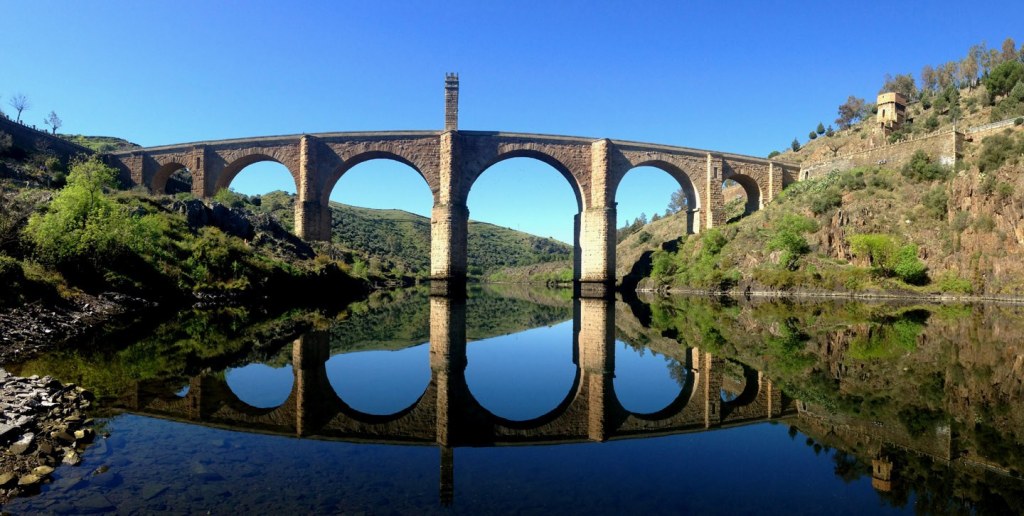
We frequently travel into Spain on Sundays through Idanha a Nova and Segura, crossing a Roman bridge and aqueduct to enter Spain several kilometers before Alcántara. Apart from a few restaurants, a tourist trap or two, mini-mercado, and pharmacy, there’s not much else at this border town. For that, you’ll need to drive another 40 kms or so.

The food, however, is quite good at the area’s three restaurants: Kantara (the most expensive), Kantara Al Saif, and Gundin (our favorite). Gundin’s €11.00 Menu del Día provides the best gazpacho I’ve enjoyed. Except for the bread (Spain doesn’t come close to Portugal’s bread), the other two dishes are also quite tasty.

This time, though, we headed farther north – through Penamacor – to visit Valverde del Fresno for its Thursday market. The town is 16 kms from the Portugal border which, in turn, is 16 kms from Penamacor.

While we looked forward to a Spanish meal, we were on a special mission this trip: shopping for stuff at prices cheaper than in Portugal.

Textiles!

The irony is that thick, plush, absorbent, 100% cotton towels tagged with “Made in Portugal” labels cost half the price in Spain. Same for linens—from sheet sets to table cloths and coverlets.

That’s the good news. The bad?

Regardless of mattress size – including “king” and “queen” – Spanish sheet sets contain only three pieces: a top sheet, bottom sheet, and pillow case—each almost the same size. For some reason unbeknown to us (or any salespeople), the Spaniards have humongous pillows—measuring almost 200 cms across! We, however, have two pillows … each about 75 cms wide.

So, despite the higher cost, we buy our sheets and pillow cases in Portugal, where the larger size sets come standard with two matching pillow cases. (And, no, the label doesn’t say “Made in Spain.”)

Our favorite place to shop for such textile goods is the Monday market in Fundão. It’s massive! In fact, our next expat get-together will be a trip to Fundão’s Monday market, followed by a fixed-price (€9.95) buffet lunch at the city’s Principe da Beira hotel.

Anyway, I’ve digressed …

Fait accompli: We purchased our towels and took time to poke about the town, which is bigger and much more typically Spanish than Alcántara. We’d forgotten that it’s an hour later in Spain than Portugal, so most of the shops were closing … and restaurants were filling.

Tapas. We wanted tapas!

In Olvera, our Spanish hometown, as in most of Andalucía – southern Spain – menus offer meals in three sizes: tapas, media (half) ración, and a full dish (ración). Not here in Extremadura. Patrons and wait staff at restaurant after restaurant explained to us that tapas weren’t available … but complimentary “pinchos” were served with the drinks.

In southern Spain, pinchos are a type of tapa—they’re anything served on a skewer. Here to the north, in Extremadura, pinchos refer to a small, tasty dish provided gratis that accompanies your beverage.

We ate at Restaurante Casa Laura. With 120 “excellent” TripAdvisor reviews – four times more than the closest competition – we soon understood why: the food is to die for there. We began with some beer accompanied by a small dish of pinchos, potatoes mixed with egg and pieces of chorizo in a carmel sauce. Yum-mo! The cool gazpacho soup was good (enough), followed by meatballs in a thick and rich tomato sauce for me and cod (bacalao) with nary a single bone for Russ. The pièce de résistance, however, was dessert: dreamy-creamy cheesecake.

Total tab for our lunch, including tip, was twenty-seven euros (€27), somewhat pricier than what we’ve paid in Alcántara. But well worth it! Everyone working at the restaurant was super friendly and all made a point of stopping by our table to be sure we were satisfied.

Heading back across the windy roads surrounded by a lush, distinctly parceled landscape, it occurred to us how different the topography of Spain is in some ways from Portugal’s.

The two countries are close enough to be kissing cousins, but remnants of historical bitterness and jealousies remain between them. That’s truly a shame, since they’re so convenient and complementary.

It’s good to see Portuguese people visiting Spain … and vice-versa.

Throughout the Castelo Branco district’s tantalizing come-hithers, we’ve come across many Spanish tourists taking day trips into Portugal.

Turnabout is surely fair play for us to sightsee and go shopping in Spain!

Shared here are personal observations, experiences, and happenstance that actually occurred to us as we moved from the USA to begin a new life in Portugal and Spain. Collected and compiled in EXPAT: Leaving the USA for Good, the book is available in hardcover, paperback, and eBook editions from Amazon and most online booksellers.

Processing…
Success! You're on the list.

Other Options

I will always admire Canada and respect the Canadian social contract with its people. But I wouldn’t want to live there. Wisconsin has been cold enough for us. Delving into international retirement trends, we learned that many Canadians owned property in Mexico, where they retreated, if possible, to escape the blustery cold.

So, we looked into Mexico as a potential retirement haven. But the stories about traveling through Mexico – especially around towns near the U.S. border – were chilling in a different way: the fear factor. Americans inadvertently (but sometimes deliberately) had been targets of drug cartels and other criminals in the country.

We considered the Lake Chapala and Ajiic areas outside Guadalajara – known for its “ideal climate” and the number of English-speaking expats residing there – but these places, not far from Mexico’s second largest city, also became headlines when Americans were found murdered there.

“They were in the wrong place at the wrong time,” explained people quoted in the news stories. “They should have known better: You don’t go out here alone at night … especially to certain places. You travel only on the major highways and roads. Don’t wander around. You learn that, to stay safe, it’s wise to live in a gated community.”

That wasn’t what we wanted; our dream included late-night strolls along cobble stone streets of old towns with lots of lanes and paths.

Mexico’s Yucatán peninsula – home to cruise ships calling on expansive, intentionally constructed resort destinations like Cancún, Cozumel, and Playa del Carmen – advertised itself as Mexico’s “safest place to be.” Rather than these tourist traps featuring all-inclusive vacations and panhandlers shilling free meals at luxurious spots in exchange for touring the premises and listening to pitches on the benefits of buying their time-shares, we decided to take a close look at the historic city of Mérida and its nearby beaches—especially Progreso.

It’s hot there. Very hot. Hot and humid and buggy. 

We stayed in a charming little hotel in downtown Mérida, on a small street not far from the city’s market. With Walmart, Costco, Home Depot, Office Max, and other U.S. brands, we felt “at home,” although stifled by the climate if not put off by the language.

But Mérida wasn’t where we wanted to be—even its own people looked to escape the oppressive heat by heading to the beaches, not even an hour’s drive away. We headed there, too.

We went there to look at “Big Blue,” a property in Progreso, just two blocks from the Gulf of Mexico beach. The stately building boasted five big bedrooms, five full baths, a separate “casita” with its own facilities, and a heart-shaped swimming pool … all enclosed and private. We’d seen it listed online by more than one property agent based in Mérida, although one seemed to be more familiar with the property and the Canadian family that was selling it. It had been on the market for a while, the agent informed us, and the owners were “motivated” to sell it.

“What does that mean?” we asked. “Come down and look at it,” replied the agent. “I’ve spoken with the sellers and feel sure that they’ll sell it to you for $10,000 less than their asking price.”

The house was truly awesome. But it needed work. And furnishings. Especially if it were to become the bed and breakfast we envisioned. How much would it cost us to have the repairs and updates made, with so many trades – electrical, masonry, plumbing, carpentry – involved? What would we pay for all the new appliances – air conditioners, a commercial kitchen, all the usual suspects – that needed upgrading? And what kind of estimate would be appropriate for the furnishings, especially comfortable new bedrooms and mattresses?

We made an offer—exactly what the agent told us the owners would accept. Leaving later that morning, we waited at the airport for a response, laptops opened and WiFi on. Just before boarding, we received the news: “Sorry. The owners changed their minds. They’ll sell you the house … but want the full asking price.”

Six years on the market. We offered what was recommended before we flew down to check out the property and Progreso. But, now, it didn’t feel right. If we were misled about the acceptable price for the property, what else might be mistaken?

More importantly, where should we consider next?

I engaged all my contacts and connections in seeking a church seeking a pastor. Preferably a Spanish-speaking pastor.  Like the patriarch Abraham long ago before me, I felt a tugging at my spirit urging me to move on to a place whose Spirit would call.

That’s when I came across this mission statement from an international church in Panama serving all people, but especially English and Spanish speakers, which was looking for a new lead pastor: “To be a bridge of cooperation and understanding among religious groups of all faiths; of acceptance of others regardless of social class, race, gender, or sexual orientation; between all of God’s children, mirroring and practicing the love God has for us; of freedom in the study of religion, the interpretation, and the practice of faith; and for God’s love in a troubled world, expressing a generosity of spirit to all those in need.”

Now, that sounded like a perfect fit in terms of my personal beliefs.

I submitted a letter of application, along with my CV, via email.

Within days of completing and submitting the application materials requested, I heard back from the pastoral search committee: “We would like to schedule an interview this coming Monday. Any chance we can hold it at 7pm or 8pm CST?” It would be an hour conversation.

The plot was thickening, but what did we really know about living in Panama? Our only experience with the country was a cruise ship excursion through Panama City, culminating on a boat that would take us through the fabled Panama Canal. But what would it be like to live there? What was its quality of life and cost of living? Even closer to the equator than Jacksonville, Florida, or Progreso and Mérida, Mexico, how hot and humid would the climate be there?

Panama is very, very hot and very, very humid. It is also very expensive, especially the areas around the church. How much would it cost us to move there—including our three dogs? Would the church help defray some of these costs? When did they expect me to start? How long would it take for us to sell our house and our cars? Would the church pay for Russ to join me for a week or so to do house-hunting while I was being oriented to the church? Ultimately, there were more questions than answers forthcoming. And those answers that were provided indicated that the move would be more difficult than either Russ or I had anticipated.

Sadly, I turned down the offer. But I continue to use this church’s mission statement as an example of what I believe a church should be.

We were beginning to become indoctrinated to the “expat” community and decided to consider the possibilities offered by two other countries in South and Central America: Ecuador and Nicaragua.

During a year in high school, Russ’s family had hosted an exchange student from Ecuador. More recently, we were hearing increasingly good things about expat life in this country: Relatively low crime, a large and active expat community, extremely generous homes at very affordable prices, and quite a comfortable climate … even in Cuenca, a beautiful colonial city high up in the mountains, where many expats have settled.

In Ecuador, you can enjoy some of the lowest prices in Latin America on everything from groceries to real estate and domestic help.  A couple could easily live a modest lifestyle on as little as U.S. $1,200 per month, including rent. With less money needed for housing and utilities, retirees have the flexibility to travel and pursue other dreams.  Inexpensive transportation is readily available and makes getting around the rest of the country a breeze.

Ecuador also offers great benefits to its senior residents, with discounts as high as 50% on things like international airfare and entertainment.

Many expats who retire to Ecuador find themselves extremely pleased with the country’s medical system, particularly with the quality of care they receive. Most doctors speak English, and many trained in the U.S.  Hospitals are excellent and equipped with state-of-the-art technology.  Best of all is the cost: Health care can run anywhere from half to one-tenth the cost for the same services in the U.S.

Yes, we’d certainly think about Ecuador.

But we also were being tickled by Nicaragua, especially Lake Granada, a freshwater lake and the largest in Central America. The lake drains to the Caribbean Sea via the San Juan River, making its lakeside city an Atlantic port, although Granada (as well as the entire lake) is closer to the Pacific Ocean geographically.

Other parts of Nicaragua can get disturbingly hot, but Granada and its lake are quite comfortable and its real estate is altogether reasonable.

“Life here [in Granada] has been good to us,” shared one retiree from the USA who was active in one of the Nicaragua online expat groups we had joined. “What you really need to think about is what you will do when you get here. Successful expats reinvent their lives and do things that they have always wanted to do. We do some volunteer work, are active in our church, and pursue interests we didn’t have time for in our former life. We also travel a great deal. Central America is a great place to see. The availability in stores is great, although imported food is expensive. We have found most of what we want. We go to Managua once a month for groceries and to have a fun time,” reported this Granada expat. But another expat living in Nicaragua had these words of warning about Granada:

“You can live here very well on whatever income you have. We live in a middle class neighborhood for a fraction of what it would cost in the U.S. or Canada. Our neighborhood is very safe, our neighbors are friendly and watch out for us, but you must practice common sense. Most of the crime is opportunistic and, if you are walking home drunk and talking on your iPhone at midnight, expect to invite trouble. We also avoid heavy tourist areas like La Calzada, which are magnets for crime. Be just as careful of expats as Nicas. Don’t trust anyone you meet in a bar. Get to know people before you get too friendly.”

Good advice. For everyone, no matter where.

While we had heard through the grapevine that “Nica” was the next best place to invest – because China was planning to spend lots of money building a canal there that would beat Panama’s – there was just something about Nicaragua that made us uneasy. Maybe it was its history. Or, perhaps, it was because of El Salvador, Honduras, and (to a degree) even Costa Rica, its current neighbors, whose citizens were among the “immigrants” fleeing their countries to live in the United States. Whatever the cause of our hesitancy, neither Nicaragua or Ecuador, nor Mexico and Panama, felt right for us to retire there.

None of these places had our names on their welcome mats.

Shared here are personal observations, experiences, and happenstance that actually occurred to us as we moved from the USA to begin a new life in Portugal and Spain. Collected and compiled in EXPAT: Leaving the USA for Good, the book is available in hardcover, paperback, and eBook editions from Amazon and most online booksellers.

Processing…
Success! You're on the list.

Our Monthly Budget

Friends often ask us, “How much does it cost to live in Portugal and Spain?” while other folks already living here are curious about how much they spend compares with what others are spending each month.

After some initial major, one-time outlays that aren’t recurring, we have been able to determine our monthly living expenses and budget what it costs us to live in Iberia.

Hopefully this will prove helpful to some of you.

When evaluating and comparing our expenses to yours, please consider that: (1) We live in relatively lower-cost areas of Portugal (a small village in the Castelo Branco and Elvas metropoles … not Lisbon, Porto, the Algarve, etc.) and Spain (Olvera, a “pueblo blanco” in Andalucí); (2) Without a mortgage or car payments, we are relatively debt-free; (3) We don’t live on a quinta or off the land. In fact, we have no land at all … just a good-size property with nine good-sized rooms in Castelo Branco, and “halfway” house between our properties in Portugal and Spain, and — of course — our get-away house in Olvera; and (4) the budget below reflects our monthly expenses for maintaining all three properties. (From the proceeds of the sale of our Sturgeon Bay, Wisconsin, house — about $150,000 — we were able to purchase, fix up, upgrade, and furnish the three houses.)

Here are our monthly budget expenditures:

€200 Electricity
€50 Water
€100 Petrol/Gasoline for the Vehicle
€125 High-Speed Internet/TV/Telephones at all three properties
€30 Property Taxes
€10 Vehicle Taxes
€150 Comprehensive Health Insurance for Two (aged 74 and 59)
€50 Insurance: Car (€25)/Properties (€25)
€500 Food: Groceries & Restaurants
€110 Miscellaneous/Contingencies (Unbudgeted)

Less than €1,400 Monthly Budgeted Expenses

That’s just about US $1,550 per month (based on the current exchange rate).

Shared here are personal observations, experiences, and happenstance that actually occurred to us as we moved from the USA to begin a new life in Portugal and Spain. Collected and compiled in EXPAT: Leaving the USA for Good, the book is available in hardcover, paperback, and eBook editions from Amazon and most online booksellers.

Processing…
Success! You're on the list.

Who Knew?

Portugal and Spain, we believe, offer something for every person, family, lifestyle, orientation, age group, budget, and taste.

There are those who choose to cultivate culture, teas, restaurants, and museum outings while living in major cities or their suburbs nearby … while others have come here to dig in the dirt, retrenching their roots.

Whether – like Eva Gabor in Green Acres – you prefer big city bustle, or an area with expats and river beaches, historic surroundings, life in a typical village, or living on lots of land, they’re all here.

But along with “location, location, location,” comes the price …

… particularly in a world that is discovering Portugal’s beauty and bounty, gobbling up properties primarily for investment purposes.

Not everyone buying, of course, is affluent or big bucks investors. Plenty of people are attracted to Iberia because of its surplus of “habitable” properties in the €40K-€75K price range. You’ll find plenty of them in Portugal’s central regions and along its Spanish border.

Spanish and Portuguese people refer to their age-old properties on the market for €25K-€40K as “antigas”; but Americans partial to this style of antiquities consider them “primitives.”

For even less than €25K, you can find and rebuild a “ruina.” or even a “quinta” (farm).

But not near Lisbon, Algarve, or Porto. Or Coimbra, for that matter.

One reason the visa application process can be so exasperating is the need to find suitable housing. That’s the beginning of your challenges. Once you arrive and set about daily living with all of its obligations and commitments, you begin to realize the vital importance of a resourceful online community such as this one. After all, into each life, some rain will fall.

For us, the rains related to our location.

Who knew about home inspections, often referred to as “surveys?” Not us. Had we been cautioned to arrange for a professional appraisal of our property, we surely would have done so. Property inspections, surveys, and appraisals may be commonplace in more upscale markets; but in Castelo Branco and Elvas, you’d probably end up relying on your local handyman or a neighbor’s friend (who works in construction) for an assessment. Again, that’s if you even knew to ask for one.

Then, there’s something most people do ask about: health care!

Just because you purchase the best insurance available, doesn’t mean you’ll necessarily have access to quality health care when and where you need it. Your insurance coverage is only as good as the physicians in its local network. Despite being metropolitan areas, few (if any) English-speaking doctors practice in Castelo Branco or Elvas … let alone Olvera, Spain. So, to discuss what’s hurting you with words that are understood, forget about family doctors, general practitioners, and internal medicine specialists.

They’re few and far between in the heart of these cities.

Our health insurance company sent us a list of thirteen providers. We discovered that three no longer are here … three are dentists, not doctors … four are laboratories, not doctors … and one single doctor is listed four separate times: as a generalist, family physician, internal medicine specialist, and gastroenterologist. He’s the one we saw … but he was often inaccessible: never available when we needed him, his staff referring us, instead, to the public hospital’s emergency room.

(Or, we could wait, with an appointment to see him eight days later.)

On another front, who knew what role an attorney should play in one’s move from the USA to Portugal? Along with all the legal work involved in your property’s transfer, should she serve as a surrogate, obtaining your NIF? Be there with you to open a bank account … arrange to have the utilities put in your name … and help you decide which level or type of service will best serve your needs and purposes? Do you expect her to order, organize, and oversee property inspections for you? Or, for that matter, defend you and your interests if what you get isn’t what you’d seen and agreed to in the contract?

Definitely, these are questions that require counsel and consultation.

Those with more disposable income (than ours, at least) may seek to benefit from customized services that handle everything for them. Good for them! If we had had the wherewithal, we would have taken advantage of such turnkey services, too (although I’m reminded that responsible people often urge us to do whatever we can personally, employing the “professionals” only when categorically necessary).

There are limitations to living in a “small” town, village, or area—even one as big as Castelo Branco (Lousa), Elvas (Vila Boim), and Olvera (Spain).

All things considered, there’s good news and bad.

The cost of living here is lower here. There’s less of a wait, swifter service, friendlier bureaucrats, and quicker turnaround times for all those vital services handled by SEF, IMT, and Finanças in the smaller towns and cities within the interior regions of Spain and Portugal.

Along with advocates, specialists, and property inspectors, the expert medical care we couldn’t find in our immediately vicinity is available just 30 minutes or so away.

The bad news is that the quantity and quality of professional services are still sadly lacking. But, who’s going to tell you that before buying?

Through my personal “stories,” I have tried to recount what we experienced in our move from the USA and transition to life here in Portugal and Spain. Some, more experienced and wiser at international maneuvers such as ours, may feel as though I’ve been overly dramatic, too often prone (perhaps) to problems, hardships, and misfortunes.

Maybe so. We’ve had our measure of dangling dilemmas.

What I share here with you isn’t published as “tales of woe,” but recaps of experiences that really happened to us.

Sometimes, because we didn’t know how to navigate, manipulate, and/or play the “system” … and other times, simply because of bad luck. Or, because where we live, options – even foods! –elsewhere available, just aren’t here (yet).

I’m not complaining or questioning our decision to buy in Castelo Branco or Elvas, with their easier access to our home away from home in Spain. We’ve made friends with many other expats and local Portuguese here.

No … it’s more of that wistful, yearning emotion the Portuguese know so well as “saudade.”

All those “who knew” questions? More important is learning how to anticipate and resolve these matters in advance. How do we effectively prepare for life’s (trivial) pursuits in a welcoming but “foreign” land?

It boils down to knowing what we don’t know – but need to – in terms of unfounded or unrealistic expectations and the real facts of life here. For better and/or worse, you then deal with the outcomes.

Especially if you‘re charmed where you live, despite its shortcomings.

That’s one of the beauties and benefits of Facebook communities like this one. Yes, with so many “newcomers,” it’s sometimes frustrating for long-timers to see the same posts, comments, questions and answers published over and again.

By sharing this series of anecdotes, we hope that you can avoid some of the pitfalls which have tripped and frustrated us. We’re not seeking sympathy (empathy, perhaps). But I do hope to avoid snarky smugness from those lurking, eager to snarl and pounce.

Shared here are personal observations, experiences, and happenstance that actually occurred to us as we moved from the USA to begin a new life in Portugal and Spain. Collected and compiled in EXPAT: Leaving the USA for Good, the book is available in hardcover, paperback, and eBook editions from Amazon and most online booksellers.

Processing…
Success! You're on the list.

More or Less?

Among our daily devotions to a lifestyle we’d all but forgotten back in the USA are a number of people-oriented practices in Portugal and Spain that underscore our different orientations and lifestyles, as well as how we pack and parcel our time.

Here are a few observations based on life in our Portuguese village and small Spanish town:

 Food isn’t fast or full of preservatives, but enjoyed slowly, sans extra embellishments or a plethora of added attractions. If and when a bit more richness is desired, mayonnaise – yes, even on hamburgers and fries! – or lemon juice are among the condiments of choice, although ketchup and mustard are always available. And, in Portugal, Piri Piri!

 Fish and seafood (like shrimp!) are served intact with their shells, heads, eyes, and legs … to be removed by us at the table. Bones, fat, and gristle aren’t surgically extracted for eating convenience or epicurean pleasure. We deal with them.

 “Juice” often comes in little cardboard containers found on the store’s shelves, not refrigerated sections. After opening, it’s then kept cold in the fridge.

 Coffee is much bolder here … “half-and-half” doesn’t flavor or temper it … café con leche may be translated as “coffee with milk,” but not the way we Americans think of coffee with cream or half+half… and black coffee is “café sólo” (coffee only), not “café negro” (coffee colored black).

 Beer or wine can be cheaper than water, while so-called “soft drinks” (colas, etc.) are the most expensive beverages.

 Before Covid-19, “take-out” was an attribute few Portuguese and Spanish could fathom. Either one enjoys a meal out somewhere … or you stay at home, cooking and eating. Sometimes, with friends!

 We walk more than drive, deriving the benefits of exercise while scoping our surroundings.

 Traffic signals (lights) in towns and villages are few and far between–roundabouts determine our directions and destinations. But when entering a town on its main thoroughfare, respect the “Velocidad Controlada” signs: Go just a smidgen faster than the speed limit and you’ll trigger the traffic light to turn from green to red. You’d best stop!

 Plumbing, though effective and efficient, is rather wimpy by American standards.

 Water “softeners” and such contrivances are foreign extravagances. Similarly, there’s hardly any HVAC – central heating and air conditioning – here in the villages and small towns. Space heaters and room air conditioners (inverters) do the job when and where needed.

 Windows without screens remain wide open—despite the flies, bees, and other flying insects that invade our sanctuaries … beaded curtains allow air to flow in through the doorways.

 Currency, the electric kind, comes in just one potency (220 v), regardless of what it’s powering.

 Corner grocery stores and food “stands” still do exist … and are essential. They’re where many people shop daily for their comestibles, rather than trekking to the big box stores in industrial malls and shopping centers.

 People, not machines, do the work and heavy lifting.

For some, these observations may seem silly and semantic; others, however, will see how our own lives, perhaps, can be a bit sterile and antiseptic. Even a week spent in a sedate Spanish town or pure Portuguese village reminds us that it’s not just about a slower and more sedate approach to life, but sometimes a simpler yet more sensible one as well.

Shared here are personal observations, experiences, and happenstance that actually occurred to us as we moved from the USA to begin a new life in Portugal and Spain. Collected and compiled in EXPAT: Leaving the USA for Good, the book is available in hardcover, paperback, and eBook editions from Amazon and most online booksellers.

Processing…
Success! You're on the list.

“Partners”

“The people of Portugal don’t judge a person’s sexual orientation but, rather, his or her character,” a wise woman said to me.

As hate crimes continue to escalate in the USA and same-sex marriage, though now the law of the land there, faces renewed opposition and denials by government representatives, I am reminded of yet another reason why we love Portugal and Spain.

Sexual orientation and gender identity don’t appear to be issues here.

How ironic that two of the most “Catholic” countries in the world – Portugal and Spain – have been in the forefront of recognizing both civil and human rights, regardless of the church’s official teaching and position.

In fact, the entire nomenclature – the words we use to identify and call this or that – takes a bit getting used to and understanding on this side of the pond.

Take “partner,” for instance. Despite its business associations and financial connections, it’s my own preferred word to describe a relationship in which we share the substance of our lives together.

Evidently, others feel the same way, too.

We’ve met more married couples here who refer to their spouses as “partners,” rather than husband or wife. The same goes for committed couples who, but for common law, aren’t technically married.

And, although I advocate gender-neutral vocabulary whenever possible (and practical), “spouse” simply doesn’t convey that warm-and-fuzzy feeling as does “partner” (or husband and wife, for that matter).

“Mate” can also be gender-neutral, but no longer implies what it did. Once upon a time – for many Americans, at least – one’s mate referred to one of a pair. Like socks or matching earrings. A sexual connection was often implied or inferred when referring to someone as one’s mate. Not anymore: Now, especially among Brits, “mate” is more commonly used as a familiar form of address—as in “friend” or “buddy.”

Attraction, like emotion, is legitimate but not logical … less a product of the mind than what abides in our hormones and hearts. So, whatever term of endearment – partner, spouse, mate, husband, wife – you’re most comfortable with when referring to that special companion in your life is yours to choose and use.

Yet, how does that play out among the Spanish and Portuguese, who refer to their intimate relationships as “esposo” and “esposa” (husband and wife, in both languages), but “marido” and “mujer” (“mulher” in Portuguese)?

The man is a husband in both countries; but the wife is referred to as “my woman.” Both countries are rather progressive, yet with remnants of provincial sexism and property ownership.

What’s more, do the same standards hold true for the Portuguese people and Spaniards today? Look around: Depending on where you live, the answers may vary. Or maybe they won’t.

You’ll need to get to know your neighbors better.

Which is how it should be, anyway.

But don’t interfere!

# # # # # # # # # # # # # # #

Shared here are personal observations, experiences, and happenstance that actually occurred to us as we moved from the USA to begin a new life in Portugal and Spain. Collected and compiled in EXPAT: Leaving the USA for Good, the book is available in hardcover, paperback, and eBook editions from Amazon and most online booksellers.

Processing…
Success! You're on the list.

Househunters International: Portugal

“You guys really should consider Portugal,” our neighbors Linda and Russ in Sturgeon Bay, Wisconsin, urged us. “We love it there. We own some property just outside a small town, Alpedrinha, and we’ll be moving there – for good! – in February, next year.”

It all looks so simple on HGTV—buying a house in another country.

Trust me: it isn’t!

Sure, it’s fun to see what’s for sale elsewhere and explore international properties online and via the telly. But putting your “boots on the ground” and confirming that what you see represented in all those come-hither Internet snapshots is actually what you’ll be getting can be a real eye-opener. The fun stops and the headaches begin once you make an offer … and it’s accepted.

Why? Take closing costs, for instance.

Apart from any deposit or down payment, in Spain the transaction can cost you about 20% above and beyond the purchase price to cover transfer taxes, lawyer and Notario charges, and an assortment of administrative fees. So, a relatively inexpensive property purchased for 50,000 Euros,would cost about another 10K in € to legally own it.

Still relatively inexpensive, all things considered.

Friends told us that “settlement” costs in Portugal are much lower … and, indeed, they are!

Take purchase and transfer taxes on a property: In Spain, one now pays 8% of the property’s value (its selling price) in taxes. While Portugal has several taxes that can accompany a property’s purchase, if you’re married and the place is your first and primary residence in Portugal, you’ll pay only 0.8% in taxes on the purchase.

That’s ten times the savings (vs. Spain’s), just in taxes!

And Portugal grants most newcomer residents the first three years of ownership tax-free. If you fill out the forms— correctly and on time.

The lower costs to purchase property is one benefit of buying Portugal. The friendly, simpatico, but saudade Portuguese people is another. The history, the magnificent topography, the exquisite monuments, memorials, castles, and cobble stone streets of intimate towns and villages are yet others. Not only is Portugal’s cost of living lower than that in many other countries, but its quality of life is high. Plus, Portugal consistently ranks among the five most peaceful countries in the world, as well as one of the most welcoming.

All told, we made several trips to look at and evaluate properties in Portugal. We stayed in cozy little hotels and inns, wandering around through their towns and cities. We attended seminars for people considering a move to Portugal or already living there. We narrowed our choices and looked at houses in in the Coimbra and Castelo Branco areas.

We found what we were looking for in Lousa – not to be confused with Lousã! – a small village about 20 minutes outside the city of Castelo Branco, with cobble stone streets and a church whose bells chimed as a heart beat, punctuating the daily rhythm of life there.

Because of its proximity to Spain, the privacy of its separate guest quarters with en suite, and the potential of opening some sort of eatery in the property’s former cafe, we purchased the property shown to us by a property agent using the flashlight of his phone. The next day, when we returned to “tour” the town, we met the owner: a lovely, little old lady who communicated with us in a polyglot of Portuguese, Spanish, and (especially) French.

Despite her honesty and answers to our questions, we’ve learned some invaluable lessons about buying property in Portugal. First and foremost, always have your property inspected and its condition evaluated by a qualified professional. If you’ve seen the place online first and gotten excited about it, remember, too, that pictures and descriptions supplied by property agents are a classic case of “what you see isn’t (necessarily) what you get!”.

So, get a second opinion.

Thanks to our lawyer, Liliana Solipa, who represented us through our power of attorney, we were assigned fiscal numbers (NIFs), the property was purchased and put in our names, a bank account opened, the water and electricity turned on again.

That’s when we decided to take advantage of a special sale offered by the airlines and spend a November week in our “new” Portugal home.

With keys in hand and hand on the front door handle, we quickly discovered how much work the place really needed after having been vacant and closed up for more than five years.

OMG!

I’ll save that for another story.

Shared here are personal observations, experiences, and happenstance that actually occurred to us as we moved from the USA to begin a new life in Portugal and Spain. Collected and compiled in EXPAT: Leaving the USA for Good, the book is available in hardcover, paperback, and eBook editions from Amazon and most online booksellers.

Processing…
Success! You're on the list.