
Same-Sex Bed Mates & Mistresses in Early American Print Advertising

With any couple, there comes a point in the relationship when flirting and flaunting must give way from eye contact and body language to actually “doing the deed” with lads and lassies so inclined. Sooner or later, subtle nuances and double-entendres must become bedding the boy or getting it on with the gal to fully realize any erotic fantasies—be they homo or hetero.
As in real life, the advertising world has created its own scenarios and domestic dramas that communicate there’s a lot more to their same-sex relationships than mere pleasantries and platonic friendships. A number of print ads from the early 1900s and on leave little doubt that something special, and most probably sexual, is going on between the men or women depicted in these ads. They’re obviously sharing close quarters. Very close quarters … and beds. Did they just spend a night together? Are they live-in lovers? Could they be “domestic partners,” sharing everything from food and the rent to sexual attachments and emotional commitments?
Leyendecker’s Legacy
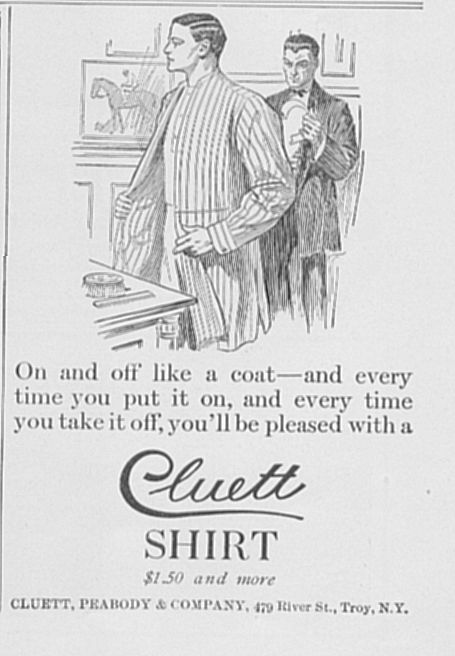
Very early on, a small (3 X 4 inch), black-and-white ad for Cluett Shirts ran in August 1908. Cluett begat the Arrow Collars and Arrow Shirts companies, and J.C. Leyendecker – championed by many, including Richard Martin (1995), Curator of the Costume Institute at the Metropolitan Museum of Art and Adjunct Professor of Art History and Archaeology at Columbia University, as a pioneer who introduced homoerotic imagery to American advertising – is believed to be the artist of this ad.
The advertisement shows two men disrobing at the end of the night, one standing behind the other in front of a dressing table where a comb and brush are set. The wainscoting and equestrian artwork on the wall leave some question as to the specific room in which the action is occurring. But there’s absolutely no question that the man in the foreground is removing his shirt as the man behind him takes off his own shirt collar. “On and off like a coat—and every time you put it on, and every time you take it off, you’ll be pleased with a Cluett Shirt,” says the copy. Many readers no doubt scanned the magazine’s pages and skimmed its contents, oblivious to the deeper implications of what the ad was showing and they might have been seeing. Nonetheless, there’s little doubt about what’s going on here … even if the exact extent of the relationship between these two men remains somewhat uncertain.

Another intriguing situational study is seen in a full-color 1923 Standard Plumbing Fixtures ad showing two men together, one ready for a shower or bed – the bathroom behind him – but, first, getting a light for his cigarette from another man with whom he obviously lives. The second man is sitting on a chair in an ante-chamber, perhaps a dressing or sitting room between the bedroom and bath. Other than the “Standard” brand name with a corporate name and address below, not a single word is given – or needed – to spell out what’s happening here.
Edward H. Sewell (2005) points out that homosexual references in the early 1900s were a coded affair in New York’s gay underground, with red ties symbolizing homosexuality and requests to light a cigarette a subtle way to initiate (intimate) contact between men. As the younger man wearing a red bathrobe bends over and leans toward the older gentleman seated in a comfortable chair and reading a newspaper in his dressing gown, a match is held out to ignite the standing man’s cigarette. The warm colors and arched doorway are carefully lighted to communicate a spirit of calm, cozy comfort in this relaxing, romantic setting.
Ladies and Lesbians?
Swains may outnumber the swans in American same-sex oriented ads, yet women who prefer the company of other women have had their fair share of being goosed and gandered by Madison Avenue over the years.

A lovely charcoal rendering of two beautiful women nestled in bed together graces more than half the page of Palmolive Soap’s 1915 full-page ad whose subhead states that it “Appeals to Dainty Women.” Dressed in frilly peignoirs and negligees, the two women shown have delicate features and long, flowing tresses or stylish, bobbed hair. They’re sitting in bed close to each other — one has her hands around her knees while the other’s legs are crossed and hang over the edge of the bed — as the lady on the left reads, perhaps a letter or a sonnet, to her rapt confidante. From the homespun linens and canopy over the bed to the gentle sensuality of the women’s looks and repose, the image exudes softness. Maybe it wasn’t uncommon back then for the gentler sex to spend nights together so intimately … but, then again, neither was it that unusual for young women to experiment with same-sex attractions before “settling down.”
It’s highly unlikely the intent of a 1939 Karpen Pil-O-Rest Mattress ad was gay on any level of understanding, but it is interesting to note that two women are shown running on a beach while holding hands. The headline announces: “They must have slept on a Karpen Pil-O-Rest Mattress!” Which means they’ve slept together in the same bed. This practice wasn’t particularly uncommon in its time; but it sure gave the girls in the ad something to smile about.

Nor do we know quite what to make of the two glam gals who grace a 1941 ad for Munsingwear Nightwear “that makes a girl feel mmmmmm all over … like Sunday morning in bed.” Delicately drawn by illustrator Gilbert Bundy in pen and ink, and overlaid with a watercolor wash in shades of red, these two temptresses are both graceful and downright sexy. What might they have planned for their evening? That may depend on whether the setting here is a boudoir, brothel, or someplace in between. Are they primping and fussing for each other … or are they expecting some late-night company? Wearing pajamas and high heels, the blonde seductively reclines in a chaise lounge while the brunette, in a swirling negligee with plunging neckline, stands and admires herself in a hand-held mirror. “Nighties beautiful to dance in; pajamas with that born-to-the purple swish of crackerjack styling,” crisply crackles the copy.
Again, can the two women in a full-page Pacific Pajamas ad from 1949 be assumed lesbians? They’re modeling pajamas for each other and the one on the right is contemplating her friend rather oddly with a “let’s see” look. The “Stop the Musing!” headline, along with such copy as “the trick is in the pic, pardner” and “West meets East with Pacific’s gay and exclusive ‘Desert in Bloom’ pattern” can be taken at face value … or stretched for added meaning.
Carl Erickson (1891-1958), a leading fashion and advertising artist especially well known for his work with Vogue and Coty cosmetics, designed a 1928 ad for The Rayon Institute of America to promote its new fabric. “Rayon fabrics are the fabrics of the heart,” murmurs the words in this art deco style ad, with the artwork gracefully complimenting the copy: Laying on a bed, head propped up by her right hand, a lady is lullabied by her companion who sits beside her at the edge of the bed, strumming a serenade on her guitar. Most probably a “flapper,” this new 1920’s woman smoked, danced and voted; she cut her hair, wore make-up, and went to petting-parties where shocking changes in the traditional moral code for women were trespassed.
Bathrooms and Bedrooms
Though they both appear to be roughly the same age, one man affectionately says to the other, “Be out in a couple of minutes, old man—just going to take a shower,” in an early 1920’s ad for Speakman Showers. Both men are wearing pajamas, slippers and bathrobes, implying that they’ve slept under the same roof. By the language used in this ad, however, it doesn’t follow that the men are necessarily related: “But if he had said: ‘I’m going to take a bath,’ that would have meant that the other fellow, unless he had considerable time to wait, would have gone to the office bathless.” Ideally controlled by the company’s Mixometer, the ad states that Speakman specialized in showers for residences, institutions, clubs, YMCA’s and hotels.

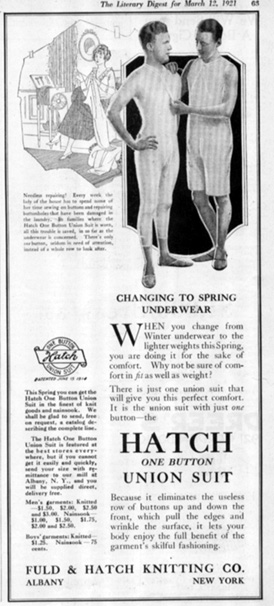
Topkis Athletic Underwear took a different turn from its traditional approach in a 1920 ad published in The American Magazine. Rather than a half-page, black-and-white ad as the brand had hitherto used, this advertisement was both full-page and full-color. What’s more, the two men in this ad are actually interacting in a bedroom rather than just sitting or standing somewhere and sizing up each other. The guys are getting up in the morning. There’s a casual air of insouciance about their morning rituals, with nothing unusual or different about this daily dressing routine, we assume, than any in their lives together. Already showered and in the process of dressing, one man stands in front of a dresser and mirror wearing his pure white Topkis union suit. Bare legs showing beneath a lilac bathrobe, his resident companion is sitting and commenting on his new spotless skivvies. Marveling about their low price, the underwear’s features are extolled in the copy: “Cut along loose, generous lines, Topkis underwear has little body contact, yet it does not bag or bulk. Free play for arms and legs supplies the needed spur in withering weather.” Heaven knows, most men do need that extra spur in withering weather … especially when it’s morning and there’s little body contact to begin with!
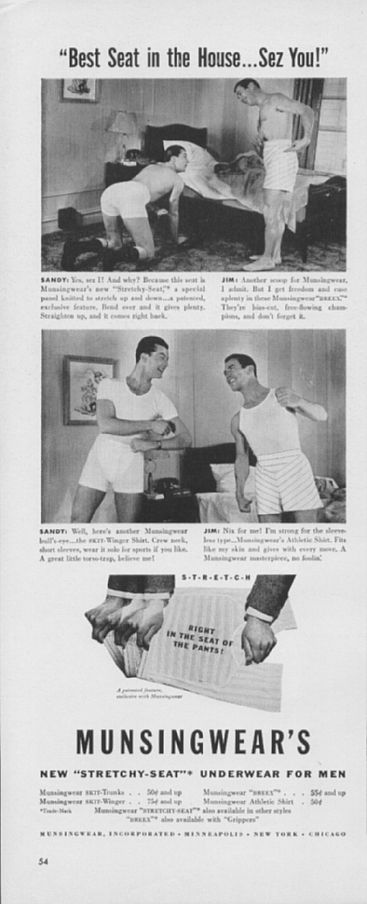
In 1942, Munsingwear, another men’s undergarment company, introduced “Sandy” and “Jim,” two half-naked men searching for something under their rumpled bed. “Best Seat in the House … Sez You!” announces the ad, to which Sandy confirms, “Yes, sez I!” Turns out he’s wearing the new “Stretchy-Seat,” an exclusive and patented feature: “Bend over and it gives plenty. Straighten up, and it comes right back.” Sandy is happy to demonstrate by kneeling down and bending over, buttocks in the air, in front of the unmade bed as if he’s about to do some push-ups. Jim, who looks as though he’s about to peel off his oddly striped boxers, stands in front of Sandy and retorts in defense of his own Munsingwears: “They’re bias-cut, free-flowing champions, and don’t forget it.” While Sandy and Jim may be different in terms of their underwear preferences – Sandy favors a crew neck, short-sleeved undershirt which he calls a “great little torso-trap,” while Jim is the sleeveless type of guy who goes for an athletic shirt that “fits like my skin and gives with every move” – they’re happy in their living arrangements. Notice that the bed is a full-size or double, not bunk beds or twin and that it’s obviously been used recently, presumably by these two attractive men.
Wink-wink went Munsingwear’s ads throughout the 1940s, deliberately cranking up the bawdy and risqué with humorous headlines, bedroom banter, and photos of men in close quarters cracking jokes about their naked cover-ups. Half-dressed, bare-chested men taking liberties in these ads made asses out of themselves – literally and figuratively – in and out of their underwear. A brief (pardon the pun) sampling: In “O.K., It Stretches! … So What!” a pillow fight in the bedroom quickly leads to a swat on the butt. “Just a Two-Timer, Eh?” progresses into “That’s Covering the End Zone!” in which a three-some massage turns into a heated exchange. “It Ain’t You That’s Well-Knit, Muscles!” quips a headline, as two home-grown acrobats clown around and show off their stuff – then lay down in bed – all with the greatest of ease. More locker room eye-locking takes place in “So You’re an Under-Cover Man!” where the guys are undressing and suiting up to hit some tennis balls. Was “under-cover man” a euphemism for “in the closet” back then?

In 1942, Reliance Universal published an ad for its pajamas. Featuring two fellows each wearing pairs of striped PJs — one seated and reading a newspaper, the other standing with an alarm clock in his hand — a casual observer could conclude that they’re brothers or friends who live together. But something is amiss with that scenario: The way they’re looking at each other, for instance, presupposes a sensuous joy and intimacy in each other’s presence. Their smiles … eye contact … tilt of the head … easiness of posture … go beyond a brotherly relationship and resonate with romantic residues. Moreover, in an affectionate gesture, the seated man’s slippered foot seems to be touching the other man’s leg just below his knee. Issued during the World War II years, the text complements and picks up on the ad’s “Rely on Reliance” headline: “Better sleep means better work, on any job! That’s why millions turn to the soft, restful comfort of Reliance Universal Nite-Tog and Rest-Rite pajamas between shifts, to return to the job refreshed and ready for action.” Whatever their “job,” the companions pictured here are both relaxed and appear ready for some action!
Bed and Breakfast Double-Entendres

Some “gay-vague” or “gay-ambiguous” advertisements are especially whimsical when their potential for double-entendre becomes a factor. A 1945 full-color Good Year Airfoam mattresses ad is headlined “Even a Steak Wouldn’t Get Me Up!” Head resting on a nicely plumped pillow, a distinguished-looking older gentleman is pictured in pajamas, comfortably ensconced under the sheet and blanket covering his cabin cruiser’s bunk. Facing him is a virile, younger man balancing a plate with a stack of pancakes on the fingertips of his right hand and a steaming pot of coffee in his left. Both men are smiling at each other. From the copy, we conclude that the elder gent’s Airfoam mattress is so comfortable that – forget the flapjacks! – even a succulent steak couldn’t convince him to abandon his bed. Yet there’s that subtle nuance of sexuality here, especially since we don’t quite know the relationship between the two men or why they’re together in such an intimate, domestic setting. “Get me up?” As in out of bed, yes … but also as in helping him to achieve an erection? Depending on the cut of the meat, it’s definitely worth a thought and certainly not out of the question.
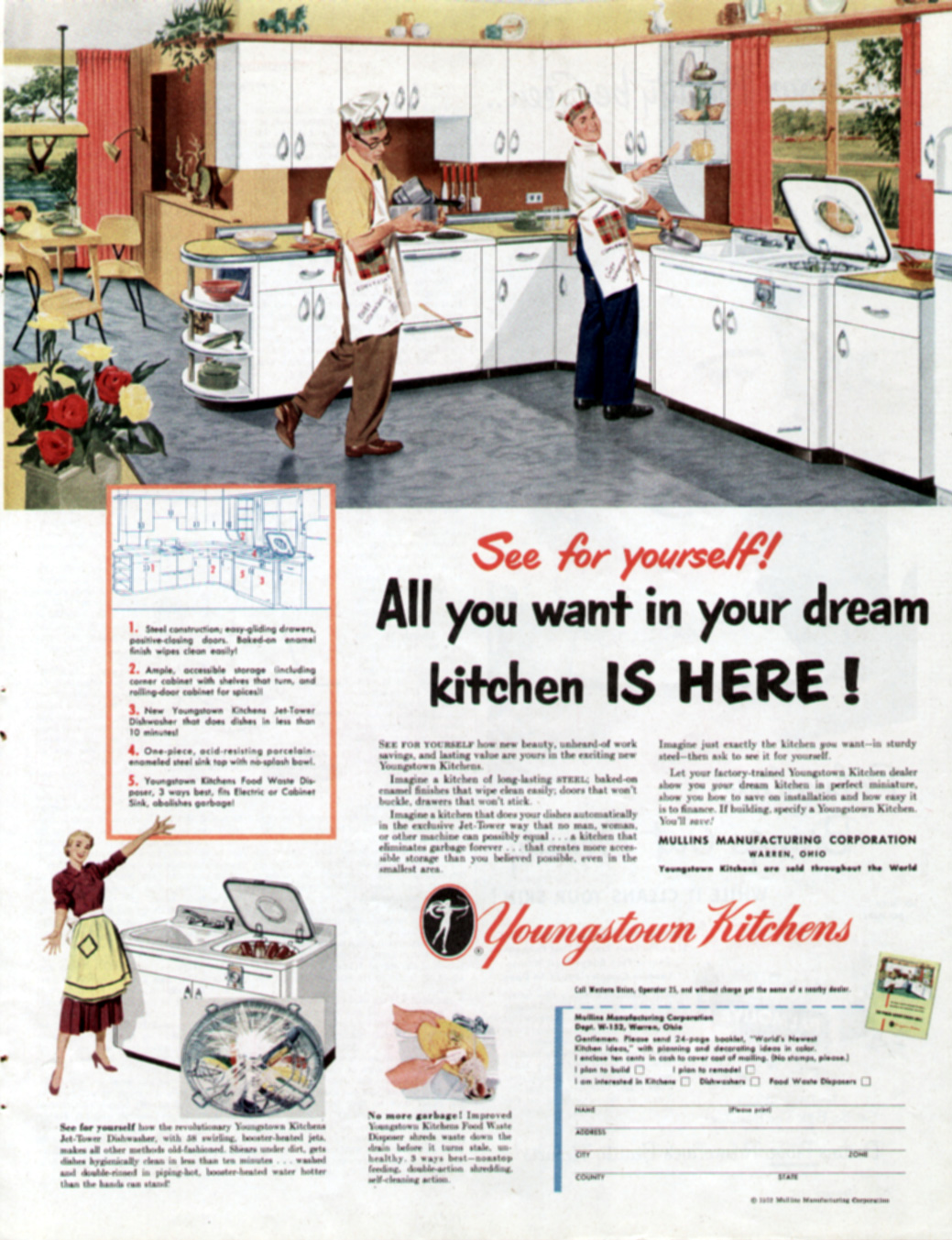
“All you want in your dream kitchen is here!” exclaimed a 1952 full-page, full-color ad for Youngstown Kitchen. What’s in this room, though, are men cooking and cleaning and tripping gaily through their bright kitchen filled with white, mid-century modern Youngstown cabinets and linoleum floors. Wearing aprons and chef hats over their shirts and ties with nice slacks and highly polished shoes, the guys maintain an immaculate yet festive area in which to cook and eat. There are fresh flowers on display, along with ferns and knick-knacks set atop the wall cabinets, and bright yellow Formica countertops above the base cabinets. So what if these guys look a bit on the nerdy side? Their spic-and-span home would make any housewife desperate and jealous!
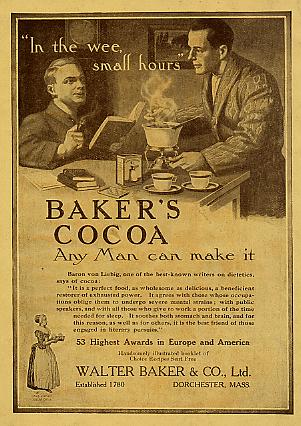
Before leaving the kitchen, let’s visit two more men shown together under the headline “In the wee, small hours.” The 1911 sepia-tone ad is for Baker’s Cocoa .
“Any Man can make it,” says the subhead. While we have no idea whether the “wee hours” here are by dawn’s early light or in the middle of the night, what we do know is that two men wearing bathrobes are alone at a table enjoying a brief respite before the rest of the world intrudes on their solace. Two cups and saucers, a few books, and the box of Baker’s Cocoa are on the table. As steam rises from the cocoa pot, smoke swirls out of the cigar the seated gent is enjoying while reading a book. The men interrupt their reverie and make eye contact … knowing that, for them and others like them, any man indeed can make it!
The More, the Merrier?
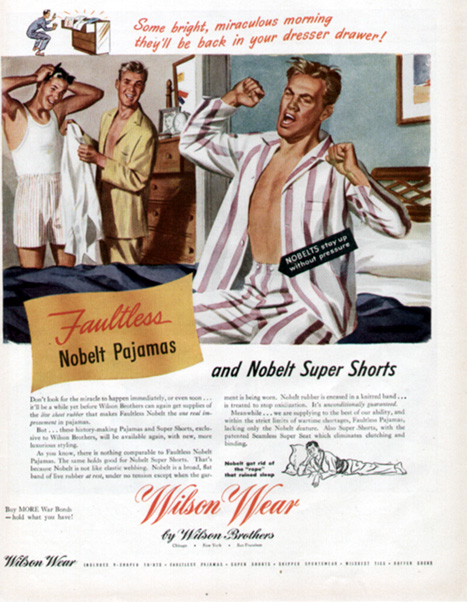
Finally, here’s a novel twist on those close encounters of the third kind … where a couple may actually have been a three-some: A 1945 full-page, full-color ad for Wilson Wear presents three men in a bedroom after a pajama party of some sort. Still in bed, one man stretches and yawns, his pajama top unbuttoned and open. In the foreground, two other guys appear as crisp and fresh as tomorrow’s Twinkies. One, dressed in boxer shorts and a T-shirt is combing his hair, evidently having just stepped out of the shower. His “friend” standing next to him hasn’t taken his PJ’s off yet but has selected the shirt he plans to wear. The Wilson Wear ad for “Faultless Nobelt Pajamas” is crowned by a headline whose cursive lettering and lilting pitch could have come straight from the Sound of Music: “Some bright, miraculous morning … they’ll be back in your dresser drawer!”
From sharing dresser drawers and bunks in the bedroom to cooking up a storm together in the kitchen, men and women in these classic advertisements can be seen throughout the house in various stages of dress and duress. On land or afloat, they’re engaged in domestic duties and feathering their nests while watching each other stay in ship-shape … or doing flip-flops over the sponsor’s product in the details.
References
Martin, Richard (1995). The Gay Blades: Homoerotic Content in J.C. Leyendecker’s Gillette Advertising Images. Journal of American Culture, Volume 18, Summer 1995, 75-82.
Sewell, Edward H. (October 25, 2005). Advertising. Encyclopedia of Lesbian, Gay, Bisexual and Transgender History in America. Retrieved September 25, 2006 from http://findarticles.com/p/articles/mi_km4448/is_200510/ai_n1626079.

From A Hint of Homosexuality? ‘Gay’ and Homoerotic Imagery in Early American Print Advertising. By Bruce H. Joffe








 "Exactly!"