World War II’s Wanton Warriors:

Same-Sex Advertising Adventures of Military Men

By Bruce H. Joffe
Attribute it, perhaps, to the Great Depression and/or the coattails of the Motion Picture Code (Hays Code) of 1930, whose “Particular Applications” specifically restricted references to “sex perversion” (i.e., homosexuality)  … but advertisements of the 1930s were relatively nondescript and anemic—especially in terms of sexually ambiguous imagery and homoerotic double entendres. 

It wasn’t until the nation began to crank up for war in the 1940s that a renaissance in same-sex subliminal seduction resolutely appeared on the pages of America’s mainstream media.

World War II brought men and women from around the globe together in close proximity.  Gays, lesbians, and bisexual people could encounter others like themselves … though, of course, it wasn’t acceptable to express one’s sexuality openly. 

Nonetheless, a number of advertisements from these war years featured soldiers in all-male environments either enjoying ribald and racy recreation or engaged in some sort of unseemly activity that, today, causes one’s eyebrows to arch in amazement.

The Cannon Towel Collection

Fieldcrest Cannon Corporation, for example, ran a series of six “True Towel Tales” ads between 1943 and 1944 in several general-interest magazines.  Showing soldiers bathing in the field and frolicking in a variety of licentious settings, the sequences showcase men engaged in what looks more like bawdy Boy Scout adventures than a weary and worrisome war.  This homoerotic campaign of playful, naked men may be the inspiration for more recent beefcake advertising such as that produced for Calvin Klein and Abercrombie & Fitch.

Lest these ads be misrepresented, let’s go on record here and now by noting that these charming vignettes about life in the armed forces were unequivocally patriotic and domestically informative.  Readers were reminded of the reasons they might not be able to find Cannon towels in their hometown shops — because “our boys in the service need them more than we do, so there are fewer to go around” — and given tips on how to make their towels last longer and stay “durable for the duration.”

Cannon produced advertisements honoring various branches of military service: the Army, Air Force, Marines, Tank Corps, and Navy. Supposedly, the story told in each ad is based on the actual recollections of a specified serviceman.
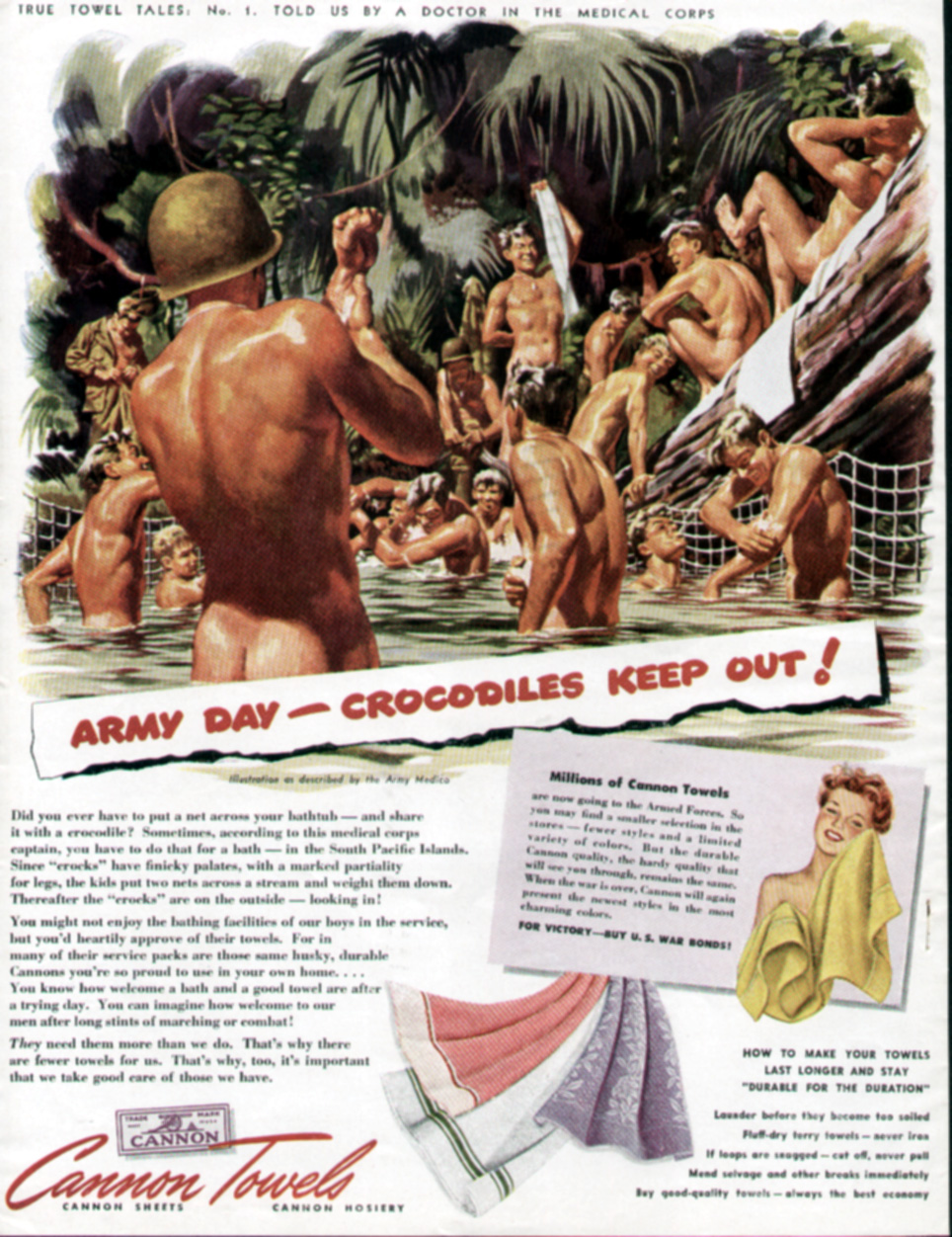
Accompanied by an illustration as described by an Army medic, “Army Day—Crocodiles Keep Out!”, Cannon’s True Towel Tales No. 1 (1943), is attributed to a doctor in the medical corps.  Did you ever have to put a net across your bathtub—and share it with a crocodile?  These naked soldiers might be smiling and having fun in the water but, according to their captain, sometimes you have to do that for a “bath” in the South Pacific Islands!  “You might not enjoy the bathing facilities of our boys in the service,” says Cannon, “but you’d heartily approve of their towels.”
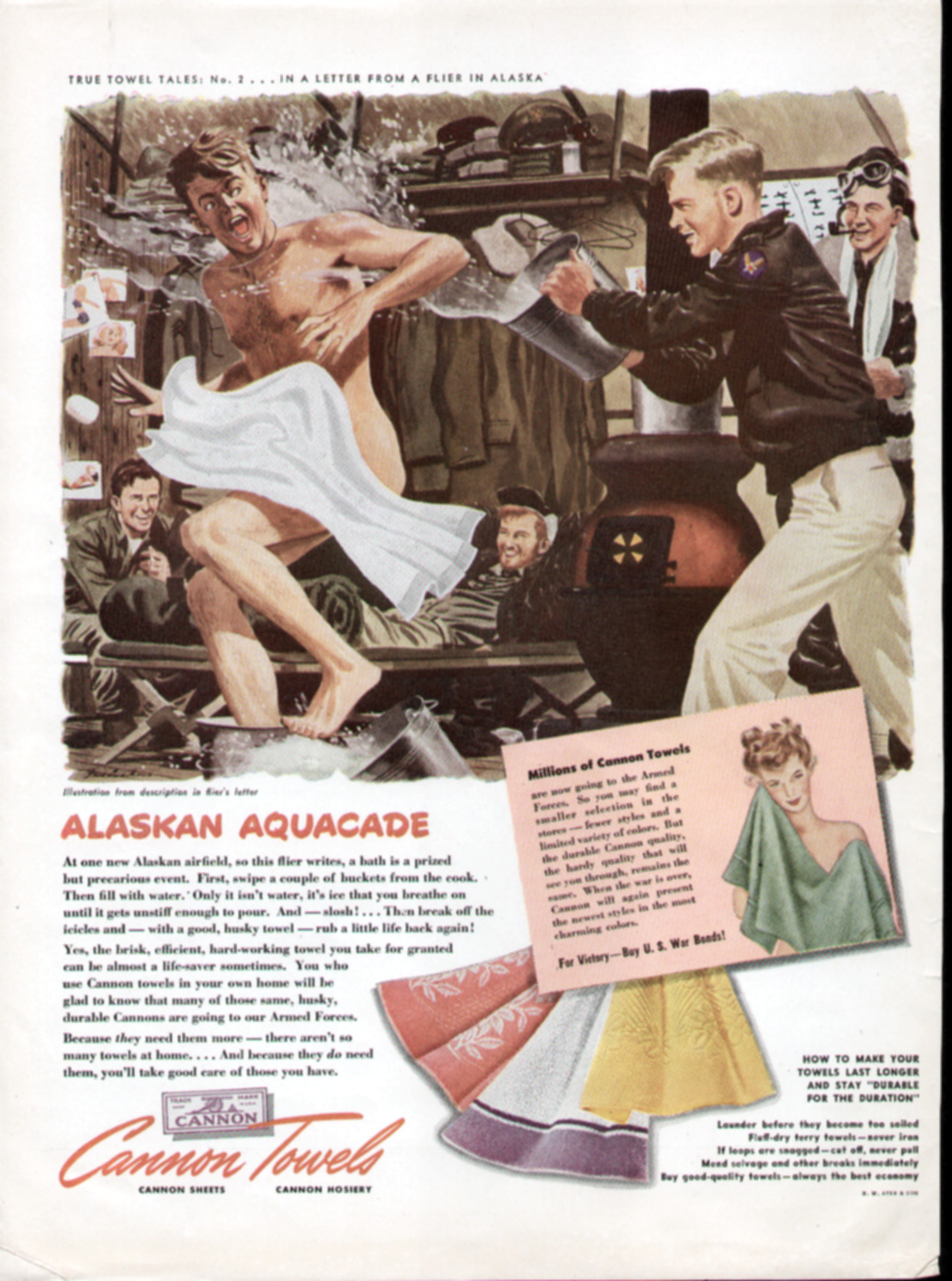
A half-naked airman is the subject of 1943’s “Alaskan Aquacade,” whose story was told in a letter from a flier.  Chased around by a smiling buddy who throws water at him from a bucket, the surprised Air Force pilot is literally showered.  A couple of grinning guys lounge nearby on the floor, under a rack of hanging uniforms.  “At one new Alaskan airfield,” recounts the flier, “a bath is a prized but precarious event.  First, swipe a couple of buckets from the cook.  Then fill with water.  Only it isn’t water, it’s ice that you breathe on until it gets unstiff enough to pour.  And—slosh! … Then break off the icicles and — with a good, husky towel — rub a little life back again!”  According to Cannon, the point is that “the brisk, hard-working towel you take for granted can be almost a life-saver sometimes.”  Especially when dealing with an “agent” that’s too stiff for comfort!

Marines are featured in the third True Towels tale.  In “…What? … No Bath Salts? …” (1943) even the illustration is based on a photograph supplied by the U.S. Marine Corps.  Here the action takes place in the Solomon Islands, where “it’s either the Pacific with a shark to tickle his pinkies—or the water-tank.”  When you’re “jungle-dirty” — as are these fighting men who take a break from battle to towel off and admire their handiwork — “the primitive water-tank’s a luxury,” claim our returned Marine heroes.  Fortunately, where towels are concerned, the bath isn’t that primitive because the “brisk, efficient (Cannon) towels you take for granted are welcome equipment to our men in all the services.”  Yep, welcome “equipment.”  Towels!

Showing members of a U.S. Tank Corps in North Africa taking a nude swim and sunbath while a soldier poses playing Julius Caesar, Cannon’s 1944 True Towel Tales #4 is based on an experience told by a sergeant in the Tank Corps.  Maybe the Roman bath was built for a conquering Caesar but in this advertisement it’s being used by “Joe Doughboy,” who’s enjoying a Roman holiday.  The holiday includes lots of men doing their best to “camp it up.”  When what ails you is the “Mediterranean heat and fight fatigue and pestering flies, a swim is welcome,” counsels Cannon.  Welcome, too, of course, is the brisk rub-down with a good towel from the good-towel company.

Now imagine yourself in boxer shorts, taking a bath with an elephant.  That’s the scenario in “Hey, Turn Off the Water, Jumbo!” Cannon’s True Towel Tales No. 5.  As told by a soldier, this 1944 ad shows Americans in Ceylon where an elephant hoses down the sailors with its trunk as natives wash the pachyderms.  According to the story, “…there’s a Hindu who lives near a river and owns an elephant.  When the hot season comes, he’ll send our shore-going sailors a shower-bath for less than a rupee.”  Of course, one has to bring his own towel!  Does the image of being hosed off by an elephant seem exciting … or appealing and tawdry?  “Me and my mates tried it,” sez the Sailor, “and ‘twasn’t bad!”  It’s different strokes for different folks as this ad goes to show that not everyone is comfortable with a jumbo hose, mate.
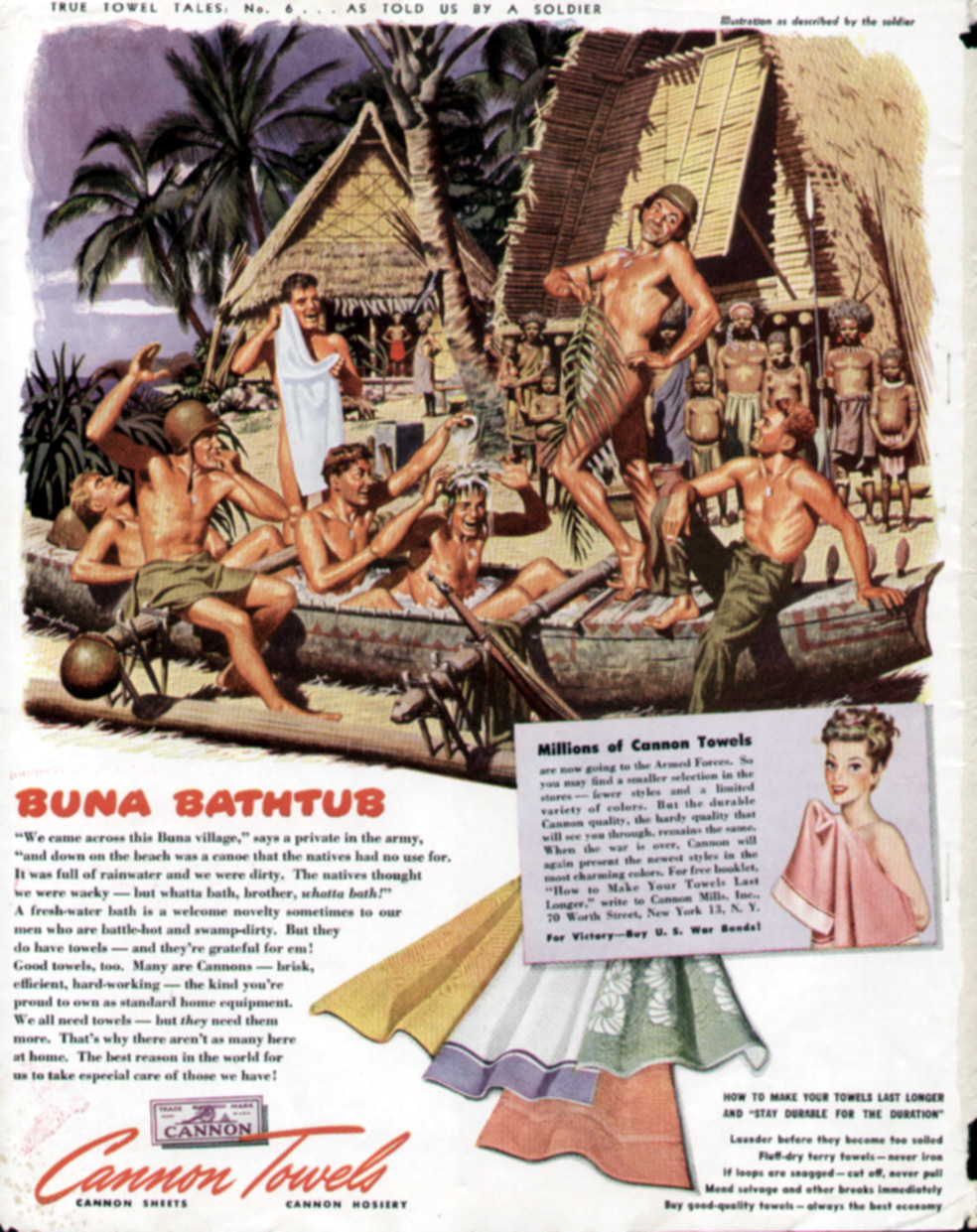
Fieldcrest Cannon’s final True Towels Tale (#6) was also published in 1944 and deals, again, with our Army men.  This time they’re center sage in an abandoned canoe, taking a nude bath while the natives form an audience.  As the villagers look on, a soldier playfully poses and vamps with a palm branch barely covering his body.  Is this a bath … the “baths” … or a drag show?  The canoe was full of rain water “and we were dirty,” explains the soldier.  “The natives thought we were whacky—but whatta bath, brother, whatta bath!”  Like the other ads in Cannon’s campaign, the men here seem to enjoy looking at each other’s nude bodies.  This ad in particular seems to focus on a man pretending to be in drag, entertaining the men — some sitting between each other’s legs.  One soldier looks on and whistles as, puzzled, the natives watch from afar.

Cannon’s strategy was an effective way to propagandize people to support the war effort, and provided some appealing eye-candy for women and the boys.  Despite what could be construed as racist images of “natives” looking on as the military men bathe, the message is clear: Our GIs are having a good time, keeping clean, and out of harm’s way.

 “The focus of these ads was on the value of Cannon towels to the soldiers, but the images were homo-erotic enough to allow for an alternate interpretation by a gay man,” says Edward H. Sewell (2005). 

Bear in mind that on the battlefield, as in other gender-specific environments (i.e., same-sex boarding schools or jails), the absence of women could possibly have allowed for a more liberal and freer expression of man’s primal needs … and that, given the circumstances, society generally may have been more willing to waive its condescension or condemnation of such activities.

Don’t Ask, Don’t Tell?

 “The war years had witnessed a sudden and dramatic change in the appearance of men in Life magazine,” writes John Ibson (2002) in Picturing Men: A Century of Male Relationships in Everyday American Photography.  “Men in various postures of intimacy had begun to appear in Life advertisements with remarkable frequency once the war was under way.  In several issues just before the conflict, in 1940, the magazine had depicted no adult men alone together, without women; by 1943 and 1944, only one issue had no such male-to-male interactions in advertising.”

The potent mix of masculinity and patriotism symbolized by soldiers and sailors has, in its biochemistry, fundamental elements of seminal appeal.  So, Cannon wasn’t the only company to employ homoerotic images in its advertising.

Nor was Cannon the only towel company to promote its products with advertisements featuring naked men engaged in activities, like doing laundry, associated with the gentler sex.  A stunning illustration in a 1942 ad for the Pepperell Manufacturing Company of Boston shows the “U.S. Hand Laundry” corps in various stages of undress, cleaning their clothes in a river.  With no washing machines or buttons to press, the muscular graphics undoubtedly drew admiration from men, as well as the attention of women.

Sacrificial Soldiers

Although a sense of free-spirited debauchery may be distilled from ads sponsored by Coca Cola, Pullman, Fisher (GM) Body Works, Armstrong Cork, Oldsmobile, Interwoven Socks, Listerine, International Harvester, and even Ma Bell, patriotism, sacrifice, and the welfare of our troops are all prioritized in these World War II ads …  whatever else can be inferred or implied.

Perhaps no other ad so succinctly represents this primordial tug-of-war between protecting our boys and allowing the men their sexual latitude in such critical times as “The Kid in Upper 4” sponsored by the New Haven Railroad and published between 1942 and 1943.  Immortalized by social historian Allan Berube (1990) in his definitive book on homosexuality in World War II, this ad has special significance:  “Life in sex-segregated quarters created homosexual tensions as well as opportunities,” Berube contends.  “A magazine advertisement illustrates how young recruits were placed ‘two in every lower berth’ on troop trains.”  Presumably, the kid in upper 4 is depicted alone, worried, and wide awake because he is so young, so angelic, so blond.  Poignant text about him leaving home and heading to war talks about what he left behind and what faces him ahead: “Next time you are on the train, remember the kid in Upper 4.  If you have to stand enroute—it is so he may have a seat.  If you have to wait for a seat in the diner—it is so he … and thousands like him … may have a meal they won’t forget in the days to come.”

What a tearjerker!  A gay man’s eyes moist over this ad even today, thinking about what may befall this beautiful boy in the upper berth once he arrives “over there.”

Madcap Male-to-Male Interactions among Military Men

Madison Avenue’s woofish sketches of warfare revolved around sweat-drenched soldiers surrounded by other fighting men (and, at times, natives) who are either smiling and sneering or leering and jeering as they hand off erectile projectiles — artillery, missiles, guns, cannons or swords — to their comrades and/or combatants in arms.

The men here may not have been alone in the trenches, but their demeanor — sometimes saucy, other times threatening — and the winsome wording of the ad copy could coalesce to produce a sexually provocative response from some men in the advertising audience. Bombastic, iconoclastic … and homoerotic … are words that would agree with these sabers-rattling ads.

A 1943 full-color ad by Fisher, then a division of General Motors, is headlined “Body blow by Fisher.”  Certainly the possibility exists for some double-entendre, especially as augmented by other ad copy here:  “Take care of that equipment … make it last … make it do.”  Beneath a blazing sky, this full-color advertisement shows a number of shirtless soldiers blowing off rigid cannons being both loaded and discharged.

That same year (1943), the National Dairy Products Corporation and Affiliated Companies issued its own call to arms with a smiling, jungle-based soldier “spoon-feeding” a hunk of cheese into the mouth of a cool, calm and collected military man from the Alaskan snows with a large firearm firmly balanced behind his bowls.  “When guns are hot and time is short, the emergency cheese ration can be eaten as it is—like a candy bar,” carps the copy.  “Or it can be mixed with a little water to make a tasty spread for bread.  Or the mixture can be set aside for an hour or so and then sliced.”  Sliced, spread or diced, America’s fighting men could cool their guns with (purportedly) tasty treats … even during emergencies!

Soldiers, some undressed and others in various stages of uniform, are also featured around a cannon that’s just shot a load in a full-color 1943 ad for Inter Woven Socks.  Nothing’s really outlandish here, although a queer eye looking beyond the (presumably) straight soldier guys will probably laugh at the headline:  “In Times Like These—Endurance Counts.”  While the socks may indeed be “Long Wearing … Comfortable … Good-Looking,” it would be most extraordinary if the battle-weary soldiers were wearing such lovely argyle, striped and solid color socks under their regulation boots and regalia.
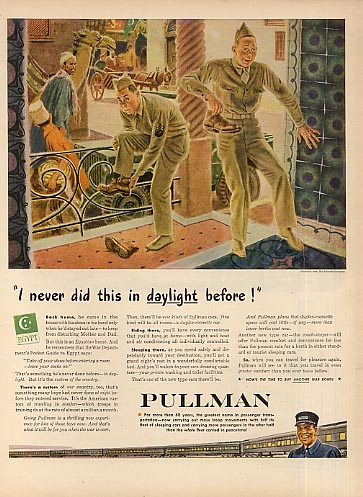
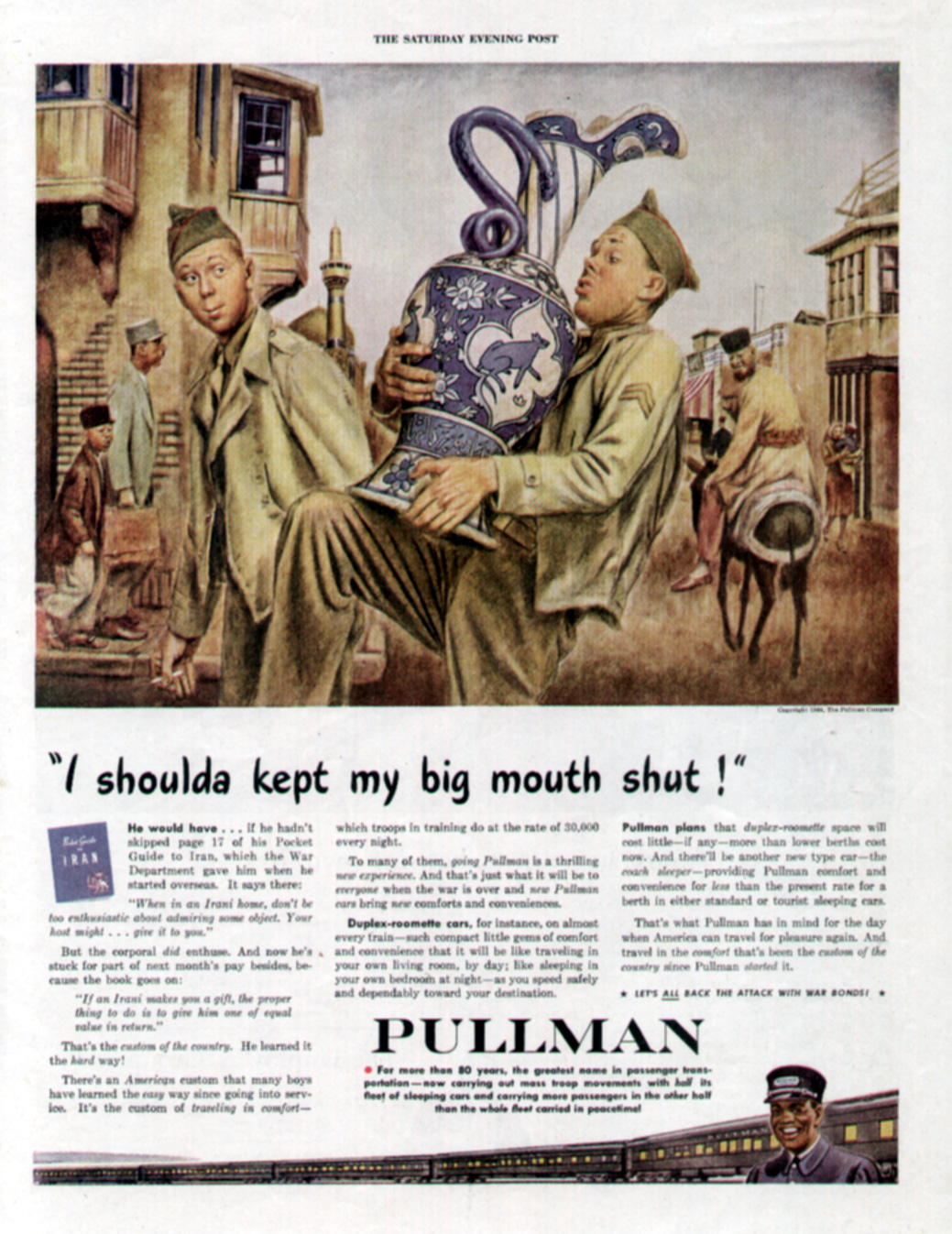
Pullman produced several ads in a series illustrated by Albert Dorne during 1944, when their passenger trains carried troops instead of people traveling for pleasure.  In one, two soldiers stationed in Egypt are trying to adapt to a particular custom of the country: taking one’s shoes off before entering a home.  But until we’re well into reading the copy, we don’t know that. Instead, as a native looks on suspiciously, two GIs guiltily remove their footwear in the threshold of a building.  The ad’s headline — “I never did this in daylight before!” — adds to the illicit sense that the soldiers have been caught doing something for which they can be discharged today.  “Back home, he came in the house with his shoes in his hand only when he’d stayed out late — to keep from disturbing Mother and Dad,” begins the copy.  The implication?  Possibly this: He might have been a good boy back home, but now he’s indulging his baser instincts. 

 A large piece of artillery from a crate of ammo in hand, another shirtless soldier with a somewhat skeptical but determined look approaches a uniformed GI in a jungle somewhere during the war.  As he brandishes the burnished shell at his comrade, the headline in an Armstrong Cork company advertisement screams:  “Listen, soldier, it just doesn’t make sense!”  Is the shirtless soldier menacing the other man, who’s attempting to talk him out of doing something unwarranted or outlandish?

Attempting to gain a sense and semblance of the action here, our eyes wander around the illustration.  There’s another soldier smack in the middle, watching what’s going on with obvious delight.  Behind him, almost hidden by the trees and foliage, other men stand in front of a cannon or, bare-chested, carry duffle bags above their heads.

Let’s now turn to the advertising copy here and read a conversation between Bill, Joe and Hank.  As it turns out, Bill is simply showing the shell to Joe so he can see the Armstrong trademark. Joe, whose father has been selling Armstrong Linoleum in his furniture store, can’t believe the same company manufactures weapons.  It’s Hank — the smiling soldier ambling up to them — who explains that the Armstrong companies make a lot of different products.

The graphics and headline of this attention-grabbing ad don’t come across as appropriate for a mild-mannered exposition on the “hundreds of diversified products” made by Armstrong. But that’s how an effective advertisement can work. Shock value grabs our attention as we sort out the pieces, seeking solution(s) to the advertisement’s purpose or message.  Appealing to our sense of fear — homophobia … a jungle setting … in the midst of a world war — this homoerotic ad uses language and images to create a complex yet compelling tableau.

Close-knit sailors — perhaps a bit too close for comfort — appear in a 1945 advertisement for Listerine Antiseptic, touted here as “the tested treatment” for infectious dandruff.  “Oh, yeah!  A month’s pay says it will!” bets the sailor on the right, referring to Listerine’s ability to get rid of the flakes and scales on his buddy’s jumper.  Head cocked aggressively with his face uplifted and an expression of bully daring about him, the sailor holds out some money in his left hand while his companion brushes the dandruff off his shoulder.  Chastised and chastened, chagrin is etched deeply across the downcast face and furrowed brow of the embarrassed sailor who’s ashamed to look his friend in the eye.  Although hardly effeminate, there’s something soft and feminine about the suffering soldier.  Here’s a twist, a role reversal from most (non-combat) advertisements of the time that show a man and woman — where she always tends to be the student to him as the teacher.  One guy learns an important lesson about personal hygiene from another in this ad.  How domestic and degrading for a military man!

Listerine had laid on a lulu of gay ambiguity in an earlier, 1943, ad:  By their body language, two bruising sailors appear to be doing some sort of cheerleading or mating minuet as they bend and bow in a bizarre ballet, looking cautiously at each other.  “Butch says don’t bring Lulu,” one tells the other in this 1943 ad for Listerine.  Leaning close, the sailor seems to be winking wonkshly while his buddy nervously looks around to see if they’ve been caught or observed together.  Turns out that little things disturb courageous men like these:  “Butch came through a couple of bombings and never batted an eye,” we learn.  But when it came to a second date with Lulu, “he wanted out.”  Sure, Lulu was a looker – with good “gams, and plenty of oomph.”  When shore leave is short, though, a man doesn’t want to spend it with a girl who’s got bad breath.  Listerine may have been part of their “passport to popularity,” but our money is still betting on Butch and his flag-waving buddy … leaving Lulu behind.

Epilogue     

After the war, titillating ads continued to appear with potentially hidden, coded, or ambiguous gay themes and messages.

“Monogamy at the Naval Academy: Now A Forced-Feeding Social Life,” proclaimed an ad promoting an upcoming story to be published in the March 1, 1958 issue of The Saturday Evening Post.  But to what kind of monogamous social life … and whose forced feeding … did the headline allude?

With 1,700 rooms and five miles of corridors, Bancroft Hall — “one of the largest single dormitories in the U.S.” — houses the Naval Academy’s entire brigade of 4,000 midshipmen, states Blaine Taylor (2005) in Military Heritage magazine.  Since Annapolis first accepted women as midshipmen in 1976, the purported lack of monogamy and potential erotic overtures among the men housed there tug at the intellect but boggle the mind.

“What will it take for a straight guy to go gay?” asks Kevin Cassell (2004). “Try just a few weeks in the United States Navy during a time when homosexuality was not just grounds for dishonorable discharge, but for a full-scale criminal investigation and, if found guilty, incarceration.  Yes, it happened: dozens of young, straight naval recruits ‘went gay,’ with no small degree of enthusiasm, at the Newport Naval Training Station in Rhode Island in 1919.”

Not a well-known fact, shares a friend, but “in the early 1950s, during the height of the Korean War, the military academies were being forced to turn out more officers than they had the capacity to house. Since most of the bunk beds were being shipped out to military barracks, the academies had to resort to double beds in their small rooms, and putting three cadets into a room with two in a double bed. This didn’t last very long when it was found out that the double beds facilitated some ‘buddy activity’ during the night when the bunkmates got familiar with each other. I don’t recall where I first learned this, and I’d certainly go look for a definitive reference before repeating it, but I’m 99% sure it’s true,” he said.

Despite McCarthyism and the myriad struggles predating Stonewall yet ahead, “gay” and homoerotic imagery — explicit or implied — made such headway during the World War II years that the roadblocks to real liberation throughout the advertising world would become fewer and farther between. 

But that’s the grist for another article … or, more likely, a series.

Retired communications professor, marketing director, and publisher Bruce H. Joffe has amassed an extensive array of media, management, and human resource experience, along with counseling and “people” skills. Fluent in Spanish and conversant in Portuguese, he has taught public relations, media, marketing, and journalism courses at The American University, George Mason University, Mary Baldwin University, Carthage College, and Kaplan College. The award-winning author of magazine features, academic research, professional journal articles, and newspaper byliners, he has published eight books: titles deal with marketing, the media, interfaith and progressive theology, church reform, gender studies, and international (intercultural) living/communication.


Processing…
Success! You're on the list.

Israel, Iran, Hamas, and Trump

Photo: CNN Portugal

Sooner or later, Rachel Maddow, Joy Reid, or another commentator will put the pieces of this puzzle involving Israel, Iran, Hamas, and Donald Trump together.

On July 28, 2023, CNN reported:

  • A top-secret document that Trump discussed at a 2021 meeting at his New Jersey golf club was included in the 15 boxes returned to the National Archives in January of last year, according to a source familiar with the matter. But Trump denied it was real.
  • Trump was charged with retaining the classified document, described as a “presentation concerning military activity in a foreign country,” which CNN reported is Iran, as part of the superseding indictment. The Iran war plan document, however, stands out as the only one from the 15 boxes Trump initially returned – before any subpoena was issued or search was conducted – that has led to any criminal charge.
  • While a July 2021 meeting at Trump’s Bedminster golf club was described in the original indictment, prosecutors did not say at the time whether they had located the document Trump was allegedly showing. The new charge makes clear they have the document and believe the former president had it in his possession at the time of the meeting at which he discussed it with people not cleared to view classified material. An audio recording of the meeting first aired by CNN captures a moment when Trump seems to indicate that he is holding a secret Pentagon document with plans to attack Iran. “These are the papers,” Trump says in the recording.

The Guardian (UK) echoed CNN’s reporting:

  • The recording, obtained by CNN, includes new details from a conversation that is a critical piece of evidence in special counsel Jack Smith’s indictment of Trump over the mishandling of classified information. It includes a moment when Trump seems to indicate he was holding a secret Pentagon document with plans to attack Iran. The episode is one of two referenced in the indictment where prosecutors allege that Trump showed classified information to others who did not have security clearances, CNN reported.

According to Factcheck:

  • The indictment says that Trump met on July 21, 2021, at his golf club in Bedminster, New Jersey, with “a writer and a publisher in connection with a then-forthcoming book,” referring to former Chief of Staff Mark Meadows’ book, “The Chief’s Chief.” Six days before the meeting, Susan Glasser of the New Yorker published a story that detailed how Gen. Mark Milley, the chairman of the Joint Chiefs of Staff, was concerned Trump might attack Iran in the final days of his presidency. At the meeting in New Jersey, Trump told his guests that Milley wanted to attack Iran and, in fact, presented him with an attack plan.

Donald Trump disseminated top-secret information about his plans to attack Iran to people not authorized to see it.

As stated by the National Archives, “Top Secret” shall be applied to information, the unauthorized disclosure of which reasonably could be expected to cause exceptionally grave damage to the national security that the original classification authority is able to identify or describe,” a definition confirmed by the U.S. Senate Select Committee on Intelligence.

This wasn’t the only time Trump disclosed top-secret or classified information.

States Wikopedia:

  • President Donald Trump discussed classified information during an Oval Office meeting on May 10, 2017, with the Russian Foreign Minister Sergey Lavrov and Russian Ambassador Sergey Kislyak. The information was provided by a U.S. ally and concerned a planned Islamic State (ISIL) operation, providing sufficient detail that the Russians could use to deduce the identity of the ally and the manner in which it was collected, according to current and former government officials. The meeting had been closed to the U.S. press, although a photographer from the Russian press was present. The disclosure was first reported in The Washington Post on May 15, 2017. White House staff initially denied the report, but the following day, Trump defended the disclosure, stating that he has the “absolute right” to “share” intelligence with Russia.

U.S. officials were concerned that information …

could be passed to Russia and then to Iran

On March 31, 2023, Russian President Vladimir Putin approved a new Russian foreign policy concept that hailed the ongoing “formation of a more equitable multipolar world order,” War on the Rocks reported. “The concept highlighted Moscow’s intent to strengthen its ties with the non-West, in particular ‘developing full-scale and trusting cooperation’ with Iran and other states discontented with Western policies toward their countries. While the Russian-Iranian relationship has been strengthening for years, this showed that the alliance was deepeningespecially as a result of the war in Ukraine. 

“This partnership is not merely a transactional alliance of convenience,” the War on the Rocks article continued. “The two countries are first tied by a shared animosity with the ‘collective West,’ whose values and strategic objectives present, according to their perspective, a hostile ideological challenge that can endanger their social cohesion and political stability. Russia and Iran also share a common concern for regime survival. They both have faced internal upheaval and international sanctions that have led them to develop mirror narratives centered around resilience, self-sufficiency, and resistance. This has drawn the two states closer.”

The relationship between Russia and Iran, Trump disclosing top-secret (Pentagon) documents about Washington’s potential war on Iran, as well as sharing classified information with Russian officials about a planned USA  Islamic State (ISIL) operation is established. What about Hamas? Where and how does it fit into all this political intrigue?

The Iranian role in the clearly well-planned and well-coordinated Hamas attack by land, air, and sea on Israel is the subject of much debate.

  • “Hamas and Iran are longtime allies. Did Tehran help with its attack on Israel?” asked CNN on October 10, 2023. “The level of planning that would have been required for such an assault (on Israel) prompted questions about whether Hamas could have done it alone – and if it had help, whether that could have come from its longtime backer in the region, Iran.”
  • Deputy national security adviser Jon Finer reiterated that the United States believes Iran is “broadly complicit” in Hamas attacks in Israel, but said the US does not have “direct information” linking these attacks to Iran at this time. “What we can be quite clear about is that Iran is broadly complicit in these attacks for having supporting Hamas going back decades,” Finer said during an appearance on ABC’s Good Morning America, pointing to weapons, training, and other financial support.
  • He continued, “What we don’t have is direct information that shows Iranian involvement in ordering or planning of the attacks that took place over the last couple of days. It’s something that we’re going to keep looking at closely.”

Yet Iran’s evolving relationship with Hamas and its Palestinian militant partners, the Islamic Jihad, is well documented, says CNN:

  • “The Palestinian Islamic Jihad – a Gaza-based militant group which is smaller than Hamas but a significant fighting force in the coastal enclave – has enjoyed a long and public alliance with Tehran.”
  • The same CNN article reports that, “Israel says Iran supports Hamas to the tune of some $100 million dollars a year. The US State Department in 2021 said that the group receives funding, weapons, and training from Iran, as well as some funds that are raised in Gulf Arab countries.”
  • A State Department report from 2020 found that Iran provided about $100 million annually to Palestinian terrorist groups, including Hamas.

Former US officials say there is little question that the massive stockpile of weapons used in Hamas’ attack was acquired and assembled with help from Iran. “Hamas didn’t build the guidance system and those missiles in Gaza,” said retired Gen. Frank McKenzie, former commander of US Central Command. “They got them from somewhere. And the technology assistance to put it together certainly came from Iran – where else would it have come from?”

• Kobi Michael, a senior researcher at the Tel Aviv-based Institute for National Security Studies (INSS), says he believes that Iran aims to create “a reality of war in order to exhaust Israeli society, in order to exhaust the Israel Defense Forces. Here is the common denominator between the Iran strategy and the Hamas strategy. Therefore, Iran is an asset for Hamas and Hamas is an asset for Iran,” says Michael.

• That Iran has supported Hamas financially by the provision of rockets and arms and by training is well known, asserts the Wilson Center. “Iran’s modus operandi in the Middle East has long been to avoid direct involvement but act through proxies—Hezbollah in Lebanon, Islamic Jihad and Hamas in Gaza, and militias in Iraq—to expand its influence and achieve its policy goals. The long-term planning that made last week’s Hamas attack possible strongly suggests an Iranian role.”

• In fact, an article in the Wall Street Journal quotes senior members of Hamas and Hezbollah, saying that Iranian security agents and representatives of the Revolutionary Guards were involved in the training and planning of the attack and that, in a meeting in Beirut, gave Hamas the go-ahead.

Former US President Donald Trump’s sharing classified intelligence with Russian officials in 2017 has come back into the spotlight amid a state of war in Israel after one of the deadliest attacks on the country by Hamas militants.

“Prominent American commentators hinted at Trump’s alleged role in intelligence-sharing with Russia as a potential reason why Hamas was able to dodge the Israeli intelligence network as it went on to launch one of its deadliest attacks on Israel in decades, catching Israelis off-guard, claims WION, an Indian English language news channel headquartered in Noida owned by the Essel Group and part of the Zee Media network of channels.

WION continues: “Thom Hartmann, author and political commentator, posted on X (formerly Twitter): ‘Hamas apparently knew how to get around Israel’s Iron Dome defenses. They probably learned this from Iran. Iran almost certainly got the information from Russia. And who gave it to Russia? Sure looks like it was Donald Trump, at the request of Putin.”

Was Donald Trump’s dissemination of top-secret classified information the smoking gun that will tie the current GOP front-runner to Hamas’ attack on Israel, as well as add fuel to the fire in both of Jack Smith’s criminal cases against the disgraced but petulant former president?

Surely, someone at MSNBC will investigate and connect the dots.

Processing…
Success! You're on the list.

Skivvies with the Givvies …

Vintage American Underwear Ads
Feature Sexual Innuendo between ‘Boys’ in the Brands

“Over the years, underwear has been associated with modesty — or with the lack of it,” points out Vintageskivvies.com.  “Underclothes are inextricably associated with morality, sensuousness, cleanliness, sexuality, hygiene and — sometimes — even social status,” claims the underwear retailer on the archival pages of its Web site: http://www.vintageskivvies.com/pages/archives/history/thetwentiethcentury.html.

The online retailer has a twist: In addition to its virtual store selling products with a sizing chart and posting its sales/return/shipping policies, along with a clickable list of brick-and-mortar underwear retailers, vintageskivvies.com features an archives section with articles, blogs, a glossary, history, and ad gallery all about underwear.  It’s the world’s first e-museum to focus on what men have worn under their trousers.

According to Vintageskivvies, undergarments “have had — and still have — important ‘psychological’ characteristics.  To understand this aspect of what we wear nearest to our skin, we have to view undergarments in the light of the epoch in which they were popular.”

It’s a complex topic, further complicated by the whims of fashion:

Then as now, advertising attempted to fulfill its raison d’etre by communicating the changes in underwear to consumers.  But in the process, it succeeded in doing more:  Explicit or implied, advertising incorporated homoerotic overtures, themes and subtexts within its messages.  Take the saga of B.V.D., for instance.

A Better View Designed

Founded in 1876 by three businessmen — surnamed Bradley, Voorhees, and Day — B.V.D. was first known for its men’s “spiral bustle” with long sleeves and legs made of a heavy knitted fabric.  In 1908, that bulky and tight-fitting garment was turned into a new, looser line of underwear.  B.V.D. then added a two-piece number and the popular “union suit” to its offerings.  With the ever-popular advertising slogan “Next to Myself I Like B.V.D. Best,” the company introduced a lightweight, waffle-like fabric, notes Esquire contributor John Berendt (1987).

Background on B.V.D. can be found on the company’s Web site http://www.bvd.com, in Wikipedia: http://en.wikipedia.org/wiki/BVD, and in “Undercover Artists,” a Time magazine article: http://www.time.com/time/magazine/article/0,9171,889224,00.html?id=chix-sphere.

Intrinsic to almost every B.V.D. ad produced between 1913 and 1926 is a pair of book-ended boys who seem to become increasingly involved with each other as their advertising adventures unfold.

 “The Fag-Free ‘Fans’ Wear B.V.D.” (Figure 1) published in 1913 features a crowd of people illustrated in cartoon-like fashion.  Headline and copy literally flow below the illustration to form a T-format layout with the two buddies in their B.V.D.s placed symmetrically in ovals aligning the copy as somewhat mirror images. Though obviously interested in each other, the B.V.D. boys are young, fresh and still relatively innocent.  “Cool and comfortable despite the grueling heat, the fag-free ‘fans’ in the foreground wear Loose Fitting, Light Woven B.V.D. Coat Cut Undershirts and Knee Length Drawers, or Union Suits,” states the copy.

Following their fag-free outing, the buddies are back in 1914 with another ad that, again, fits them to a “T.”  This time they appear cool, calm and collected below a bunch of chums struggling to enjoy their vacation from the stifling summer heat.  “No Fun,” Says He, “Unless You Wear B.V.D.”  It’s not precisely clear who the speaker is in the headline here, but, for argument’s sake, let’s assume it’s one of the smiling guys lifting the boat out of the water.  If so, he’s facing the seated lad who’s uncomfortably wiping sweat off his brow, tie undone and hat on his knee, a duffle bag on the ground beside him.  The plot thickens as we continue reading the copy: “Get the full fun out of your vacation in B.V.D.  If you’re cool, work is play, and either side of the road is the shady side.”  Either side of the road is the shady side?  Could this possibly be construed as referring to men who like their sex both ways, with women … and with men?  Probably not – at least not at the time; but it’s something today’s reader might consider. 

The boys are joined by others seeking comfort at Camp B.V.D. in a 1915 ad.  Though a line in the advertising copy – “It’s the Underwear of red-blooded, right-living men who find clean fun in keen sport” – conjures up images of fundamentalists denigrating what Arnold Schwarzenegger has called “girly-men,” taken as a whole cloth, this advertisement is both welcoming and inclusive.  From a man in business attire to another wearing more casual dress (and, of course, the emblematic B.V.D. boys in their cool and comfortable socks, sneakers, and undergarments), the environment, as the clothing, “won’t bind or irritate.”

In other ads published during these years, the B.V.D. lads visit the movies, take a train ride, go cruising on an ocean liner, fish, play a game of shuffleboard, avoid the summer’s stifling heat … and just lounge around enjoying being together.  The loose-fitting, light woven B.V.D. underwear teaches them the fine art of “Take-It-Easy,” as in a 1916 ad where they’re admiring each other while holiday travelers hustle and bustle about in an illustration above them. Wherever they are and whatever they’re doing, there’s one thing they both agree upon … the B.V.D. slogan:  “Next to myself I like ‘B.V.D.’ best.”  A bit conceited and self-serving?  Perhaps.  But, to B.V.D., they’re obviously worth the words and congenial compliment.

The graphic “T” layout returns in an 1917 ad in which the B.V.D. boys continue to enjoy each other’s company (at the bottom of the ad) while a baseball game is played above.  Any question about the appropriateness of the appreciation the B.V.D. boys may share for each other is overshadowed by the ad’s striking athleticism, in which a batter and catcher face a crowd full of fans.

Recreation is also the theme of a 1917 ad where our buddies, crisp as cucumbers, relax in their underwear.  Above them, a park filled with people swelter wearing parisols and hats.  The boys, as always, are at their best “physically and mentally,” because their B.V.D.’s “cool, clean touch helps take your mind off the heat, as well as the heat off your body.”  When you’re hot you’re hot; when you’re not, you’re not, n’est-ce pas?

Whatever the temperature might be outside (or in), the relationship between the B.V.D. boys has heated up by the time they appear in a 1919 ad.  While still separated by the copy between them (below), their thoughts are on the two men pictured (above) who’d be too close for comfort in other circumstances or surroundings.  Here, however, they’re quite at home … ready to turn in and spend the night together.

As World War I raged, a 1918 B.V.D. ad reminds us that “the comfort of the individual must come second to the need of the nation.”  Back then, even government requirements urged all citizens to “please be tolerant,” since undergarments weren’t as freely available as previously.  The consequences of such a shortage surely must have created a challenge, as well as untold possibilities.  Even though the B.V.D. boys by now have been liberated from their chaperones, spectators and companions – they appear alone (without even a “double-date”) from this point on in B.V.D. ads – it’s comforting to know, especially given the circumstances, that their undergarments haven’t been sacrificed to the war efforts.

Somewhat older and a bit more mature in a 1920 ad (Figure 2), our buddies are seeing red as color is added to the B.V.D. advertisement.  Perhaps it’s a registration problem with the printing press or process, but our protagonists appear to have rouge on their cheeks … and the man on the left has obvious traces of red lipstick on his mouth.  Nobody overseeing their activities, the guys are in close proximity in front of a phonograph.  One’s holding onto the Victrola, the other has a vinyl record in his right hand with his left hand resting atop a nearby chair.  Smiling, both seem to be happy in their underwear—alone yet together.  The man with darker hair (on the left) has his undershirt unbuttoned from top to bottom, although the buttons fastening his bottoms are completely closed.  Is this a “pajama” (underwear) party?  Are they preparing to spend another night together by setting the tone, tenor and treble for a possible paso doble?  Clearly, they approve of the music selected.  Is it time for an encore?

In this continuing B.V.D. soap opera whose storyline could track a progressive relationship between these two buddies, can a later (1921) ad showing them in the same underwear as the earlier (1920) ad be an allusion to the morning after?  It looks like the one on the left is holding a note in his hand as his line of vision heads directly towards his partner’s crotch. What’s more, a small inset of his posterior may hint of another view they’ve shared together. His undershirt still unbuttoned, feet sheathed in slippers, one of the boys holds onto a bathrobe.  Has he just taken it off … or is he about to put it on?

Two other 1920 advertisements for B.V.D. merit a mention.  In both, the boys again are alone in their underwear. 

In “Longwear,” the man on the left holds out what looks like a tennis ball, inches from his buddy’s lips.  It’s a gesture reminiscent of Eve tempting Adam with an apple and one almost expects to hear that “the serpent beguiled me and I did eat.”  Copy in this ad seems rather defensive or competitive, making the point that you get a lot for your money with the B.V.D. brand:  “Materials of enduring strength and workmanship of scrupulous care make B.V.D. wear far beyond what it is fair to expect.” 

The second 1920 ad, “Quality,” refers to it being a “tradition with its makers and a proverb with its wearers.”  While it might be a proverb for other wearers, our boys here seem to be scanning the morning newspaper instead of reflecting on their Bibles. 

Looking almost angelic and cherubic, the B.V.D. boys pose in front of a Christmas tree inside a home parlor in a 1924 ad.  Despite any pretense about what they’ve been doing together, undressed except for their undies, they’re obviously comfortable and at ease.  Though the headline copy reiterates the slogan, “Next to myself I like ‘B.V.D.’ best,” one has a sneaking suspicion that what (or who) each really likes best next to himself isn’t an undergarment—B.V.D.s or any other brand!

Modeling their starchly-pressed union suits, our own Betty (blond) and Veronica (brunette) are warned to “Look before you leap!” in a 1925 ad.  To their right, sketchy cartoonish characters incautiously jump off a diving board onto the beach below.  But they hold little interest for the B.V.D. boys, who are immaculately attuned to each other.  The “‘Looking for the label’ after you’re sorry won’t change it to ‘B.V.D.’” subhead is a curious reminder during our current era of STDs, HIV and AIDS to use protection and practice safe sex rather than suffering the potential consequences later.

In 1926, the B.V.D. ads took on a new look with illustrator Walter Jardin.  Artwork is sketchier, with less emphasis on the earlier style of portraiture or classical realism.  The ads, here one-third instead of full-page, are smaller but contain almost the same wording and copy in their texts and headlines.  To be sure, the type and font is similar … but the focus remains on both B.V.D. boys. 

In one 1926 ad they’re in a park or forest, again spinning records and enjoying music.  Flies, ants, bugs and bees don’t bother these two, even as dressed only in their underwear.  “The test of underwear comfort is to be able to forget you have underwear on,” advises the ad copy.  Somehow, one doesn’t think that’s an issue for these buddies in their B.V.D.s.

A second 1926 ad places the boys inside a house … maybe in a parlor, living room, or sitting room adjoining a bedroom.  The men appear ready to call it a night and head off to bed, as a bathrobe is about to slip off one of their arms.  “Every Time You Dress give yourself the delight of slipping into cool, fresh B.V.D.”! headlines the copy.  Given the implications of the illustration, however, a slight variation might make for a more appropriate title and lead copy: “Every Time You Undress, give yourself the delight of slipping out of cool, fresh B.V.D.”! 

Battles among the Brands

B.V.D. wasn’t the only brand courting the male underwear market in the 1920s.  Other makers included Duofold, Hanes, Hatch, Madewell, Munsingwear, Navicloth, Superior Underwear, and Topkis.  Unlike today’s sensual poster boy exhibitionists in their Calvin Kleins, underwear wasn’t always attire for the fashion-conscious male. Instead, men sought comfort and value from the clothing that came closest to their skin.  And, maybe, a psychological pick-me-up from their advertising, too.

“All a man used to seek was some sort of underwear that would not bulge, bind, gap, chafe, or sag,” says vintageskivvies.com on http://www.vintageskivvies.com/pages/archives/history.html, “something that — when hung out to dry — would not attract enemy fire.” 

“Oil paintings of men in their Kenosha Klosed Krotches by Saturday Evening Post artist J.C. Leyendecker were daring for 1911 and made history as the first national print ads for men’s underwear,” according to the web site, http://www.vintageskivvies.com/pages/archives/history/theteenyears.html.  “Most of the [m]en [s]hown in early underwear advertisements were fellows who ‘Put hustle in the tussle!’ as the Superior Underwear Company put it, men who were likely to put a lot of ‘strain’ on their undergarments.” 

A cute 1915 Wilson Bros. ad, for example (Figure 3), advances the company’s undergarments with two men in their Athletic Union Suits out on a dock of the bay casually shooting the breeze and smoking pipes.  Neither appears to be embarrassed or self-conscious about doing something out of the ordinary as they chat and relax outside dressed only in their underwear.  (A tall wooden wall does partially hide them from potential onlookers.)  “Seat opening cut generously full for greatest convenience,” states the copy, neatly positioning one of the product’s prime benefits.

“Sold in a Cleaner Way” was the distinguishing characteristic of Sealpax Athletic Underwear for Men.  Surrounded by admiring male fans in the bleachers, an athletic underwear champion jumps over the Cool and Clean sidelines holding honors in hand in a 1921 Sealpax ad loaded with homoerotic innuendo:  “‘Boy, oh Boy,’ you appreciate Sealpax when you’re mixed up in a crowd, when it’s hot—and stuffy—and everybody ‘round you is sweltering.  Sealpax keeps you cool as a cucumber.  It’s that kind of underwear—built for man-sized comfort.  Cool because the fine nainsook fabric is cool—comfortable because it is cut to follow the movements of your body—no chafe—no irritation—the coolest, finest underwear a man can slip into.”  But the best thing about the underwear is the brand’s package:  “Sealtex is better athletic underwear and it is sold in a cleaner way—packed in the individual Sealpax envelope which keeps it as fresh and clean as the day it was made and laundered.”  Not unlike today’s prophylactics, that sanitary covering was salutary and undoubtedly appealed to health-conscious men.

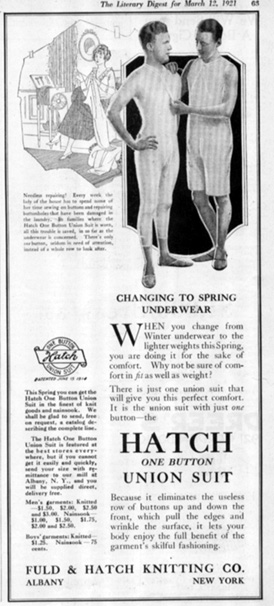
That same year (1921), Hatch advertised its one button union suit with a two-thirds page black and white ad (Figure 4).  Two pretty men standing very close to each other draw all eyes to their interaction.  With an hourglass body, the one on the left has his right hand on his hip in a most unmanly manner.  Meanwhile, the man on the right has his right hand on the other’s shoulder and his left touching the man’s chest.  The way they’re drooling over each other as caught at this snapshot in time leaves little question about what’s on their minds and what they intend to do about it. 

The Focus Shifts

As the industry turned the corner, making inroads through the 1920s, its emphasis began to shift towards convenience, comfort, and value.  Perhaps no other company better synthesized these concepts in its market positioning as Topkis Athletic Underwear. 

If B.V.D. had its boys preening and admiring each other as the company’s advertising developed, Topkis — whose very name conjures up a talisman capable of girding one’s loins — distinguished the different men pictured in each of its ads not as playful, peek-a-boo boys but more mature and fully functional men capable of carrying on life’s affairs and, perhaps even, a relationship with each other. 

Moreover, B.V.D. may have been the market leader in men’s underwear back then but Topkis had its own marketing strategy and unique selling proposition: value.  In fact, nearly all Topkis ads emphasized how much quality you got for just a dollar!

A young man formally dressed in a suit, white shirt and tie sits backwards on a chair ogling another youthful gentleman wearing only his underwear in a half-page, black-and-white Topkis ad published in 1921.  Even though it’s only early fall, the headline warns, “Your skin must breathe in winter, too.”  Mid-way through the copy, however, we find out that “The way to let your skin breathe properly is to wear the Topkis Athletic Union Suit all year ‘round.”  Soon, the brand’s positioning statement appears: “It’s the biggest underwear value your dollar ever bought.”  That being said, a rationale for the graphics still must be questioned:  Why are two young men — one fully attired, the other only in his underwear — sitting that closely together and smiling so playfully at each other?

Unlike the iconic B.V.D. boys who appeared in each of the brand’s advertisements we’ve seen, different men participate in the action of Topkis. 

Once again, a fully and formally clad gentleman is seated backwards on a chair and seriously contemplating a young man — this time standing with a brush in his right hand, his left hand ruffling through his hair — in a 1923 ad of the same size and graphics.  The Topkis positioning statement is prominently articulated in the headline: “You can’t beat Topkis at double the price.”  Advertising copy continues to belt home the fact that, regardless of the price, no athletic underwear beats Topkis for quality or value.  Succinctly stated at the end of the ad:  “Why should I pay more, when I can get Topkis for a dollar?”  Copy is convincing and market-driven.  But what’s the story of the two men in the picture?  Why does it seem that one is standing in the footlights, “auditioning” for the other?

“Topkis is worth lots more than a dollar,” insists the headline of another Topkis ad, also published in 1923 (Figure 5).  Evidently, the handsome man looking intently at the binoculars he’s holding — possibly a gift from the chap dressed to the nines in a sailor’s jacket, cuffed slacks, cap, white shirt, and bowtie who’s seated in front of a ship’s porthole — is worth lots more than a dollar, too.  From the following copy, it’s obvious that the clothes-horse is used to paying the price for what he wants and that he’s used to having his way:  “An athletic union suit has to be a good bit above the average to satisfy me,” he says.  “It must fit me without either skimpiness or bagginess — the material must be of good quality — and I insist on long service.”  We learn a bit more about him, too, in his following revelation: “I’ve been accustomed to paying fairly stiff prices to get the kind of underwear I want.  But no more!  Topkis gives me everything I could ask for—and at One Dollar!”  Are the binoculars a gimmick or prop … or are they a bribe, a teasingly tempestuous toy that will figure more prominently into whatever may happen next between these two swains?

The beat goes on as another debonair young man, hat in hand, admires the virgin-white Topkis athletic underwear exposed when his cute friend removes his bathrobe.  Unlike the previous ads, both men are standing here.  This half-page ad, which ran in 1924, bears the headline: “Dollar Topkis worth more say the men who wear it.”  Why, just ask any man who wears it and he’ll tell you “the way to be sure of getting the most for your money when you buy underwear is to look for the famous Topkis label.”   Maybe that’s what the well-groomed dandy is looking at here: the Topkis label?  But where, exactly, is that label?  Following the gentleman’s line of vision, the label must be directly below the belly button, somewhere above the crack in the shorts!  

Two months later, Topkis ran a half-page ad featuring two other men.  A hunky stud in all-white undies begins to unbutton his athletic underwear in the April 1924 ad’s foreground, as a shorter and somewhat stoical cohort — maybe his butler or valet? — is standing nearby.  Dressed in dark colors, he uses a brush to remove any lint from the jacket he’s holding.  For some reason, the guy appears subservient and not too happy.  Maybe it has something to do with the book on the bench between them with its pages open to a particular passage?  Though the darker man’s face has turned in the direction of his client or patron, he stands with an arched back angled away from him.  “One dollar — and a dollar never bought more value,” heralds the headline.  Perhaps any acrimony (rightly or wrongly) perceived in the ad can be attributed to the following copy.  “No good dealer asks more than One Dollar for Topkis.  Many will tell you it’s worth more.”

And the Boys in the Brands Played on …

As the underwear battles continued throughout the 1920s, one maker’s attributes and the qualities that set it apart from another manufacturer’s jockeyed for market position.  Whether it was Wilson’s, Hanes, B.V.D. or Topkis, the boys in the brands played on.     

Hanes had the anti-squirm shorts with the seamless seat, but Topkis underwear boosted the roominess, allowing men to move in comfort:  “Why, man, Topkis lets you forget you have underwear on!  Fit?  It sure does!  Roomy, easy — never a hint of skimpiness anywhere,” claimed a company ad published in 1921.  “In your most active hours or work or sport, as well as your moments of rest, Topkis gives your body full freedom.  Seats open easily.  Drawer legs don’t creep up.”

About a decade later, in a statement to fashion-conscious men of the time, an Arrow underwear ad (Figure 6) appearing in the Spring 1933 issue of Apparel Arts: Fabric & Fashions skirted the delicate line between being Gay … but not too gay:  Two handsome jocks in a locker room (either dressing or undressing) evidently are pleased with the virtues of their underwear.  “And now the Shorts with the Seamless Crotch go Gay!  (BUT NOT TOO GAY),” we’re happy to learn from the headline, as the text’s message extols the “greatest contribution ever put in shorts—the seamless crotch.”

 After all, who wouldn’t be glad to say goodbye forever to binding … bunching … climbing … and cutting?  What’s more, Arrow now has taken its seamless crotch to new heights of haute couture by adding color “that makes men blush in the locker room,” according to the ad.

Homoerotic or Simply a ‘Gay’ Trompe L’Oeil?

Advertising is typically designed to convince us to buy a specific product or service, whether for the first time or by switching brands.  In pursuit of consumers, themes such as vanity, vitality and pleasure are strategically communicated.

So, what can we conclude from these early years of underwear advertising … before gay-specific images became so prolific?  That ads infused with same-sex imagery and intimacy simply stood out and caught the readers’ attention because they were oddly dramatic or hinted at homoerotic themes?

Or is it all but a devotion to smoke and mirrors, a razzle-dazzle gay trompe l’oeil?  Exploring, explaining and extolling the homo-eccentricities of these ads, perhaps what we see here is just a curious byproduct of the author’s misguided imagination?

No; the trail of evidence is quite clear: Discount, if you will, some of these ads as funny fabrications and fantastic stretches of the imagination.  Remaining is a large number of advertisements that, without question, are indicative of sexual and/or emotional intimacy and contact.  They’re more than a matter of pure camaraderie or platonic companionship between members of the same sex.

These men’s underwear ads from the early 1900s are suggestive … with homosexual imbroglios and innuendo teasing at us amid the subliminally seductive elements perceived and quixotically portrayed.

Obviously, the time wasn’t right for Madison Avenue to launch a concerted effort to court and woo the homosexual consumer … for this market and constituency didn’t yet dare to speak its name.  It wasn’t defined or measured and the power of its purse strings hadn’t been imagined — qualitatively or quantitatively.  Nor were the media yet in place to target the community of gay consumers efficiently, effectively … or even legally!

Looking back at them now through the trajectory of time and prism of exposure, we’re tempted to presume that some of the people — or activities — depicted were, in fact, Gay … or, at least, given the circumstances, that they found themselves involved in actions, activities, situations and/or environments we’d label today as “gay.”

“Even in ads intended to appeal primarily to heterosexuals, there may be a homosexual subtext,” opines journalist Georgia Dullea(1992).  

Now that’s the real givvies on the skivvies!

A Professor of Communication focused on Gay and Lesbian Studies, Bruce H. Joffe taught such courses as “Foundations of Gay & Lesbian Studies” and “Studies in Gay and Lesbian Communication” at George Mason University (Fairfax, VA) before relocating to Virginia’s Shenandoah Valley and joining the faculty of Mary Baldwin College (Staunton, VA) where he continues to explore sexual minorities, the media, and cultural norms.  This article is based on the research Dr. Joffe conducted for his book A Hint of Homosexuality? ‘Gay’ and Homoerotic Imagery in American Print Advertising. 

Processing…
Success! You're on the list.

California Dreaming

“The pithy, punchy line ‘Portugal is the California of Europe’ resonates for a lot of West Coasters,” writes Becca Williams in The Portugal News. “The two bask in look-alike sweeping coastlines (Cali with 840 miles, Portugal with 1,114), undulating hills, mountains, valleys, deserts, and forests. Both share a rich biodiversity up and down the coast of plants and animals in varying climates and landscapes with wine regions flourishing in each.”

Portugal’s sunny Algarve coast is often branded the “California of Europe.” Although Portugal experiences more hours of sunshine per year than California, and its winter is less harsh, their weather is relatively similar.

While some compare California to the Algarve, others look to Lisbon, the capital city, when seeking to put down roots in “Portugal’s California.”

Then, too, there are undeniable similarities between San Francisco and Lisbon, from iconic bridges to quaint trams and hilly landscapes. Comparisons between the two cities run deeper than that, with some people wondering whether they are twin cities. And then it hits you: Lisbon is a sister city to San Francisco. The older sister city. Identical in nature. Steep, narrow, winding residential streets. Well adorned buildings, and great, big bridges. 

“It seems like an odd choice, doesn’t it?” Madonna quipped after moving from London to Lisbon in 2017. But lately, Portugal has become a vital destination for Californians in search of reinvention and rejuvenation, says Jonathan Littman in his LA Magazine story about Portugal. “A nation that once split the globe with Spain, then lost relevance for centuries, is the new chic spot to grow a startup, forge an international team, buy an apartment, or truly live. The cost of living is less than half that of California, dinner for two runs about $25, good vinho de supermercado is cheaper than our state’s bottled water, and the work-force malaise and politicization of the pandemic that gripped the Golden State and the nation are refreshingly absent.”

“Lisbon pulses with a vibrant expat community,” he continues: “Brazilians, French, Ukrainians, Brits, Africans, Italians, and, increasingly, Californians. Scarlett Johansson bought a flat in the city’s tony Principe Real neighborhood; fellow superhero Michael Fassbender scored a $2 million apartment overlooking the Tagus River. John Malkovich was so smitten he delivered a video mash note: ‘a feast for the eyes … the architecture and the variety of it, the colors, the landscape … great culture, great people, great food.’

“Portugal’s newly arrived celebrities are symbols of a larger diaspora in the making,” Littman concludes. “U.S. emigration to Lisbon and Porto leapt 33 percent in the year before the pandemic. And that quintessential California experience, the tech confab, is back … in Lisbon with the massive Web Summit conference, its in-person status a product of a nation that now boasts an 89 percent vaccination rate, the world’s highest. Once Europe’s budget-vacation destination, Portugal is now Europe’s top tourist spot several years running.”

While not to begrudge Littman and others of their fondness for Lisbon and Portugal’s coastal cities, the adulation doesn’t begin or end there.

Take Portugal’s central cities: Do any deserve the recognition and regard of the Midwestern USA’s? Different though they may be, are there places in Portugal like Chicago, Madison, Cincinnati, Philadelphia and Pittsburgh, Ann Arbor, Omaha, Indianapolis, Minneapolis, Rochester, Des Moines, and Kansas City?

Yes, indeed there are!

Coimbra, Peniche, Aveiro, Castelo Branco, Monsanto, Óbidos, Ovar, Espinho, Vila de Rei, Leiria, Caldas da Rainha, Viseu, Almeida, Tomar, Fátima, and Évora immediately come to mind.

You’d be forgiven for associating Portugal with and tourist resorts. Yet for many expats, the Portugal they know and love is a world away from these sun, sea, sand, golf course stereotypes. The peaceful mountainous landscapes of central Portugal are a world away from the bright lights and relentless energy found in Lisbon and Porto.

“Much of the region is the very definition of unspoiled, both in terms of landscape and lifestyle,” writes Ben Taylor in Portugal Property Guides. “The ancient villages dotted throughout the undulating verdant surroundings make it appear as if time has stood still.”

Rural getaways in the countryside between the city of Coimbra and the Serra de Estrela Natural Park are particularly popular. In this region, new arrivals tend to learn Portuguese out of necessity. This enables them to integrate more quickly than in places like the Algarve, where English is widely spoken. Although plenty of expats are scattered around the area, it’s more likely that your neighbors will be Portuguese–which is exactly what most people who choose to move to this kind of area prefer.

Even east coast Portugal has its worlds of wonder. Among them: Elvas, Belmonte, Chaves, Monsaraz, Almeida, Marvão, Vila Viçosa, Vila Nova de Cerveira, Montalegre, Figuera de Castelo Rodrigo, and, of the Alentejo region bounded on the east by the Spanish frontier. While these may not have the same name recognition as such east coast USA cities as Atlanta, Atlantic City, Boston, Charleston, Charlotte, Hartford, Miami, New York, Portland, Philadelphia, Providence, Richmond, and Washington, DC, what they may lack in nomenclature is offset by history and charm.

The lyrics of California Dreamin by the Mamas and Papas have absolutely nothing in common with the realities of Portugal: All the leaves are brown. And the sky is gray. I’d be safe and warm If I was in L.A. If I didn’t tell her, I could leave today. California dreamin’ on such a winter’s day.

Nonetheless, the California Dream is a concept with which we all are familiar: dreaming about being free and away from hardships, a popular phrase used in the 1960s during the Vietnam war and the Civil Rights movement.

Seeking to strengthen connections between Portugal and California through surfing and conservation — with initiatives linked to sustainability and the blue economy — the Portuguese consulate in San Francisco hosted a conference organized by the consulate and TMA Blue Tech, bringing together an audience of surfers and academics from the University of California San Diego (UCSD).

“As I often say, California is Portugal on steroids,” said Pedro Pinto, in an interview with Lusa/The Portugal News on the sidelines of the ‘Surf Industry Sustainability Initiatives’ conference held in San Diego (USA).

“It’s four times bigger, [it has] four times more population, but there are many similarities and a natural empathy,” he mused. “This is something that we work on—to promote synergies … mutually beneficial at a political and economic level, a macro level, but it is also important to do this at a local level.”

With the similarities, he said, also come common challenges. “One of them is coastal protection, another is the use of offshore renewable energy. It’s something we see more and more with relevance, this connection between Portugal and California, and [we] also want to promote this through surfing.”

(The San Diego event kicked off the Global Wave Conference between Peniche, Nazaré, and Ericeira from October 2nd to 4th, 2023.)

Yes, there are similarities between California and Portugal. But regardless of where you’re from, you can find cities, towns, and villages in Iberia that remind you of physical aspects of America once that “if only …” qualifier is factored in.

We should look to Portugal for what it is, not what it isn’t: California or a replica of anywhere else!

Bruce H. Joffe is publisher and creative director of Portugal Living Magazine.

Processing…
Success! You're on the list.

Are Americans ‘Flocking in Droves’ to Portugal?

In a word, no.

“For the seventh year in a row, the immigrant population in Portugal has increased, totaling 752,252 in 2022,” writes Lara Silva in in Portugal.com. “According to the Immigration and Borders Service (SEF), there was an increase of 58,365 immigrants in comparison to the year prior (2021), an 8.3% increase.”

The largest growing immigrant populations in Portugal in 2022 were from Brazil and India. The Brazilian community remains the largest immigrant population in Portugal, with over 230,000 people, a 13% increase since 2021, according to Silva (and SEF). The Indian community also increased by 13% to around 34,000 residents, making it the fourth-largest immigrant population in Portugal.

According to SEF, the 10 largest immigrant populations in Portugal are:

  1. Brazil (233,138)
  2. United Kingdom (36,639)
  3. Cape Verde (35,744)
  4. India (34,232)
  5. Italy (33,707)
  6. Angola (30,417)
  7. France (27,614)
  8. Ukraine (26,898)
  9. Romania (23,967)
  10. Nepal (23,441)

Nowhere near that figure are (North) Americans–whether from the USA or Canada.

Data from the Portuguese Immigration and Border Service show that only 216 of the 1,281 foreigners granted permanent residence in Portugal in 2022 came from the United States. Overall, we make up less than 1.5% of the country’s total immigrant population. Statistically, we don’t move the needle.

So, why are the Portuguese increasingly pointing fingers at Americans as the source of their malaise … unable to afford the costs of living in their own country?

Frankly, it’s a matter of politics, not pocketbook economics or immigration.

Brazilians are the most prevalent foreign nationality. The 239,744 resident Brazilians represent 2.29% of the total population. Other significant foreign communities (excluding naturalized citizens) are the ones from other countries of the Lusosphere. In 2023 there were 110,517 from PALOP countries (Equatorial GuineaGuinea-BissauSão Tomé and PrincipeAngolaMozambiqueCape Verde) as well as from Timor-Leste and Macau, corresponding to 1.06% of the total population. In addition, there is a thriving community of people from the Indian subcontinent (chiefly Indians and Nepalis) adding up to 86,698 people or 0.83% of total population. A number of EU citizens have also chosen Portugal as a destination, with the majority being part of the British, Italian, French, German, Spanish, Dutch, Belgian or Swedish communities. These communities are mostly composed of persons looking for quality of life and include an increasing number of pensioners.

Again, no mention of Americans.

It is important to acknowledge that Portugal has become a great destination for expats, digital nomads and international investors looking for a stable country to reside and invest. It is a safe country, with “comfortable” weather, stunning pristine beaches, and an effervescent cultural scene, making Portugal a hotspot for foreigners seeking a great place to emigrate. The friendly population, universal health coverage, free public schools system, and receptive policies, likewise, are elements that define Portugal as among the better destinations for a foreigner to live and grow roots. Even the language is not that a great barrier, since Portugal has one of the biggest English populations in Europe and offers a free translation service available through a simple phone call

Because of the few Americans they’ve come across daily, many Portuguese people assumed that everyone who speaks English is British. Thanks to the USA’s massive media machine and social media, now almost everyone who speaks English is assumed to be American. Articles come out almost daily saying Americans are driving up housing prices, putting Portuguese people out of their homes. It’s beginning to feel as though (some) Portuguese people resent Americans and have stopped welcoming us to their country.

Truth be told, Portugal is being oversold.

Professionals are pumping up the rhetoric and joining the bandwagon of those selling Portugal. Grocers specializing in food products generally hard to find ship them to your doorstep. Therapists deal with post-expat syndrome and other unsettling behaviors. Lawyers cater to the big slice of business that comprises the market of people needing NIFs, bank accounts, and houses. Property agencies are a dime a dozen. Relocation experts promise to facilitate the transition. Packed tighter than sardines in a tin are webinars, blogs, vlogs, and YouTube channels catering to expats, immigrants, and foreigners. We have countless scores of people and groups teaching Portuguese in a variety of formats. Others arrange round-trip scouting trips to the destination(s) of client interest(s), as well as charter flights bringing people and their pets to Portugal. Customized trips and tours are at your disposal, as are money lenders and currency brokers. Portugal itself is subsidizing numerous public relations undertakings that lure people — tourists, travelers, and residents — to its land of the fado and saudade.

Yesterday, I posted an article on my personal Facebook feed about our budget and expenses here in Portugal. (We spend significantly less and have a greater quality of life than in the USA.) Immediately, I was attacked: “Enough! You should know better because you live here. Don’t encourage any more Americans to come here … you are making it impossible for the Portuguese people to live in their own country,” indignantly came a response in Portuguese. Angry, belligerent, and frustrated, she demanded that I remove my post. With nasty, condemning words, she pointed a finger personally at me for failures of a society.

I can understand her frustrations.

“There are probably all sorts of reasons to resent US citizens, starting with our last 50 or more years of foreign policy,” writes Barbara Grassey. “Reality TV is a good reason, too. The MAGA mentality is seen as naïve and offensive. Fortunately, Portuguese people mostly find the things we do odd, more than something that needs to be resented.”

Inflation and housing prices are going up everywhere.

Are Americans driving up the prices?

Americans may be more willing to pay higher prices for housing because their frame of reference is US housing prices. But there aren’t enough US citizens in Portugal to be the sole driver (or really any kind of driver) of higher housing prices.

Part of the problem is that wages are low here. Portuguese minimum wage is €887 per month or about $967–the lowest in western Europe. In Portugal’s larger, preferred, and coastal cities, the average rent for a one bedroom begins at €600 to €700–and more. One thousand euros seems closer to average. So yes, just like in the US, people making minimum wage or a little more cannot afford housing in areas where their families have lived for generations. That is bad and wrong, no matter what country you’re in. Jobs are in the cities; affordable housing is outside the cities. Americans coming in with remote jobs or retirement income are better able to afford these places, but even some of them are looking outside the cities due to the skyrocketing rents.

Will this housing problem be resolved? There are no quick and easy solutions, but the Portuguese government is making moves to help keep costs down. 

Some of the housing upheaval has been caused by corporations buying up large numbers of apartments in major cities and tourist areas for Airbnb-type rentals. A new law put in place bans short term rentals (read: Airbnb) in residential buildings where people live permanently. An Airbnb host can make a lot more money with overpriced short term rentals than s/he can on an annual rental agreement. This new law should limit the number of Airbnbs and create more permanent housing for residents, which will hopefully stabilize rents and perhaps cut the ROI for overpriced units, making them a bad investment. While I don’t expect prices to go down, hopefully it will stall some of the huge price jumps and settle the market.

The Portuguese Golden Visa program also has changed its requirements to encourage investment outside of the popular cities where Portuguese are being priced out of housing. Minimum investment for a Golden Visa has been raised to €500,000 and, if you’re investing in residential real estate, you are restricted to buying in the interior of Portugal (not in popular coastal areas like Lisbon, Porto, and The Algarve) or Madeira and the Azores. The “record numbers” of US citizens receiving Golden Visas in 2021 was 102. Few Americans are arriving waving wads of cash and screwing the housing market.

Also to be considered is Portugal’s debt.

“While the troika (comprising the European Central Bank, the European Commission, and the International Monetary Fund) was determining Portugal’s fate, China was busy buying Portuguese companies,” charged writer Jochen Faget. “That trend has continued. Is the EU member on the road to economic and political dependence?”

“At one time the Portuguese power company Energias de Portugal (EDP) was a proud state- owned company with more than 25,000 employees. Soon it could be a lucrative corporation owned by the Chinese,” Faget predicts. China Three Gorges (CGT), a state owned power company which already owns a quarter of EDP, has made a takeover bid on the Lisbon Stock Exchange, intending to buy the remainder of the company’s stock.

It’s part of a ‘master plan’ with which the People’s Republic wants to take over key areas of the Portuguese economy, warn critics. The Portuguese government, on the other hand, says that the Chinese are just as welcome as any other foreign investors.

The chronically cash-strapped government of hard hit Portugal is pleased with the Chinese financial injections — especially since they helped the country at the western end of Europe through the tough troika (made up of the European Central Bank, the European Commission and the International Monetary Fund) period. The Chinese even stepped up during the crisis and bought — as no one else did — Portuguese government debt.

Today, the Portuguese insurance company Fidelidade belongs to the Chinese Fosun Group, just like the highly lucrative private clinic operator Luz Saude. Fosun also controls a quarter of the Millennium BCP Bank. Haitong bought the investment bank BESI for €379 million ($423 million at the time).The HNA Group became a junior partner at the airline TAP. The Portuguese power grid operator REN is now part of China’s State Grid International. In Sines, south of Lisbon, a barely used deep-sea port is being expanded by Chinese companies.

Chinese investment raised through golden visas totaled 433.7 million euros between 2020 and July 2023, with eight visas granted that month, according to SEF data, reports The Portugal News

“The Chinese are investing mainly in finance, insurance and banking, as well as infrastructure,” said Ilidio Serodio, vice president of the Portuguese-Chinese Chamber of Commerce in the capital.

Meanwhile, a total of 78% of US companies anticipated new investments on Portuguese soil, according to the most recent Barometer of the American Chamber of Commerce in Portugal cited by The Portugal News in March 2022. “In a universe of around 1,000 American companies in Portuguese territory – which employ close to 50,000 workers – 75% believe their turnover will increase this year, while 25% predict that it will continue. Regarding investments, the trend is similar. A total of 78% of US companies anticipate new investments on national soil, with 19% not expecting to make any investments.”

Whether capitalism or communism, Portuguese nationals are less concerned about corporate buyouts and takeovers … unless they’re directly affected consequentially. Isn’t it easier to take umbrage at individuals collectively than at multi-national corporations?

As is unfortunately true in many nations worldwide — especially in western Europe — the growth of alt-right politics always requires a scapegoat for its purposes and propaganda:

Americans.

But let’s not forget that Americans, especially the USA, historically have been welcoming of Portuguese immigrants.

In 1957–58, the Capelinhos volcano erupted on the Azorean island of Faial, causing massive destruction from lava and smoke. In response, then Senators John F. Kennedy and John Pastore co-sponsored an Azorean Refugee Act. President Dwight Eisenhower signed the legislation in 1958, making 1,500 visas available to victims of the eruption. An extension was enabled in 1962, providing opportunities for even more Portuguese immigrants. According to the United States Census from 2000, there were 1,176,615 Portuguese-Americans, the majority being of Azorean descent.

This led to the passing of the 1965 Immigration Act, which stated if someone has legal or American relatives in the United States, they could serve as a sponsor and, therefore could be a legal alien. This act dramatically increased Portuguese immigration into the 1970s and 1980s. Today, a national organization — PALCUS — represents Portuguese-Americans.

By and large, we don’t want to be those “ugly Americans” of lore.

For the most part, Americans who move to Portugal tend to be respectful and sensitive. We don’t want to change Portugal. Someone who moves anywhere and starts a sentence with “Well, back home we did it like this …” is not going to be happy and will most likely leave.

Actually, many of them do.

Portugal Living Magazine Publisher Bruce H. Joffe has lived in Portugal for almost six years.

Processing…
Success! You're on the list.

A Victim of Internet Thieves

The name on her Portuguese bank account is “Lucilla Sous.” On the Certificate of Delivery for the car I purchased from her online, she’s identified as Fernandes Da Silva Câtia. And according to her Facebook profile — which shows that she moved with her family from Barcelos in Braga (Portugal) to Valence, Rhone-Alpes (France) in January this year — she goes by Catia Vanessa Rego Barbosa.

No matter.

Spanish and Portuguese people, especially, are given and take on any number of names. In our *correspondence, I just called her Vanessa.

I first contacted her late in July 2023 for more information about a car she had listed for sale. It was advertised on a number of sites, which, by now, had been scrubbed. But the ad is still listed here. It’s a 2008 X-Type Jaguar 2.2 diesel with about 203,500 miles on the odometer, not bad for a 15-year-old car in the European Union. And this one was loaded: GPS Navigation, leather seats, moon roof, front and rear parking sensors, leather upholstery, heated seats, sports suspension … literally everything available in that model and year. As can be seen in the top photo above, the car was said to be “Como Novo” … like new.

This was to be a “new” toy for an old man (me), who had been infatuated with the sexy Jaguar X-Type (2004-2008 models) I had owned — new and used — between 2004 and 2017 while living in the USA. Unlike the American versions which came with all wheel drive, large V6 (3.0) gasoline engines and muscular “leapers” on their “bonnets,” the EU versions were mainly diesel, front wheel drive, and unadorned with machismo. Produced on the east side of the pond between 2001 and 2009, the gas (petrol) version was known to be a gas-guzzler, while the diesel engines were stronger, lasted longer, got far better mileage, and — strange as it seems — emitted less carbon into the atmosphere. Introduced in in mid-2005, the 2.2 diesel engine was superior in many ways to the smaller 2.0, according to reviews.

I had done my homework and knew that the advertised price of €3,000 for a car of this description was extraordinary; people in Jaguar X-Type groups couldn’t believe it and suggested I buy it and then flip it for twice the price.

If it’s too good to be true, trust me: it probably is!

Vanessa said that the car had been in storage since they moved to France and no longer had any need or use for it. She wanted a quick sale which she believed would be difficult, as the car would need to be transported from France to Portugal (where the car was still registered and had nine months left before its next required inspection) at extra cost: €906, which she would split with a buyer.

The storage agent/transporter also went by several names: On their website, the name is DL Transport Logistics, although their URL is dimilogistics.com. Their French bureau is headquartered at 4th avenue, C Saint-Denis, but the office I would be dealing with is elsewhere in France—at 19 Rue Henry Bordeaux, 74000 Annecy. The company also has an office in Luxembourg. Stamped on documents I received from it was DIMI Logistics Transport, although they referred to themselves as DLT. So did I.

From everything on their website, they appeared to be legit. No bad reviews (I searched) and a robust series of services.

Then, again, what did I know? Although I could understand and reply to emails with Vanessa in Portuguese, I had abandoned any French more than 50 years ago and needed to rely on Google Translate with a bit of tweaking to communicate with DL Transport Logistics.

On 15 August, I agreed to purchase the car and transferred €1,453 to Vanessa (aka Lucilla Sous). We agreed €1,000 would be a deposit on the €3,000 car and she’d transfer €453 to the delivery agent as my half of the transport fees to bring the car from France.

The next day (16 August), I received a flurry of documents from DLT, four in all: delivery information, a transport form, a delivery contract/guarantee, and – of course – an invoice. The documents informed me when the car would leave the facility, when it would arrive at my home, how it would be transported (by truck), the driver’s name, terms and conditions. Buried somewhere in the fine print was a statement that an additional €3,000 deposit, refundable three (3) days after the car was delivered, must be paid before the car could leave. Search as I did, I couldn’t find it.

I emailed Vanessa about this.

“Yes,” she agreed. “It’s additional insurance … for the truck, or the car, or the driver, or the person who’d be accompanying the driver. I’ve already transferred my €1,000 to DLT.” Vanessa insisted it would be better – and quicker – if I transferred the €2,00 to her for immediate transfer to DLT. “That way,” she proposed, “you won’t have to pay anything more when the car arrives. It will be yours.”

No, I demurred, I’d rather stick to our original agreement. So, on 16 August, I transferred €2,000 via immediate payment, as required, to DLT.

“The car will be delivered to your home on 19/08/2023 at 16:30,” said the email I received from DLT. “The order has already been given to the courier in charge of ordering this car for delivery. In accordance with the method chosen by the sender, the transport company takes a guarantor in the car to the agreed address. The courier will depart on 16/08/2023 at 18:45 (French time) and we will progressively inform you of your journey so that you become available to receive the car.”

My delivery, however, was cancelled the next day. Neither DLT nor Vanessa informed me of this; I learned about it through my bank online: DLT had refunded €2,000 to my account.

Responding to my “what happened?” email, Vanessa said, “Since yesterday we have a problem with the transport company that I am trying to resolve with my husband. We are doing everything in our power to resolve the situation and the transport company will continue with the delivery. So, don’t worry!”

But the weekend intervened.

On Monday, 21 August, I heard again from Vanessa. Insisting that the matters between her and DLT had been resolved, she stated that it would be best and most expedient for me to send her the €2,000 deposit, which she would transfer immediately to DLT. DLT agreed. But I refused. Instead, I sent €2,000 a second time to DLT via immediate transfer.

That same evening (21 August), the delivery was again cancelled by DLT. Again, I wasn’t told about the cancellation, but learned about it from the refund to my bank account. This time, however, there were differing accounts about what had happened.

According to DLT, the car had been stopped at the border between Spain and France because Vanessa had seven unpaid fines and tickets.

“Normally, I would forward messages from the carrier to you,” wrote Vanessa. “But the situation does not concern you. The car was stopped at the France-Spain border, and I have an unpaid fine that I must pay before the car is released. This is not the shipping company’s fault or your fault. But … I will resolve the situation. I hope you understand.” The next day (Sunday), she added, “I already fixed the problem. Tomorrow, the carrier will pick up the car and continue the delivery. I have resolved the situation and I think you will have the car tomorrow or Tuesday at the latest.”

Strange. What government agencies work on Sundays … or Saturdays, for that matter? Where was the courier and why was he to pick up my car the next day? Where was the car? And why was the car stopped and inspected when it was supposed to be inside a truck?

An hour later that Sunday, Vanessa sent me another email: “They (DLT) required (a) deposit to make an express delivery. It’s just an additional 78 euros. I will pay tomorrow morning. As they are late, they offered express delivery so the car (would be) delivered quickly.”

That was in addition to the €2,000 deposit which I would need to send DLT for a third time.

Once, shame on you; twice, shame on me! DLT had already refunded my €2,000 deposits–twice, which instilled a sort of confidence in me.

I exchanged a series of emails with Vanessa the following morning, notifying her that I no longer wanted the car. I said I didn’t trust her. She pleaded with me to finalize the purchase and had the transport company contact me to assure me that all was well. And again, I was told by DLT and Vanessa that the delivery would be expedited – and move forward – if I sent the €2,000 to her for immediate transfer to DMI. Still, I refused. This time, DLT gave me a Spanish account and IBAN in the name of Ribeiro Sampaio SC (a Portuguese, not Spanish, spelling) they told me was theirs to transfer the €2,000 deposit … which I did.

I didn’t hear from Vanessa again, but on Tuesday, 22 August, I received a series of email notifications from DLT:

“The driver is not in possession of the delivery document; the act of delivery will be sent to you at 6 p.m. by email. The driver will start in a few minutes. After his departure the delivery time will be given to you. But the driver will drive a maximum of 9 hours.” (12:44 PM)

“The estimated time for delivery to your home is 7 hours 54 minutes. The driver has already left. Thanks.” (1:33 PM).

“Can you suggest hotels near you?” (3:26 PM)

“The driver has just crossed the Portuguese border. He will take an hour’s rest before continuing on his merry way.” (5:22 PM)

• At 6:58 PM, I asked, “Where is he in Portugal please? I’m trying to visualize the route he’s following.

“One moment please…” came the reply at 7:01 PM. “About 1 km from the Quintanilha border. He’ll be back on the road in a few minutes.”

• “That’s about 5 hours to us in Vila Boim,” I replied at 8:10 PM. “Do you still intend to deliver the car tonight? Should I stay awake and wait…or will you deliver the car tomorrow?”

“There are two hours left for the driver to come to your home,” came the reply at 11:28 PM. But the time it is it will pass tomorrow before 9am. Stay connected …”

• At 10:09 AM Wednesday, the car hadn’t arrived. I sent this email: “I’m starting to worry.”

• The reply came at 10:21 AM: “Good morning. The road police just stopped the car this morning for unpaid tickets. We are currently resolving the problem with Madame Vanessa. You can go to place and check with your own eyes if you want because the car is already on Portuguese territory. Please wait …”

None of this made sense anymore—if it ever did! Wasn’t the transporter stopped days earlier at the France-Spain border for traffic violations Vanessa hadn’t paid? Did she have unpaid tickets both in France and Portugal? Why was the truck stopped again and inspected … with the vehicle’s information conveyed to the authorities, anyway? As alarming as all this seemed, it was complicated by a second email from the driver:

“Your car should be delivered,” I was informed eight hours later at 6:23 PM. “The driver didn’t quickly leave his hotel today; we had trouble sending him money and doing some repairs on the car. Two tires are worn and have been changed. Repair times and the time it takes for banks to receive transfers affect the delivery time. This is the car that the driver drives from the Spanish border to Portugal. The tires are probably worn.”

The pieces began tumbling together. My car hadn’t been transported by truck, as contracted. Instead, it was driven more than 1,500 miles … which I never would have agreed to, given that the car already had 203,500 kms on its odometer. Who knows what had happened to it enroute from France to Portugal? Besides, the company’s own transport document listed “transporter truck” as its mode of transportation!

I had been duped. A victim of Internet thievery … in this case, conspiracy between the seller of an automobile and a transport agent determined to defraud me. I never did receive the car. Nor did either Vanessa or DLT reply to any of my emails. I was out €3,453.

Hindsight is always 20/20, especially when you want and anticipate something so eagerly. Senses dulled, you’re not fully aware of what’s happening. Or isn’t. Or shouldn’t be.

Neither Mme Vanessa nor DL Transport Logistics know me. They have no idea the lengths I will go to see them brought to justice. Already, my attorney in Portugal has been advised. And I’ve made initial contact with police departments in Portugal, France, and the European Union that specialize in Internet crimes.

Hopefully, you’ll never be conned by Internet crime. If you suspect that you have, please bypass those sponsored ads that come up first in Google searches. Despite their promises, some of them can make a bad thing even worse. Instead, be sure to keep careful records, to contact your lawyer, and to touch base with your local police.

If you’ve been swindled on the Internet, you can also start the complaints process online.

In Portugal, Safe Communities Portugal recommends this link: https://www.safecommunitiesportugal.com/report-a-crime-online/swindle-deception

Another Portugal site for reporting cybercrime: https://en.ministeriopublico.pt/en/contato/cybercrime-office

In France, use this link:  https://www.service-public.fr/particuliers/vosdroits/R19620

In the European Union: https://www.europol.europa.eu/operations-services-and-innovation/services-support/joint-cybercrime-action-taskforce

Vanessa and DL Transport have been copied on this report … so that they will know what’s happening when they receive visits from the police.

*I have all correspondence, notices, and documentation referred to herein.

Bruce H. Joffe is publisher and creative director of Portugal Living Magazine.

Processing…
Success! You're on the list.

Rule of Law v. Law of Rulers

Passed by Congress June 13, 1866, and ratified July 9, 1868, the 3rd section of the US Constitution’s 14th Amendment appears as unambiguous today as when it was written:

No person shall be a Senator or Representative in Congress, or elector of President and Vice-President, or hold any office, civil or military, under the United States, or under any State, who, having previously taken an oath, as a member of Congress, or as an officer of the United States, or as a member of any State legislature, or as an executive or judicial officer of any State, to support the Constitution of the United States, shall have engaged in insurrection or rebellion against the same, or given aid or comfort to the enemies thereof. But Congress may by a vote of two-thirds of each House, remove such disability.

Look carefully and reread the first (very long) sentence.

It makes no hint or mention that any elected official who has sworn to protect the Constitution of the United States must be criminally convicted of insurrection. Rather, the words state that those who “shall have engaged in insurrection or rebellion against the same, or given aid or comfort to the enemies thereof …”

Nonetheless, therein lies the crux of debate about what this means today.

Constitutional scholars – both academic and judicial – have researched and studied this clause dutifully, especially in recent years.

A law review article claiming that Donald Trump is automatically disqualified from holding elected office is getting attention in large part because it was written by two conservative, originalist law professors, William Baude and Michael Stokes Paulsen, who argue that Trump should be excluded from ballots for giving aid to an “insurrection or rebellion” in violation of Section 3 of the 14th Amendment.

The Washington Post questioned the validity of the scholars’ thesis: “… although Baude and Paulsen’s originalism is honest and conscientious, originalists outside of academia typically won’t apply their originalism if it leads to a result at odds with their conservatism. Second, there is precedent that contradicts their argument — precedent the scholars dismiss because they say it contradicts the original meaning of Section 3.”

When the 14th Amendment was drafted after the Civil War, the original meaning of Section 3 was that anyone who previously held public office and then rebelled against the US government should be automatically barred from office unless two-thirds of Congress made an exception. This constitutional provision is law and requires no further action by Congress to implement it, the article says. Courts can and should apply it, but we don’t need to wait for them to do so. Any government official, state or federal, whose duty it is to apply the Constitution must obey Section 3. It follows, the authors say, that the state officials who set the ballots for the primaries and general elections should exclude Trump. If he wants to fight that in court, he can. But there’s no need for the officials to await a judicial determination.

“To state this argument is to see why it won’t be followed by state officials,” argued the Washington Post in an opinion piece published on August 20, 2023. “Was the Jan. 6 attack on the Capitol an ‘insurrection’? Did Trump participate or give aid and comfort to the ‘enemies’ of the Constitution under Section 3? These are contentious questions of constitutional interpretation.”

From Trump’s second impeachment to his fourth criminal indictment and his very own words, I believe the answers to the Post’s questions are irrefutable:

Apart from the evidence, the case against Donald Trump engaging in insurrection is clear even by his own words.

According to CNN, Trump called for the termination of the Constitution to overturn the 2020 election and reinstate him to power in a continuation of his election denialism and pushing of fringe conspiracy theories:

“Do you throw the Presidential Election Results of 2020 OUT and declare the RIGHTFUL WINNER, or do you have a NEW ELECTION? A Massive Fraud of this type and magnitude allows for the termination of all rules, regulations, and articles, even those found in the Constitution,” Trump blasted in a post on his Truth Social network and accused “Big Tech” of working closely with Democrats. “Our great ‘Founders’ did not want, and would not condone, False & Fraudulent Elections!”

Trump falsely cited election fraud as a reason to terminate the Constitution, after Elon Musk released information about Twitter’s role in limiting access to a story about Hunter Biden, says Axios.

The irony, huh?

White House spokesman Andrew Bates said that Trump’s remarks are “anathema to the soul of our nation and should be universally condemned.”

“You cannot only love America when you win,” Bates declared. “The American Constitution is a sacrosanct document that for over 200 years has guaranteed that freedom and the rule of law prevail in our great country. The Constitution brings the American people together – regardless of party – and elected leaders swear to uphold it. It’s the ultimate monument to all of the Americans who have given their lives to defeat self-serving despots that abused their power and trampled on fundamental rights.”

Republican Rep. Liz Cheney of Wyoming, an outspoken Trump critic, denounced the former president’s Truth Social statement. Cheney, who served as vice chair of the House select committee investigating the January 6, 2021, attack on the US Capitol, tweeted that, “Donald Trump believes we should terminate ‘all rules, regulations and articles, even those found in the Constitution’ to overturn the 2020 election. That was his view on 1/6 and remains his view today. No honest person can now deny that Trump is an enemy of the Constitution.”

Trump expressed support for the rioters behind the deadly January 6, 2021, attack on the US Capitol, saying in a video played during a fundraiser that, “People have been treated unconstitutionally in my opinion and very, very unfairly, and we’re going to get to the bottom of it.” Further, in a September 2022 interview, Trump said he was “financially supporting” some January 6 defendants and promised he would issue pardons and a government apology to those being prosecuted if he were re-elected.

In the aftermath of the events of January 6, 2021, in and around the U.S. Capitol, there have been calls for accountability for those who participated, as well as for those who may have helped instigate it. The breach of the Capitol resulted in numerous injuries, multiple deaths, and significant property damage. It also delayed Congress’s constitutional duty of certifying electoral votes for President-elect Joseph Biden and caused Capitol Police and other law enforcement personnel to evacuate the Vice President and Members of Congress from the House and Senate floors to safer locations. Some observers, historians, and other commentators are wondering whether the Disqualification Clause of the Fourteenth Amendment might provide a mechanism to disqualify individuals who participated in or encouraged the siege, including former and sitting government officials, from holding office.

“Invocation of the Disqualification Clause raises a number of novel legal questions involving the activities that could trigger disqualification, the offices to which disqualification might apply, and the mechanisms to enforce disqualification,” reports the Congressional Research Service. “The clause has been seldom used, and the few times it has been used in the past mainly arose out of the Civil War—a very different context from the events of January 6. It is therefore unclear to what extent historical precedents provide useful guidance for its application to the events of January 6. This Legal Sidebar describes the Disqualification Clause, explains to whom it might apply and what activities could incur a bar on holding office, and discusses possible mechanisms to implement it.”

The same Congressional Research Service report states, “Section 3 of the Fourteenth Amendment does not expressly require a criminal conviction, and historically, one was not necessary” and indicates that, “Section 3 does not expressly provide a procedure for its implementation other than Section 5’s general authority of Congress “to enforce [the Fourteenth Amendment] by appropriate legislation.”

There might be multiple ways Congress could enforce the Disqualification Clause, including relying on federal criminal prosecution for insurrection and treason, allowing private civil enforcement through writs of quo warranto or other procedures, enacting legislation establishing general procedures for adjudicating disqualification under Section 3, or for identifying specific disqualified individuals, or measures by the House or Senate to exclude or expel individuals from their respective houses.

In the June 7, 2022 issue of Lawfare, Roger Parloff, a Washington, DC-based journalist who was the main legal correspondent at Fortune magazine for 12 years, writes: “It’s extremely likely that at least one of those election officials will find Trump disqualified under Section 3.” Parloff continues, “There is actually a disquietingly strong case at this point that Trump should be disqualified under Section 3 as a factual matter. I say ‘disquietingly’ because the prospect of seeing his name blocked from the ballot in at least some states — though certainly not in others — gives pause in terms of both the violence it might unleash among his followers and the chaos it could bring to the 2024 presidential election. Still, the prospect of his returning to power, notwithstanding all the evidence of his having incited the Capitol insurrection, is even more disquieting.

“The decisions about whether Trump’s name can appear on the presidential ballot will be made, in the first instance, by 51 different secretaries of state. It’s extremely likely that at least one of those election officials — perhaps quite a few — will find Trump disqualified under Section 3. And that will usher in a truly unprecedented and volatile situation,” concludes Parloff.

Mechanisms to implement Section 3 of the 14th Amendment purportedly involve the secretaries of state in each of the 50 states and “territories” where people vote in the USA. The secretaries of state must approve all candidates who appear on the ballot. A single “nay” can – and will – trigger a constitutional crisis, as the election cannot proceed without the approval of all eligible voters.

The case will immediately be presented to the U.S. Supreme Court for adjudication. With three Trump-appointed associate justices, SCOTUS is heavily conservative (6 to 3).

Unfortunately, the media – mainstream and “(un)social” – have paid but mere and passing attention to Article 3 of the 14th Amendment, preferring, instead, to cover the ever-widening web of intrigue surrounding Donald Trump and his supporters from before the 2020 election to today and beyond. In effect, it’s been a case of the spider (Trump) to the flies (the media).

Back in 1964, Canadian communication theorist Marshall McLuhan coined the “Medium is the message” phrase, contending that a message could be construed by any of three ways: (1) The content of the message, per se, could be construed as the message—i.e., it is what it is and says what it means; (2) The messenger, himself or herself, can personify the message incarnate—witness such charismatic personalities as Oprah Winfrey, Michelle and Barack Obama, Hitler, Winston Churchill, John F. Kennedy, and Donald Trump. What they’re saying is secondary to the people, themselves, who are saying it; and (3) The medium is the message in that what’s most important to a message being received and re/acted upon isn’t what’s being said or by whom, but where—on Fox News or MSNBC, on Rachel Madow or Tucker Carlson, in the New York Times or New York Post, on Facebook or Truth Social.

For Section 3 of the 14th Amendment to become the message even before the general election, it’s up to us to use all the media at our disposal: posts on Facebook, YouTube, Twitter, Instagram, LinkedIn, and others … letters written to the editors of the New York Times, Boston Globe, USA Today, Washington Post, Los Angeles Times, and our local newspapers … emails, faxes, and telephone messages sent to our legislators and justices … feedback and questions sent via the websites of cable news shows and anchors, streaming services, and radio speakers.

There’s a lot of rage in this country at a lot of things, so much so that newscaster Howard Beale’s cry in the 1976 film Network, “I’m as mad as hell and I’m not going to take this anymore!” has become a kind of national mantra.  

The Dow goes up. The Dow goes down. Today it’s up. Everybody is smiling. Everybody is happy. Great. Maybe I’m wrong. I don’t think I am, but maybe I am. I think people understand that with all of the spending and the uncertainty from government, we are far from standing on solid ground. But the media seem to be painting a picture of anyone who is worried enough to prepare for the future as crazy. Call them crazy. I’m crazy. You’re crazy. We’re all crazy together.

Bruce Joffe is publisher and creative director of Portugal Living Magazine.

Processing…
Success! You're on the list.

A “Single Market” European Union?

Not with All These Trade Barriers!

The European Union aims to enable EU citizens – and legal residents – to study, live, shop, work, and retire in any EU country while enjoying products from all over Europe. To accomplish this, it ensures the free movement of goods, services, capital, and persons in a single EU internal market.

Sounds like a great idea!

By removing technical, legal, and bureaucratic barriers, the EU also allows people to trade and do business freely in this “single market.”

That’s all well and good. But moving beyond principles to practice, let’s see if and how this market actually works. To simplify matters, we’ll consider just two EU members – Portugal and Spain – and one item to be traded: vehicles.

According to the EU’s Competition Commissioner Mario Monti:

More competition in car distribution leads to lower prices. By finally tearing down remaining obstacles to cross-border vehicle purchases, consumers will make use of the full potential of the single market for car purchases.”

The above quote referred to new EU laws effective October 2003 that would make car sales more competitive throughout member nations.

Even before then, no dealers could be prevented from supplying cars to consumers from abroad, allowing them to make cross-border purchases.

The Commission’s twice-yearly car price report consistently revealed major differences in car prices between EU Member States. A study published for the Commission concluded that the differences couldn’t be totally explained by differences in tax levels.

So, why can’t I buy a car in Spain and register it in Portugal?

Theoretically, I should be able to …

But it just doesn’t work that way.

Let’s begin with buying the car. I’m a legal and fiscal resident of Portugal who wants to buy a car in Spain because there’s a much larger pool of competitive vehicles to choose from there and – bottom line – the prices are substantially lower for cars new and used in Spain than in Portugal.

What does Spain require of people to buy cars in its country? Can I really buy a car in Spain if I’m a non-resident foreigner? The good news is that non-residents can indeed purchase a car in Spain, regardless of their nationality.

Spanish law allows “foreigners” to own a car in Spain. You don’t need to be a resident in Spain to buy a car a Spain, whether new or second-hand, but you will be required to provide proof of address, even if this address is for less than six months of the year. Foreigners who don’t hold Spanish residency cards must present an identity document from their country of origin, if they are citizens of member states of the Agreement on the European Economic Area (EEA) … or a passport or certificate of nationality if they are citizens of third-party countries. It also stipulates that they must provide proof of address in Spain by any of the following documents: empadronamiento (certificate of residency from the municipality where you live full-time or on vacation), or house deeds, or a lease contract. Also required is a Tax Identification Number (NIE).

For those who own property in Spain, this shouldn’t be a problem as an NIE is prerequisite to making any major purchase—i.e., cars and homes. Nonetheless, unless you claim Spain as your fiscal and legal residency, you shouldn’t register as a padrón at your local town hall in Spain because doing so can subject you to Spanish taxes that you shouldn’t be paying!

Do I need a padrón certificate to purchase a vehicle?

“This is a question that continually crops up on our Facebook group page, owning to misinformation from personnel at many vehicle dealerships,” reports Citizens Advice Bureau Spain, a registered charity and Spanish Non-Profit/NPO/ONG organization (Registration nº 11253). “Nonresidents should not be registered on the padrón (unless habitual residents of a town in Spain). Nonresidents, many who own holiday homes here, are entitled to purchase a car … and many do. They are not registered on the padrón. What is needed to purchase a vehicle is your ID—such as passport or ID card and an NIE number. The padrón is a census and could have tax implications for those registering. By being inscribed on the register, you are stating that you reside in Spain.”

Maybe so. But reread the words above carefully: what’s referred to here is buying a car in Spain … not registering it in Spain. Yes, we can buy cars in Spain, but the country won’t let us register, drive, and maintain them there with Spanish plates unless we have Spanish residency. Otherwise, we can buy a car in Spain but register it in our country of residence. In Portugal, for instance, that takes lots of money (especially if the car is less than 15-years-old and you need to pay 23% IVA), time, and patience with the bureaucracy.

Okay, let’s take all this pomp and circumstance and see how or if it works.

I already checked the market for second-hand cars in Portugal online. I found one in Spain that matches what I’m looking for, Virtually the same car – make, model, mileage, year, condition, options, etc. – costs twice the price in Portugal than Spain. So, I send the dealer an email from Portugal saying I want to buy the car. Included as attachments are copies of my passport, NIE, deed to my house in Spain, utility bills, and my Portuguese residency.

The dealer in Spain, however, balks … insisting that I must provide a copy of my padrón from Olvera, the town where our getaway home in Spain is located. I send him a link to the Citizens Advice Bureau declaration, which I translate to Spanish. He refuses to budge, continuing to insist that I must send him a padrón I don’t have. We engage in emails back and forth as I research and report on the issue using Google with Spanish prompts.

Meanwhile, I am engaged in another herculean endeavor: trying to secure insurance for the car so I can drive it. I first contact the insurance agency in Portugal that’s issued insurance on our other car, health, and houses. “We’re sorry, Bruce,” says my agent. “We cannot insure cars that aren’t registered in Portugal. You must obtain Spanish insurance until your car is inspected and registered in Portugal.”

Okay, I think. No problem. I’ll contact the Spanish agency that insures our little pied a terre in Spain. I email our agent, explaining the situation, and attaching a copy of our original insurance policy issued more than five years ago when we bought our first car in Portugal. I also attach copies of the last two year’s renewal bills. Considering that we pay €400 per year in Portugal for comprehensive coverage of a new 2022 Dacia Duster, I’m blown away when our agent in Spain replies with an insurance proposal of €1,263 (per year!) on a 2008 car that would be driven only occasionally. This, from an agency that saved us almost €300 per year on our home and property insurance. The agent tells me that she will contact her superiors and try to do better. She comes back with several offers, all way too much.

Next, I use Google to search for “Seguros baratos para coches en España”–cheap vehicle insurance in Spain. Up pops a list of more than a dozen companies, all with websites and all with online premium simulators after answering a few simple questions. One by one, I visit the companies online and complete their questionnaires. I’m amazed at the results returned, ranging from €240 to about €500 per year. I breathe a sigh of relief: I can get insurance at a reasonable price in Spain to cover my car until I can get it registered in Portugal.

Except, I can’t …

Although the rates look great in their proposals, when I try to purchase the insurance, a few other questions appear: Approximately how many kms. do I estimate putting on the car each year? Will the car be used for business or pleasure? Will I be using it to commute back and forth to work? Is there anyone in my household under the age of 26 who will be driving the car? How long have I had vehicle insurance in effect—from less than one year to more than four? And, finally, what are the last five (5) digits of my current insurance policy?

Diligently, I answer the questions. But suddenly, a new rate is proposed … double or triple the original cost! Six different companies offered me reasonable rates. I went back to my saved proposals and tried to buy insurance from each. Same set of questions to answer, same result from each. Why, I wondered? What’s the problem here?

Turns out the culprit is those last five digits entered from my current insurance policy: They’re from Portugal and aren’t recognized in Spain.

One of the European Union’s comprehensive single market ambitions is what it says about insurance, specifically addressed in DIRECTIVE 2009/138/EC:

(2) “In order to facilitate the taking-up and pursuit of the activities of insurance and reinsurance, it is necessary to eliminate the most serious differences between the laws of the Member States as regards the rules to which insurance and reinsurance undertakings are subject. A legal framework should therefore be provided for insurance and reinsurance undertakings to conduct insurance business throughout the internal market, thus making it easier for insurance and reinsurance undertakings with head offices in the Community to cover risks and commitments situated therein.”

(11) “Since this Directive constitutes an essential instrument for the achievement of the internal market, insurance and reinsurance undertakings authorised in their home Member States should be allowed to pursue, throughout the Community, any or all of their activities by establishing branches or by providing services. It is therefore appropriate to bring about such harmonisation as is necessary and sufficient to achieve the mutual recognition of authorisations and supervisory systems, and thus a single authorisation which is valid throughout the Community and which allows the supervision of an undertaking to be carried out by the home Member State.”

(16) “The main objective of insurance and reinsurance regulation and supervision is the adequate protection of policy holders and beneficiaries. The term beneficiary is intended to cover any natural or legal person who is entitled to a right under an insurance contract. Financial stability and fair and stable markets are other objectives of insurance and reinsurance regulation and supervision which should also be taken into account but should not undermine the main objective.”

In other words, to benefit consumers, insurance companies in member states should cooperate with each other (and their respective states) to facilitate insurance transactions between one member state and another.

Quite a noble objective!

But this 2009 directive isn’t operating 14 years later (2023).

Meanwhile, the car dealership steadfastly refuses to sell me the car without a padrón. Even if I can find a comparable car from a more compliant seller, I still face the challenge of insuring it. To be honest, I now have in hand a document from my Portuguese insurance agency stating that I have had vehicle insurance with them for more than five years, and that I have had no accidents or claims during this time. Hopefully, this document will override the disconnect between the last five numbers of my Portuguese insurance in Spain.

Yet, assuming I could buy a car and have it insured in Spain, that doesn’t account for all I must do to register the car in Portugal.

First, I must have the car inspected by an authorized Portuguese vehicle inspection center. Cost: about €75. Second, I need to go to a customs agency and explain – perhaps in Portuguese – that I want to register my car in Portugal. They will give me a vehicle customs declaration (DAV) form to fill it out and then wait for a response, which usually takes the form of a vehicle tax (ISV), as well as Portugal’s 23% IVA. Cost for my €5,000 car: about €1,250. (In Portugal, the tax value depends on various factors like the level of CO2 emissions produced or the age of the car. I may be exempted from paying IVA only if the car has been in my name for at least six months prior to moving to Portugal; and I must have lived in the country the car is from for at least six months.) I must order a “Certificate of Compliance” from the car manufacturer’s licensed agent to document that the car meets Portugal’s (EU) standards. Cost: about €300. Within 60 days of being issued the Vehicle Customs Declaration, I need to go to an IMT counter with all the supporting paperwork and ask for Single Vehicle Documentation, kind of an identity card for my vehicle. I will also have to bring it to yet another institution, the automobile registry office, to complete the registration process after paying all the fees and taxes. But, first, IMT will need to have my Certificate of Compliance (COC) “homologated,” meaning that my car and its technical characteristics really match the technical characteristics stated in the COC. Supposedly, I will get the homologation after “some days” and, equally amazing, the process is free of charge!

I’m here to tell you that it just ain’t happening …

The European Union operates with the best of intentions. But let’s not forget that the road to perdition is paved with good intentions.

Ultimately, I spent about €3,000 more to buy my second-hand car in Portugal, where it already was registered. There were no taxes to pay, just a form to fill out and about €50 in IMT fees.

Bruce H. Joffe is publisher and creative director of Portugal Living Magazine.

Processing…
Success! You're on the list.

Purge the Evil

If you’re like me, you’ve been seeing increasing media coverage of the climate crisis – including pollution – resulting in death and devastation among creation. How many species have succumbed and died—some by natural evolution, others killed by our wanton ways?

I remember a Bible verse from the Psalms (24:1-2), “The earth is the Lord′s, and everything in it, the world, and all who live in it; for he founded it upon the seas and established it upon the waters.”

Yesterday, the camera chronicled the sudden demise of coral which, in the circle and interconnections of life, protects fish, algae, and our shorelines from the ravages of weather. Coral cannot live in heated waters which recently have risen by more than 1.5 degrees and register 92.5F degrees currently around the Florida Keys.

As often happens, my mind wandered … until stopping at the story of Noah’s Ark.

I could be wrong (especially if we take into account the water turning into blood and the hail, among the ten plagues of Egypt, and the parting of the Red Sea), but I suspect that in the chronicle of Noah’s Ark, we find the first example of climate change and crisis. Remember? According to the story, it suddenly rained 40 days and 40 nights. Noah, his family, and animals entered the Ark on the day flooding began. It lasted 40 days and nights. The waters rose and all creatures, except those aboard, were destroyed.

In this account, Noah labored faithfully to build an Ark, ultimately saving not only his own family, but humanity itself and all land animals from extinction during the flood which God supposedly created after regretting that the world was full of sin.

After 40 days (and nights), the Creator was appeased. Noah sent out a dove, which returned with an olive branch indicating the presence, again, of land. And the Holy One made a promise – a covenant – in which he resets and renews the blessings of creation, reaffirming God’s image in humanity and the work of dominion. “Never again will all life be cut off by the waters of a flood; never again will there be a flood to destroy the earth. I have set my rainbow in the clouds, and it will be the sign of the covenant between me and the earth,” we are told by the author of Genesis 9:11 and 13.

Let’s not miss a vital point here …

Why are we told the Creator caused the flood?

Allegedly, because the world was full of sin.

This seems to be a theme in both books of the Bible, starting with Deuteronomy, whose core is the covenant that binds Yahweh and Israel by oaths of fidelity and obedience: God will give Israel blessings of land, fertility, and prosperity so long as it is faithful to God’s teaching; disobedience will lead to curses and punishment.

Remember: these blessings and curses are specific to Israel.

In Deuteronomy we’re told, “You must purge the evil from among you” (17:7). Several verses later (19:15-20), we are warned again: “Thus you shall purge the evil from among you. The rest will hear and be afraid, and will never again do such an evil thing among you (19). Thus you shall not show pity: life for life, eye for eye, tooth for tooth, hand for hand, foot for foot (20-21).

Despite its Hebrew reference to Israel, the idea of purging evil reportedly continues in the Greek testament with Paul the Apostle – aka Saul of Tarsus, a Pharisee – reiterating, “God will judge those outside. Expel the wicked person from among you” (5:13).

Throughout all his presumed writings, however, Paul’s focus is purging what he saw as the “evils” inside of us, our “sinful” nature … although his Christianity ultimately led to the Inquisition, Crusades, and evangelical bullying. In the Hebrew scriptures, it’s the “other” and outsiders – peoples who worship foreign gods and idols – whom a jealous and zealous god used the Israelites to avenge.

Today, purging evil is paramount in subduing and saving ourselves from the climate crisis which threatens to destroy our world and ourselves. We must deal with the effects of a poisoned environment of our own making.

According to the United Nations, results of our changing environment already include intense droughts, water scarcity, severe fires, rising sea levels, tragic flooding, polar ice melting, catastrophic storms, volcanic eruptions and emissions, seismic earthquakes, shifts in plant blooming times, and declining biodiversity. The heat is getting more intolerable; floods and mudslides are destroying people and property; hurricanes and typhoons are coming at us faster and more furiously; air quality indices show how difficult it is to breathe; winter and summer seasons are starting earlier and lasting longer.

Our beliefs will have little to sustain us if we don’t purge these evils from among us.

Pastor Bruce is with People of Faith Online Congregation and publishes Portugal Living Magazine.

Processing…
Success! You're on the list.

Happy July 4th …

What Independence Means to Me

Those who have followed my musings about the national elections which, already, have left the starting gate may recall that I was toying with the idea of third-party candidates.

I am well aware of the bleak history of those running against the Democrats and Republicans … especially in the cases of Gore v. Bush (2000) and Clinton v. Trump (2016). Without third-party contenders, election victories would easily have gone to Hilary Clinton and Al Gore.

For all the talk about why Donald Trump was elected president while losing the popular vote and how he could win again, one of the least discussed results of the 2016 election offers valuable lessons for Democrats.

An astounding 7.8 million voters cast their presidential ballots for someone other than Trump or Hillary Clinton. The two biggest third-party vote-getters were Libertarian nominee Gary Johnson (almost 4.5 million votes) and the Green Party’s Jill Stein (1.5 million voters). But others received almost another 1.9 million votes as well.

Their strong showing was due to the unpopularity of the two major-party nominees.

New?

If anything, lack of enthusiasm for both party candidates is even stronger today. People will be voting against rather than for: A vote for Biden will likely be a vote against Trump … and vice-versa.

Please, don’t misunderstand: When push comes to shove, the bottom line is simple: Joe Biden is a good man. Donald Trump is not. He’s a very, very bad man. But both are politicians playing to their bases, with difficulty attracting independent voters and suburban women who will probably decide the winners. And if push comes to shove, with Biden as the Democrats’ nominee v.Trump or any other Republican, I will vote for Joe Biden.

However …

Our electorate historically has had 40% voting for Democrats, 40% voting for Republicans, and 20% being unaffiliated, issues-based voters.  But today, the situation has significantly worsened for the two major parties as both have shed support from center-oriented voters who perceive both the right and the left as increasingly pandering to activists and the extremes of each party.

Recent polling data indicates a new split: 35% leaning Democrat, 35% leaning Republican, and a full 30% who are unaffiliated, issues-based voters.  Yes, close to a third of voters today are issue-driven voters looking for solutions to the nation’s problems. These voters may well determine the winner in 2024. What’s more, in another recent poll, close to half of American voters say they would consider backing a third-party candidate if President Biden and former President Trump head toward a rematch in 2024.

Nonetheless, I have changed my mind about supporting third-party candidates in the 2024 presidential election.

Why?

Because I think there’s a better option:

For the greater good of the USA and democracy, per se, I believe President Biden needs to complete his term, step aside, and defer to another candidate.

Not because of his age or health, which concerns many voters, and is a very legitimate concern. But because Americans need to shed these years of divisiveness – of which Joe Biden is part – and move on.

Last summer, after a reporter cited poll numbers suggesting just 26 percent of Democrats wanted him to be the nominee, the president rejected the idea that a large majority of his own party’s voters don’t want him on the ballot in 2024. “Read the polls, Jack!” Biden said. “You guys are all the same. That poll showed that 92 percent of Democrats, if I ran, would vote for me.” This statement, however, was somewhat misleading: Ninety-two percent of Democrats said they would vote for Biden in a general election rematch with Trump, not that they wanted him to run. In fact, 2022 exit polls showed that two-thirds of USA voters don’t want him to run for reelection.  

Nevertheless, Joe Biden launched his re-election campaign with a video in which he says the country faces a pivotal moment in the 2024 vote.

The Democratic Party, however, still needs convincing that he is the best candidate they have. Polls show about half of Democrats want the party to nominate someone else – although many of those have said they will still vote for him. Because of Trump … not because of Biden’s record.

Joe Biden has made it clear he intends to stand for re-election in 2024, but despite his fighting spirit, Biden’s intention may not necessarily hold up.

Within the Democratic party, concerns have grown over the president’s age (he’ll be 82 shortly after the 2024 election), his low approval ratings (he’s mired in the low 40s in job approval), and ongoing political struggles … and you get this: a series of stories examining whether Biden runs again and, if not, who might take his place.

Recent news of classified documents found in his Delaware home have certainly not helped in soothing these concerns. Nor did the dogged plea deals arranged with his son, Hunter.

If Biden does not run, the 2024 Democratic primaries would become a much more open contest. And there are several potential candidates:

Kamala D. Harris would be the presumptive nominee. Biden’s announcement may raise some doubts that Harris will be his running mate again in 2024. According to The Washington Post, “There have been questions about how voters might feel about that, given that her ascension to the top job is a more real prospect with Biden in his 80s, and she’s generally less popular than both Biden and recent vice presidents. Polls suggest she’s the nominal front-runner in a Biden-less race, but without anything approaching a convincing margin.

Gretchen Whitmer Democrats have shown they’re more interested in pragmatism, including by nominating Biden in 2020. And it’s hard to see them doing worse than the well-regarded and liked female governor of a swing state (Michigan) who has won two campaigns there by about 10 points. Whitmer has said she wouldn’t run even in a Biden-less race, but it’s not difficult to see a huge recruiting effort emerging. Plenty will believe she is the answer.

Amy Klobuchar The Minnesota senator is among those seen as quietly doing the things one would do to remain a part of the conversation in a post-Biden race. She makes sense as a stand-in for Biden and his more pragmatic brand of politics, but she might have competition for that lane with others.

Pete Buttigieg The transportation secretary is seemingly aiming higher — whether in 2024 or 2028 — after passing on running for an open Senate seat in his adoptive home state of Michigan. While he finished fifth in pledged delegates in 2020, it’s worth recalling that he just about won both of the first two states, Iowa and New Hampshire. His lack of appeal to minority voters is a major obstacle that must be dealt with—especially given his open sexual orientation. But he’s also the most established and capable national messenger on this list. And perhaps more people would give him a look now that he’s no longer just a 30-something mayor of a medium-size city. If elected, Buttigieg would be the youngest ever president and the first openly gay man to become president.

Gavin Newsom Despite his protestations, the California governor is widely viewed as being among the most likely candidates to run if Biden falters. He’s gone to great lengths to build his national profile in recent months, while pushing his party toward a more in-your-face approach to taking on Republicans. It’s easy to see how that message might play well. Newsom is less disliked than Biden and Harris, but is still polling in the single digits. But this may be explained by his slightly lower name recognition among voters. Data from the January Granite State Poll in New Hampshire shows that some voters felt they do not know enough about him to form an opinion yet. If Newsom enters the race for the Democratic nomination, his early campaign strategies would need to be focused on raising his public profile across the nation.

No sitting president in modern American history has been primaried successfully, although intraparty challenges usually end up hurting the incumbent in the general election. If something happens to change Biden’s mind or circumstances in the long months before the 2024 Democratic National Convention in Chicago, however, “then it’s open season,” Tampa-area Democrat Doris Carroll told The Wall Street Journal

Whether vice president or wild card favorite, no Democrat except Biden has formally declared an intention to run. The ball is in the president’s court. But if he decides not to run amid increased calls for him to step aside, the Democratic party certainly has options, and the primaries could shape up to become a highly competitive contest.

As they should be.

Processing…
Success! You're on the list.