I may be a pastor, but I question the efficacy of intercessory prayer. Personally, I believe that prayer comforts the one praying more than it helps the intended beneficiary.
I don’t understand or respect why he was there, but I will light a candle for Corey Comperatore, the former fire chief killed at the Pennsylvania rally who spent his final moments diving down in front of his family, protecting them from the gunfire.
Remember when Jesus came upon a gang of zealots about to stone a woman for allegedly committing adultery? Each lay down his rocks when Jesus reminded them that the one among them without sin should be the first to throw a rock. One by one, they left … realizing that none of us is without indignities or indiscretions.
The man I’ve been asked to pray for — because his ear was pinged either by a bullet or a stray piece of glass — has used his bully pulpit to throw lots of rocks, warning the world about bloodshed if he doesn’t win. He’s called for chaos, using tear gas for his convenience to empty a park so he could have a photo op in front of a church with an upside-down Bible. He’s published his own Bible. He floated the idea of executing Joint Chiefs Chairman Mark Milley, inciting violence against the nation’s top general. He mocked the attack on Paul Pelosi. And he repeatedly has promised to weaponize the federal government by pursuing revenge, retaliation, and retribution against his political enemies.
Analyzing over 13,000 of his Truth Social posts from January 1, 2023 to April 1, 2024, media found that threatening political opponents has been a consistent fixation for him. Since the start of last year, he has issued direct or implied threats to use the powers of the federal government to target Joe Biden at least 25 times. He’s also threatened or suggested that the FBI and the Department of Justice should take action against senators, judges, members of Biden’s family and even non-governmental organizations. ABC News found 54 cases invoking his name in connection with violence, threats, alleged assaults. He declared New York Justice Juan Merchan a “highly conflicted” overseer of a “kangaroo court” and his supporters swiftly replied to his Truth Social post with a blitz of attacks on the judge. Some called for Merchan and other judges hearing cases against Trump to be killed.
As he was taken away from the rally and to a hospital, his campaign power brokers declared that the pictures of him punching the air with blood trickling down his face would become “iconic,” all too useful in painting him a strong man contrasted with his weak opponent. Such were their calculations during this photo opportunity. They will be especially useful motifs for the Republican Convention beginning today.
Indeed, the attempted assassination sparked a frenzy of online merchandise featuring pictures of the former president just after he was shot, with slogans such as “Bulletproof,” “Legends Never Die,” “Grazed but not Dazed,” and “Shooting Makes Me Stronger.”
Didn’t Jesus preach that we’re to love our enemies? Bless them that curse us? Do good to them that hate us? And pray for them who despitefully used and persecute us? (Matthew 5:43-44) Yes, he did. But he also warned that “blasphemy against the Holy Spirit will not be forgiven,” which I believe this man has committed.
Devout Jewish people traditionally throw food to the fish during their High Holidays — Rosh Hashanah and Yom Kippur — each year, as instructed by Ecclesiastes 11:1–“Send out your bread upon the waters, for after many days you will get it back” (NSRV), or this translation from the Complete Jewish Bible, “Send your resources out over the seas; eventually you will reap a return,” or this one from the Living Bible: “Give generously, for your gifts will return to you later.”
This verse about diligence is open to many interpretations.
But in the case of the former president, I believe that Ecclesiastes 11:1 was fulfilled this past Saturday night.
Pastor, professor, publisher, and journalist Bruce H. Joffe is an award-winning author of magazine features, academic research, journal articles, self-help manuals, and newspaper stories. His nine books deal with international (intercultural) living, progressive theology, gender studies, “social” politics, our vulnerabilities, marketing, and the media.
Processing…
Success! You're on the list.
Whoops! There was an error and we couldn't process your subscription. Please reload the page and try again.
Recently, a member of my spiritual community contacted me privately, seeking my advice. Married for years in a committed and loving relationship, he now found himself attracted to and caring about another. Is that a sin, he wanted to know, and what should(n’t) he do about it? The plot thickened because all three people involved were of the same sex. My interlocutor found himself increasingly thinking about the other. Although “nothing” had happened between the two, he was suffering pangs of guilt. What could I say to him? How could I help?
Takeaways:
• Biblical adultery is restricted to a man having sexual relations with another man’s wife. It occurs only within the confines and context of marriage.
• Jesus addresses adultery specifically as a matter between a man and a woman.
• “Sin” is open to many interpretations, understandings, and translations.
• Adam was the first of many Bible men to have more than one wife.
• The Bible appears to support “polygyny” (one man, two or more women in marriage), but not “polyandry” (one woman, two or more men in marriage).
• Although the Hebrew scriptures describe numerous examples of polygamy among God’s devotees, most Christian groups have historically rejected the practice.
• Polygamy is illegal and criminalized in every country in North and South America, including all 50 U.S. states. However, in February 2020, the Utah House and Senate reduced the punishment for consensual polygamy, which had previously been classified as a felony, to roughly equivalent to a traffic ticket.
Starting with the Seventh Commandment – “You shall not commit adultery” (Exodus 20:14) – the Bible is implicit in its condemnation of adultery. Later, in Leviticus 20:10, punishment for being involved in adultery was mandated: “If a man commits adultery with another man’s wife — with the wife of his neighbor — both the adulterer and the adulteress are to be put to death.”
Notice, please, that adultery in this passage is restricted to a man having sexual relations (or whatever constituted “adultery” back then) with another man’s wife.
According to Easton’s Bible Dictionary, the simple meaning of adultery is marital infidelity. An adulterer is a man who has illicit intercourse with a married or a betrothed woman, and such a woman is an adulteress.
And what did Jesus say about adultery?
John 8:3-11 (NIV) tells this story: The teachers of the law and the Pharisees brought in a woman caught in adultery. They made her stand before the group and said to Jesus, “Teacher, this woman was caught in the act of adultery. In the Law Moses commanded us to stone such women. Now what do you say?” They were using this question as a trap, in order to have a basis for accusing him. But Jesus bent down and started to write on the ground with his finger. When they kept on questioning him, he straightened up and said to them, “Let any one of you who is without sin be the first to throw a stone at her.” Again he stooped down and wrote on the ground. At this, those who heard began to go away one at a time, the older ones first, until only Jesus was left, with the woman still standing there. Jesus straightened up and asked her, “Woman, where are they? Has no one condemned you?” “No one, sir,” she said. “Then neither do I condemn you,” Jesus declared, “Go now and leave your life of sin.”
What, I wonder, was Jesus writing on the ground?
Elsewhere, in Matthew 5:27-28, Jesus says, “You have heard that it was said, ‘You shall not commit adultery.’ But I tell you that anyone who looks at a woman lustfully has already committed adultery with her in his heart.”
Jesus, too, addresses adultery here as specifically a matter between a man and a woman. What about same-sex adultery, as my congregant had asked?
I don’t know about you but, for me, denying physical attraction to someone is one of those beatitudes that is easier to preach about than to practice. Like loving those who hate you. Not resisting an evil person. Praying for those who persecute you. Turning the other cheek. Loaning money to those who ask. Being perfect. And walking that extra mile.
All take a spirit and soul bigger than mine.
My own shortcomings reminded me not to rush to judgment when responding to the questions I had been asked. After all, didn’t I look beyond the literal when it comes to the larger and/or metaphorical meaning of the scriptures? What conclusions would I reach, I wondered, if I scratched beneath the surface of these verses about marriage and marital fidelity?
First, I needed to wrestle with the idea of sin. What is sin and to be sinful?
The dictionary offers two definitions: (1) an immoral act considered to be a transgression against divine law, and (2) to offend against (God, a person, or a principle).The Encyclopedia Britannica says that sin is a moral evil as considered from a religious standpoint. In Judaism and Christianity, sin is regarded as the deliberate and purposeful violation of the will of God. Elsewhere, sin is called “a corrupted state of human nature in which the self is estranged from God.” In the Old Testament, the word for sin is “khata,” meaning “to fail” or “to miss the goal.”
According to the Torah, the standard noun for sin is ḥeṭ (verb: hata), meaning to “miss the mark” or “sin.” The word avon is often translated as “iniquity”, i.e. a sin done out of moral failing. The word pesha, or “trespasss,” means a sin done out of rebelliousness. The word resha refers to an act committed with wicked intent.
How did Jesus work around sin?
In John 8:34, he tells the unbelieving Pharisees, “Truly, truly, I say to you, everyone who commits sin is the slave of sin.”
Paul, as usual, is conflicted:
“I do not understand what I do. For what I want to do I do not do, but what I hate I do. And if I do what I do not want to do, I agree that the law is good. As it is, it is no longer I myself who do it, but it is sin living in me. For I know that good itself does not dwell in me, that is, in my sinful nature. For I have the desire to do what is good, but I cannot carry it out. For I do not do the good I want to do, but the evil I do not want to do—this I keep on doing. Now if I do what I do not want to do, it is no longer I who do it, but it is sin living in me that does it.” (Romans 7:15-20)
The Bible seems to indicate that there are degrees of sin—that some are more detestable to God than others (Deuteronomy 25:16; Proverbs 6:16-19). However, when it comes to the “eternal consequences of sin,” all are the same. Every sin, every act of rebellion, leads to condemnation and eternal death (Romans 6:23), Paul insists.
As always, I look beneath and beyond the words written in a different time to people whose culture was different than ours, and then transcribed from oral traditions, redacted, and translated from one dialect to other languages. Similarly, I’m hesitant to accept the Apostle Paul’s edicts as gospel, or to explain one dubious scripture by citing another.
Consider, for example, this egregious assessment of marriage rites and rituals proposed by Paul – aka Saul the Pharisee – who, to the best of our knowledge, hadn’t been in any relationship with a woman, let alone married to one:
“Wives, submit to your own husbands, as to the Lord. For the husband is the head of the wife even as Christ is the head of the church, his body, and is himself its Savior. Now as the church submits to Christ, so also wives should submit in everything to their husbands. Husbands, love your wives, as Christ loved the church and gave himself up for her, that he might sanctify her, having cleansed her by the washing of water with the word, so that he might present the church to himself in splendor, without spot or wrinkle or any such thing, that she might be holy and without blemish.” (Ephesians 5:22–27)
Similarly, I take with a large grain of salt Paul’s further pronouncements on marriage in 1 Corinthians 7:2–5:
“But because of the temptation to sexual immorality, each man should have his own wife and each woman her own husband. The husband should give to his wife her conjugal rights, and likewise the wife to her husband. For the wife does not have authority over her own body, but the husband does. Likewise the husband does not have authority over his own body, but the wife does. Do not deprive one another, except perhaps by agreement for a limited time, that you may devote yourselves to prayer; but then come together again, so that Satan may not tempt you because of your lack of self-control.”
Curiously, apart from Paul, the Bible has very little to say about the specifics of marriage and adultery, per se, although they’re inherent to civil and ecclesiastical dictates. When searching the scriptures and religious traditions about marriage and marital infidelity, we open a Pandora’s box of conflicting facts and folklore … especially when adding polyamorous relationships to the equation.
God, many believe, designed marriage as the place for the expression of human sexuality. Sex within marriage has both relational and spiritual benefits. It also has the practical benefit of reducing the temptation to engage in sex outside of marriage.
Sometimes … but not always.
Research from the past two decades shows that between 20 and 25 percent of married men cheat and between 10 and 15 percent of married women cheat, according to Professor Nicholas Wolfinger, a professor of family and consumer studies at the University of Utah.
Written by Nathaniel Hawthorne, The Scarlet Letter is a dark romantic story about a woman and her minister who had an affair and are punished by Puritan society.
The institutional church believes adultery, divorce, remarriage after divorce, marriage without the intent to transmit life, polygamy, incest, child abuse, free union, and trial marriage are sins against the dignity of marriage:
“As first described in Genesis and later affirmed by Jesus, marriage is a covenantal relationship between a man and a woman. This lifelong, sexually exclusive relationship brings children into the world and thus sustains the stewardship of the earth. Biblical marriage — marked by faithfulness, sacrificial love, and joy — displays the relationship between God and his people,” posits the National Association of Evangelicals.
Matthew quotes Jesus as saying: “It was also said, ‘Whoever divorces his wife, except on the grounds of porneia (sexual immorality), makes her an adulteress; and whoever marries a divorced woman commits adultery.” (Matthew 5:31-32).
Of this I am certain: According to the Bible, adultery only occurs within the confines and context of marriage. Far less sure, however, were Bible “givens” that I had overlooked or not fully comprehended because they made me uneasy based on today’s social norms.
Polygamy, for instance …
In the Bible, it is written of Adam that, “Then the LORD God said, ‘It is not good that the man should be alone; I will make him a helper fit for him.’” (Genesis 2:18). In this instance, help meet means a help that is meet (proper) for Adam, and the term has since been transformed into helpmeet, or helpmate.
God, it follows, brings to Adam all the livestock, birds, and beasts of the field. None of these, however, proves to be “fit for” the man. “Fit for him” or “matching him” (ESV footnote), scholars maintain, is not the same as “like him,” providing a plausible reason that God didn’t bring Adam another man.
“Two are better than one, because they have a good reward for their toil. For if they fall, one will lift up his fellow. But woe to him who is alone when he falls and has not another to lift him up!” we’re told in Ecclesiastes 4:9-10. The wise person works side by side with another, enjoying a good reward and finding help in times of need.
In Genesis 2:23–24 we read that, “Then the man said, ‘This at last is bone of my bones and flesh of my flesh; she shall be called Woman, because she was taken out of Man.”
Notice that it is Adam, not God, who is speaking. And remember that there is more than one creation story! Christians try to use Adam and Eve as a prototype for how all marriages should be. The problem is that the ancient Hebrews did not interpret the story of Adam and Eve in this manner.
For instance, how many wives did Adam have? According to some sources, he had two. Although not mentioned directly in the Bible, according to Jewish lore, Lilith, Adam’s first wife, explains the two contradictory versions of Creation within the book of Genesis.
One of the rabbinic folklore books, the medieval Alphabet of ben Sirach, gives an alternate version of the story of Adam and Eve. In this version, God decides it is bad for Adam to be alone, so he makes a woman named Lilith. Lilith and Adam have an argument about their sexual relations, and Lilith leaves Adam.
Unlike Eve, who we’re told was made from one of Adam’s ribs, and who agreed to be subservient to Adam, Lilith was made from the same clay as Adam, as his equal, and she refused to be obedient to Adam … which is why she was ejected from the Garden of Eden. In other words, Lilith was a very modern woman, a feminist’s woman, and the authors of the Bible chose to leave her out, setting Adam along another path, the path of the Patriarchy.
Adam was the first of many to have more than one wife or concubine. The list includes such notable patriarchs and kings as Esau (Gen 26:34; 28:6-9), Jacob (Gen 29:15-28), Elkanah (1 Samuel 1:1-8), David (1 Samuel 25:39-44; 2 Samuel 3:2-5; 5:13-16), and Solomon (1 Kings 11:1-3).
Abraham had a second wife, Hagar, who played an important role as his wife and mother of Ishmael. As such, she is an essential figure within Judaism, Christianity, and Islam. In Genesis 16, she is introduced as an Egyptian slave woman who belongs to Abraham’s wife, Sarah.
Jacob ended up having four wives out of whom came the tribes of Israel. Hannah was a baron wife out of a plural marriage; King David had several, and his son, Solomon had 700 wives and many concubines—including the Queen of Sheba! The only wife of King Solomon known by her personal name was Naamah, the Ammonite princess, mother of Rehoboam, heir to the throne.
“King Solomon, however, loved many foreign women besides Pharaoh’s daughter—Moabites, Ammonites, Edomites, Sidonians and Hittites. They were from nations about which the Lord had told the Israelites, ‘You must not intermarry with them, because they will surely turn your hearts after their gods.’ Nevertheless, Solomon held fast to them in love. He had seven hundred wives of royal birth and three hundred concubines, and his wives led him astray.” (I Kings 11: 1-3)
Miriam and Aaron were jealous because Moses had two wives and more of his attention would be taken by the newly married woman. (Numbers 12:1-10)
This is what God said to David after he cheated on his wives with Bathsheba: “I gave you your master’s house and your master’s wives into your keeping, and gave you the house of Israel and Judah. And if that had been too little, I also would have given you much more!” (1 Sam. 12:8)
Although some Christians argue that polygamy is a sin because it’s adultery. the Bible appears to support “polygyny” (one man, two or more women in marriage), but not “polyandry.” Women could have only one husband, and certainly no male concubines. Women who had sex with a man other than their legal husband were considered adulteresses, and those men were thought of as illegally robbing her husband of his possession: his wife.
“I first started to question what I was being taught at Bible college when I was in my 1&2 Samuel class, and the teacher kept saying that polygamy is a sin. I raised my hand and asked where in the Bible it said that specifically. He didn’t have an answer so he said he would ask the director of the Bible college and get back to me,” a classmate of mine in seminary said. “So, next class I raised my hand again and asked if he had an answer. He flatly said, ‘nowhere in the Bible does it say that polygamy is a sin; but it is not recommended because it can detract from a person’s focus on God.’ And then he said, ‘It’s also currently illegal in this country and God calls us to follow the laws of the land.’ Then he changed the topic. The more I thought about it, the more I realized modern Christians were trying to insert their own biased views on monogamy into the Scriptures.”
The debate focuses almost exclusively on polygyny (one man having more than one wife) and not polyandry (one woman having more than one husband), as polyandry is specifically outlawed by the Hebrew Bible’s laws of adultery, which narrowly define adultery as the practice of polyandry by or with an already married (or betrothed) female.
Ashkenazi and Sephardic rabbis passed decrees in the Middle Ages forbidding polygamy and the law in Israel, which is mostly secular in any case, does not recognize or permit it. With the founding of the modern State of Israel, a number of Yemenite Jewish men immigrated with their multiple wives. The government allowed them to keep the wives they brought with them but did not allow them to take on additional wives. This was done out of compassion for the wives, who were already dependent on their husbands.
Technically, polygamy is still allowed in Judaism (since it is allowed in the Torah), but if a man wants to take on a second wife, he needs to have a petition allowing him to do this signed by 100 rabbis. In principle, this should be done only under dire circumstances. The best example I heard is that of a man whose wife is institutionalized due to a severe mental illness. Since Jewish law forbids divorce under these circumstances, the man could be allowed to take on a second wife. Note that in such a case he would no longer be living with the first wife. The Orthodox rabbi who explained this said that it should apply only in the case of a young couple, especially when the man is responsible for raising his children. It should not be used for an older man whose wife develops Alzheimers late in life.
Judaism has never allowed a woman to have two husbands simultaneously.
Although the Hebrew scriptures describe numerous examples of polygamy among devotees to God, most Christian groups have historically rejected the practice and upheld monogamy alone as normative. Nevertheless, some Christian groups in different periods have practiced, or currently do practice, polygamy. Some Christians actively debate whether the New Testament or Christian ethics allows or forbids polygamy, and there are several Christian views on the “Old Covenant.”
The debate focuses almost exclusively on polygyny (one man having more than one wife) and not polyandry (one woman having more than one husband), as polyandry is specifically outlawed by the Hebrew Bible’s laws of adultery, which narrowly define adultery as the practice of polyandry by or with an already married (or betrothed) female.
Mormon men can lawfully have only one wife. The practice of polygamy, the marriage of more than one woman to the same man, was practiced by Church members from the 1830s until the early 1900s.
Marriage is a sacred institution in Islam with very important objectives. In most cases, the objective is achieved through monogamy. In certain situations, however, a man is allowed to marry more than one wife, with the condition that he treats his wives with justice and takes the decision with Taqwa or “God Consciousness.” Verse 3 of Surah 4 An-Nisa (Women) declares that a man may marry up to four women under specific (and debated) circumstances. In observance of this text, many Muslim countries allow a man to have up to four wives. However, many also require the man to state whether he plans to be monogamous or polygamous as part of the marriage agreement with his first wife, and if she disallows it, he cannot marry another wife while married to her. Polyandry, in which a wife has multiple husbands, is still strictly prohibited.
The idea that Islam allows polygamy so that men could pursue lust and as an excuse to fulfill sensual desires is a far cry from what the religion seeks to achieve.
Time and again, the question of polygamy in Islam is raised as a grave issue and a big hurdle to any serious discussions about the faith. The general idea is to ask: How can Islam claim that there is gender equality when it allows men to marry up to four wives? If men can have multiple wives, why are women also not allowed to marry more than one husband?
Research from the past two decades shows that between 20 and 25 percent of married men cheat and between 10 and 15 percent of married women cheat, according to Professor Nicholas Wolfinger, a professor of family and consumer studies at the University of Utah.
Most countries that criminalize adultery are those where the dominant religion is Islam, and several sub-Saharan African Christian-majority countries, but there are some notable exceptions to this rule, namely the Philippines and 17 U.S. states (as well as Puerto Rico). State laws typically define adultery as vaginal intercourse only. Therefore, two people seen kissing, groping, or engaged in oral sex, may not meet a state’s legal definition of adultery.
In the USA, laws vary from state to state. Although rarely prosecuted, adultery is still on the statute books and penalty may vary from a fine of few dollars to even life sentence. But in the US military, it is an impending court-martial crime.
State laws typically define adultery as vaginal intercourse only. Therefore, two people seen kissing, groping, or engaged in oral sex may not meet a state’s legal definition of adultery.
The legal status of polygamy varies from country to country, with each nation outlawing, accepting, or encouraging polygamy. In those countries that accept or encourage polygamy, polygyny is most common. In countries where only monogamous marriage is legally valid, de facto polygamy is typically allowed if adultery is not illegal. In regions such as these, in which polygamy is outlawed but tolerated, additional spouses after the first are not legally recognized.
With the exception of the Solomon Islands, polygamous marriages are not recognized in Europe and Oceania. In India, Malaysia, the Philippines, and Singapore, the governments recognize polygamous marriages, but only for Muslims. In Australia, polygamous marriage is outlawed, but polygamous relationships are common within some indigenous Australian communities. In Indonesia, polygamy is legal in some areas, such as in Bali, Papua, and West Papua. Balinese Hinduism allows for polygamy, which has been practiced for centuries by the Balinese and Papuans. Protests to outlaw polygamy and polygamous marriages occurred in 2008 in Indonesia but did not result in legislative changes.
In some African countries, polygamy is illegal under civil law but still allowed through customary law, in which acts that have traditionally been accepted by a particular culture are considered legally permissible. This arguably confusing loophole results in two types of marriages: “civil” marriages and “customary” or “religious” marriages, and enables countries such as Liberia, Malawi, and Sierra Leone to allow and even support polygamous marriages without officially recognizing them.
Another unusual loophole is that many Muslim countries will recognize polygamous marriages as long as the husband, before marrying his first wife, informs her that he intends to add additional future wives … and she consents. If the first wife does not consent, the husband is not allowed to marry additional wives as long as he is married to her.
Some countries that have outlawed polygamy may still recognize polygamous marriages from other countries. For example, Sweden recognizes polygamous marriages performed abroad. Switzerland outlawed polygamy, but polygamous marriages conducted in another country are handled on a case-by-case basis. Australia recognizes polygamous marriages formed in other countries only under certain circumstances.
While illuminating, my studies didn’t reveal any “Abracadabra!” words I could share with my congregant to assuage his feelings of guilt and remorse. Maybe I should have cited this scripture: “Confess your sins to one another and pray for one another, that you may be healed” (James 5:16). Although our relationship with God is personal, it’s not private. What we do in our personal lives affects others.
Ultimately the best I could do was to repeat two hackneyed euphemisms: “To thine own self be true” and “Let your conscience be your guide.”
From Hamlet, not the Bible, to thine own self be true means that we should be true to our principles and who we are. It’s a way of saying that we should stick to our principles, not assimilate, and do what we believe. It is beautifully phrased, and invokes ideas with positive connotations: truth, self-ownership, individuality.
There is something right about our need to follow our heart, to pursue our goals in an unwavering fashion, and to remain committed to those ideas we believe in. We should never be someone who betrays ourselves to impress or win over other people. Nor should we give up easily or quickly on those things we believe deep in our heart. So, we are right to whisper to ourselves “to thine own self be true.”
Jiminy Cricket offered Pinocchio this advice: “Always let your conscience be your guide.”
I always have a goal in mind when I counsel others: to get them to the point where they know the right thing to do before being faced with an ethical dilemma. It’s our inner conscience that drives us to act one way or another, informed by moral values and a desire to do the right thing … not because of any personal gain, but because we believe it’s the right thing to do.
Ultimately, that’s what I told him.
Pastor, professor, publisher, and journalist Bruce H. Joffe is the award-winning author of magazine features, academic research, journal articles, self-help manuals, and newspaper bylines. His eight books deal with international (intercultural) living, interfaith theology, gender studies, “social” politics, marketing, and the media.
Processing…
Success! You're on the list.
Whoops! There was an error and we couldn't process your subscription. Please reload the page and try again.
Marketing experts will tell you that, in business, “branding” refers to what makes your products or services so special … and what sets them apart from the competition.
Churches also offer services … they compete for business (members) … and promote a unique, extraordinary product.
We call that product, “God.”
In fact, godliness is our byproduct, evidenced by the changes we experience as we grow in grace and increasingly exhibit the fruits of the spirit sown and cultivated in communities of faith.
Churches come in all different shapes, sizes, and … brands: Baptist, Episcopal, Methodist, Roman Catholic, Pentecostal, Lutheran … the biggest and most powerful one, your corner community church, churches that speak in tongues and churches that don’t … churches that believe we’ll be raptured before the great revelation and other churches that maintain Christians will be still here to suffer along with everyone else … there are churches that worship on Saturday, the Sabbath, and those that worship on Sunday, the Lord’s Day.
So, I can’t help but wonder whether the God that all these churches worship is the same One as mine.
For me, it’s important to understand my own brand of faith and to purposefully live it, because it reinforces who I am and what I believe … as well as what attracts others to, come, follow me.
Which is something we’re all called to do as disciples of Jesus, isn’t it?
Come, follow me!
(No, not me … but Jesus!)
So, when I was called to pastor a church in Jacksonville, Florida, it was crucial that I understand what it believes and stands for … to identify its brand.
“A Rainbow Spiritual Community,” the sign outside the church said. That I understood. Yeah – wink, wink – I got it! We know about rainbows and pride parades, unicorns and drag queens.
But, “Innovative Ministry in Service to God,” the church’s vision statement … imprinted on letterhead, envelopes, business cards and brochures? What did that mean? Sounds great on paper; but what do you do with it?
Churches where LGBT people are welcome use “code” words that speak to their audience. People know what words like “welcoming,” “inclusive,” and “affirming” really mean.
Saying you’re a welcoming, inclusive, and affirming congregation means more than just repeating these three words and using them as a slogan or mantra. It means that you’ve got to embrace and abide in those words which name qualities of God’s goodness and justice that, as Christians, we’re expected to live.
Welcoming, inclusive, and affirming are vital signposts of the Way of Jesus and the way we are called to be.
How many churches claim in their advertising and on their signs outside, “Everyone welcome here!”? Yeah, right! Everyone welcome, except …. you, and you, and you. Fill in the blanks. It’s not too hard to figure who’s not really welcome and why.
Remember Sodom and Gomorrah? No, it wasn’t a sin of same-sex attraction. In fact, it wasn’t about attraction at all. Quite the opposite. It was about rage and rape, about taking advantage, a lack of hospitality to others. Especially strangers. The people of Sodom and Gomorrah weren’t welcoming; in fact, they were totally clueless of the angels in their midst.
That’s why Jesus warns of a worse judgment for those who don’t show hospitality to his followers, when he dispatches us to share the Good News: “If anyone will not welcome you or listen to your words, shake the dust off your feet when you leave that home or town. I tell you the truth, it will be more bearable for Sodom and Gomorrah on the day of judgment than for that town,” he says in Matthew 10:14-15.
Welcoming churches are spiritual communities that show love and kindness, compassion, friendship and hospitality, to those that they know … and to those that they don’t. People at such churches can actually feel the touch of God’s love tugging at their hearts when they greet each other, pray together, and share the peace of the Lord through word and deed.
Next on our branding list is “inclusive.”
An inclusive church beckons all to come in and be part of its communion. Oh, I know that calling a church “inclusive” is a not-too-subtle euphemism, a clue that it accepts LGBT people. That’s how it should be. But it also should be so much more!
Black and white, old and young, single and married, mentally handicapped and physically challenged, afflicted by all sorts of illness, demons, and distress, people who speak Spanish and English or Pig Latin, those with willing spirits but weaker flesh – whosoever! – an inclusive church should be the mortar that binds us together and to God.
Look at Jesus: Who did he hang around with? Certainly not the religious zealots presumed to be the “good guys.” Nope. He could be found with prostitutes and charlatans, tax collectors and publicans, a Roman centurion who loved his male servant, in every sense of the word. When push came to shove, Jesus called people rejected by others to come and be with him.
For me, that’s a major difference between the Old Covenant and the New: The Hebrew Testament was exclusive; its long list of rules and regulations was designed to keep out all but a few. Those allowed in were to be a nation of priests, a light to the nations. Except that they weren’t. Instead, they worshiped idols and were so self-centered that they put themselves first … even before God … time and again.
All that changes in the New Covenant, where everyone – good and bad and in between – is invited to the wedding banquet to celebrate the marriage blessing between Creator and creation.
“Whosoever believes.”
That’s all it takes to be invited to feast at the tabernacle of faith and welcomed into the Kingdom of God.
But we continue to build fences, keeping people out simply because they don’t believe this or won’t accept that.
How silly is that … and, oh, such a shame!
God wants us all to be one: “Echad,” that composite unity, is like a cluster of grapes or one team with many players. The Hebrew scriptures cry out and testify, “Hear, O Israel, the LORD is our God … the LORD alone!”
Still, we prefer to worship around our differences, the creeds and dogma and doctrines that separate us … rather than those things that, as Luke put it, we so assuredly believe among us.
Is that so wrong, such a bad thing, to want to have a special relationship – a covenant, if you will – with certain people in given places along God’s way? No, not in and of itself. But, when it excludes people from participating and treats some as better, more holy and righteous than others, then it’s exclusive and contrary to God’s will, I believe.
Asked which of the commandments is the greatest and most important, Jesus was quick to reply: “Love the Lord your God with all of your heart, and with all of your mind, and with all of your might.” And then, in the same breath, he tacked on this addendum: “Love your neighbors as you, yourselves, would be loved.” It was at that point in Luke’s Gospel, Luke 10, that Jesus shares the parable of the Good Samaritan. We’ve all heard it, I hope, and we all know what it means: that even those people we don’t particularly care for or would rather not be around should be treated with dignity and considered our neighbors!
Which brings me to the final word in this holy trinity of words reflecting qualities I believe God would brand our hearts to be: affirming.
Lots of churches claim to be inclusive and welcoming. And I don’t doubt their sincerity. But it’s one thing to invite people into your building, letting them sit in the pews. That doesn’t mean, though, that the churches are supportive and positive about you, asserting and expressing their commitment to you as a truly beloved child of God.
Just as you are.
More than recognizing that we exist and acknowledging that we’re people with feelings, thoughts and, perhaps, something to contribute, affirming churches actually endorse us as made in God’s image and worthy to be celebrated in all that we do!
Affirming means saying “yes” rather than “no” … looking for the positive, instead of the negative … lifting up, not tearing down … accepting not rejecting … believing rather than denying or condemning … seeking and approving the good over the bad.
After each act of creation, what does God say? “It is good!”
It’s there in the Scriptures, friends. We only need to look for it, focusing on the good news in the message instead of the bad. Remember what the Apostle Paul said about love?
That it doesn’t dishonor others and isn’t self-serving … but rejoices with the truth. Patient and kind, love doesn’t boast and isn’t proud. It always protects, trusts, hopes, perseveres. In a word, therefore, love is always affirming!
In my humble opinion, there’s way too much bad theology out there, misguided Christianity that nails Jesus to the cross and crucifies him repeatedly, instead concentrating on the more powerful message affirmed by a risen Lord.
The world may have said “no” to Jesus when it rejected and crucified him … but God Almighty said “yes,” resurrecting him – and us! – to newness of life. Now, it’s up to us to spread the good news of God’s everlasting and unconditional love!
Showing hospitality comes from the heart … it’s the desire of our soul to be welcoming, loving and compassionate to others. To affirm the goodness of God and God’s amazing creation.
To be inclusive is to be just and to put justice into practice. It’s a matter of the mind, deciding that we’re not going to show preference for one over another.
So, give somebody a helping hand. A heartfelt hug or embrace goes far to demonstrate fellowship (fillyship?) and friendship. Reaching out and shaking hands is symbolic of greeting someone and using our body language to say, “howdy!” Even putting your hand in your pocket and reaching down deep to provide for God’s Kingdom is a matter of might, of physical effort.
Every one of us is created in God’s image … but, over the years, through socialization and worldly influences, we have lost our God-connection and ceased to act as God would have us do.
Love, compassion and forgiveness can be abstract concepts that we talk about, yet don’t do enough or put into practice.
But by living welcoming, inclusive, and affirming lives, we become more loving, compassionate, and forgiving people transformed into God’s body and image.
Unfortunately, human nature is such that – even in churches – it’s easy to be seduced and fall into the trap of saying “Stay away!” or “Keep out!” rather than, “Come join us; we’ll make room at the table for you” … it’s more comfortable to form cliques and circles around those we know best and longest, instead of venturing outside our comfort zone to get to know a stranger better … we find ourselves more likely to shout, “No, you can’t!” than to echo, “Yes, of course, we can!”
Welcoming. Inclusive. Affirming.
Or: Alien. Self-centered. Denying.
Which three word sets brand your church? Which words brand the church of Jesus Christ?
Processing…
Success! You're on the list.
Whoops! There was an error and we couldn't process your subscription. Please reload the page and try again.
Imagine if you were a special “type” of person … someone who belonged to what might be called a “sexual minority” … a person who would be conveniently used by others when your special gifts and talented were needed … yet, although you were good-natured, attractive, talented and trustworthy, you were despised and damned by many people.
Not too hard to imagine, huh?
Well, that’s exactly the predicament faced by a group of people known as “eunuchs” in the Bible.
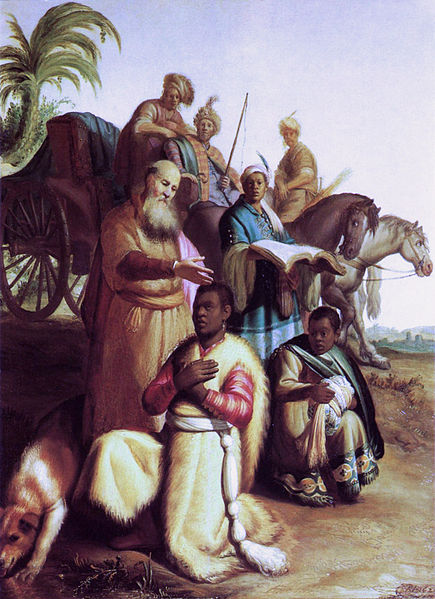
Rembrandt’s Baptism of the Eunuch
Eunuch.
Even the name, itself, sounds strange. Be that as it may, some scholars say there upwards of 40 Old Testament verses containing a word – in Hebrew, Greek or Aramaic – used to mean “eunuch” … while, in at least two New Testament passages, eunuchs are at the heart of the message.
So, what, exactly is a eunuch?
Simple: A eunuch is someone who has no physical attraction to people of the opposite sex. Back in the Bible, eunuchs didn’t have sex with women and they didn’t have children. Since they had no children, they had no vested interest in leaving a fortune to the next generation. Therefore, they had no reason to be crooked or seek advantage for their own offspring.
Some people were just born that way. Others were made that way surgically in order to serve their masters. Still others chose to deny themselves and be celibate in order to focus entirely on God.
Translated to English, eunuch essentially means “keeper of the bed chamber” or “overseer of the household.”
Put another way, a eunuch was an “emasculated man.” Many historians believe that eunuchs were homosexuals.
In other words, people living thousands of years ago all across Europe and Asia acknowledged a certain category of men as different from the norm. Their difference consisted in the fact that they had no sex drive toward women and that difference was conceived of as natural and inborn. We know, too, of ancient cultures where there were women who, by nature, had no lust for men.
The ancient Hebrews didn’t practice castration. The Law excluded eunuchs from public worship, partly because self-mutilation was often performed in honor of a heathen god, and partly because any maimed creature was deemed unfit for the service of Yahweh. That ban, however, was later removed. The kings of Israel and Judah often followed their royal neighbors in employing eunuchs as guardian of the harem and other official posts.
Apart from castration, eunuchs were naturally incapacitated, either for marriage or for begetting children.
Eunuchs were common in other cultures featured in the Bible. Remember Potiphar, who managed the household of a high-ranking official in Pharaoh’s court? He was a eunuch. Maybe that explains why the official’s wife made a play, instead, for Joseph, he of the coat of many colors. Joseph tried to escape and left the woman holding his garment (but that, my friends, is another story).
Eunuchs were trusted around the women who were married since they weren’t a threat in committing adultery with another man’s wife or engaging in pre-marital sex with a household of women.
In fact, eunuchs were exalted to such positions that they watched over the harems of the kings they served. Both boys and girls were sold into slavery as eunuchs by their parents to give their child a better life or to provide for the rest of the family.
Eunuchs could be extremely beautiful and attractive. Some say that Daniel – along with his friends Shadrach, Meschach, and Abednego — were virile and handsome men who were castrated before being banished into captivity by the Babylonians and sent to serve Nebuchadnezzar. First century historian Josephus asserts that Daniel and his three friends were made eunuchs. Even before that, the writer of 2 Kings 20:18 predicts, “And some of your descendants, your own flesh and blood that will be born to you, will be taken away and they will become eunuchs in the palace of the king of Babylon.”
While in exile, Queen Esther – the wife of Persian King Xerxes – had a eunuch assigned to serve her personal needs, showing that in this time period it was common for such women to be attended by “men who didn’t pose a sexual threat.” According to the Book of Esther (1:10), the king had seven eunuchs who served him.
The New Testament also refers to eunuchs. Candace, Queen of the Ethiopians, sent one of her eunuchs to Jerusalem to worship Yahweh, God of the Hebrews. As the eunuch was drawing close to Jerusalem, the Apostle Phillip, one of the leaders in the early New Testament church, was sent by God to explain and preach the gospel to him.
But I’m getting a bit ahead of myself here. (You can read the entire story yourself in Acts 8:26-31.)
Ironically, some could say that the Apostle Paul was a eunuch in that he remained single and celibate to fully concentrate on his mission for Christ.
What’s really important here is the idea that even a eunuch could be baptized, draw close to God, and become part of God’s family.
I believe this reaffirms the impartiality of God.
“Whosoever believes,” says the Scripture … and that includes eunuchs.
Which brings us to what Jesus has to say about these extraordinary people. Let’s take a look at Matthew 19:8-12, where Jesus and his disciples are discussing marriage and divorce, and the conditions under which it is permissible to divorce:
8Jesus replied, “Moses permitted you to divorce your wives because your hearts were hard. But it was not this way from the beginning.9I tell you that anyone who divorces his wife, except for marital unfaithfulness, and marries another woman commits adultery.” 10The disciples said to him, “If this is the situation between a husband and wife, it is better not to marry.” 11Jesus replied, “Not everyone can accept this word, but only those to whom it has been given.12For some are eunuchs because they were born that way; others were made that way by men; and others have renounced marriagec because of the kingdom of heaven. The one who can accept this should accept it.”
In this context, Jesus is saying that some people aren’t suitable for marriage. His reasons are lumped together under the category of being a eunuch.
The Lord himself expanded the meaning of eunuch to include those who are unmarried for a variety of reasons. Some are made this way by others. Some are born this way. They are unable to get married because they have no natural inclination to have sexual relations with a mate of the opposite sex.
It is highly unlikely that Jesus is referring to a straight, but impotent, male … or a castrated one, for that matter … when he talks about eunuchs.
Why?
Because castrated and impotent men still can be attracted to women.
A eunuch is a man who can’t reproduce, not necessarily a man who isn’t sexual. Some men were castrated specifically so they could stay young and pretty and be sexual with other men.
We’ve all heard the joke about the pamphlet entitled, “What Jesus Said about Homosexuality.” Open it up and it’s blank. Of course, that’s true.
Jesus never mentioned homosexuality, per se.
But as knowing and wise as Jesus was – or, as the fundamentalists like to say, “Jesus Christ is the same yesterday, today and forever” (Hebrews 13:8) – wouldn’t you think that he’d know there would one day be a terrible problem in his church, in Christianity, and in culture over homosexuality, gay rights, and same-sex marriage? Then, why didn’t he say anything specific?
I believe he did:
Jesus said, “Let the one who can accept this accept it.”
Not everyone can accept this.
So, I have to wonder: Is Jesus talking to us, preaching to the choir? Or is he talking about others in his church who need to understand and accept what he’s saying here about eunuchs … about those of us who don’t conform to society’s norms about gender identity and sexual orientation?
Eunuchs were foreigners to God’s temple when Isaiah made his prophecy, due to one of those damning Deuteronomy verses (23:1): “No one who has been emasculated by crushing or cutting may enter the assembly of the Lord.”
But Isaiah here states that God Almighty will wipe away the bonds of the Mosaic Law through his love, mercy, and grace.
It is, therefore, very clear that eunuchs not only have a place in heaven, but are given “a name better than sons and daughters.”
Can it get any better than that?
Processing…
Success! You're on the list.
Whoops! There was an error and we couldn't process your subscription. Please reload the page and try again.







 "Exactly!"