
Food for Thought

It’s said that in these parts of the Alentejo, the best porco preto (“black pork”) is served in a town named Arronches, not far from Portalegre. We’ve come to love the sweet and savory taste of this pork … when well prepared. If not, it’s just another Portuguese dish.

Arronches is about 45 minutes from our home in Vila Boim, Elvas. We’ve passed by the place when visiting friends who live in the nearby village of Assumar; but we’ve never been to Arronches.

Today we went.

During this time of the year, many villages, towns, and cities in Portugal hold their own special ferias–holiday fairs. Somewhere online I’d seen that Arronches would be celebrating this weekend.

“Want to go?” I asked Russ earlier this week.

“Sure!” he replied. “Let’s see if we can finally find a good restaurant to try the porco preto.”

I searched on TripAdvisor and a bunch of other sites dedicated to recommending restaurants. On every single one of them, A Cabana (The Cabin) came up as #1 … with hundreds of 5★ and far fewer 4★ reviews. Its atmosphere was described as “romantic” (we found it charming and adorable) with prices ranging from € (Facebook) to €€-€€€ (TripAdvisor). Based on our tab, I’d say TripAdvisor is more accurate. In a way, the digs reminded me of a restaurant with the same name (The Cabin) on the outskirts of Sturgeon Bay, WI.
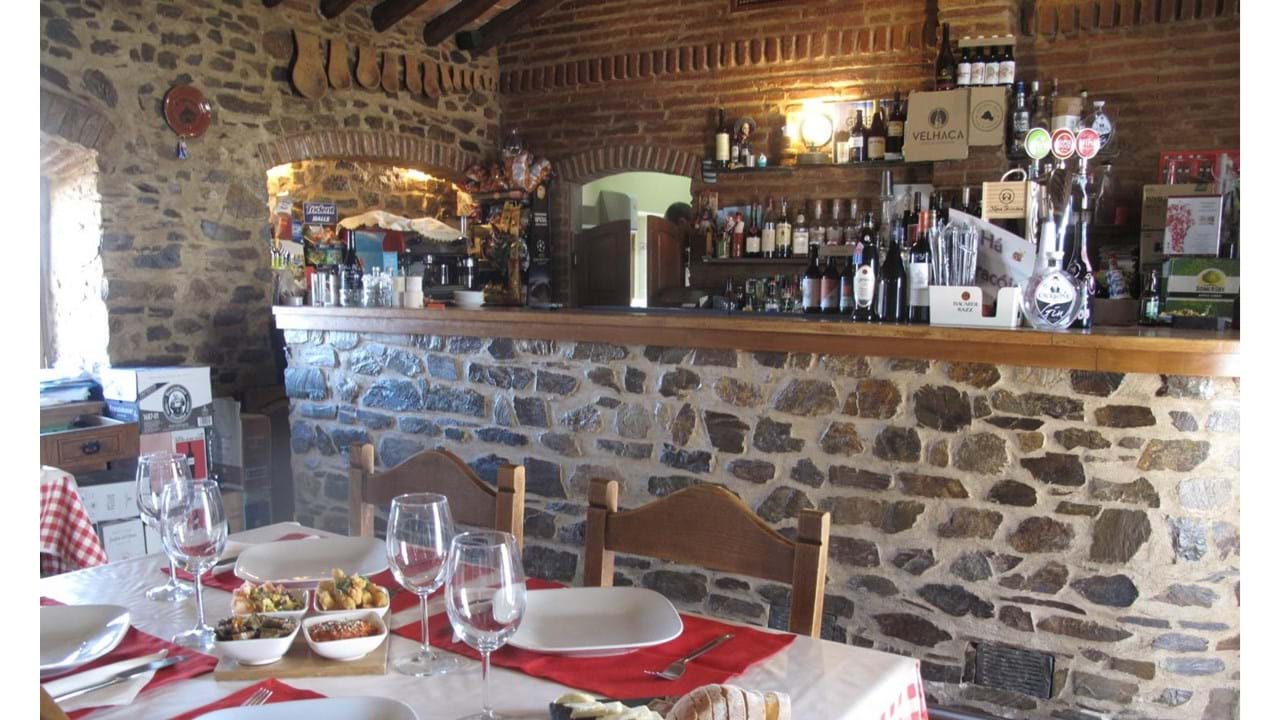
A Cabana doesn’t have its own website, but it does have a Facebook page. On Thursday, I messaged them to make a reservation for the two of us at 1:30 PM (13:30) on Saturday. We figured that would give us enough time to visit the fair and then eat a hearty meal early enough. Within five minutes — I kid you not! — I had a response: “combinado!” (confirmed).

Unless you’re an expat or immigrant living in Portugal, you can’t understand how unusual (even rare!) it is to receive a reply to one’s email or message here. The Portuguese tend to ignore them. You’re better off telephoning or stopping by.

Two thumbs up for A Cabana!

We arrived in Arronches at about 11:45 (AM), only to find ourselves lost in space. GPS and Google Maps were no help. Russ thought that the fair would be held in the “campo” (countryside), while I distinctly remember reading something about it being held in a pavilion. Before going around the bends another time, I asked Russ to pull off so that I could ask a local for information.

“Isn’t today a holiday in Arronches? Where can we find the fair grounds?” I asked a gentle giant of a man with a beard who nodded “yes” and pointed down the road … “Just continue going down this street until you come to he,” he said.

Russ turned to me before driving down the street to tell me, “He looks familiar. I think he might be the chef at A Cabana.”

Driving downhill, we finally approached the site. Amazing–there was plenty of parking! Very unusual in Portugal … especially when something of general interest is happening.

We soon understood why:

The only activity occurring at the fairgrounds when we arrived was a sheep competition. Nothing else. Not even the dozens of stalls selling food and souvenirs were open, let alone live music. It all would begin later that evening.

“What do you want to do?” Russ asked me.

“Let’s go to the restaurant and see if they’ll take us earlier,” I suggested. “That way, we can get an earlier start on doing some shopping we’d planned at E LeClerc, along with filling the car with GPL (liquefied gas) and washing it.

A bunch of people of all ages were already queuing up outside the restaurant, whose front door was open but nobody was inside. I approached the owner-chef-waiter — who, indeed, was the helpful man who’d given us directions earlier! — and asked if we could change our reservation to now rather than later. “Of course,” he said, pointing to the first of four tables for four. Behind them, in a row against the back wall, all of the tables were pulled together to accommodate 22 people … including those waiting outside, and then some.

“We understand that you make the best porco preto in town,” I told him while we both were standing in front of the chalk board where the menu was written.

He smiled broadly and recommended both the “secretos” (secrets) plate for €20 and the “plumas” (feathers) dish for €23. We ordered one of each, which came with salads and the best fried potatoes (“crisps,” per our British friends) we’d had in a while–super thin yet crispy, without any soggy orphans left behind. To go with our food, I had (two) glasses of tinto wine and Russ had (two) steins of beer.

It suddenly occurred to me that the maitre d was responding to my questions in Spanish, not Portuguese, although I was doing my best to speak coherent Portuguese. ¿No é portugues? (aren’t you Portuguese?) I asked him. “Sim, claro” (Yes, of course), he replied. “Then, why are you talking Spanish to me?” I asked in Portuguese. “I thought you were Spanish, he grinned.” It must have been my accent, One lesson I’ve learned since living in this western part of Iberia is always to speak Portuguese … to never initiate a conversation in Spanish, assuming the Portuguese understand it.

Anyway, everything was delicious!

The food, the service, the atmosphere were all extraordinary. (We personally preferred the plumas — cut thickly, parts cooked medium, others medium-rare to perfection — over the secretos.)

Of special note to us — who spend two months in Portugal and one month in Spain — was how relatively quiet and civilized the table of 22 behind us was. In Spain, you’d never be able to hear yourself think with that many people clustered together.

Our bill came to less than sixty euros. Although I tend to cringe when food here in Portugal costs that much, I reminded myself that we’d be gone from the USA for six years already. Who knew how much a meal like this would cost in a place like Sturgeon Bay?

Probably lots more.

Whatever …

It was well worth it!

P.S. If you plan to eat at A Cabina, remember to bring cash. The restaurant doesn’t accept plastic — credit or debit cards — although it does honor MB Way.

Pastor, professor, publisher, and journalist Bruce H. Joffe is an award-winning author of magazine features, academic research, journal articles, self-help manuals, and newspaper stories. His nine books deal with international (intercultural) living, progressive theology, gender studies, “social” politics, our vulnerabilities, marketing, and the media. 
Processing…
Success! You're on the list.

The System Is Broken

When even Portuguese officials complain publicly about the “broken system” and tell you that it’s “impossible” to schedule an appointment online, by phone, or in person — yet recommend that you show up at the local AIMA office and storm the gates — you know that the problem is dire and probably unfixable.

I’m referring, of course, to AIMA, SEF, and SIGA (they’re all culprits in the conspiracy) … and getting your residency visa renewed.

We’ve lived in Portugal for over six years now, arriving when D7 residency visas were issued for one year … renewed for two … and then renewed again for two, before one could get “permanent” residency (a misnomer, as it’s only good for five years) or even apply for citizenship, if so desired.

During our tenure here, residency changed from 1+2+2 to 2+3 and we were caught betwixt and between, as our last residency was for three years (not two) … requiring us to wait an extra year (totaling six) before applying to renew our residency.

HAH! If it weren’t so serious, the foibles, facts, and fables told about trying to get an appointment with SEF’s current iteration (AIMA) would be the stuff bureaucratic boondoggles are laughed about.

We had tried ourselves through SIGA, Portugal’s official scheduling “app” for all the country’s often overlapping agencies and entities. That led us down a rabbit hole since, when searching by agency, neither AIMA (nor SEF) appear … and, when searching by purpose or keyword (“residency renewal”), we’re taken to Registros where the only real option is to select renewal of citizen, not residency, cards. Once you enter the requested data, however, a pull-down menu magically appears … allowing you to indicate that the purpose of your appointment is specifically residency renewal. When we appeared at the designated place and time, we had to wait almost an hour, only to be told by quite frustrated clerks that, no, they couldn’t renew our residency there … we’d have to go to either Portalegre or Évora. It was then and there that we were told by the frustrated bureaucrats that the system was broken and nothing worked now as regards to renewing one’s residency.

Ultimately, we hired a lawyer (lawyers, we were told had better access to the system) to make an appointment for us. She did. Scheduled for 24 January 2024, officialemail notification showed that our residency renewals would be for two “cases” (i.e., people). The next day, nonetheless, we received a cancellation notice–no reason given. Later that day, another email arrived confirming a new date: 31 January, a week later than originally scheduled.

When we arrived and our number was called, the attendant insisted that only one of us — me — was on the “list.” And my spouse? “Reschedule!” we were told. We called our attorney while seated opposite our interrogator and she spoke directly to him. Back and forth, back and forth, they argued in Portuguese … him finally handing me the phone. “He could handle you both, if he wanted to,” she told me. “He doesn’t want to. So, you’ll be processed now and I will try to schedule another appointment for your partner.”

Again, that was on 31 January.

My better half still doesn’t have an appointment, although our residency expired several months ago. And, despite being told that I’d receive my new residency card within 60 days, it’s been 90 already … and I’m still waiting, my proof of processing and payment in hand.

Is it any wonder that people are protesting, demonstrating in front of AIMA’s headquarters in Lisbon? (https://www.theportugalnews.com/…/immigrants-to…/88011)

Meanwhile, “The Portuguese Agency for Integration, Migrations and Asylum (AIMA) has said that it needs around one and a half years to resolve 350,000 pending residency applications filed by foreigners until 2025. (https://www.linkedin.com/…/portugal-wont-able-process…)

It will be 2025 before AIMA resolves the 350,000 pending residency applications? What about all the new visas being granted? Are they still good for four months only? How long will it take AIMA to get around to them?

May be a graphic of text that says "aSaS CROWN ROWN AIMA A A The Agency for Integration, Migrations, and Asylum wwww. aima.gov.pt Renewal appointments already open on SIGA WWW.CROWNPORTUGALEU Welcome"

Pastor, professor, publisher, and journalist Bruce H. Joffe is the award-winning author of magazine features, academic research, journal articles, self-help manuals, and newspaper bylines. His eight books deal with international (intercultural) living, interfaith theology, gender studies, “social” politics, marketing, and the media.

Processing…
Success! You're on the list.

My Portugal Learning Curve

I dropped off my midterm election ballot at DHL in Castelo Branco, so it would arrive at the city clerk’s office in Sturgeon Bay, Wisconsin – still, technically, our legal residence … for voting purposes – in plenty of time to be counted.

The effort made me realize that it will soon be five years that we’ve lived and had our legal residencia in Portugal. We’ll be applying for permanent residency and citizenship here soon, too.

We’ve learned so much since arriving and departing the airport in a rental car, where an attendant warned us that it’s prohibido to allow dogs (and cats) to accompany us in the car unless they’re tethered to the rear seat belt sockets or confined to an acceptable carrier for traveling.

Shortly thereafter, our second, never-to-be-forgotten experience with Portugal initiated us to the country’s bureaucracy: registering for and buying a Via Verde pass for the country’s national toll roads. Who knew when entering Portugal on land for the first time that one had to go into a post office – anywhere in Portugal, assuming it’s open – to fill out the form, pay the fee, and be on our way … with the tolls conveniently deducted from our bank account?

The process of acculturating to Portugal took us from being expats to becoming immigrants.

How exciting it was to be able to decipher what the words on the highway’s digital signage were saying—and warning. Otherwise, bom dia, boa tarde, and obrigado were the extent of my Portuguese language. Though fluent in Spanish, I had no idea that my knowledge of a sister Iberian language would be a stumbling block, as much hindrance as help that would always complicate and confound my Portuguese. I could easily mispronounce my uttered words and/or say something entirely different than intended, as I guessed – based on Spanish – a sought after word … which would or wouldn’t be perfectly understood.

I’ve come to grips that, in the western part of Iberia, I will be speaking Portu/ñ/nhol.

There’s a lot I’ve gotten used to—whether by choice or by chance since moving to and living in Portugal.

Out of choice, for instance, I now drink Portuguese coffee – Sical is my favorite, #7 on the Strength Scale – while what I drank when we first arrived had neither number nor name but was laughed at and referred to as “dirty water.”

Similarly, I’ve become accustomed to shelved milk with shelf lives three or four months hence. It’s only to tone down the coffee’s bitterness, I tell myself. Besides, as soon as I get home and unpack the groceries, the milk will be properly placed in the refrigerator.

There have been other choices, too, which we initially made but later came to regret. Like our housing and accommodations.

To be issued a visa (let alone residence), Portugal requires that we document our housing—whether rented or purchased—for a minimum of 12 months. It’s hard enough to find suitable housing that’s both agreeable and affordable these days, even with feet on the ground … which could require multiple roundtrips between the USA and Portugal. That was the route we took … since we pictured precisely what and where we wanted to live.

We’ve never rented, always owned, and wanted to live in a quintessential fairy tale village with cobblestone streets and church bells tolling the time, rather than packing and unpacking more than once. And, as we thought we’d open a snack bar – Tacos Americanos – the street level of the property had to be approved for commercial purposes. Even back then, Lisbon, Porto, and Algarve were beyond our budget, so we looked to the interior and towns bordering Spain.

Searching the Internet daily from the USA, we found four properties that fit our criteria. That called for one round-trip visit to Portugal. Too bad that one of the four was under contract, another already sold, and two … just weren’t what they appeared to be online. We made a second trip to look at available properties in another area (Coimbra) and attend a Pure Portugal seminar on buying property. We thought we’d found an ideal place to live and, possibly, work … until the experts (especially architects and builders) explained why we shouldn’t buy a home built directly into the mountain on three sides without any vapor barriers.

Back to searching the Internet, we expanded our horizons and property portals.

At last, we found something that looked and felt like “us” (even) online. Spacious and interestingly configured with a separate wing for a guest suite, the faded sign on the storefront downstairs announced that it formerly was a café.

You got it: Another trip to and from Portugal. This time, however, we worked with a lawyer to negotiate the price, write a contract, open a bank account for us, pay a deposit, obtain our NIFs, and transfer the utilities to our names.

There was a lot of work to do before we moved in—lock, stock, and barrel.

Who knew back then that we’d have to upgrade the electricity throughout the house to handle the upgrades we wanted to install: inverter aircon units, a new fridge, range, hot water heater, and washer? Didn’t the sweet little old lady who owned the house and ran the café below (“the most popular one in the village because it was the only one to sell lottery tickets”) know that her commercial license on the café had expired and couldn’t be renewed? That, to get a new license and permit, we’d have to bring the place up to current code and standards—amounting to somewhere between €10,000-€15,000? Had I any inkling that, within three years, I’d no longer be able to go up and down the 37 steps dozens of times daily, especially to walk our three dogs … two together and the third by himself … around the cobblestone streets of the village—including in the rain, which we had back then? And that living on the main street of the village with your bedroom facing the street would subject you to noise, traffic overload, and processions for every occasion?

Following a series of examinations, procedures, and laboratory analyses, the doctor spelled it out load and clear: “You must move.” I couldn’t deal with all those steps anymore. The cobblestone streets are too slippery—especially when it’s raining, and I’m being pulled by the dogs chasing after a cat or street dog. “What I prescribe for you is a bungalow, and one-level house with a small, enclosed quintal (backyard) to plant and let the dogs out,” said Dra. Conceição.

And, so, we sold our imposing dwelling and purchased a hobbit house nearby.

Other choices have been far simpler.

I choose to read the Portugal News instead of the Portugal (aka Algarve) Resident. The former seems more forthright and honest; the latter is a tad too tabloid and sensationalist for my taste. I’m choosier, too, about my Facebook friends. Usually, I choose vinho tinto over branca. And I choose not to be surrounded by smokers.

I also elect to do my weekly grocery shopping at a variety of stores.

Why?

Because I prefer Lidl’s orange juice and bagged salads, along with its small pouches of chicken chunks. The aisles of non-food items are for browsing and buying stuff one wouldn’t expect to find in a grocery—at prices much lower than Aldi’s. Oh, but Aldi has a couple of great items in its bakery & bread department, like those mini quiches that make for delicious lunches. Continente is the only supermarket that carries the refrigerated grapefruit juice I mix with the orange for my cold breakfast beverage. In my opinion, Continente also has the best tasting bakery items, although Auchan’s is a close second. But Auchan only sells the branded (Bailey’s) Irish Cream – for 15 or 16 euros – while Continente has its own store brand which costs about six euros. While we do the bulk of our weekly shopping at Auchan, we run out at least once or twice a week to our town’s Intermarché for whatever we’ve run out of or forgotten.

I generally like seafood — shrimp, crabs, lobster — but I’ve never been particularly fond of fish. (I know: Living in Portugal and not liking fish?) Of course, I do like tuna and salmon and sometimes, depending on how it’s cooked and served, cod (bacalhau). But I’m completely turned off by ads for fresh fish–no matter how attractively their dead heads, fins, tails, and other pulpous parts are arranged and published by photographers and designers.

Other things, I have gotten used to—like Portuguese workers and government agencies moving at their own pace. And that there’s often disagreement between one and the other: One branch of SEF insists on a year’s worth of private health insurance, while others accept a six-month travel insurance policy without question. One electrician (from EDP) insists that we hard-wire our cooker directly to the electric; another (British) electrician says “rubbish,” that hooking the contraption up to the electric using a plug and socket will work the same.

I have nibbled a bit of saudade — that pervasive tension between yearning and resignation — knowing that massive fires are frequent and persistent, no matter where in Portugal you live. That persistent dust and predatory flies won’t stay outside. And that Portugal has its problems, too.

Slowly but surely my Spanish is receding. My immediate impulse now is to (try to) respond in Portuguese, especially when angry, although my accent and pronunciation will always sound foreign to the natives.

No longer the tourists, we’d trade a couple of those magnificent azure skies, day after day, for some rain—lots more of it. Because Portugal needs rain desperately.

There’s lots I’ve learned without realizing it over the past few years. I can deal — argue if necessary — with people who have tried to do us wrong. I can carry on rather lengthy conversations with neighbors and strangers … as long as they speak clearly and devagar. I understand what store clerks and delivery people are asking for and respond appropriately. I can even converse over the phone rather than online where I had the benefit of Google Translate. I now know quite a few ways to take leave and say goodbye, although I’m still not sure which to use when. And I can readily detect the difference between Brazilian and European Portuguese, along with a few expressions particular to given reasons.

Yet, one thing I’ll never learn is to pull when the sign on the door says “Puxe!”

It’s here that my Spanish (or Portu|nh/ñ|ol kicks in, wanting to know why the Portuguese don’t use the verb tirar, a word recognized and used (at times) by both languages.

Oy, vey. There’s still so much to learn!

Bruce Joffe is publisher and creative director of Portugal Living Magazine, the “thoughtful magazine for people with Portugal on their minds.” You can read the current issue online and subscribe — FREE! — at https://portugallivingmagazine.com/our-current-issue. Prefer the feel of fingers flicking paper pages? High-quality, low-cost copies of Portugal Living Magazine are available through all Amazon sites.

Processing…
Success! You're on the list.