In an unprecedented time of turmoil and political chaos creating personal conflicts and public confusion, increasing numbers of Americans are considering moving out of their country for a better, more peaceful life … and to enjoy a higher standard of living at lower costs. The U.S. State Department, in fact, estimates that 9 million Americans were living abroad in 2016. And the emigrant exodus is rising!
Every year, more Americans leave the USA to seek better lives elsewhere. The “New World” has become old and decayed to many and they’ve chosen to reside abroad for any number of reasons–personal, political, financial, family, health, retirement, etc.
Gallup reports in its January 2019 survey that an astounding number of Americans want to leave the USA permanently. As noted in the UK’s *Daily Mail newspaper:
• A record 16% of Americans wanted to move out of the country in 2018;
• Wanting to flee the country is significantly higher under Donald Trump than past presidents;
• The desire to leave the USA permanently fell along gender lines, with 20% of women vs. 13% of men wanting out;
• Younger people were more likely to consider packing their bags: 30% of those aged 15-29 said they hoped to leave the country permanently.
You can’t define it; to truly understand its meaning, you’ve got to experience it.
It’s different than depression, distress, disillusionment, discouragement, despair. It’s wistful and wishing for the way things were … and ought to be … but aren’t anymore.
Although “melancholy” probably is its closest cousin in English, it’s much more than that: a longing, yearning, aching void.
It’s the heart swelling up and crying out inside. It’s a lump in the throat … anxiety attacks … a feeling of foreboding … brooding … bleeding internally … unable to heal the hurt.
It’s a slow burn about the utter unfairness of it all … coupled with an irresolute resolve to go on and make it through yet another day–despite the turmoil, trespasses, and travails along the way.
It’s caring so much and coping so continuously that we’re overwhelmed and exhausted, unable to do much more than sigh as we watch the world go by(e).
It’s abject and deject, anguish and agony, feeling victimized and caught up in an elusive web of betrayal beyond our control.
It’s something for which, elsewhere at another time, they’d prescribe mind-numbing drugs, psychotherapy sessions, and therapeutic confinement.
It’s sort of like the Yiddish word “Rachmones,” whose translations – mercy, compassion, empathy, understanding – don’t come close to what we actually feel when recognizing the trait in a kindred spirit: Namaste.
It’s a voice heard in Ramah, weeping and great mourning, Rachel weeping for her children and refusing to be comforted, because they are no more.
It’s hiding in Anne Frank’s attic, knowing full well what the future holds.
Yet, it is part of the song and dance that are our lives.
The Portuguese sensitize these doldrums and call them “Saudade.”
For me, it’s a dark cloud hovering over us as I await what’s beyond … looking away and staying inside without precious connection to others … hoping it will pass sometime soon.
I feel like a psalmist, pleading with the Almighty to allow me to be joyful, yet unable to understand how and why we’ve become such drained and divided fragments of our fabric.
Then I remember that verse: “ … weeping may remain for a night, but joy comes in the morning.”
So be it.
Shared here are personal observations, experiences, and happenstance that actually occurred to us as we moved from the USA to begin a new life in Portugal and Spain. Collected and compiled in EXPAT: Leaving the USA for Good, the book is available in hardcover, paperback, and eBook editions from Amazon and most online booksellers.
Processing…
Success! You're on the list.
Whoops! There was an error and we couldn't process your subscription. Please reload the page and try again.
People here take the virus seriously. Very seriously, indeed.
Wherever we go in our Spanish town of Olvera in Andalucía, folks have masks dangling, half-mast, from their ear lobes, ready to pull them up to cover their mouths and noses as soon as the shadows of others are seen approaching.
That’s outside, on the streets.
Elsewhere, the masks are also facial appendages. Little old ladies sit and chat with covered faces, night after night, on benches in the tidy little park at the bottom of Calle Campillos, where Olvera´s former post office had stood, replaced years ago with this quaint oasis in the midst of row houses zig-zagging as they bend and stretch up and down the narrow, steep street.
Across the border in Portugal, little old men sit on knee-high walls surrounding their village churches, pontificating about this or that (as is their nature). It’s difficult enough to understand their dialects under the best of conditions; but, with mouths muffled by máscaras (mascarillas in Spanish), it’s even more challenging to decipher their staccatoed opinions and argumentative crescendos.
Even the youngsters – from toddlers to teens – understand the seriousness of the moment, responding without usual rebellion when told to step back, stay away, come inside, don’t touch, wear their masks.
These are people, entire populations, who barely survived under severe lockdowns for three or more months. They’ve seen death and the toll Coronavirus can take, up-close-and-personal. So, they´re now bound and determined to do whatever they can to ensure they and their communities aren’t again victimized by the virus.
Now, they take Covid-19 damned seriously.
To promote social distancing at restaurants, cafés, and snack bars, Olvera’s local government has granted special dispensations to eating venues and watering holes, allowing them to squat on public space: either grassy land nearby or by cordoning off four or five asphalt parking spots and dedicating them to diners.
After all, this is a café culture where people relish food, drink, and companionship … with wine, coffee, cola, and beer.
Nobody – employees, delivery personnel, clients, customers – enters a shop (large or small) without wearing a mask. Sanitizer is plentiful everywhere. Plastic gloves are often available, sometimes required (in groceries and markets), other times not—but recommended. Cosmetologists and stylists apologize for having to raise prices by fifty cents to pay for the plastic booties and robes clients are required to wear. And, woe to the supermarket customer who dares to inch beyond the designated markers! You may be allowed to put purchases on the conveyor belt … but you’ll be warned to wait until the previous customer has completed paying and packing, before advancing. The one person per elevator (lift) rule is respected, as is a minimum meter distance on escalators. Waiting rooms, as elsewhere, maintain two empty seats between each available one. Spitting on streets is strictly prohibited and enforced by one hundred to one thousand euro fines.
Throughout the Iberia peninsula, Covid-19 isn’t a matter of personal politics or in-your-face freedom fighters; rather, it’s actually about personal hygiene and public welfare: the common good.
I certainly don’t mean to imply that everyone here is a sanitized saint, dutifully and willingly following the new “normal” rules for social interactions. Just the other day, in fact, I observed a woman in one of our favorite supermarkets picking up plastic packages of pastry, squeezing them, and putting them in front of her (masked) nose for a sniff. She picked up and put back at least a half-dozen packages. Not that she was malicious, but simply self-serving and negligent, not thinking about the potential consequences she was causing to others. I caught the eye a store associate and nodded at the woman. Without hesitation, the supermarket employee approached the offender and gave her a lesson she’ll not soon forget about appropriate protocols for grocery shopping.
Nonetheless, such experiences are exceptions to the rule.
By and large, we live among demonstrably caring, emotional and “affectionate” people who share their feelings with hugs, handshakes, and serial kisses on both cheeks. Not now, however. Instead, we poke elbows … laughing about how silly (but serious) such a greeting seems.
Elbow kissing doesn’t come close to sharing a good, hearty hug.
And that’s what really, truly hurts.
No hoax intended!
Shared here are personal observations, experiences, and happenstance that actually occurred to us as we moved from the USA to begin a new life in Portugal and Spain. Collected and compiled in EXPAT: Leaving the USA for Good, the book is available in hardcover, paperback, and eBook editions from Amazon and most online booksellers.
Processing…
Success! You're on the list.
Whoops! There was an error and we couldn't process your subscription. Please reload the page and try again.
Three beloved Miniature Schnauzers – Jax: a white male, Sheba: a black female, and Manny: a silver-gray male – moved with their family from a cold climate in the upper Midwest of the United States to a new home in a small village of central Portugal.
When they finally arrived at their destination after three long airplane flights and almost a full day traveling, all three dogs were insecure. “Where are we?” they wondered. “What happened to the rooms and smells – the world – we loved and lived in for so long?”
Now, they had pet passports that allowed them to travel from country to country throughout the European Union, and licenses which recognized them in their own Portuguese village.
Their human daddies did everything they could to comfort and reassure them. In addition to packing their favorite keepsakes to bring along, the dogs had new beds and bedding, plenty of good food to eat, squeaky toys to play with, and the attention of their two devoted dads.
One day not long after the dogs arrived, their dads fastened leashes onto the dogs’ collars and took them for a long walk around the village. Suddenly, they came across three other dogs in the street.
“Bow-Wow-Wow!” greeted Gonçalo the Galgo.
“Woof, Woof, Woof!” welcomed Pedro the Podengo.
“Bark, Bark, Bark!” began María, mistress of the streets.
But Manny, Sheba, and Jax could not understand a word they were saying, because the other dogs were speaking Portuguese … and the three American dogs had not yet learned that language.
So, they just wagged their tails with excitement.
Later that same day, the American dogs were out on their afternoon walk when the Portuguese dogs came running over to them.
All of the dogs were happy to meet again and discovered that, by listening carefully, they were able to understand the words and the motions shared by each other. It was a common language!
The Portuguese dogs introduced themselves first.
“Boa tarde,” said Gonçalo. “I am a galgo, a dog used for racing and hunting—for only one season … but then I was discarded.” Tears filled Gonçalo’s eyes, as he continued his sad story: “I was starved before hunting, to make me more hungry for the prey.”
Jax, Manny, and Sheba couldn’t imagine a life like that.
Pedro spoke next: “Podengos are even more persecuted than galgos. Curious and clownish, we are very aware of our surroundings and very sensitive to humans. We are wonderful family members! But, like Gonçalo, I came from a breeder who chained me and sold me for sport. I was abused, treated badly, and abandoned because I wouldn’t kill.”
The three American dogs felt very sad for their new friends. Though shaggy and unkempt – their teeth needed cleaning and they all could benefit by baths – the Portuguese dogs were welcoming and outgoing.
“When I was young and just a pretty little puppy, I was a Christmas gift to two little children,” María explained.” She had fond memories of their times together, until she grew bigger and they were older. A few years later, the family moved, leaving María behind–without even a hug good-bye or words of farewell. Closing the door to the house where they lived one last time, they left María on the street. Over the years, she had given birth to many litters of puppies … but no longer could remember what had happened to them or where they went.
Licking their new friends with their tongues to make them feel better, the American dogs said, “Até breve,” because their daddies were ready to return home and the dogs wanted to see the dogs again soon.
Eating dinner in the warmth of their kitchen, the three American dogs talked about their new friends.
“Where do they live?” asked Jax. “Who takes care of them and feeds them?” wondered Sheba. “What do they do during the days and nights, while we’re taking our naps?” Manny inquired.
Eager to learn more about their lives, the American dogs decided to bring bits of their food as treats for their Portuguese amigos.
Early the next morning, right after their breakfast, leashes and collars were put on Jax, Sheba, and Manny. Their dads opened the front door, as the dogs scampered along, tugging at their leashes.
Where were María, Pedro, and Gonçalo?
Turning the corner and walking past the garbage bins (where Manny and Jax lifted their legs), they could hear the voices of their friends coming from farther down the street. But there were other voices, too.
“Olá, amigos,” said Pedro upon seeing his English-speaking friends from America. “I want you to meet Francisco, Ana, Rodrigo, Miguel, Patricia, and Tomás. They live in this village, too!”
“You do? Where?” Sheba and Manny responded immediately. “Why haven’t we seen you before? It’s great to have so many friends!”
Gonçalo explained that the other dogs lived with families in houses and were put outside a few times each day.
“But, but …” the American dogs didn’t know what to ask first.
“Your families don’t walk you with leashes?” Manny wanted to know. “Aren’t you afraid to walk by yourselves with all these cars and trucks on the streets? How do you pick up after yourselves?”
“We don’t!” exclaimed Rodrigo. “Sometimes the rain washes it away. Other times, it just stays here, until it dries up. Often, cars drive over it, pushing it down between the cobble stones. You dogs from America have servants who clean and pick up after you, no?”
Sheba was anxious and wanted her question to be answered: “All those vehicles are going in both directions so fast! Aren’t you afraid?”
“Oh, you get used to it,” Ana and Patricia nodded. “Usually, they’ll slow down if they see you … but sometimes you need to run to a spot in a doorway, against the wall, or between cars, and wait for them to pass.”
Patricia and Ana lived together with the same family. They heard the mother calling their names, so they scampered off. “Adeus,” they said, wishing the newcomers well. Rodrigo, Miguel, Tomás, amd Francisco followed the girls, leaving the Americans with their three first friends.
“Where do you live?” Jax asked María, Pedro, and Gonçalo.
“Right here,” Pedro responded. “We live on the streets.”
“But who takes care of you? Who feeds you? Where do you sleep? What do you drink?” concerned Jax, the eldest dog of his family.
“We can take care of ourselves,” grinned Gonçalo with pride. “The water from the village fountain is always plentiful and quite good.”
“People throw table scraps onto the street for us … pieces of fish, chicken, and even meat,” piped in Pedro. “Cats rip open the plastic trash bags, but we chase them away and find food there, too. Some people are really nice: They buy food for us at the grocery store and put it outside, on the street, for us to eat. That’s really convenient, eating food on the street—right next to where we sleep.”
“Food from the street? Food on the street? That’s where you eat?” asked Manny, trying to imagine eating like that.
The American dogs were on low-fat diets. Yet, compared to their new Portuguese friends, they were very well fed. Their dads mixed together special dry food from bags with moist dog food from cans. Then, tiny pieces of boiled chicken breasts with rice – along with fresh pumpkin or squash – were cooked, pureed, and placed in plastic containers in the freezer or refrigerator … until they were needed. Everything would be mixed together: some of this with some of that. Why, it took almost twenty minutes just for the food to be mixed in their stainless steel bowls, which were picked up and washed as soon as the dogs finished eating their meals.
“You sleep on the street?” Sheba cried, her motherly instincts kicking in. “Aren’t you cold? Or hot in the summers? What about all the bugs, flies, and mosquitoes? Don’t they bite? Won’t you get sick?”
“Não,” answered Pedro, muzzling María. “We watch out for each other. Often, we curl up together to sleep. That’s nice and warm. When it’s not raining, we find a welcome mat to lie on …. if it rains, we will sleep under the parked cars.”
Usually shy, María began to speak:
“You Americans have many questions. We tried, our best, to answer them. Now it’s our turn. Can we ask you some questions?”
“Of course,” echoed Manny, Sheba, and Jax … all at once.
“What are those colorful tags, decorating your necklaces?” she asked. “Do you always wear jewelry like that?”
“Oh, they’re not necklaces,” laughed Sheba, “but collars attached to our leashes. And the tags on them show that we have been vaccinated by the veterinarian against diseases that flies and worms and mosquitoes can spread. Haven’t you had shots to keep you safe, too?”
The Portuguese dogs shook their heads, explaining that they were from the same land and were not bothered by their bites. As foreigners and newcomers to their environment, however, the American dogs would need to be protected from such pests and diseases.
“And we all must be careful to avoid the processionary caterpillars,” warned Gonçalo. “They are dangerous to us all!”
“Hey, don’t those collars and leashes bother you?” María doubted. “How can you run and roam if you’re always attached to them?”
Jax scratched his head before responding, “We can’t. Why would we want to race around town, anyway? We’re perfectly happy walking with our dads. They’re looking for a piece of land now near our house, so that we can run around safely. Before moving here, we always had a yard where we could go outside to play and do … stuff,” he said.
“You mean that you never travel or go anywhere without people?” Pedro wondered. “Like there …” He lifted his leg and pointed his paw toward the snow-capped tops of the distant Serra mountains.
“We’ve traveled a lot with our family,” sniffed Sheba. “But we always go by plane or car, in the back with seat belts. We’ve been on vacation to Porto, we go to the groomer in the big city, and we have a holiday home in Spain, where we know lots of dogs who speak Spanish … a language not unlike Portuguese. Their lives are similar to yours, although more of them walk with leashes held by people now. And snow? We’ve seen lots of it. In fact, we played in the snow quite often. One of the places we lived before moving here was Wisconsin, where there’s so much snow that, sometimes, it’s higher than us!”
“But you can only go where your family takes you,” remarked the Portuguese dogs. “Even in our village, there are so many delightful places to visit, sights to see, and smells to enjoy!”
Like a shadow, a thoughtful silence fell over the dogs for a moment.
“Yes,” Jax admitted. “That is true. But we’d rather be with our family than out and about without them. They take such good care of us. So, seeing and smelling what’s here isn’t that important. We’re happy!”
“Well … since you mention it,” reacted María, “it appears your family does take very good care of you. Maybe too good? Are they feeding you too much? Is that good for your health? And, look at your nails!”
“Our nails?” all three American dogs gasped.
While the Portuguese dogs sorely needed baths and haircuts, their nails were neat and trim. How was that?
“Because of the cobble stone streets in the village,” Pedro explained.
The American dogs had walked only on soft grass, so their nails had to be trimmed by a groomer. They didn’t like that at all! And their wet feet always were wiped off with the towel by the front door.
“What I want to know,” Gonçalo interrupted, “is who will take care of you if your family is gone? When or if your dads aren’t here?”
Suddenly, all of the dogs – Portuguese and American – were sad, as they thought about their lives and the people they loved.
At the end of the week, after several very long conversations where they all learned new languages, the friendly dogs went back again to where they lived. Although the American dogs regretted that they didn’t have the freedom to come and go as the Portuguese dogs did, they truly loved their families and appreciated their comfortable lives.
Waving good-bye to their Portuguese friends until later, the American dogs realized that their lives might be different from how their friends lived, but that they really were not any better than them.
“We are quite fortunate,” they said to each other, as their new friends bounded off down the street after a cat that had come out from under one of the cars.
“Até logo!”
Shared here are personal observations, experiences, and happenstance that actually occurred to us as we moved from the USA to begin a new life in Portugal and Spain. Collected and compiled in EXPAT: Leaving the USA for Good, the book is available in hardcover, paperback, and eBook editions from Amazon and most online booksellers.
Processing…
Success! You're on the list.
Whoops! There was an error and we couldn't process your subscription. Please reload the page and try again.
Months after arriving in Portugal and finishing much of the work on our property in Lousa, Castelo Branco, we decided to take our three dogs with us on a “real” vacation and see some of the sights (and sites) we’d thus far only posted Thumbs Up! *Likes* on Facebook pictures.
Our time away would be short (just six days) and our agenda agreeable: We’d stay somewhere near the beaches north of us, close to the coast, with easy access to Portugal’s convenient train system. From there, we’d take day trips: Monday’s market at Espinho, a gondola ride in Alveiro, the extraordinarily tiled buildings (especially the church) of Ovar, and a day sampling some of Porto’s special deliciousness.
Searching the listings on AirBnB, FlipKey, and TripAdviser, we found what sounded like the perfect place: a “romantic room in a magic place near the beach,” the property touted its “artistic atmosphere.” Offering “lots of privacy,” it was in front of the train station–just ten minutes to Porto!
Amenities included bed linens and bathroom towels, WiFi Internet, a private garden, and a kitchen with fridge, stove, toaster, and kettle. Plus, among the property’s features was its waterfront location!
The sole drawback (for us) was that its one-and-a-half bathrooms would be shared.
The place had been booked continuously, from April through October, according to its hosts. But with a bit of shuffling, six consecutive available days were found. I contacted the property’s lister with a bunch of questions: Would three dogs be acceptable? Was it a non-smoking property? How would sharing the bathroom(s) actually work?
“No problem at all,” she replied. “Just enjoy.”
Before losing our chance at what appeared to be a place ideally suited for us, I confirmed the reservation and paid by credit card.
Hindsight, at best, is 20/20. But using a credit card is paying it forward!
“Don’t you think it’s a little strange that, with all those bookings, there’s not even a single review for this place?” Russ asked me. Not one guest had taken a moment to say something – good, bad, indifferent – about their experience there. Most properties had a fair share of comments. Not this one, though.
That should have been a harbinger.
We packed the car and spent about €50 in tolls and a tank full of gas before pulling up and parking in front of the property.
“Is this it?” I asked, incredulously. There’s always one derelict property surrounded by others in pristine condition.
Ours was the destitute one.
Blue boards tried valiantly to look like a cross-weave pattern through which weeds wound their way up, down, and through the broken wooden remnants. An unlatched double gate, painted the same color blue, was opening and closing on one side, blown by the breeze.
From the exterior, at best it could be thought of as a “beach house” … but the word that stuck in my mind was “ramshackle.” Nowhere to be seen was a beach, let alone the promised waterfront.
Facing the house was the train station. Every ten minutes, sometimes sooner, we’d hear the tick-tick-tick-tick signaling an approaching train, followed by a series of bells, as the guard rails came down. Local commuter trains. Freight trains. Express train service between Porto and Lisbon. All stopped or sped by, clickity-clack, clickity-clack on the tracks, as the transports tooted, honked, squealed, and blared off-key melodies announcing their every approach and departure.
While Russ – with some help from the property agent and her artist – emptied the car and carried in our bags, I walked the dogs.
Our amiable hosts apologized when the bedroom’s inside door knob kept falling off and onto the floor, explaining that the property wasn’t actually theirs—they rented it from the owner, who had been negligent in his responsibilities regarding its upkeep.
Although the description specifically stated that the property’s two-bedroom, one full and one-half bath could accommodate four people, whether that took into account the two caretakers and their bedroom is uncertain.
Especially since the listing began in the singular: “Romantic room … near the beach” and unequivocally stated, “A total of 4 people can sleep here comfortably.”
Romantic room. Not rooms. A total of four people …
Our hosts then told us we would be joined the next day by other guests and their dog. Wouldn’t that be nice?
“If you had told us that earlier, we would have reconsidered …” was all I could muster, as we continued to take stock of the accommodations.
Our bedroom was at the front of the house, directly facing the trains. Mismatched furniture – a small “matrimonial” size bed with a well-worn mattress, throw pillows that felt as though they were filled with rice, two totally incompatible nightstands (one with a tiny lamp sold at most Chinese markets for ten euros), a bookcase, a round table with two chairs in front of the window – could all trace their ancestry to rummage sales or second-hand stores. Neither of the two bath towels on the bed compared to the ones we had bought at thrift shops in the USA for use as packing materials, and later used for the dogs.
An eclectic mix done well can be artistic and even elegant: “shabby chic.” Chic? This place was plain shabby.
If you’re renting this room out to a steady stream of people, how about investing twenty euros on a clothing rack, instead of the over-the-door hanger with five hooks? Isn’t that where bathrobes and towels hang? What about a bureau or chest-of-drawers? Where do people put their other stuff—underwear, socks, bathing gear, bathroom necessities, and collaterals? For that matter, where was a garbage can?
Nowhere near the bedroom, both bathrooms were way down the hall, beyond the kitchen. Add the full one (with shower and tub) and the half bath next door with only a sink and a WC, and you’d have one full and proper working bathroom. Depending on the time of day or night. Painted, one toilet was taped shut; the plastic toilet seat cover on the other wasn’t attached; so, using it was awkward. The sink’s faucets were outdated: scalding hot water came out of one spigot, cold from the other, yielding no comfortable temperature without filling the sink.
Not that it mattered. We had no hot water (in either bathroom) that night. Nor were our hosts around to help us deal with it.
The bathroom was missing a bath mat, an anti-slid mat, and a garbage can. The tub was lined with someone else’s bottles of shampoo and conditioner–more than a dozen of them! Two glass shelves near the sink were full of creams and cosmetics, powders and perfumes. There was no space for anything of the guests, so we schlepped our toiletries back to the bedroom.
Settling down to sleep that night, we were thankful the trains, by then, had stopped. (Two did pass in the middle of the night: at 2:00 and 4:00 AM, but didn’t honor us with their horns). Sleepless noises were constant, however, courtesy of the beach and its breezes: the front gate and shutters banged open and shut … again and again and again.
Itching to bite, one or more mosquitoes whined in my ears throughout the night. I slapped my face but missed the bugger.
The next morning, I went quietly to the kitchen. Sometime during the night or early that morning, someone had left a package of cheese open on a plate with a knife, a half-empty glass and coffee cup next to it. Flies weren’t fickle as they feasted.
Russ saw the upset look on my face when I came back to our room. “Let’s pack,” he implored. “We’re going back home!”
Following a hurried and harried breakfast at a nearby café, we hustled ourselves and the dogs out of there and headed back home.
Spending lazy time in Lousa and visiting nearby points of interest, we relaxed and tinkered together.
Merriam-Webster calls that a “staycation.”
Our credit card company, through which we disputed the charge (and won!), agreed with us, calling it a “sham!” and removing the property from its listings.
Shared here are personal observations, experiences, and happenstance that actually occurred to us as we moved from the USA to begin a new life in Portugal and Spain. Collected and compiled in EXPAT: Leaving the USA for Good, the book is available in hardcover, paperback, and eBook editions from Amazon and most online booksellers.
Processing…
Success! You're on the list.
Whoops! There was an error and we couldn't process your subscription. Please reload the page and try again.
Partner, mate, significant other, other half (or better) all are words we commonly use to connote a special commitment between two people who have chosen to pursue a life together.
But for those seeking the state’s full and complicit recognition of their relationship, only marriage will do. For better or for worse, it’s a status laden with directives handed down from on high by religious orders, civil authorities, and public policies.
And while marriage is a sacred trust, a “sacrament,” as some churches call it, peculiarities portuguêsas and eccentricities españolas make it a miracle that expat marriages even occur on the Iberia peninsula.
In countries like Spain and Portugal, those wanting to wed have two choices: A Catholic Marriage. Or a civil (secular) one.
Everything else is an afterthought.
To be binding under Portuguese law, if you want to have a “religious” wedding but don’t follow the Catholic faith, you’ll first need to undergo a civil ceremony. Meanwhile, residency restrictions and administrative formalities governing civil ceremonies sway many American expats or foreign nationals to go the route of a religious ceremony in Spain.
To qualify for a civil ceremony, at least one of you must be a Spanish citizen or a legal resident for two years prior to the wedding day. Other options are to get married elsewhere and have your wedding ceremony blessed in Spain … or to cross the border into Gibraltar, where conjugal requirements are less stringent.
Jewish, Islamic, and Protestant wedding ceremonies are legally recognized in Spain; and, unlike Portugal, a civil marriage is not required a priori to one conducted outside the Catholic faith.
The Portugal Civil Registry Code, as does its Spanish counterpart, has specific requirements one must satisfy to be married:
• You must be at least 18-years old—with parental consent, however, you can marry if you’re 16 or 17;
• The bride and groom must not be related;
• You need to request a license from a Civil Registrar Office in Portugal or Spain, and indicate whether the marriage will be performed under civil codes or religious beliefs;
• There’s a waiting period while the announcement of your intention to marry is posted and made available for the public to comment; and
• Portugal wedding ceremonies must be in Portuguese, with at least two witnesses watching (language isn’t an issue in Spain, where only one witness who’s not related is required).
Under U.S. law, diplomats and consular officers are not permitted to perform marriages, nor can they be performed on the premises of U.S. embassies or consulates.
Same-sex marriages have been allowed in Portugal since 2010 and offer equal rights to the couple regarding property, taxes, and inheritance … since 2016, married couples of the same sex can adopt and foster children. (Spain legalized same-sex marriage in 2005, along with its adoption rights.)
While there are no residency requirements to get married in Portugal, one of you must be in the country a minimum of thirty (30) days before notice of your proposed marriage can be given.
The marriage route is long and tedious in both Spain and Portugal, usually taking a minimum of four weeks just to process an application. After you have received approval to get married, the wedding can then be arranged … as long as it takes place within three months.
Documents must be obtained and presented to the Civil Registry where the wedding will occur, as well as taken with you on your wedding day to the place where you will marry. The documents must be original, either endorsed with an Apostille or authenticated by a licensed Notary Public. Official translations undertaken by authorized agencies must accompany all these documents if they’re not in Portuguese or Spanish:
• Certified birth certificates issued within six months;
• Passports (and/or residence permits);
• A “Certificate of No Impediment” (except for British nationals) from the local registry office in your Portuguese town or at an embassy for a civil wedding, or by a parish priest for a Catholic one. This document can’t be issued by the U.S. Embassy, as, “no such document or governmental authority exists to issue it,” explains the U.S. Department of State. “However,” it notes, “you can execute a statement of eligibility to marry at the U.S. Embassy in Lisbon before a consular officer and present it to the Civil Registry office.” Similarly, “No document equivalent to Spain’s Fe de Solteria y Vida (Certificate of Existence and Civil Status) exists in the United States.” According to the State Department, “Spanish authorities will accept a sworn statement from a U.S. citizen, affirming that he/she is single and free to marry, executed before a U.S. Consular Officer”;
• Proof of residency, a Spanish town hall certificate attesting that you’ve lived in the area at least two years. Although that isn’t required to marry in Portugal, you should be able to prove that you’ve been in the country at least 30 days prior to the marriage;
• Final divorce papers, if applicable, apostilled and translated into Portuguese or Spanish within the last six months. If your marriage wasn’t canonically annulled, you cannot be married in the Catholic church in either country;
• If applicable, the death certificate of your prior spouse, translated and apostilled within the last six months.
Want to be married in a Roman Catholic church? You also will need to provide official copies of your baptismal certificate.
Legal marriages contracted abroad generally are valid everywhere. Regardless of your residency status, if you’re a “foreigner” in Portugal or Spain, though, remember to register the marriage with the country’s consulate and with the local Civil Registry where you’re now living.
An “interdenominational” pastor, I have been asked to officiate at weddings in Spain and Portugal.
One was a recommitment ceremony celebrating 30 years of marriage; another was a repeat performance of nuptials conducted days earlier in another country. Technically, both of these marriages already had taken place and, therefore, were recognized in Spain and Portugal.
So, there was no question about my pastoral propriety to pronounce the couples lawfully married.
Not that it mattered: It was pure pomp and circumstance for the “newlyweds,” who wanted a ceremony to share their joy with others who couldn’t be present to participate at the first, faraway wedding.
Standing before God as we witnessed and affirmed the sanctity of their marriages, it made no difference what the government thought or said. We were responding to a higher authority, seeking a blessing to live happily ever after.
Shared here are personal observations, experiences, and happenstance that actually occurred to us as we moved from the USA to begin a new life in Portugal and Spain. Collected and compiled in EXPAT: Leaving the USA for Good, the book is available in hardcover, paperback, and eBook editions from Amazon and most online booksellers.
Processing…
Success! You're on the list.
Whoops! There was an error and we couldn't process your subscription. Please reload the page and try again.
I’m going to get some flak-back on this post … because I believe that good manners are preferable to bad.
Common courtesy and proper protocols transcend cultures and/or countries. No matter where you are or what language you speak, correct conduct is always appropriate and appreciated.
Why, then, do some people ignore “etiquette,” alienating, antagonizing, or offending others? Is it deliberate or incidental?
As a child, weren’t you taught to cover your mouth when you cough and your nose when you sneeze—especially in public?
Queuing at the supermarket or grocery store, I am shocked by how many people cough or sneeze without covering their faces while standing over food. And by people who work in restaurants, where they cough or sneeze – without covering up – when dispensing beverages or handling food!
It’s a matter of respecting personal places and private spaces.
Whether breaking into line out of turn, cutting someone off on the road, denying right of way to pedestrians at cross walks, or invading those sacrosanct spaces immediately surrounding us, it’s self-serving behavior rather than observing conventions for the greater good.
Some people shower or bathe regularly. Others don’t. Some brush their teeth and practice good personal hygiene. Others don’t. Some people apply deodorant. Others don’t. Some smoke. Others don’t. Some people douse themselves in perfume or cologne. Others don’t.
Whether you do or don’t is your choice. But, please, be considerate of mine.
The same can be said of our pets: If you have dogs and cats, especially, please pick up after them and dispose of their waste. Simply opening the door to let pets roam the streets, do their business outside, and then return home is irresponsible. Your home may be clean, but who wants to step in feces … or have our dogs contaminated by it? Sickening to see and worse to smell, it’s a public health hazard.
Driving aggressively, carelessly, and/or inconsiderately also violates the rules of acceptable behavior. Recklessly speeding down the narrow streets of our villages – especially with a cigarette in one hand and cell phone in the other – makes it harder to stop and control a vehicle if/when something unexpected or unforeseen should be presented. On the other hand, we’ve been taught to drive in the right lane and use the left only for passing. So, why stay in the left lane driving 60 kms/h in a 90 kms/h zone? I’m told there’s no specific law here against tailgating (despite all the warning signs); but please stay off my butt. Planning to exit the roundabout or roadway? Again, you need to be where you belong … rather than drifting across in front of us and nearly causing an accident. That little lever (usually) attached to the left side of your steering wheel? It’s called a directional signal for a purpose: to alert others of the direction you’ll be taking or changing. Use it! And, granted that some parking spaces are smaller or tighter than others—even in public shopping centers. But, that doesn’t give anyone the right to park haphazardly … taking up two or more spots, leaving none for others.
Courtesy extends beyond these spaces, streets, and roadways. It also includes online behavior. Just because you’re virtually anonymous doesn’t entitle you to act aggressively, ugly, snarky and/or petulant. What pleasure do some people derive from being so snooty, anyway?
Finally, here’s a nod to professional responsibility: If you want my business, practice good public relations. Return phone calls or reply to my emails promptly. Show up when you say you will. Charge me what we’ve agreed to. I’ll be appreciative and likely to do repeat business with you, as well as to refer others to your products and services.
Finding fault is distasteful.
Yet being selfish, indignant, and malicious have become increasingly in vogue and accepted … especially when spotlighted daily by the revolting conduct and shameful language of our leaders.
Nonetheless, antagonism and rudeness never are really successful. Except when it comes to breeding. They poison a healthy environment and turn prevailing positive attitudes hostile and rotten.
So, let’s do what we can to make this world better for all!
Shared here are personal observations, experiences, and happenstance that actually occurred to us as we moved from the USA to begin a new life in Portugal and Spain. Collected and compiled in EXPAT: Leaving the USA for Good, the book is available in hardcover, paperback, and eBook editions from Amazon and most online booksellers.
Processing…
Success! You're on the list.
Whoops! There was an error and we couldn't process your subscription. Please reload the page and try again.
Three major firms – MEO, NOS, and (increasingly) Vonage – serve the telecommunications market in Portugal. All those “extras” that come bundled in your telecommunications package: Wifi Internet + TV + landline telephone + mobile phone with given data? Study your contract carefully for caveats and exceptions! MEO, for instance doesn’t charge you for calls from mobile phones (whose first digit is “9”) to either other mobiles or landlines in Portugal … but call a mobile from your landline (whose first digit is “2” here), and you’ll be charged. (In Spain, landlines begin with a “9” and mobile phone numbers with a “6.”) If you’re somewhere with free WiFi available, be sure to connect to it on your mobile phone. And outside the country, where the EU has decreed that telecommunications, too, are to be “without borders” … they are and they’re not—with plenty of “ifs,” “ands” and “buts.” Know your restrictions and tariffs before using your mobile for handling calls or ^/downloading data elsewhere.
Attaching timers to certain electrical devices – electric waters heaters, for one – is a convenient, practical, cost-effective way to limit energy consumption … and reduce your electricity bills!
Coin-chained supermarket carts cut down the clutter and damage caused by shopping carts abandoned, helter-skelter, in parking lots. Are you listening, Walmart and grocery stores? Learn from responsible retailers!
Is Dawn your preferred dish-washing detergent? Sorry, but no Fairy or store brand can compare. And Dawn, by and large, isn’t available in Spain or Portugal.
Feeling “comfortable” navigating all those roundabouts, deciphering international road signs, practicing roadway rules and etiquette, can be daunting when dealing with drivers who are daredevils or laggards. Please, use your turn signals and stay in the appropriate lane!
Regarding the sensitive subject of bathroom hygiene, let’s just say that the paper here isn’t what Charmin would have us crave.
Bureaucracy is almost an art form in both Spain and Portugal.
When using a credit card and you’re given the option to pay either in euros or dollars, always choose euros. The savings can be substantial! If your Multibanco or ATM also offers this option with debit card withdrawals, choose euros over whatever conversion rate and currency exchange amount presented. Jot down the amount (in dollars) shown on the screen to be deducted from your account … then, after opting for euros, go online to see how much has been deducted from your bank account. Yesterday, the Multibanco ATM wanted to charge us $123.46 to withdraw 100 euros. Our bank deducted only $113.87 for the transaction.
Looking at a house to buy? Don’t neglect to check out the roof carefully—not just the condition of the exterior tiles (cracks and breaks often lead to water infiltration), but the supports – beams and trusses – in the attic (sótão) as well. The best supports are made of concrete or galvanized steel; wooden supports are susceptible to wood-boring insects (like termites and carpenter ants) that eat the insides of those wooden beams, leaving them hollow and unable to support the weight of the roof—especially during heavy rains.
Mold and mildew are frequent problems in Portugal and Spain, especially in typical houses not built to today’s standards. Especially when the wetter, windier, cooler weather sets in. A few suggestions for dealing with it: (1) Be sure your property can breathe. It needs “vents” that let air in and out. (2) Periodically, move things away from the walls–headboards of beds, clothing hanging from a rod next to the wall, even artwork. Be sure to give a good scrubbing with any of the products recommended to remove mold and mildew. (3) Keep your eyes closed when applying these noxious chemicals topically … but keep them open for what our UK friends refer to as the “damp.” Even if it’s not dark in color, wetness (damp) on your ceilings and walls means that water is somehow — somewhere — getting in. You need to track it down and secure it from entering. (4) Use those humidifiers. We have a large house, with four dehumidifiers going–one (without a window or vent) dedicated to the bathroom and shower. The dehumidifiers have made a major difference. (5) As tempting as it might be after opening those windows and letting in fresh — but C-O-L-D — air, be frugal with your heating appliances. Electricity is quite expensive here!
Shared here are personal observations, experiences, and happenstance that actually occurred to us as we moved from the USA to begin a new life in Portugal and Spain. Collected and compiled in EXPAT: Leaving the USA for Good, the book is available in hardcover, paperback, and eBook editions from Amazon and most online booksellers.
Processing…
Success! You're on the list.
Whoops! There was an error and we couldn't process your subscription. Please reload the page and try again.
Among Portugal’s extraordinary pleasures are its amazing panoramas, extraordinary places, and breathtaking vistas that can be enjoyed in a day trip.
From Algarve to Nazaré, people along the coast head to the Atlantic for a change of pace and a respite on the beach.
On the other side of the country, closer to its Iberian border, others cross into Spain along spiraling roads, with little villages dotting the way. Suddenly, we’re in another country … with different foods, related culture, and a somewhat “sister” language.
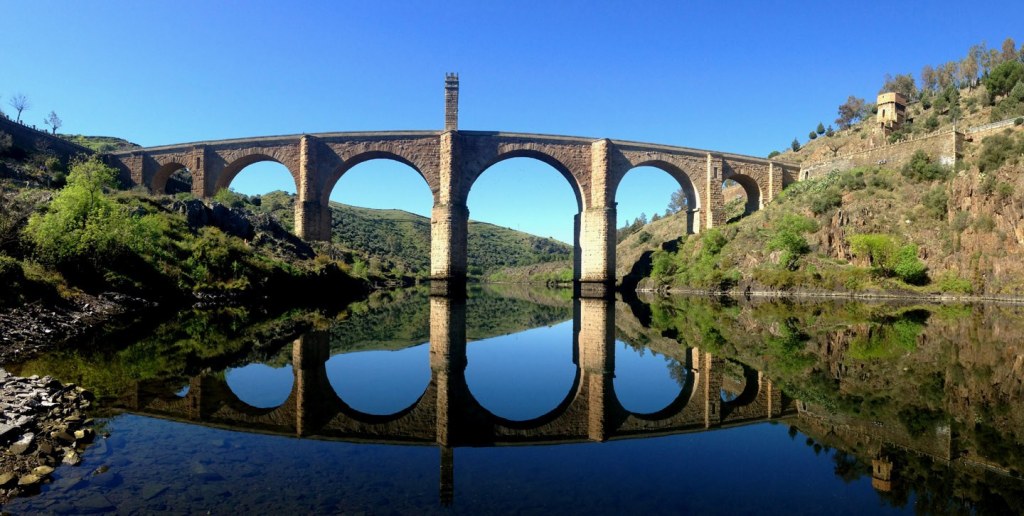
We frequently travel into Spain on Sundays through Idanha a Nova and Segura, crossing a Roman bridge and aqueduct to enter Spain several kilometers before Alcántara. Apart from a few restaurants, a tourist trap or two, mini-mercado, and pharmacy, there’s not much else at this border town. For that, you’ll need to drive another 40 kms or so.
The food, however, is quite good at the area’s three restaurants: Kantara (the most expensive), Kantara Al Saif, and Gundin (our favorite). Gundin’s €11.00 Menu del Día provides the best gazpacho I’ve enjoyed. Except for the bread (Spain doesn’t come close to Portugal’s bread), the other two dishes are also quite tasty.
This time, though, we headed farther north – through Penamacor – to visit Valverde del Fresno for its Thursday market. The town is 16 kms from the Portugal border which, in turn, is 16 kms from Penamacor.
While we looked forward to a Spanish meal, we were on a special mission this trip: shopping for stuff at prices cheaper than in Portugal.
Textiles!
The irony is that thick, plush, absorbent, 100% cotton towels tagged with “Made in Portugal” labels cost half the price in Spain. Same for linens—from sheet sets to table cloths and coverlets.
That’s the good news. The bad?
Regardless of mattress size – including “king” and “queen” – Spanish sheet sets contain only three pieces: a top sheet, bottom sheet, and pillow case—each almost the same size. For some reason unbeknown to us (or any salespeople), the Spaniards have humongous pillows—measuring almost 200 cms across! We, however, have two pillows … each about 75 cms wide.
So, despite the higher cost, we buy our sheets and pillow cases in Portugal, where the larger size sets come standard with two matching pillow cases. (And, no, the label doesn’t say “Made in Spain.”)
Our favorite place to shop for such textile goods is the Monday market in Fundão. It’s massive! In fact, our next expat get-together will be a trip to Fundão’s Monday market, followed by a fixed-price (€9.95) buffet lunch at the city’s Principe da Beira hotel.
Anyway, I’ve digressed …
Fait accompli: We purchased our towels and took time to poke about the town, which is bigger and much more typically Spanish than Alcántara. We’d forgotten that it’s an hour later in Spain than Portugal, so most of the shops were closing … and restaurants were filling.
Tapas. We wanted tapas!
In Olvera, our Spanish hometown, as in most of Andalucía – southern Spain – menus offer meals in three sizes: tapas, media (half) ración, and a full dish (ración). Not here in Extremadura. Patrons and wait staff at restaurant after restaurant explained to us that tapas weren’t available … but complimentary “pinchos” were served with the drinks.
In southern Spain, pinchos are a type of tapa—they’re anything served on a skewer. Here to the north, in Extremadura, pinchos refer to a small, tasty dish provided gratis that accompanies your beverage.
We ate at Restaurante Casa Laura. With 120 “excellent” TripAdvisor reviews – four times more than the closest competition – we soon understood why: the food is to die for there. We began with some beer accompanied by a small dish of pinchos, potatoes mixed with egg and pieces of chorizo in a carmel sauce. Yum-mo! The cool gazpacho soup was good (enough), followed by meatballs in a thick and rich tomato sauce for me and cod (bacalao) with nary a single bone for Russ. The pièce de résistance, however, was dessert: dreamy-creamy cheesecake.
Total tab for our lunch, including tip, was twenty-seven euros (€27), somewhat pricier than what we’ve paid in Alcántara. But well worth it! Everyone working at the restaurant was super friendly and all made a point of stopping by our table to be sure we were satisfied.
Heading back across the windy roads surrounded by a lush, distinctly parceled landscape, it occurred to us how different the topography of Spain is in some ways from Portugal’s.
The two countries are close enough to be kissing cousins, but remnants of historical bitterness and jealousies remain between them. That’s truly a shame, since they’re so convenient and complementary.
It’s good to see Portuguese people visiting Spain … and vice-versa.
Throughout the Castelo Branco district’s tantalizing come-hithers, we’ve come across many Spanish tourists taking day trips into Portugal.
Turnabout is surely fair play for us to sightsee and go shopping in Spain!
Shared here are personal observations, experiences, and happenstance that actually occurred to us as we moved from the USA to begin a new life in Portugal and Spain. Collected and compiled in EXPAT: Leaving the USA for Good, the book is available in hardcover, paperback, and eBook editions from Amazon and most online booksellers.
Processing…
Success! You're on the list.
Whoops! There was an error and we couldn't process your subscription. Please reload the page and try again.
I will always admire Canada and respect the Canadian social contract with its people. But I wouldn’t want to live there. Wisconsin has been cold enough for us. Delving into international retirement trends, we learned that many Canadians owned property in Mexico, where they retreated, if possible, to escape the blustery cold.
So, we looked into Mexico as a potential retirement haven. But the stories about traveling through Mexico – especially around towns near the U.S. border – were chilling in a different way: the fear factor. Americans inadvertently (but sometimes deliberately) had been targets of drug cartels and other criminals in the country.
We considered the Lake Chapala and Ajiic areas outside Guadalajara – known for its “ideal climate” and the number of English-speaking expats residing there – but these places, not far from Mexico’s second largest city, also became headlines when Americans were found murdered there.
“They were in the wrong place at the wrong time,” explained people quoted in the news stories. “They should have known better: You don’t go out here alone at night … especially to certain places. You travel only on the major highways and roads. Don’t wander around. You learn that, to stay safe, it’s wise to live in a gated community.”
That wasn’t what we wanted; our dream included late-night strolls along cobble stone streets of old towns with lots of lanes and paths.
Mexico’s Yucatán peninsula – home to cruise ships calling on expansive, intentionally constructed resort destinations like Cancún, Cozumel, and Playa del Carmen – advertised itself as Mexico’s “safest place to be.” Rather than these tourist traps featuring all-inclusive vacations and panhandlers shilling free meals at luxurious spots in exchange for touring the premises and listening to pitches on the benefits of buying their time-shares, we decided to take a close look at the historic city of Mérida and its nearby beaches—especially Progreso.
It’s hot there. Very hot. Hot and humid and buggy.
We stayed in a charming little hotel in downtown Mérida, on a small street not far from the city’s market. With Walmart, Costco, Home Depot, Office Max, and other U.S. brands, we felt “at home,” although stifled by the climate if not put off by the language.
But Mérida wasn’t where we wanted to be—even its own people looked to escape the oppressive heat by heading to the beaches, not even an hour’s drive away. We headed there, too.
We went there to look at “Big Blue,” a property in Progreso, just two blocks from the Gulf of Mexico beach. The stately building boasted five big bedrooms, five full baths, a separate “casita” with its own facilities, and a heart-shaped swimming pool … all enclosed and private. We’d seen it listed online by more than one property agent based in Mérida, although one seemed to be more familiar with the property and the Canadian family that was selling it. It had been on the market for a while, the agent informed us, and the owners were “motivated” to sell it.
“What does that mean?” we asked. “Come down and look at it,” replied the agent. “I’ve spoken with the sellers and feel sure that they’ll sell it to you for $10,000 less than their asking price.”
The house was truly awesome. But it needed work. And furnishings. Especially if it were to become the bed and breakfast we envisioned. How much would it cost us to have the repairs and updates made, with so many trades – electrical, masonry, plumbing, carpentry – involved? What would we pay for all the new appliances – air conditioners, a commercial kitchen, all the usual suspects – that needed upgrading? And what kind of estimate would be appropriate for the furnishings, especially comfortable new bedrooms and mattresses?
We made an offer—exactly what the agent told us the owners would accept. Leaving later that morning, we waited at the airport for a response, laptops opened and WiFi on. Just before boarding, we received the news: “Sorry. The owners changed their minds. They’ll sell you the house … but want the full asking price.”
Six years on the market. We offered what was recommended before we flew down to check out the property and Progreso. But, now, it didn’t feel right. If we were misled about the acceptable price for the property, what else might be mistaken?
More importantly, where should we consider next?
I engaged all my contacts and connections in seeking a church seeking a pastor. Preferably a Spanish-speaking pastor. Like the patriarch Abraham long ago before me, I felt a tugging at my spirit urging me to move on to a place whose Spirit would call.
That’s when I came across this mission statement from an international church in Panama serving all people, but especially English and Spanish speakers, which was looking for a new lead pastor: “To be a bridge of cooperation and understanding among religious groups of all faiths; of acceptance of others regardless of social class, race, gender, or sexual orientation; between all of God’s children, mirroring and practicing the love God has for us; of freedom in the study of religion, the interpretation, and the practice of faith; and for God’s love in a troubled world, expressing a generosity of spirit to all those in need.”
Now, that sounded like a perfect fit in terms of my personal beliefs.
I submitted a letter of application, along with my CV, via email.
Within days of completing and submitting the application materials requested, I heard back from the pastoral search committee: “We would like to schedule an interview this coming Monday. Any chance we can hold it at 7pm or 8pm CST?” It would be an hour conversation.
The plot was thickening, but what did we really know about living in Panama? Our only experience with the country was a cruise ship excursion through Panama City, culminating on a boat that would take us through the fabled Panama Canal. But what would it be like to live there? What was its quality of life and cost of living? Even closer to the equator than Jacksonville, Florida, or Progreso and Mérida, Mexico, how hot and humid would the climate be there?
Panama is very, very hot and very, very humid. It is also very expensive, especially the areas around the church. How much would it cost us to move there—including our three dogs? Would the church help defray some of these costs? When did they expect me to start? How long would it take for us to sell our house and our cars? Would the church pay for Russ to join me for a week or so to do house-hunting while I was being oriented to the church? Ultimately, there were more questions than answers forthcoming. And those answers that were provided indicated that the move would be more difficult than either Russ or I had anticipated.
Sadly, I turned down the offer. But I continue to use this church’s mission statement as an example of what I believe a church should be.
We were beginning to become indoctrinated to the “expat” community and decided to consider the possibilities offered by two other countries in South and Central America: Ecuador and Nicaragua.
During a year in high school, Russ’s family had hosted an exchange student from Ecuador. More recently, we were hearing increasingly good things about expat life in this country: Relatively low crime, a large and active expat community, extremely generous homes at very affordable prices, and quite a comfortable climate … even in Cuenca, a beautiful colonial city high up in the mountains, where many expats have settled.
In Ecuador, you can enjoy some of the lowest prices in Latin America on everything from groceries to real estate and domestic help. A couple could easily live a modest lifestyle on as little as U.S. $1,200 per month, including rent. With less money needed for housing and utilities, retirees have the flexibility to travel and pursue other dreams. Inexpensive transportation is readily available and makes getting around the rest of the country a breeze.
Ecuador also offers great benefits to its senior residents, with discounts as high as 50% on things like international airfare and entertainment.
Many expats who retire to Ecuador find themselves extremely pleased with the country’s medical system, particularly with the quality of care they receive. Most doctors speak English, and many trained in the U.S. Hospitals are excellent and equipped with state-of-the-art technology. Best of all is the cost: Health care can run anywhere from half to one-tenth the cost for the same services in the U.S.
Yes, we’d certainly think about Ecuador.
But we also were being tickled by Nicaragua, especially Lake Granada, a freshwater lake and the largest in Central America. The lake drains to the Caribbean Sea via the San Juan River, making its lakeside city an Atlantic port, although Granada (as well as the entire lake) is closer to the Pacific Ocean geographically.
Other parts of Nicaragua can get disturbingly hot, but Granada and its lake are quite comfortable and its real estate is altogether reasonable.
“Life here [in Granada] has been good to us,” shared one retiree from the USA who was active in one of the Nicaragua online expat groups we had joined. “What you really need to think about is what you will do when you get here. Successful expats reinvent their lives and do things that they have always wanted to do. We do some volunteer work, are active in our church, and pursue interests we didn’t have time for in our former life. We also travel a great deal. Central America is a great place to see. The availability in stores is great, although imported food is expensive. We have found most of what we want. We go to Managua once a month for groceries and to have a fun time,” reported this Granada expat. But another expat living in Nicaragua had these words of warning about Granada:
“You can live here very well on whatever income you have. We live in a middle class neighborhood for a fraction of what it would cost in the U.S. or Canada. Our neighborhood is very safe, our neighbors are friendly and watch out for us, but you must practice common sense. Most of the crime is opportunistic and, if you are walking home drunk and talking on your iPhone at midnight, expect to invite trouble. We also avoid heavy tourist areas like La Calzada, which are magnets for crime. Be just as careful of expats as Nicas. Don’t trust anyone you meet in a bar. Get to know people before you get too friendly.”
Good advice. For everyone, no matter where.
While we had heard through the grapevine that “Nica” was the next best place to invest – because China was planning to spend lots of money building a canal there that would beat Panama’s – there was just something about Nicaragua that made us uneasy. Maybe it was its history. Or, perhaps, it was because of El Salvador, Honduras, and (to a degree) even Costa Rica, its current neighbors, whose citizens were among the “immigrants” fleeing their countries to live in the United States. Whatever the cause of our hesitancy, neither Nicaragua or Ecuador, nor Mexico and Panama, felt right for us to retire there.
None of these places had our names on their welcome mats.
Shared here are personal observations, experiences, and happenstance that actually occurred to us as we moved from the USA to begin a new life in Portugal and Spain. Collected and compiled in EXPAT: Leaving the USA for Good, the book is available in hardcover, paperback, and eBook editions from Amazon and most online booksellers.
Processing…
Success! You're on the list.
Whoops! There was an error and we couldn't process your subscription. Please reload the page and try again.
Friends often ask us, “How much does it cost to live in Portugal and Spain?” while other folks already living here are curious about how much they spend compares with what others are spending each month.
After some initial major, one-time outlays that aren’t recurring, we have been able to determine our monthly living expenses and budget what it costs us to live in Iberia.
Hopefully this will prove helpful to some of you.
When evaluating and comparing our expenses to yours, please consider that: (1) We live in relatively lower-cost areas of Portugal (a small village in the Castelo Branco and Elvas metropoles … not Lisbon, Porto, the Algarve, etc.) and Spain (Olvera, a “pueblo blanco” in Andalucí); (2) Without a mortgage or car payments, we are relatively debt-free; (3) We don’t live on a quinta or off the land. In fact, we have no land at all … just a good-size property with nine good-sized rooms in Castelo Branco, and “halfway” house between our properties in Portugal and Spain, and — of course — our get-away house in Olvera; and (4) the budget below reflects our monthly expenses for maintaining all three properties. (From the proceeds of the sale of our Sturgeon Bay, Wisconsin, house — about $150,000 — we were able to purchase, fix up, upgrade, and furnish the three houses.)
Here are our monthly budget expenditures:
€200 Electricity €50 Water €100 Petrol/Gasoline for the Vehicle €125 High-Speed Internet/TV/Telephones at all three properties €30 Property Taxes €10 Vehicle Taxes €150 Comprehensive Health Insurance for Two (aged 74 and 59) €50 Insurance: Car (€25)/Properties (€25) €500 Food: Groceries & Restaurants €110 Miscellaneous/Contingencies (Unbudgeted)
Less than €1,400 Monthly Budgeted Expenses
That’s just about US $1,550 per month (based on the current exchange rate).
Shared here are personal observations, experiences, and happenstance that actually occurred to us as we moved from the USA to begin a new life in Portugal and Spain. Collected and compiled in EXPAT: Leaving the USA for Good, the book is available in hardcover, paperback, and eBook editions from Amazon and most online booksellers.
Processing…
Success! You're on the list.
Whoops! There was an error and we couldn't process your subscription. Please reload the page and try again.







 "Exactly!"