An Exceptional Language: Portuguese, La Lingua Franca

Unfortunately, Portuguese was never one of the languages offered in most USA schools.


Spanish and French, yes … with some of the more upscale schools including Latin (or Greek) – even Russian! – in their curriculum.


Mas não português.


So, most of us opted for Spanish or French.


Even a limited knowledge of Spanish, especially, can be both a help and a hindrance — a mixed blessing — to learning Portuguese.

Let me be clear: I am not saying that Portuguese derives from Spanish or that peering into Portugal’s language portal through Spanish eyes is what learning Portuguese is all about. Many people have difficulty understanding and speaking Portuguese (though reading it is somewhat easier), not just because of the vocabulary and syntax, but — especially — because of its pronounciation. But, once our ears are attuned to the sounds and rhythm of the language, there’s a nasalized beauty in the poetics of Portuguese.


The communications professor in me wants to know about a language and understand what makes it tick. Peering through the peephole of Spanish, because it’s my familiar tongue, I try to unpack the mysteries of how the Portuguese language works—and why.


But my Spanish also causes obstacles, hurdles, and stumbling blocks. People constantly remind me that I’m thinking – and talking – in Spanish.


When I speak Portuguese, it comes out sounding like a Spanish mish-mash.


“Fala português … não espanhol!” my Portuguese friends admonish and encourage me.


Intent at understanding the “why” behind the language, its psychology, the rules governing its syntax, I’ve embarked on an ambitious adventure to analyze Portuguese, at least as the language relates to Spanish … arriving at a number of “Eureka!” findings in the process.


Some rules hold true rather regularly between Portuguese and Spanish. For instance:


• An “n” in Spanish is usually an “m” in Portuguese, while the Spanish “ie” is simply an “e” in Portuguese. Examples: una/uma … con/com … en/em … diez/dez … sin/sem … tiene/tem … bien/bem … abierto/aberto … también/tambén … alguien/alguem … siempre/sempre … tiempo/tempo … invierno/inverno … fiesta/festa;


• That “ny”sound (as in“canyon”) signaled by a tilde over the “n” (ñ) in Spanish is much the same in Portuguese, with words having “nh”letters: viño/vinho … señora/senhora … español/espanhol … baño/banho … leña/lenha;


• Although also used in Portuguese – most frequently over the letter “a”(ã) – the tilde produces an entirely different (nasal) sound: João … cartão … educação … manhã … não;


• The “ue” diphthong in Spanish becomes an “o” in Portuguese: luego/logo … puerta/porta … puerto/porto … puede/pode … fuego/fogo … fuerza/força … escuela/escola … cuenta/conta … suerte/sorte … juega/joga.


• “O” in Spanish is often “ou” in Portuguese: poco/pouco … otro/outro, while the Spanish “l” often becomes an “r” in Portuguese: plato/prato … placer/prazer … plaza/praça;


• “U” in Spanish can become “ui” in Portuguese: mucho/muito … at other times, instead, it becomes an “o”: gusto/gosto … punto/ponto;

• The double “ll” in Spanish often translates to “ch” in Portuguese: llave/chave … llama/chama … lluvia/chuvia … llegando/chegando;


• Words beginning with “h” in Spanish often switch to an “f” in Portuguese: horno/forno … hacer/fazer … hablar/falar … hijo/filho … harina/farinha … fugir/huir … hablar/falar … harto/farto;


• When you see a word with a “çao” suffix in Portuguese, it probably ends in “ión” in Spanish: relação/relación … informação/información … edição/edición … habitação/habitación;


Confused?
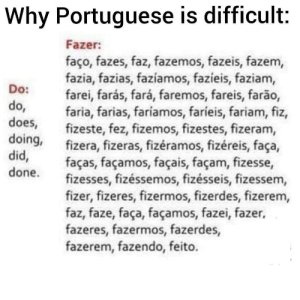

Wait, the questions keep coming … and we haven’t yet touched upon tenses and sentence structure:


It’s “bom dia, boa tarde, boa noite” in Portuguese, but “buenos días, buenas tardes, buenas noches” in Spanish. Why are the day’s divisions plural in Spanish but singular in Portuguese?


When does “dia” end and “tarde” begin, anyway? Why, after 12:00 PM, of course, you say? Maybe technically. But people in Portugal generally suppose that “tarde” begins after one has eaten lunch. What about “noite”? When it becomes dark … or after eating dinner?


And why are the words for “day” spelled the same in Spanish and Portuguese, while only Spanish gives it an accent mark (día)?


Spanish, like most Latin-derived languages, names the days of our lives: lunes, martes, miércoles, jueves, viernes, sábado, domingo. Except for the weekends (sábado, domingo), Portuguese, instead, numbers them: segunda-feira, terça-feira, quarta-feira, quinta-feira, sexta-feira.


But don’t confuse “feira” (market, as in market days) with “feria” (fair, market, and often, holidays) or ferias: vacation.


Thankfully, many words are identical in both languages: “casa,” “porque,” “tal|vez,” “médico,” “viajar”, “comprar,” “poder,” “vida” … and even “de nada,” to say “you’re welcome.” So, how come cats are cats – “gatos” – in both languages, while a dog is “perro” in Spanish but “cão” in Portuguese? And, for goodness sake, how did “gracias” become “obrigado,” every foreigner’s favorite Portuguese word?


Pronunciation and accents are other matters entirely, as Portugal uses almost every accent mark in existence—and then some! How can anyone other than a native enunciate clearly the subtle differences between “pais” (parents), “país” (country), and “pães” (breads)?

Who but the Portuguese can tell the difference between grandfather and grandmother, when the ending of both seemingly masculine words differs only by an accent mark: avô (grandfather) and avó (grandmother)? Yeah, right. Now try pronouncing them both.


Similarly, verb tenses and conjugations differ in the two countries of Iberia. For instance, consider so-called “reflexive” verbs. More often than not (although not always), their order is reversed: In Spanish it’s “se vende, se trata, se llama,” while in Portuguese we get “vende-se” and “trata-se,” but “se chama” … except when asking a question, used in the negative, and other exceptions: “Se vende a casa?” “Como é que se chama?”

And the past tense (pretérito) is so similar, yet different. Take the verb “ir,” for instance. In Spanish and Portugal, the first person singular in both is “fui.” Yet, while the third person singular is close in the two languages, a miss is as good as a mile: fue (Spanish) and foi (Portuguese).


Here’s where turnabout between the Portuguese and the Spanish isn’t necessarily fair play: Some Portuguese people understand spoken Spanish, because they grew up watching Spanish TV.


Spanish people, however, have a hard time understanding Portuguese. Some say that’s a matter of choice, not of ability. Because whether it’s Portuguese, Spanish, or Portu|ñ|ol, we certainly understand each other at the border cities and towns.


As for me, I don’t think I will ever get used to seeing “Puxar!” on a door and pushing rather than pulling.

Shared here are personal observations, experiences, and happenstance that actually occurred to us as we moved from the USA to begin a new life in Portugal and Spain. Collected and compiled in EXPAT: Leaving the USA for Good, the book is available in hardcover, paperback, and eBook editions from Amazon and most online booksellers.

Processing…
Success! You're on the list.

The Americanization of Iberia

Conveniently, we’re eating lunch in the food court at one of Castelo Branco’s largest shopping centers. With a dozen or so eateries in a semi-circle filled abundantly with tables and chairs, eateries abound: churrascarias (bbq), fish, soup and sandwich, Italian (pizza & pasta), kebabs and gyros, burgers, ice cream, pastries, and other desserts.

Our favorite is a Brazilian steak house where, for €4.90 – about $5.50 – you can get a grilled flank steak on a roll with a side salad, bowl of soup, French fries, and your choice of beverage—wine and beer included. Other meals are comparably priced. All are served on real plates and dishes, with flatware and drinking glasses.

But many of the Portuguese we see prefer to eat, instead, at the Pizza Hut, KFC, Burger King, or McDonalds next door … tapping digital buttons to order food and then waiting for their LED numbers to flash, summoning them to pick up bags with disposable contents.

Meals at these American franchises typically cost more than Portuguese food.

Hamburgers, chicken, pizza, and sandwiches, of course, are international foods, unlimited by American influence. It’s how the food is cooked and served that makes all the difference (along with the type and quality of products used).

Why would anyone want to eat such assembly line food with “paper” plates and plastic utensils, when so much better is available in the very same space?

It got me thinking about the influence America – the USA, in particular – is having on Portugal and Spain in Iberia. Is that still called “imperialism?” Good, bad, or indifferent, the USA has affected Portuguese and Spanish cultures in many ways:

• Language. As American English differs from the British, European Portuguese and Spanish differ from their Brazilian and Hispanic cousins. And American lingo is increasingly taking root in both languages. English – accented by American English, by and large – is mandatory learning in Portuguese schools, from elementary grades through secondary school. English speakers seek to practice their Portuguese; but as soon as we open our mouths with mispronounciation, the Portuguese reply in excellent English. Daily, more American expressions and words are imported, even though native words already exist: “take-away,” and “tênis” (sneakers) … along with many other words of common usage: “marketing,” “workshop,” “brownie,” “cupcake,” “low cost,” “cheap,” “check in,” “designer,” “email,” “blog” “clic(k),” “check up,” and “yummy” are just a few examples, along with the universal gadgets and widgets of technology.

Media. If you watch TV’s The Price Is Right or America’s Got Talent, you’d best take their Spanish and Portuguese equivalents with a large dose of salt! As for cinema, we get first-run American movies here upon release. Soundtracks are hilariously dubbed in Spanish, while shown in their original English with Portuguese subtitles.Heck, there’s even Netflix.es and Netflix.pt. American music – current and oldies – is quite popular on much Iberian radio … until interrupted periodically by Catholic masses and Hail Marys broadcast in their entirety.

• Money. Plastic seems preferred over cash—especially during the pandemic. Although Americans reach for their credit cards, the Portuguese and Spanish are more likely to use debit cards. The ATM was invented by a Brit (not the Yanks), but their use is everywhere today. In Spain, you can withdraw and deposit money, pay bills and even traffic fines at an ATM. Portugal’s “multibanco” machines do even more! They’re so smart, in fact, that they don’t deem cash withdraws – where we’re assessed fees from both the dispensing and our home banks – as such. (Not so with Spain’s ATMs.)

• Medicine. Although universal health care is the birthright of all Spanish and Portuguese citizens (legal residents in Portugal, as well), locals often opt to supplement their public health care with private coverage. There’s quite a difference (in price!) between the USA’s and Iberian medical plans. While the cheapest and least inclusive health insurance policies can cost thousands of dollars per month in America, comprehensive health care insurance in Portugal runs us about $160 per month (all-inclusive) for two people–one 70+, the other almost 60. Spain, too, offers the option for foreigners residing there to buy into the country’s national insurance or purchase comparable coverage through private market insurers.

• Urbanization. How are you going to keep them down on the farm? The Portuguese lament the loss of their younger, educated population who flee the small villages of their birth to elsewhere … other countries, as well as bigger cities in Portugal, where employment opportunities are more plentiful and the proverbial “rat race” appears to be exciting. Buy, sell, spend, borrow, bigger, better … more! After a while, however, keeping up with the Joãs takes its toll. Like the city mouse and the country mouse, there’s a pronounced distinction between city dwellers and their more provincial relatives, with natives dividing lifestyles as either city or country (campo).  Increasingly, however, the Spanish and Portuguese experience that yearning, “saudade,” to return to their roots … tilling the soil and enjoying a more peaceful, tranquil, less hurried and hectic lifestyle. Wherever the location, however, for those looking to buy or rent property, there’s a local office of the Re/Max, ERA, Century 21, and Keller Williams real estate networks.

• Technology. The globalization of technology certainly can’t be limited to the United States. But silicon valleys across the country are the forbearers and creators of our digital world. The most popular mobile phone in Portugal and Spain? Apple’s iPhone.The preferred computer? Apple’s iMac. The ubiquitous operating systems and tools of computers? Microsoft’s. The go-to search engine? Google. The most popular social media platforms? Facebook and its WhatsApp. The best known computer chips and graphic cards? Intel.

Unfortunately, ignorance and belligerence — byproducts of American polarization — appear to be finding friends in Spain and Portugal. Chanting “freedom,” hundreds of people rallied in Madrid and Lisbon in to protest the mandatory use of facemasks and other restrictions imposed by the governments to contain the coronavirus pandemic. And in Portugal, one of the countries intent on containing and crippling the virus, we are impressed with the fortitude and compassion displayed by the Portuguese people. “It is not perfect here,” states an American expat living in Lisbon. “The police need to enforce mask rules (occasionally meeting violent resistance) in some ethnic ghettos, but the city is trying to increase communications and messaging in those neighborhoods and incidents are rare.” In southern Portugal, “most are following the rules, but still get too close at the grocery, leaning in or reaching around. On the boardwalk, tourists don’t cover when they cough and sneeze.”

American outreach has cribbed many inroads to territories Spanish and Portuguese.

T-shirts glorify alleged American icons and phrases, while shopping carts are filled with brands such as Heinz, Tropicana, Listerine, Johnson & Johnson, Old Spice, Colgate, Oral-B, Coca Cola (and Pepsi), Kellogg’s, Finish, Raid, Vaseline, Woolite, Hellman’s, Vaseline, Dove, Bic, Purina, Pedigree, and Friskies (among others) … outpacing the national ones.

So be it.

But if and when Walmart arrives here, it will be time for us say enough is enough!

Shared here are personal observations, experiences, and happenstance that actually occurred to us as we moved from the USA to begin a new life in Portugal and Spain. Collected and compiled in EXPAT: Leaving the USA for Good, the book is available in hardcover, paperback, and eBook editions from Amazon and most online booksellers.

Processing…
Success! You're on the list.

What Do You Call It?

The Portuguese have a word for it.

English really doesn’t.

You can’t define it; to truly understand its meaning, you’ve got to experience it.

It’s different than depression, distress, disillusionment, discouragement, despair. It’s wistful and wishing for the way things were … and ought to be … but aren’t anymore.

Although “melancholy” probably is its closest cousin in English, it’s much more than that: a longing, yearning, aching void.

It’s the heart swelling up and crying out inside. It’s a lump in the throat … anxiety attacks … a feeling of foreboding … brooding … bleeding internally … unable to heal the hurt.

It’s a slow burn about the utter unfairness of it all … coupled with an irresolute resolve to go on and make it through yet another day–despite the turmoil, trespasses, and travails along the way.

It’s caring so much and coping so continuously that we’re overwhelmed and exhausted, unable to do much more than sigh as we watch the world go by(e).

It’s abject and deject, anguish and agony, feeling victimized and caught up in an elusive web of betrayal beyond our control.

It’s something for which, elsewhere at another time, they’d prescribe mind-numbing drugs, psychotherapy sessions, and therapeutic confinement.

It’s sort of like the Yiddish word “Rachmones,” whose translations – mercy, compassion, empathy, understanding – don’t come close to what we actually feel when recognizing the trait in a kindred spirit: Namaste.

It’s a voice heard in Ramah, weeping and great mourning, Rachel weeping for her children and refusing to be comforted, because they are no more.

It’s hiding in Anne Frank’s attic, knowing full well what the future holds.

Yet, it is part of the song and dance that are our lives.

The Portuguese sensitize these doldrums and call them “Saudade.”

For me, it’s a dark cloud hovering over us as I await what’s beyond … looking away and staying inside without precious connection to others … hoping it will pass sometime soon.

I feel like a psalmist, pleading with the Almighty to allow me to be joyful, yet unable to understand how and why we’ve become such drained and divided fragments of our fabric.

Then I remember that verse: “ … weeping may remain for a night, but joy comes in the morning.”

So be it.

Shared here are personal observations, experiences, and happenstance that actually occurred to us as we moved from the USA to begin a new life in Portugal and Spain. Collected and compiled in EXPAT: Leaving the USA for Good, the book is available in hardcover, paperback, and eBook editions from Amazon and most online booksellers.

Processing…
Success! You're on the list.

Elbow Kissing

People here take the virus seriously. Very seriously, indeed.

Wherever we go in our Spanish town of Olvera in Andalucía, folks have masks dangling, half-mast, from their ear lobes, ready to pull them up to cover their mouths and noses as soon as the shadows of others are seen approaching.

That’s outside, on the streets.

Elsewhere, the masks are also facial appendages. Little old ladies sit and chat with covered faces, night after night, on benches in the tidy little park at the bottom of Calle Campillos, where Olvera´s former post office had stood, replaced years ago with this quaint oasis in the midst of row houses zig-zagging as they bend and stretch up and down the narrow, steep street.

Across the border in Portugal, little old men sit on knee-high walls surrounding their village churches, pontificating about this or that (as is their nature). It’s difficult enough to understand their dialects under the best of conditions; but, with mouths muffled by máscaras (mascarillas in Spanish), it’s even more challenging to decipher their staccatoed opinions and argumentative crescendos.

Even the youngsters – from toddlers to teens – understand the seriousness of the moment, responding without usual rebellion when told to step back, stay away, come inside, don’t touch, wear their masks.

These are people, entire populations, who barely survived under severe lockdowns for three or more months. They’ve seen death and the toll Coronavirus can take, up-close-and-personal. So, they´re now bound and determined to do whatever they can to ensure they and their communities aren’t again victimized by the virus.

Now, they take Covid-19 damned seriously.

To promote social distancing at restaurants, cafés, and snack bars, Olvera’s local government has granted special dispensations to eating venues and watering holes, allowing them to squat on public space: either grassy land nearby or by cordoning off four or five asphalt parking spots and dedicating them to diners.

After all, this is a café culture where people relish food, drink, and companionship … with wine, coffee, cola, and beer.

Nobody – employees, delivery personnel, clients, customers – enters a shop (large or small) without wearing a mask. Sanitizer is plentiful everywhere. Plastic gloves are often available, sometimes required (in groceries and markets), other times not—but recommended. Cosmetologists and stylists apologize for having to raise prices by fifty cents to pay for the plastic booties and robes clients are required to wear. And, woe to the supermarket customer who dares to inch beyond the designated markers! You may be allowed to put purchases on the conveyor belt … but you’ll be warned to wait until the previous customer has completed paying and packing, before advancing. The one person per elevator (lift) rule is respected, as is a minimum meter distance on escalators. Waiting rooms, as elsewhere, maintain two empty seats between each available one. Spitting on streets is strictly prohibited and enforced by one hundred to one thousand euro fines.

Throughout the Iberia peninsula, Covid-19 isn’t a matter of personal politics or in-your-face freedom fighters; rather, it’s actually about personal hygiene and public welfare: the common good.

I certainly don’t mean to imply that everyone here is a sanitized saint, dutifully and willingly following the new “normal” rules for social interactions. Just the other day, in fact, I observed a woman in one of our favorite supermarkets picking up plastic packages of pastry, squeezing them, and putting them in front of her (masked) nose for a sniff. She picked up and put back at least a half-dozen packages. Not that she was malicious, but simply self-serving and negligent, not thinking about the potential consequences she was causing to others. I caught the eye a store associate and nodded at the woman. Without hesitation, the supermarket employee approached the offender and gave her a lesson she’ll not soon forget about appropriate protocols for grocery shopping.

Nonetheless, such experiences are exceptions to the rule.

By and large, we live among demonstrably caring, emotional and “affectionate” people who share their feelings with hugs, handshakes, and serial kisses on both cheeks. Not now, however. Instead, we poke elbows … laughing about how silly (but serious) such a greeting seems.

Elbow kissing doesn’t come close to sharing a good, hearty hug.

And that’s what really, truly hurts.

No hoax intended!

Shared here are personal observations, experiences, and happenstance that actually occurred to us as we moved from the USA to begin a new life in Portugal and Spain. Collected and compiled in EXPAT: Leaving the USA for Good, the book is available in hardcover, paperback, and eBook editions from Amazon and most online booksellers.

Processing…
Success! You're on the list.

Channeling Andy Rooney: Breaking Bad for the Greater Good

I’m going to get some flak-back on this post … because I believe that good manners are preferable to bad.

Common courtesy and proper protocols transcend cultures and/or countries. No matter where you are or what language you speak, correct conduct is always appropriate and appreciated.

Why, then, do some people ignore “etiquette,” alienating, antagonizing, or offending others? Is it deliberate or incidental?


As a child, weren’t you taught to cover your mouth when you cough and your nose when you sneeze—especially in public?

Queuing at the supermarket or grocery store, I am shocked by how many people cough or sneeze without covering their faces while standing over food. And by people who work in restaurants, where they cough or sneeze – without covering up – when dispensing beverages or handling food!

It’s a matter of respecting personal places and private spaces.

Whether breaking into line out of turn, cutting someone off on the road, denying right of way to pedestrians at cross walks, or invading those sacrosanct spaces immediately surrounding us, it’s self-serving behavior rather than observing conventions for the greater good.

Some people shower or bathe regularly. Others don’t. Some brush their teeth and practice good personal hygiene. Others don’t. Some people apply deodorant. Others don’t. Some smoke. Others don’t. Some people douse themselves in perfume or cologne. Others don’t.

Whether you do or don’t is your choice. But, please, be considerate of mine.

The same can be said of our pets: If you have dogs and cats, especially, please pick up after them and dispose of their waste. Simply opening the door to let pets roam the streets, do their business outside, and then return home is irresponsible. Your home may be clean, but who wants to step in feces … or have our dogs contaminated by it? Sickening to see and worse to smell, it’s a public health hazard.

Driving aggressively, carelessly, and/or inconsiderately also violates the rules of acceptable behavior. Recklessly speeding down the narrow streets of our villages – especially with a cigarette in one hand and cell phone in the other – makes it harder to stop and control a vehicle if/when something unexpected or unforeseen should be presented. On the other hand, we’ve been taught to drive in the right lane and use the left only for passing. So, why stay in the left lane driving 60 kms/h in a 90 kms/h zone? I’m told there’s no specific law here against tailgating (despite all the warning signs); but please stay off my butt. Planning to exit the roundabout or roadway? Again, you need to be where you belong … rather than drifting across in front of us and nearly causing an accident. That little lever (usually) attached to the left side of your steering wheel? It’s called a directional signal for a purpose: to alert others of the direction you’ll be taking or changing. Use it! And, granted that some parking spaces are smaller or tighter than others—even in public shopping centers. But, that doesn’t give anyone the right to park haphazardly … taking up two or more spots, leaving none for others.

Courtesy extends beyond these spaces, streets, and roadways. It also includes online behavior. Just because you’re virtually anonymous doesn’t entitle you to act aggressively, ugly, snarky and/or petulant. What pleasure do some people derive from being so snooty, anyway?

Finally, here’s a nod to professional responsibility: If you want my business, practice good public relations. Return phone calls or reply to my emails promptly. Show up when you say you will. Charge me what we’ve agreed to. I’ll be appreciative and likely to do repeat business with you, as well as to refer others to your products and services.

Finding fault is distasteful.

Yet being selfish, indignant, and malicious have become increasingly in vogue and accepted … especially when spotlighted daily by the revolting conduct and shameful language of our leaders.

Nonetheless, antagonism and rudeness never are really successful. Except when it comes to breeding. They poison a healthy environment and turn prevailing positive attitudes hostile and rotten.

So, let’s do what we can to make this world better for all!

Shared here are personal observations, experiences, and happenstance that actually occurred to us as we moved from the USA to begin a new life in Portugal and Spain. Collected and compiled in EXPAT: Leaving the USA for Good, the book is available in hardcover, paperback, and eBook editions from Amazon and most online booksellers.
Processing…
Success! You're on the list.

“Partners”

“The people of Portugal don’t judge a person’s sexual orientation but, rather, his or her character,” a wise woman said to me.

As hate crimes continue to escalate in the USA and same-sex marriage, though now the law of the land there, faces renewed opposition and denials by government representatives, I am reminded of yet another reason why we love Portugal and Spain.

Sexual orientation and gender identity don’t appear to be issues here.

How ironic that two of the most “Catholic” countries in the world – Portugal and Spain – have been in the forefront of recognizing both civil and human rights, regardless of the church’s official teaching and position.

In fact, the entire nomenclature – the words we use to identify and call this or that – takes a bit getting used to and understanding on this side of the pond.

Take “partner,” for instance. Despite its business associations and financial connections, it’s my own preferred word to describe a relationship in which we share the substance of our lives together.

Evidently, others feel the same way, too.

We’ve met more married couples here who refer to their spouses as “partners,” rather than husband or wife. The same goes for committed couples who, but for common law, aren’t technically married.

And, although I advocate gender-neutral vocabulary whenever possible (and practical), “spouse” simply doesn’t convey that warm-and-fuzzy feeling as does “partner” (or husband and wife, for that matter).

“Mate” can also be gender-neutral, but no longer implies what it did. Once upon a time – for many Americans, at least – one’s mate referred to one of a pair. Like socks or matching earrings. A sexual connection was often implied or inferred when referring to someone as one’s mate. Not anymore: Now, especially among Brits, “mate” is more commonly used as a familiar form of address—as in “friend” or “buddy.”

Attraction, like emotion, is legitimate but not logical … less a product of the mind than what abides in our hormones and hearts. So, whatever term of endearment – partner, spouse, mate, husband, wife – you’re most comfortable with when referring to that special companion in your life is yours to choose and use.

Yet, how does that play out among the Spanish and Portuguese, who refer to their intimate relationships as “esposo” and “esposa” (husband and wife, in both languages), but “marido” and “mujer” (“mulher” in Portuguese)?

The man is a husband in both countries; but the wife is referred to as “my woman.” Both countries are rather progressive, yet with remnants of provincial sexism and property ownership.

What’s more, do the same standards hold true for the Portuguese people and Spaniards today? Look around: Depending on where you live, the answers may vary. Or maybe they won’t.

You’ll need to get to know your neighbors better.

Which is how it should be, anyway.

But don’t interfere!

# # # # # # # # # # # # # # #

Shared here are personal observations, experiences, and happenstance that actually occurred to us as we moved from the USA to begin a new life in Portugal and Spain. Collected and compiled in EXPAT: Leaving the USA for Good, the book is available in hardcover, paperback, and eBook editions from Amazon and most online booksellers.

Processing…
Success! You're on the list.

The Way We Were

“Mem’ries light the corners of my mind

Misty water-colored mem’ries of the way we were …”

I’m beyond 70-years-old now. Not young; truly a “senior” citizen! At best, my body is 70% of what it was and I’m functioning with about 70% of that “gray matter” cooperating consistently. But age does give one perspective, a remembrance of things past … when disagreements were resolved diplomatically and debts of all kinds were repaid with dignity.

Honestly …

I do miss my homeland. At least, how the USA used to be.

“Scattered pictures of the smiles we left behind

Smiles we gave to one another for the way we were …”

Wherever we lived – in Jacksonville (Duval County), Florida, the country’s most expansive geographical area … Racine and Sturgeon Bay, Wisconsin, where the bitter-sweet cold weather warmed the hearts of friendships kindled and kept glowing … or Staunton, Virginia, verily a Queen City – we were family and friends, neighbors and community.

Sadly, that sense of “community” has changed: People we’d considered friends, now disenfranchise us because trust has become a matter of convenience and compromise. That’s what hurts most when reminiscing about our lives in the United States of America: It’s been broken and divided now.

“Can it be that it was all so simple then

Or has time rewritten every line…”

Cutting the umbilical cord with our homeland, we’re grateful to the two countries that welcomed and adopted us—Portugal and Spain.

In Portugal, we reclaimed our souls; Spain enlivens our spirits.

We’ve learned that less can be more and more can be less—especially when bundling up and wearing layers in the watery cold that pervades those thick (but uninsulated) concrete walls of our village house. So, we’re miserly about the rooms where the heating or cooling is turned on … and are adjusting to leaving spaces with mechanically controlled climates, passing through those where the temperature soars and/or plunges. Electricity adds up quickly and the bills can be mind-boggling. You learn to compromise and do lots with less. Similarly, with gasoline costing almost €1.50 per liter, we pay about six euros (almost U.S. $8.00) for a gallon here. Apart from thinking twice about whether a drive is “necessary” or recreational, we’ve learned that walking really is the most convenient way to get around our village. For those longer trips into the city, there’s the bus (two blocks away) which comes and goes throughout the day. Roundtrip transport: six euros or so.

That two-hour “lunch” between 1:00 and 3:00 in Portugal? It’s to relax and enjoy. Spain’s “siesta” is even longer … but you get used to stores closing and reopening again later, between 5:00 and 8:00 daily, and adjust your routine accordingly.

Everyone benefits!

What you see is what you get in Portuguese villages and Spanish towns. What you don’t get is pretension and attitude. There’s little or no need to keep up with the Joãs or Juanas.

The good things in life – bread, soup, wine – are readily available and absurdly cheap … but the best things – crystal blue skies, accessible health care, the inherent decency of people, church bells telling times rather than us running to stop watches – are priceless.

“So it’s the laughter we will remember

Whenever we remember the way we were.”

Shared here are personal observations, experiences, and happenstance that actually occurred to us as we moved from the USA to begin a new life in Portugal and Spain. Collected and compiled in EXPAT: Leaving the USA for Good, the book is available in hardcover, paperback, and eBook editions from Amazon and most online booksellers.
Processing…
Success! You're on the list.

Why Aunt Jemima’s Life Matters

Two struggles are ongoing simultaneously: The battle to contain and eradicate the Covid-19 virus, which has taken the lives of so many; and the Black Lives Matter movement, which appears to be making some inroads to challenging 400+ years of systemic racism and injustice.

Perhaps nowhere do these dual dynamics converge more today than in the higher contagion rates, suffering, and death of African-American communities … which tend to be poorer, inadequately equipped, and less healthy to begin with than the predominantly white suburbs.

I am white and privileged, so what right – if any – do I have to comment on this? None! Other than to share my own, personal opinions.

Unquestionably, slavery and its ensuing racism are our shame and national sin. For far too long, we’ve nodded in recognition of the unfairness and inequalities our corporate culture and people of privilege have hoisted on those born with brown or black skin.

Now, it seems that real, across-the-board efforts are being made to bring this darkness to light, exposing national and international complicity in keeping poor people down.

Sometimes, in an effort to overcome and make amends for the errors of our past, however, we can become poor judges and juries of our present. Time and culture have a way of turning such that today we laugh at what, not that long ago, appeared normal and civilized.

In the late 1800s, Missouri newspaper editor Chris L. Rutt decided to name his brand of self-rising flour after “Aunt Jemima,” a song performed by minstrel actors. A former slave named Nancy Green was later hired to portray Aunt Jemima as a “mammy” a caricature that depicts female slaves as smiling, happy homemakers for white families.

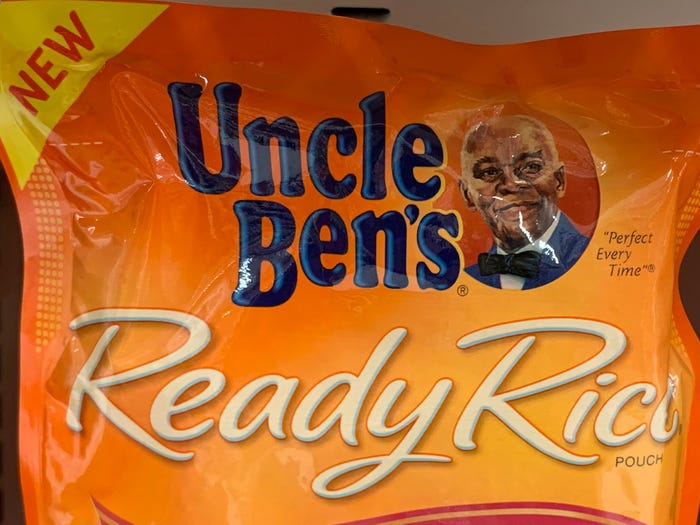
Quaker Oats, a subsidiary of PepsiCo, announced that it will retire its Aunt Jemima brand of syrup and pancake mix, saying the company recognizes that “Aunt Jemima’s origins are based on a racial stereotype.” Hours after Quaker Oats announced it was changing its Aunt Jemima logo, Mars, which makes the boxed rice product “Uncle Ben’s,” said it plans to change the product’s “brand identity.”

Uncle Ben’s, a rice and grains company, adopted its brand name and logo in 1946. According to the company’s website, the name “Uncle Ben” is that of a Black Texan rice farmer and the image is of a Black Chicago chef and waiter named Frank Brown.

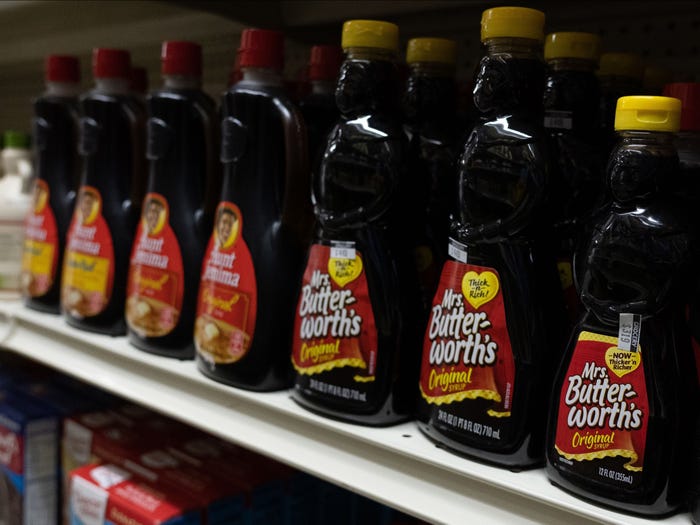
Syrup and pancake-mix company Mrs. Butterworth’s adopted the personality of “Mrs. Butterworth” in 1961.

For years, the shape of Mrs. Butterworth’s syrup bottles has been a point of contention. “Critics have long associated the shape of the Mrs. Butterworth’s bottle with the mammy, a caricature of black women as subservient to white people,” one critic wrote.

Conagra Brands, parent company of Mrs. Butterworth’s syrup and pancake mixes, released a statement saying that they have started a review of the brand and packaging: “The Mrs. Butterworth’s brand, including its syrup packaging, is intended to evoke the images of a loving grandmother. We stand in solidarity with our Black and Brown communities and we can see that our packaging may be interpreted in a way that is wholly inconsistent with our values,” they said.

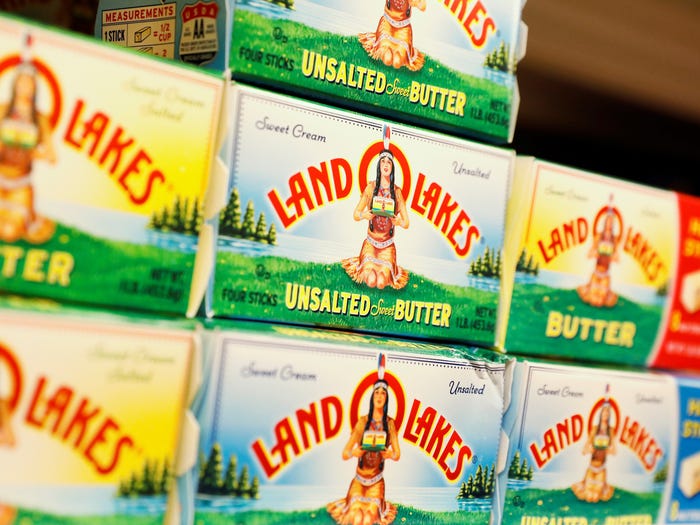
Land O’Lakes (butter) recently changed the packaging for its consumer products to remove the image of a Native American woman with a feather in her hair. The change was implemented ahead of the company’s 100th anniversary. The new packaging is very similar to the original, save for the removal of the Native American woman. It also added the phrase “farmer-owned” above the Land O’Lakes name.

Originally a sexy banana, the Chiquita brand’s mascot is now a sexy banana seller. She wears a Carmen-Miranda-esque fruit hat that gives an exotic and idealized image of the tropics. Other companies, too, have appropriated idealized women to represent their iconoclastic brands: Betty Crocker (whose image has been updated many times), Mrs. Paul, Maybelline, Helena Rubenstein, Estee Lauder, and (of course), the bevvy of beauties tantalizing Victoria’s Secret.

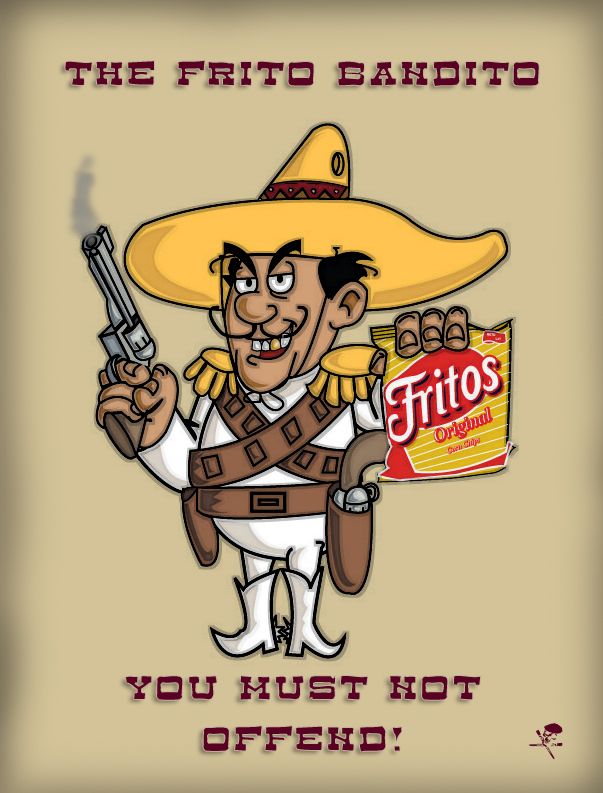
Remember the Frito Bandito? Speaking broken English and robbing unsuspecting bystanders, the Frito Bandito was an armed Mexican conman with a disheveled look and a gold tooth. Responding to pressure from the Mexican American Anti-Defamation Committee, the snack-food giant cleaned up Frito Bandito’s look. But combed hair and a friendlier expression didn’t quite cut it. Similarly, a battle rages about inappropriate stereotypes implied or inferred by the original packaging of Eskimo pies.

Now we have Goya products whose Hispanic products don’t need a stereotypical icon—they’re personally endorsed by Ivanka Trump and her father in the White House.

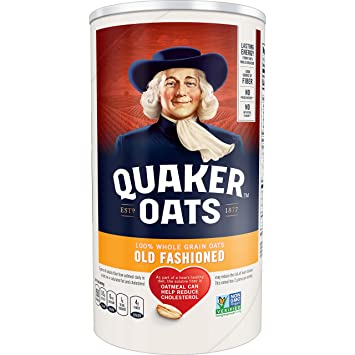
Sometimes, I suspect, we take ourselves and our imaging a bit too seriously. Demarcation must be drawn between “marketing,” which seeks to promote an organization’s products (or services) and “public relations,” whose purpose is to promote the organization itself. Are people demanding that the Quaker Oat Company remove the picture of the Quaker because it is exploiting a religious minority? When and where will it stop?

Separating the brands from their figureheads – if not the stereotypes – has long been the purview of American television.

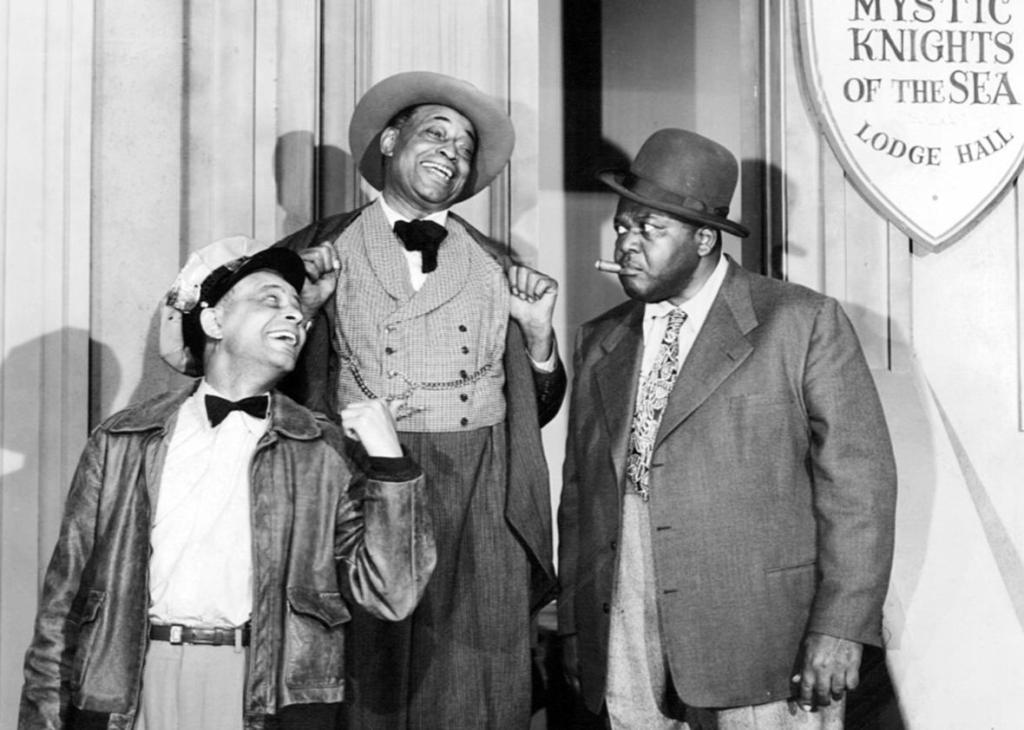
Amos ‘n’ Andy, an American radio and television sitcom set in Harlem, the historic center of Afro-American culture in New York City, was cancelled by The Columbia Broadcasting System (CBS) network after a national boycott led by the National Association for the Advancement of Colored People (NAACP).

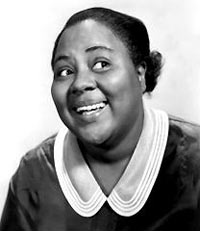
Beulah was an American sistuation comedy series that ran on CBS Radio from 1945 to 1954, and on ABC Television from 1950 to 1953. The show is notable for being the first sitcom to star an African American actress, for being ABC TV’s first hit situation comedy, and the first hit TV sitcom without a laugh track. When actress Hattie McDaniel took over the role on November 24, 1947, she earned $1000 a week for the first season, doubled the ratings of the original series and pleased the NAACP which was elated to see a historic first: a black woman as the star of a network radio program. In 1950, Roland Reed Productions adapted the property into a TV situation comedy for ABC, and the Beulah TV show ran for three seasons, Tuesday nights at 7:30 ET from October 3, 1950, to September 22, 1953. Most of the comedy in the series derived from the fact that Beulah, referred to as “the queen of the kitchen,” had the ability to solve problems that her employers couldn’t. Other characters included Beulah’s boyfriend, Bill Jackson, a handyman constantly proposing marriage, and Oriole, a befuddled maid for the family next door. Like the contemporaneous Amos and Andy, Beulah came under attack from many critics, including the NAACP, which accused the show of supporting stereotypical depictions of black characters with Beulah viewed as a stereotypical “mammy” similar to Aunt Jemima.

I often wonder whether whites and blacks viewed Amos and Andy through the same or different lenses. Did white viewers find themselves laughing with or at these simple people? Was Amos and Andy little more than Laurel and Hardy in blackface for them? As for blacks, did they accept the series because it reflected the significance of humor in the African-American experience?

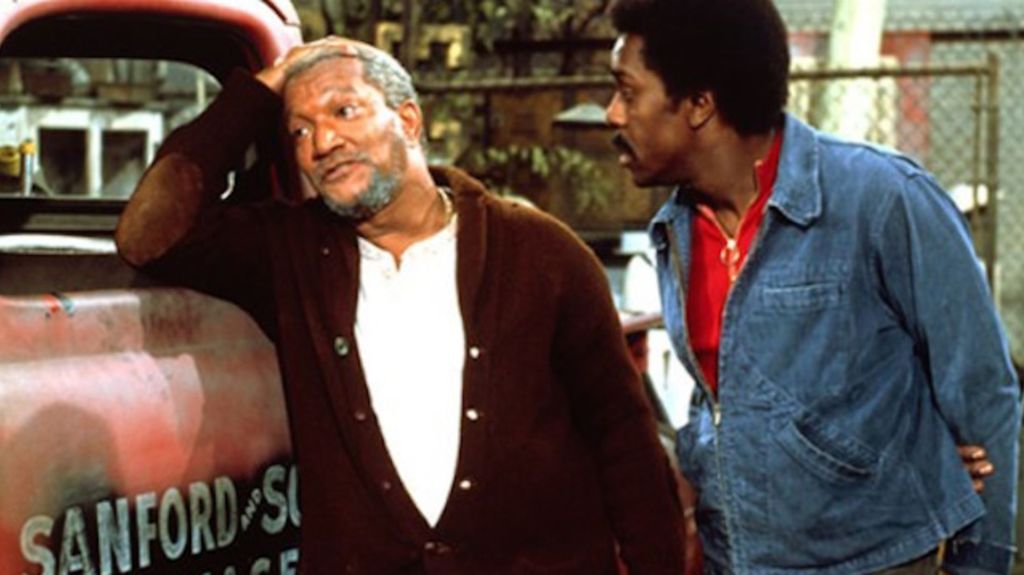
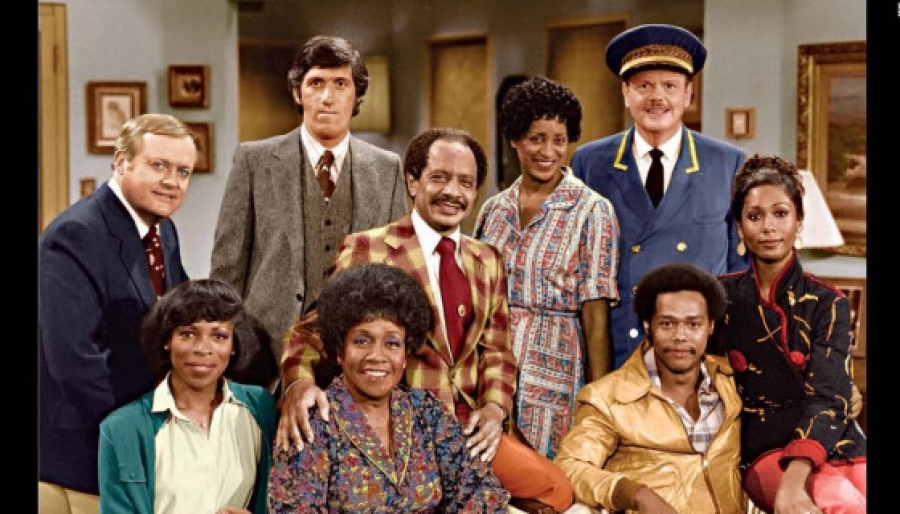
Sanford and Son was a black version of All in the Family. Widower Fred Sanford was as bigoted and ignorant as Archie. His son, Lamont, like Mike, was oriented to middle-class standards. He was embarrassed by his father’s behavior. George, the father in The Jeffersons, although a businessman, fit the same mold as Archie and Fred, namely, loud and bigoted. In the episode “Once a Friend,” George Jefferson learns that his old Army buddy Eddie is now a transgender woman named Edie (Veronica Redd).

Pinky Lee and Billy Crystal in Soap. Paul Linde, a character actor with a distinctively campy and snarky persona that often poked fun at his barely closeted homosexuality, was well known for his roles as Uncle Arthur on Bewitched, the befuddled father Harry MacAfee in Bye Bye Birdie, and as a regular “center square” panelist on The Hollywood Squares. Lynde regularly topped audience polls of most-liked TV stars. Speaking of most liked TV stars, let’s give a nod to Ellen DeGeneris. “The Puppy Episode,” a two-part episode of her Ellen sitcom, detailed lead character Ellen Morgan’s realization that she is a lesbian and her coming out.

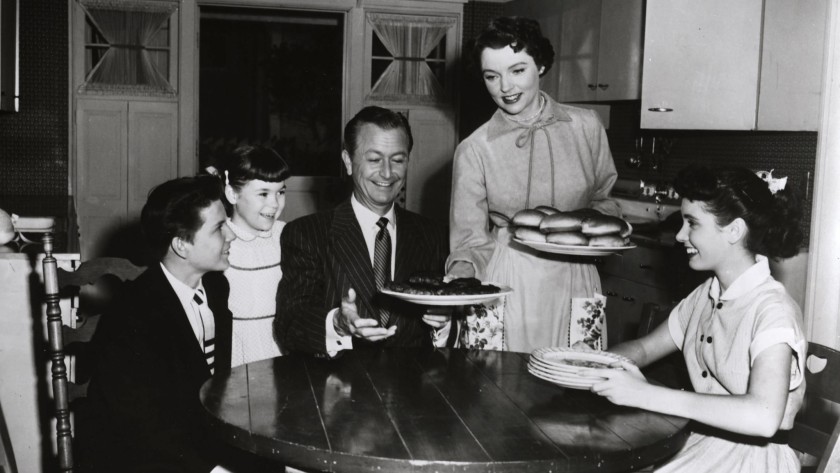
What about shows that depicted women and mothers in subservient roles to men: Father Knows Best? Ozzie and Harriet? I Married Joan? My Little Margie? I Love Lucy? December Bride? June Cleaver in Leave it to Beaver? Even Charlie’s Angels? Donna Reed was the first show to focus on the mother instead of the father. Later series increasingly empowered women: Police Woman, That Girl, Maude, Murphy Brown, Carole Burnett, Mary Tyler Moore, Julia, Roseanne, The Golden Girls, Designing Women, Sex and the City, and myriad others.

What about programs with Indians named “Tonto” (fool, dumb, ignorant) as in the Lone Ranger and other gunslinger westerns. On Wagon Train, frontier scout Flint McCullough and a longtime Sioux Indian friend reunite; but trouble is brewing as the Cheyenne are on the warpath and in their way is Fort Hastings, an old flame of his, and her new Army Captain fiancé. The Cisco Kid was an American Western TV series starring Duncan Renaldo in the title role and Leo Carrillo as his jovial sidekick, Pancho. Cisco and Pancho technically were desperados, wanted for unspecified crimes, but instead viewed by the poor as Robin Hood figures who assisted the downtrodden when law enforcement officers proved corrupt or unwilling to help. Sound familiar today?

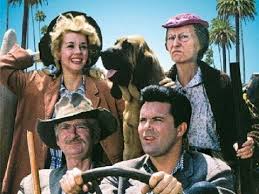
What stereotype images did The Beverly Hillbillies provide of, well, Appalachian hillbillies and the rich folks who tried to show them a new and better way of living? Meanwhile, white working-class men were reduced to Homer, Archie, Fred, and Ralph.

Chester, the father on The Life of Riley, was continually concocting schemes to help his family. Attempting to fix a school election so his daughter would win, he succeeded only in embarrassing her. His incessant failures were expressed in his closing line for each episode: “What a revoltin’ development this is!”

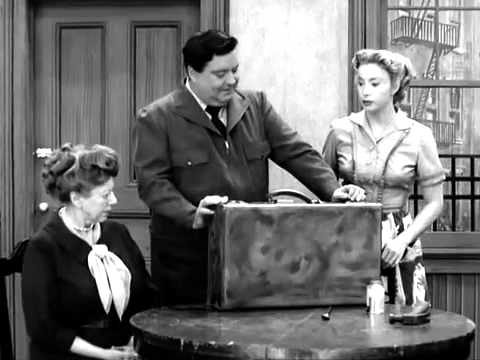
The main characters in The Honeymooners lived in a bare Brooklyn apartment with few amenities. Consequently, husband Ralph was obsessed with success and modest affluence, at which he constantly schemed but invariably failed. He wanted to afford simple comforts such as a television for his wife, Alice. He tried get-rich-quick schemes, such as marketing what he thought was Alice’s homemade sauce, only to learn it was dog food. Alice always quipped, “I told you so.” Alice’s logic and sarcasm invariably bested Ralph in arguments, which typically ended with Ralph saying, in angry frustration, “Just you wait, Alice, one of these days, pow, right in the kisser.”

For that matter, remember the lame-brained antics of policemen Toody and Moldoon on Car 54 Where Are You? featuring the misadventures of two of New York’s finest in the 53rd precinct in the Bronx. Toody, the short, stocky and dim-witted one, either saves the day or messes things up, much to the chagrin of Muldoon, the tall, lanky and smart one.

Regarding the Russians, who can forget Boris and Natasha, foils for Rocky and Bullwinkle? Natasha is a spy for the fictional country of Pottsylvania, and takes orders from the nation’s leader, Fearless Leader. Natasha usually serves as an accomplice to fellow spy Boris Badenov.

And Howdy Doody, that quintessential children’s favorite featuring such characters as Buffalo Bob Smith, Princess SummerFall WinterSpring Chief Thunderthud, Clarabell, and Mister Bluster.

In his book Television in Black-and-White America: Race and National Identity (University Press of Kansas), Rensselaer Polytechnic Institute Professor Alan Nadel argues that the medium in the 1950s and ’60s deepened racial divisions by offering an intentionally skewed version of reality.

It was, quite literally, a whitewash: “Television was the place where one found definitively normal families,” Nadel writes, “and no black children were to be found in that excessively normal world.”

Perhaps the 1998 movie Pleasantville best sums up our love-hate relationship with these TV shows from our formative years.

David Wagner is a Nineties kid with a Fifties addiction. He’s hooked on reruns of a classic television show called “Pleasantville,” set in a simple place where everyone is swell and perky, “confrontation” is a dirty word and life is pleasingly pleasant. Addicted to this utopian world, David immerses himself in “Pleasantville” as an innocent escape from the trouble-plagued real world that he must share with his ultra-hip, totally popular twin sister, Jennifer. But one evening, life takes a bizarre twist when a peculiar repairman gives him a strange remote control, which zaps David and his sister straight into Pleasantville. All the repressed desires of life in the Fifties begin to boil up through the people of Pleasantville, changing their lives in strange and wonderful ways that none of them had even dared to dream of, until they were visited by two kids from the real world.

In these increasingly difficult times, where we are confronting an out-of-control virus and our ghosts from the past, a simple place where everyone is swell and perky, confrontation is a dirty word, and life is pleasingly pleasant, the simple black-and-white of our past – no matter how stereotyped or distorted – gives us some small comfort.

I am not talking about statues or monuments purposefully built to honor and memorialize those who, historically, have done us wrong.

We can’t erase history … but we can learn from — and appreciate — its social dimensions and cultural context.

Which is why Black Lives Matter. And Brown. Asians and Immigrants, as well.

Because we still have a lot to learn!

Rev. Bruce H. Joffe, Ph.D., is a retired professor and pastor probing the intersections of media, religion, gender, international living, and allied cultural norms.

Processing…
Success! You're on the list.