Presidents and Precedents

Since my public school days, I’d seen a president assassinated, the murder of his assassin, and the capture of his assassin’s assassin … all reported by the media, often “live” on our black and white TVs.

Later, I saw that same president’s brother assassinated as he, too, campaigned to become our country’s number one man.

I’d seen a Democrat – from Texas yet! – inherit the presidency, but decide not to seek another term because we had become so deeply entrenched in a war triggering marches on Washington and uprisings at campuses across the country (where students were shot dead by “first responders”).

I’d seen a president and his vice-president, both disgraced by scandals, resign from the two highest offices in the land.

I’d seen our first “unelected” president, when a guy-next-door congressman – but not the Speaker of the House – succeeded his predecessors.

I’d seen a well-meaning peanut farmer from Georgia elected president, a decent and truly Christian man, relegated to the back burners of history … remembered more for his brother’s beer than his own accomplishments (which finally are being realized and accredited).

I’d seen a beloved, second-rate actor become president and be shot (along with others) in front of our televised eyes … and, yet, despite the outcry, no real gun controls were effected.

I’d seen a father and son each elected president—the first for a single term, the second for two;

I’d seen a president selected by a partisan Supreme Court when the votes were so close and the election errors so many that day after day, week after week, a “winner” still couldn’t be called.

I’d seen a likable boomer – one of my own generation – impeached while in office because of alleged improprieties dealing with questionable real estate transactions and this president’s penchant for women, including consensual sex with a young intern whose stained, blue dress immortalized the evidence of his infidelities.

I’d seen the first black man elected President of the United States, yet denied his rightful responsibilities during eight years of impasse with a do-nothing Congress.

And I’d seen the first woman nominated to be our country’s commander-in-chief … only to be trumped by a lying, cheating, tax-evading, bankrupt, conflicted con man who abused and took advantage of people, denouncing them daily with tweets, and promoting a helter-skelter agenda of favoritism to idle rich capitalists–he and his family first in line.

Authoritarian leaders had long come and gone, but the populist braggadocio of Trumpism spread far and wide … cultivating extremist attitudes off the far right growing in Portugal and Spain.

Flabbergasted, flustered, and furious, I began asking everyone who’d listen a series of “since when” questions.

# # # # #

Since when:

• Did the executive branch of our government become so authoritarian that the legislature cowers instead of confronting the mess (or rushes off to retire with its ill-begotten gains and lifetime pensions)?

• Did members of Congress become “leaders” of this country, rather than representatives of the people who elected them … as if we were mere pawns in some preconceived, haphazard game of high stakes chess or roller skating championships?

• Did it become all right for nepotism to be an acceptable way of governing this country, where non-credentialed family members wheel and deal with emissaries from foreign countries for personal gain right there on site in the White House?

• Did it become legitimate for subordinate staff and aides to claim “executive privilege” and refuse to testify before Congress and/or its designated special investigators?

• Did we become a people who cheer – whose religious leaders bless – malicious, slanderous, hateful, and divisive words of a toxic, laughing stock president and his henchmen?

• Did our country stand alone, apart from the rest of the world (especially our allies and trading partners), in such critical matters as climate change, first-strike warfare, trade wars and economic tariffs … all based on the nonsensical ramblings of one man whose ignorance is only surpassed by his ego and arrogance?

• Did we have such a revolving door of executive and administrative staff – ambassadors, advisers, agency heads, justice officials – coming and going … due, in large measure, to firings or their fear of being associated with criminals and/or criminal offenses?

• Did responsible statesmen so deliberately ignore and refuse to investigate multiple alleged crimes and charges of injustice against a lifetime judicial nominee, so as to effectively rush through the confirmation of a new justice with dubious standards and questionable morality? Especially when that judge will serve as jurist in a potential trial of high crimes and misdemeanors (including treason) committed by the man who nominated him?

• Did our principal international nemesis (Russia) become a country whose leaders and politics are coddled and colluded … or where independent “back channels” between the Kremlin and White House are surreptitiously planned by players from both regimes?

• Did our government cater exclusively to the richest 1% of the country, while denying the other 99% even scraps from the banquet table?

• Did the administration in power benefit and take so much in personal pursuits and paranoid pleasures … a country whose president spends one-third of his time playing golf, a third tweeting or watching TV, and another third grand-standing before his base?

• Did it become legal to ambush trillions of dollars in new debt a year for tax cuts to appease the already privileged and patrons … only to warn that Social Security, Medicare, and other government programs we were required to pay into must be minimized?

• Did our chief executive dedicate himself with such glee to so swiftly and unilaterally dismantling myriad social welfare and infrastructure programs that guided and protected our people, basically to strike his predecessor president?

• Did it become acceptable to acknowledge – without corrective measures – that more than two-thirds of what a president says are proven lies?

• Did money so effectively dictate the rules of the realm, rather than the voices and votes of the people?

• Did the legitimate, mainstream press – always considered the fourth pillar of government – degenerate into an “enemy of the people” … while hurried and bizarre social media platforms became the pedestals for fake news and alternative realities?

• Did we end becoming a melting pot of diversity, benefiting from the talents and hard work of immigrants seeking to contribute to a better life?

• Did democracy despair and break down in the USA?

# # # # #

Since when did all these heinous things happen in a country birthed by liberty, freedom, and justice for all?

Since November 2016, when Donald Trump was (s)elected president and commander-in-chief of this hitherto generous, gallant, compassionate country … although some will maintain that planning for much of this usurping had been long in the making—by a complicit Congress, curtailed court system, and conspiring officials, whose patrons pull their (purse) strings … to divert attention from their back room back-stabbing. And by too many people who should know better, but prefer to gloat in their deplorable despair and disdain.

We lived in a place and time where – by and large – our elected representatives are beholden to their patrons, rather than to their constituents. They answer to no one (except themselves and their keepers) and exempt themselves from the rules that they make.

We lived in a place and time where the disparity between the income of corporations and their executives is radically beyond the grasp of working people. And, yet, despite all the loot the rich have accumulated and stashed, it’s not enough.

So, our Congress was intent on denying the safety nets ordinary people depend on, while giving even more money to those hoarding what they already have.

We lived in a place and time where our legitimate mainstream media, hitherto the bastion of freedom and justice, had been summarily dismissed and replaced with alternative facts, truths, and realities. Yellow journalism and slanted nonsense were held above our responsible press.
We lived in a place and time where political gerrymandering had corrupted our Electoral College such that twice – twice! – within a generation, the people’s choices for president were overruled and citizens denied their right to vote.

We lived in a place and time where we were isolated from the rest of the world, often the brunt of its jokes. We were the only nation in the world not to sign on to global environmental protection agreements and accords. We vacated our promises to trade with, protect, and support other countries (which now question whether we can be trusted anymore).

We lived in a place and time where moneyed people against public education, investment people who caused our near financial collapse, opportunistic people who inflated the prices of critical medicines, energy executives who knew naught about diplomacy, hunting advocates, and people whose memories failed them on imperative legal matters, were now running the very government offices they had hijacked … but scientists and otherwise knowledgeable people were forbidden — ostrasized — for speaking truth to power.

We lived in a place and time where a destructive, conflicted, ignorant, narcissistic, self-serving, delusional, degenerate man believed that his own, private empire should benefit from the country’s public business. Because, he believed, he was above the law.

We lived in a place and time where some of us signed petitions, wrote letters to editors and our representatives, made calls, knocked on doors, used every technological advantage to speak our hearts and minds, march on occasion, gather for community and committee meetings … but our representatives declined to address us.

Indeed, we lived in a desperate place and time.

What kind of desperate measures, if any, should we personally be taking?

Each must do what we believe best, according to our own particular situations, strategies, and peculiar circumstances.

For us, the decision was to leave.

We will always consider ourselves American citizens, register and cast our votes in USA elections, care about the land where we were borne.

But to intake and inhale this poisonous venom, a contagious cancer that has spread across the United States and, through it, the world?

No!

Internalizing the strife, we were grief-stricken, mentally exhausted, spiritually drained, and physically disabled.

The time had come for us to move on …

We would emigrate from the USA and become immigrants in Europe.

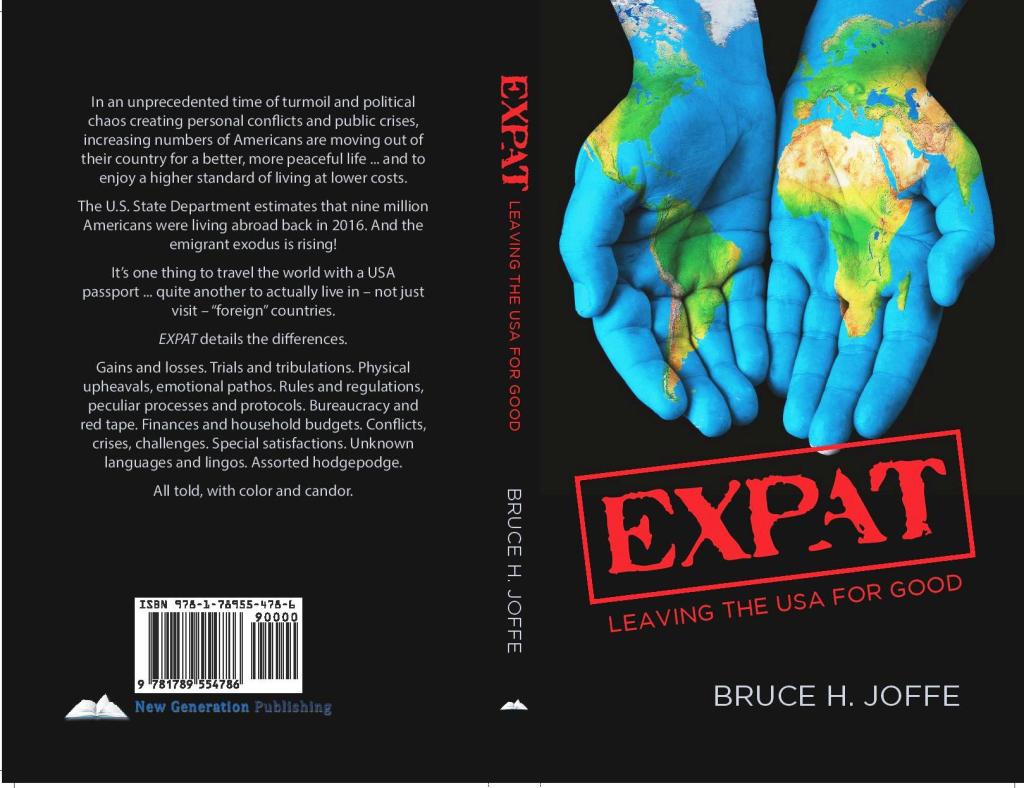
Shared here are personal observations, experiences, and happenstance that actually occurred to us as we moved from the USA to begin a new life in Portugal and Spain. Collected and compiled in EXPAT: Leaving the USA for Good, the book is available in hardcover, paperback, and eBook editions from Amazon and most online booksellers.
Processing…
Success! You're on the list.

Motivations

“Get going, already,” motioned the young couple who had purchased our house in Sturgeon Bay, Wisconsin, and were waiting, eagerly, for us to depart from what was now to be their new home.

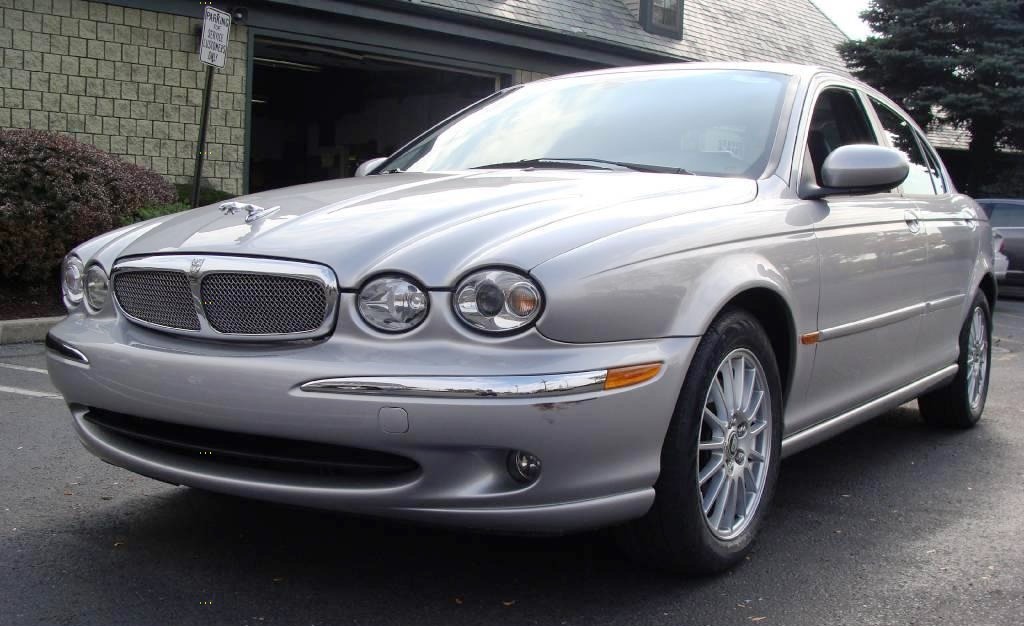
In addition to our house, they had bought a good deal of our furniture … as well as my favorite toy, an all-wheel drive Jaguar.

We had disposed of most of our possessions and keepsakes.

Except for the contents of one 8 x 8 x 20 foot shipping container filled with an assortment of “household goods” and our beloved artwork, collected and curated together over 25+ years together (plus not too few U-Haul “wardrobe” boxes filled with blankets, comforters, bed linens, towels, and other household goods that we’d purchased for donation to the needy in Portugal–especially victims of the fires), everything else we owned, including Russ’s Jeep Grand Cherokee, had been sold, gifted to loved ones, or donated to nonprofit charities.

Turning back one last time to wave a final good-bye, I realized that we had divested much if not most of the content comprising our life in the United States, as we prepared to make the one-way journey to Portugal with our three dogs, three large suitcases, and two allotted carry-on bags containing computers, passports, and other essentials.

Over the past ten years, we had been fortunate and privileged to own “vacation bolts” in Spain and/or Portugal, and to travel there once or twice annually, enjoying a month to six weeks during each visit.

But, this time would be different.

It wasn’t a visit. We’d be staying, not returning.

One-way, not round-trip, tickets.

This was the first time we were traveling with our dogs, three miniature schnauzers, who’d accompany us in the cabin on the three flights taking us to our new home: Green Bay > Chicago, Chicago > Philadelphia, and Philadelphia > Madrid (where we would rent a car large enough to transport our family and assorted paraphernalia on the four-hour drive to our property in Lousa, a village of 600 on the outskirts of Castelo Branco).

Endlessly, we had talked about living in Europe alongside other the expats and immigrants – from the UK and the Netherlands, Australia, Canada, Sweden and elsewhere – who had become part and parcel of our family and circle of friends in Spain and, later, in Portugal.

But they were European Union nationals. Different rules applied to them than applied to us. Even the Brits, though fearful of potential consequences their “Brexit” might cause, were convinced they would never be forced to leave the countries to which they had emigrated. Certainly, protections and provisions would be included in the terms and conditions negotiated during the UK’s exit from the EU.

For our part, we loved our lifestyle in Spain and Portugal. Life was easier (or easy-going) and slower there. Calmer and more tranquil. Far cheaper, too. And healthier. We walked rather than drove most days; typically, we ate less but healthier; and we drank far more red wine. As a “mañana mentality” took hold, we felt far less stressed and much more liberated. All in all, our quality of life greatly surpassed our cost of living.

Yet …

Visits and vacations are different from full-time living and residence. So, we dawdled, too comfortable in our intimacies and surroundings to actually make such a major move.

Perhaps it was the regular, routine Social Security payments I had worked a lifetime to earn. More probably, however, the political changes – first subtle, then crassly overt – which had changed the climate of our country, provided the real motivation for us to get going and relocate.

Shared here are personal observations, experiences, and happenstance that actually occurred to us as we moved from the USA to begin a new life in Portugal and Spain. Collected and compiled in EXPAT: Leaving the USA for Good, the book is available in hardcover, paperback, and eBook editions from Amazon and most online booksellers.

Processing…
Success! You're on the list.

Prologue

About 15 years ago, we purchased a small “vacation bolt” in a typical town in southern Spain, where we’ve spent months each year enjoying a different way of life. Later, we added a property in a small Portuguese village where we now live—about a six-hour drive, door-to-door, from our home in Spain–and, this year, we added a second small home on the Portuguese border at Badajoz, Spain, reducing our drive to four hours.

On March 25, 2017 we departed our country of birth to live in another.

We no longer reside in the USA, but divide our time between Portugal and our home-away-from-home in southern Spain. Yet we still are citizens of the United States and care (cringe?) deeply about what’s happening there. We have chosen — deliberately — not to be embroiled day and night with all the political atrocities, crimes, and conflicts which have divided the country, estranged families, stolen from the people, alienated us from our allies, poisoned our environment, and brought us time and again to the brink of unthinkable disasters.

# # # # #

My heart continues to cry for the beloved country and I will express disgust and rage at those who claim to represent us but actually profit and privilege from their perches.

I don’t regret the moves we made.

All things considered, our lives have been enriched by knowing people from all walks of life throughout the United States and around the world. Social media conveniently bring many together, enabling us to cross-pollinate the people and places we’ve known over the past 50+ years: high school classmates, college alumni … and dearly beloved friends in New York, Virginia, Florida, Wisconsin, Spain, and Portugal.

We now face challenges of a different sort here in Portugal, the world’s third most peaceful country (following Iceland and New Zealand) and, reportedly, the friendliest and most popular one–especially for immigrants and expats.

In essence, we started from scratch … finding friends, doctors, dentists, veterinarians, hair cutters, food, and our way around … all in a language we couldn’t yet speak or quite understand. We needed to learn how to slow down, to enjoy the simplest pleasures of life, and trust that tomorrow will bring its own promises and priorities.

Thank you for taking part in our journey.

As “they” say, it’s not the destination – but how we get there – that matters most.

Shared here are personal observations, experiences, and happenstance that actually occurred to us as we moved from the USA to begin a new life in Portugal and Spain. Collected and compiled in EXPAT: Leaving the USA for Good, the book is available in hardcover, paperback, and eBook editions from Amazon and most online booksellers.

Processing…
Success! You're on the list.

← Back

Thank you for your response. ✨

Rx Rip-Off

Three years ago today, I had a doctor’s appointment. My physician gave me a prescription for three — just 3! — tablets of a medication not covered by my Medicare Advantage plan.

“They’re quite expensive,” he warned, “so you will probably want to shop around for them.”

As his nurse reviewed the doctor’s notes with me before leaving, she bent over and whispered, “Look online, hon. I’m sure you can find these drugs for far less from Canada … or elsewhere.”

“Are you kidding?” I joked. All I needed was more inbox spam for male enhancers.

So, I called every pharmacy in the area. The mail order division of my Medicare provider. And U.S. online drug stores.

Bottom line:

TWO HUNDRED AND EIGHTY-SIX DOLLARS ($286) FOR THREE TABLETS!!!!!

Then, I went back online and looked at Canadian pharmacies. A legal, licensed, accredited Canadian “dispensary” requiring a bona fide prescription would charge me US $19.80 + $9.00 shipping for eight — not three — of the same brand tablets. But, I’d have to have my doc rewrite the ‘script for eight tablets instead of three.

Living in Portugal and Spain now, pills and pharmaceuticals cost a whole lot less–23 Euros for six “comprimidos” of the same drug from a different supplier.

Portugal and Spain subsidize their pharmaceuticals and set the price for them.

I still can’t help but wonder what’s wrong with this picture: $19.80 for eight of the same, non-branded tablets from a Canadian pharmacy vs. $286.00 for three from a U.S. drug store and about US $27 to purchase them here in Portugal. Per pill, that’s @ $95 (USA) vs. $3.60 (Canada) vs. $4.50 (my Portuguese pharmacy).

That’s not right. It’s wrong. Very wrong!

Shared here are personal observations, experiences, and happenstance that actually occurred to us as we moved from the USA to begin a new life in Portugal and Spain. Collected and compiled in EXPAT: Leaving the USA for Good, the book is available in hardcover, paperback, and eBook editions from Amazon and most online booksellers.

Processing…
Success! You're on the list.

An Exceptional Language: Portuguese, La Lingua Franca

Unfortunately, Portuguese was never one of the languages offered in most USA schools.


Spanish and French, yes … with some of the more upscale schools including Latin (or Greek) – even Russian! – in their curriculum.


Mas não português.


So, most of us opted for Spanish or French.


Even a limited knowledge of Spanish, especially, can be both a help and a hindrance — a mixed blessing — to learning Portuguese.

Let me be clear: I am not saying that Portuguese derives from Spanish or that peering into Portugal’s language portal through Spanish eyes is what learning Portuguese is all about. Many people have difficulty understanding and speaking Portuguese (though reading it is somewhat easier), not just because of the vocabulary and syntax, but — especially — because of its pronounciation. But, once our ears are attuned to the sounds and rhythm of the language, there’s a nasalized beauty in the poetics of Portuguese.


The communications professor in me wants to know about a language and understand what makes it tick. Peering through the peephole of Spanish, because it’s my familiar tongue, I try to unpack the mysteries of how the Portuguese language works—and why.


But my Spanish also causes obstacles, hurdles, and stumbling blocks. People constantly remind me that I’m thinking – and talking – in Spanish.


When I speak Portuguese, it comes out sounding like a Spanish mish-mash.


“Fala português … não espanhol!” my Portuguese friends admonish and encourage me.


Intent at understanding the “why” behind the language, its psychology, the rules governing its syntax, I’ve embarked on an ambitious adventure to analyze Portuguese, at least as the language relates to Spanish … arriving at a number of “Eureka!” findings in the process.


Some rules hold true rather regularly between Portuguese and Spanish. For instance:


• An “n” in Spanish is usually an “m” in Portuguese, while the Spanish “ie” is simply an “e” in Portuguese. Examples: una/uma … con/com … en/em … diez/dez … sin/sem … tiene/tem … bien/bem … abierto/aberto … también/tambén … alguien/alguem … siempre/sempre … tiempo/tempo … invierno/inverno … fiesta/festa;


• That “ny”sound (as in“canyon”) signaled by a tilde over the “n” (ñ) in Spanish is much the same in Portuguese, with words having “nh”letters: viño/vinho … señora/senhora … español/espanhol … baño/banho … leña/lenha;


• Although also used in Portuguese – most frequently over the letter “a”(ã) – the tilde produces an entirely different (nasal) sound: João … cartão … educação … manhã … não;


• The “ue” diphthong in Spanish becomes an “o” in Portuguese: luego/logo … puerta/porta … puerto/porto … puede/pode … fuego/fogo … fuerza/força … escuela/escola … cuenta/conta … suerte/sorte … juega/joga.


• “O” in Spanish is often “ou” in Portuguese: poco/pouco … otro/outro, while the Spanish “l” often becomes an “r” in Portuguese: plato/prato … placer/prazer … plaza/praça;


• “U” in Spanish can become “ui” in Portuguese: mucho/muito … at other times, instead, it becomes an “o”: gusto/gosto … punto/ponto;

• The double “ll” in Spanish often translates to “ch” in Portuguese: llave/chave … llama/chama … lluvia/chuvia … llegando/chegando;


• Words beginning with “h” in Spanish often switch to an “f” in Portuguese: horno/forno … hacer/fazer … hablar/falar … hijo/filho … harina/farinha … fugir/huir … hablar/falar … harto/farto;


• When you see a word with a “çao” suffix in Portuguese, it probably ends in “ión” in Spanish: relação/relación … informação/información … edição/edición … habitação/habitación;


Confused?


Wait, the questions keep coming … and we haven’t yet touched upon tenses and sentence structure:


It’s “bom dia, boa tarde, boa noite” in Portuguese, but “buenos días, buenas tardes, buenas noches” in Spanish. Why are the day’s divisions plural in Spanish but singular in Portuguese?


When does “dia” end and “tarde” begin, anyway? Why, after 12:00 PM, of course, you say? Maybe technically. But people in Portugal generally suppose that “tarde” begins after one has eaten lunch. What about “noite”? When it becomes dark … or after eating dinner?


And why are the words for “day” spelled the same in Spanish and Portuguese, while only Spanish gives it an accent mark (día)?


Spanish, like most Latin-derived languages, names the days of our lives: lunes, martes, miércoles, jueves, viernes, sábado, domingo. Except for the weekends (sábado, domingo), Portuguese, instead, numbers them: segunda-feira, terça-feira, quarta-feira, quinta-feira, sexta-feira.


But don’t confuse “feira” (market, as in market days) with “feria” (fair, market, and often, holidays) or ferias: vacation.


Thankfully, many words are identical in both languages: “casa,” “porque,” “tal|vez,” “médico,” “viajar”, “comprar,” “poder,” “vida” … and even “de nada,” to say “you’re welcome.” So, how come cats are cats – “gatos” – in both languages, while a dog is “perro” in Spanish but “cão” in Portuguese? And, for goodness sake, how did “gracias” become “obrigado,” every foreigner’s favorite Portuguese word?


Pronunciation and accents are other matters entirely, as Portugal uses almost every accent mark in existence—and then some! How can anyone other than a native enunciate clearly the subtle differences between “pais” (parents), “país” (country), and “pães” (breads)?

Who but the Portuguese can tell the difference between grandfather and grandmother, when the ending of both seemingly masculine words differs only by an accent mark: avô (grandfather) and avó (grandmother)? Yeah, right. Now try pronouncing them both.


Similarly, verb tenses and conjugations differ in the two countries of Iberia. For instance, consider so-called “reflexive” verbs. More often than not (although not always), their order is reversed: In Spanish it’s “se vende, se trata, se llama,” while in Portuguese we get “vende-se” and “trata-se,” but “se chama” … except when asking a question, used in the negative, and other exceptions: “Se vende a casa?” “Como é que se chama?”

And the past tense (pretérito) is so similar, yet different. Take the verb “ir,” for instance. In Spanish and Portugal, the first person singular in both is “fui.” Yet, while the third person singular is close in the two languages, a miss is as good as a mile: fue (Spanish) and foi (Portuguese).


Here’s where turnabout between the Portuguese and the Spanish isn’t necessarily fair play: Some Portuguese people understand spoken Spanish, because they grew up watching Spanish TV.


Spanish people, however, have a hard time understanding Portuguese. Some say that’s a matter of choice, not of ability. Because whether it’s Portuguese, Spanish, or Portu|ñ|ol, we certainly understand each other at the border cities and towns.


As for me, I don’t think I will ever get used to seeing “Puxar!” on a door and pushing rather than pulling.

Shared here are personal observations, experiences, and happenstance that actually occurred to us as we moved from the USA to begin a new life in Portugal and Spain. Collected and compiled in EXPAT: Leaving the USA for Good, the book is available in hardcover, paperback, and eBook editions from Amazon and most online booksellers.

Processing…
Success! You're on the list.

The Americanization of Iberia

Conveniently, we’re eating lunch in the food court at one of Castelo Branco’s largest shopping centers. With a dozen or so eateries in a semi-circle filled abundantly with tables and chairs, eateries abound: churrascarias (bbq), fish, soup and sandwich, Italian (pizza & pasta), kebabs and gyros, burgers, ice cream, pastries, and other desserts.

Our favorite is a Brazilian steak house where, for €4.90 – about $5.50 – you can get a grilled flank steak on a roll with a side salad, bowl of soup, French fries, and your choice of beverage—wine and beer included. Other meals are comparably priced. All are served on real plates and dishes, with flatware and drinking glasses.

But many of the Portuguese we see prefer to eat, instead, at the Pizza Hut, KFC, Burger King, or McDonalds next door … tapping digital buttons to order food and then waiting for their LED numbers to flash, summoning them to pick up bags with disposable contents.

Meals at these American franchises typically cost more than Portuguese food.

Hamburgers, chicken, pizza, and sandwiches, of course, are international foods, unlimited by American influence. It’s how the food is cooked and served that makes all the difference (along with the type and quality of products used).

Why would anyone want to eat such assembly line food with “paper” plates and plastic utensils, when so much better is available in the very same space?

It got me thinking about the influence America – the USA, in particular – is having on Portugal and Spain in Iberia. Is that still called “imperialism?” Good, bad, or indifferent, the USA has affected Portuguese and Spanish cultures in many ways:

• Language. As American English differs from the British, European Portuguese and Spanish differ from their Brazilian and Hispanic cousins. And American lingo is increasingly taking root in both languages. English – accented by American English, by and large – is mandatory learning in Portuguese schools, from elementary grades through secondary school. English speakers seek to practice their Portuguese; but as soon as we open our mouths with mispronounciation, the Portuguese reply in excellent English. Daily, more American expressions and words are imported, even though native words already exist: “take-away,” and “tênis” (sneakers) … along with many other words of common usage: “marketing,” “workshop,” “brownie,” “cupcake,” “low cost,” “cheap,” “check in,” “designer,” “email,” “blog” “clic(k),” “check up,” and “yummy” are just a few examples, along with the universal gadgets and widgets of technology.

• Media. If you watch TV’s The Price Is Right or America’s Got Talent, you’d best take their Spanish and Portuguese equivalents with a large dose of salt! As for cinema, we get first-run American movies here upon release. Soundtracks are hilariously dubbed in Spanish, while shown in their original English with Portuguese subtitles.Heck, there’s even Netflix.es and Netflix.pt. American music – current and oldies – is quite popular on much Iberian radio … until interrupted periodically by Catholic masses and Hail Marys broadcast in their entirety.

• Money. Plastic seems preferred over cash—especially during the pandemic. Although Americans reach for their credit cards, the Portuguese and Spanish are more likely to use debit cards. The ATM was invented by a Brit (not the Yanks), but their use is everywhere today. In Spain, you can withdraw and deposit money, pay bills and even traffic fines at an ATM. Portugal’s “multibanco” machines do even more! They’re so smart, in fact, that they don’t deem cash withdraws – where we’re assessed fees from both the dispensing and our home banks – as such. (Not so with Spain’s ATMs.)

• Medicine. Although universal health care is the birthright of all Spanish and Portuguese citizens (legal residents in Portugal, as well), locals often opt to supplement their public health care with private coverage. There’s quite a difference (in price!) between the USA’s and Iberian medical plans. While the cheapest and least inclusive health insurance policies can cost thousands of dollars per month in America, comprehensive health care insurance in Portugal runs us about $160 per month (all-inclusive) for two people–one 70+, the other almost 60. Spain, too, offers the option for foreigners residing there to buy into the country’s national insurance or purchase comparable coverage through private market insurers.

• Urbanization. How are you going to keep them down on the farm? The Portuguese lament the loss of their younger, educated population who flee the small villages of their birth to elsewhere … other countries, as well as bigger cities in Portugal, where employment opportunities are more plentiful and the proverbial “rat race” appears to be exciting. Buy, sell, spend, borrow, bigger, better … more! After a while, however, keeping up with the Joãs takes its toll. Like the city mouse and the country mouse, there’s a pronounced distinction between city dwellers and their more provincial relatives, with natives dividing lifestyles as either city or country (campo).  Increasingly, however, the Spanish and Portuguese experience that yearning, “saudade,” to return to their roots … tilling the soil and enjoying a more peaceful, tranquil, less hurried and hectic lifestyle. Wherever the location, however, for those looking to buy or rent property, there’s a local office of the Re/Max, ERA, Century 21, and Keller Williams real estate networks.

• Technology. The globalization of technology certainly can’t be limited to the United States. But silicon valleys across the country are the forbearers and creators of our digital world. The most popular mobile phone in Portugal and Spain? Apple’s iPhone.The preferred computer? Apple’s iMac. The ubiquitous operating systems and tools of computers? Microsoft’s. The go-to search engine? Google. The most popular social media platforms? Facebook and its WhatsApp. The best known computer chips and graphic cards? Intel.

Unfortunately, ignorance and belligerence — byproducts of American polarization — appear to be finding friends in Spain and Portugal. Chanting “freedom,” hundreds of people rallied in Madrid and Lisbon in to protest the mandatory use of facemasks and other restrictions imposed by the governments to contain the coronavirus pandemic. And in Portugal, one of the countries intent on containing and crippling the virus, we are impressed with the fortitude and compassion displayed by the Portuguese people. “It is not perfect here,” states an American expat living in Lisbon. “The police need to enforce mask rules (occasionally meeting violent resistance) in some ethnic ghettos, but the city is trying to increase communications and messaging in those neighborhoods and incidents are rare.” In southern Portugal, “most are following the rules, but still get too close at the grocery, leaning in or reaching around. On the boardwalk, tourists don’t cover when they cough and sneeze.”

American outreach has cribbed many inroads to territories Spanish and Portuguese.

T-shirts glorify alleged American icons and phrases, while shopping carts are filled with brands such as Heinz, Tropicana, Listerine, Johnson & Johnson, Old Spice, Colgate, Oral-B, Coca Cola (and Pepsi), Kellogg’s, Finish, Raid, Vaseline, Woolite, Hellman’s, Vaseline, Dove, Bic, Purina, Pedigree, and Friskies (among others) … outpacing the national ones.

So be it.

But if and when Walmart arrives here, it will be time for us say enough is enough!

Shared here are personal observations, experiences, and happenstance that actually occurred to us as we moved from the USA to begin a new life in Portugal and Spain. Collected and compiled in EXPAT: Leaving the USA for Good, the book is available in hardcover, paperback, and eBook editions from Amazon and most online booksellers.
Processing…
Success! You're on the list.

Would You Buy This Property?

Would You Even Go to Look at It?
http://www.facebook.com/USAExpats/videos/1043444559187343

Often, it’s hard to understand the mentality of property agents in Portugal and Spain.

I mean, honestly, what were they thinking?

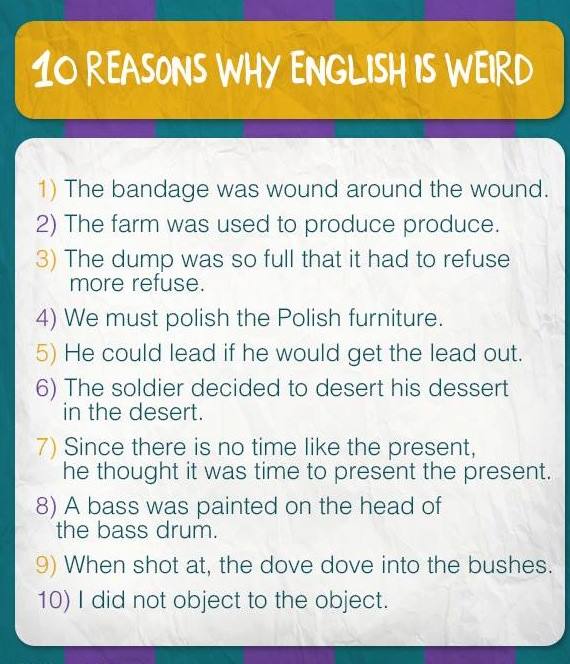
The photos linked above are actual representations of an actual property listed by an actual property agent and actually sent to me as a possible property in which I might be interested … the agent supposed.

Not!

It’s a different world out there selling properties in Portugal and Spain than in the USA and UK. But just as there are good, bad, and indifferent property agents on the west side of the pond, the same holds true for the east side–especially Portugal and Spain.

We have had some excellent agents in both countries who have gone out of their way to understand our needs (and wants), our budget, location, and property condition … they’ve been honest in telling us that, “There’s nothing we have for that price that meets your criteria,” or, “We have a property that might work for you, but it needs some work,” or, “You’re going to have to look outside that area for a place that is everything you want.”

Part of a property agent’s responsibility, we believe, is to advise and counsel clients that — before they can put their property on the market for sale — they need to clean and straighten it up … even to make a few fixes, inexpensive stuff like removing surface mold and adding a lick or two of paint.

Property agents must do more than charge clients a fee for hanging out a “For Sale” sign and listing the property on their websites. They must work with their clients, advising and showing them how to make the most of what they are trying to sell. And then, before clicking on the “Publish” button, they should take appropriate photos that accurately and honestly show the property in its honest but best possible reflection.

Yes, the photoss here are from a lower-priced property (€48K) in a smaller village off the beaten track … but, still, there is no excuse to present it with pictures like these.

Wouldn’t you wonder: If this is what I can see in this property, what about what I can’t see? What’s hiding inside the roof, behind the walls, under the floors?

Too many property listings are simply sloppily slapped together and thrown out there online, hoping that somebody, somewhere, might be interested in taking a closer look.

We’re not. Are you?

Shared here are personal observations, experiences, and happenstance that actually occurred to us as we moved from the USA to begin a new life in Portugal and Spain. Collected and compiled in EXPAT: Leaving the USA for Good, the book is available in hardcover, paperback, and eBook editions from Amazon and most online booksellers.
Processing…
Success! You're on the list.

What Do You Call It?

The Portuguese have a word for it.

English really doesn’t.

You can’t define it; to truly understand its meaning, you’ve got to experience it.

It’s different than depression, distress, disillusionment, discouragement, despair. It’s wistful and wishing for the way things were … and ought to be … but aren’t anymore.

Although “melancholy” probably is its closest cousin in English, it’s much more than that: a longing, yearning, aching void.

It’s the heart swelling up and crying out inside. It’s a lump in the throat … anxiety attacks … a feeling of foreboding … brooding … bleeding internally … unable to heal the hurt.

It’s a slow burn about the utter unfairness of it all … coupled with an irresolute resolve to go on and make it through yet another day–despite the turmoil, trespasses, and travails along the way.

It’s caring so much and coping so continuously that we’re overwhelmed and exhausted, unable to do much more than sigh as we watch the world go by(e).

It’s abject and deject, anguish and agony, feeling victimized and caught up in an elusive web of betrayal beyond our control.

It’s something for which, elsewhere at another time, they’d prescribe mind-numbing drugs, psychotherapy sessions, and therapeutic confinement.

It’s sort of like the Yiddish word “Rachmones,” whose translations – mercy, compassion, empathy, understanding – don’t come close to what we actually feel when recognizing the trait in a kindred spirit: Namaste.

It’s a voice heard in Ramah, weeping and great mourning, Rachel weeping for her children and refusing to be comforted, because they are no more.

It’s hiding in Anne Frank’s attic, knowing full well what the future holds.

Yet, it is part of the song and dance that are our lives.

The Portuguese sensitize these doldrums and call them “Saudade.”

For me, it’s a dark cloud hovering over us as I await what’s beyond … looking away and staying inside without precious connection to others … hoping it will pass sometime soon.

I feel like a psalmist, pleading with the Almighty to allow me to be joyful, yet unable to understand how and why we’ve become such drained and divided fragments of our fabric.

Then I remember that verse: “ … weeping may remain for a night, but joy comes in the morning.”

So be it.

Shared here are personal observations, experiences, and happenstance that actually occurred to us as we moved from the USA to begin a new life in Portugal and Spain. Collected and compiled in EXPAT: Leaving the USA for Good, the book is available in hardcover, paperback, and eBook editions from Amazon and most online booksellers.

Processing…
Success! You're on the list.

Elbow Kissing

People here take the virus seriously. Very seriously, indeed.

Wherever we go in our Spanish town of Olvera in Andalucía, folks have masks dangling, half-mast, from their ear lobes, ready to pull them up to cover their mouths and noses as soon as the shadows of others are seen approaching.

That’s outside, on the streets.

Elsewhere, the masks are also facial appendages. Little old ladies sit and chat with covered faces, night after night, on benches in the tidy little park at the bottom of Calle Campillos, where Olvera´s former post office had stood, replaced years ago with this quaint oasis in the midst of row houses zig-zagging as they bend and stretch up and down the narrow, steep street.

Across the border in Portugal, little old men sit on knee-high walls surrounding their village churches, pontificating about this or that (as is their nature). It’s difficult enough to understand their dialects under the best of conditions; but, with mouths muffled by máscaras (mascarillas in Spanish), it’s even more challenging to decipher their staccatoed opinions and argumentative crescendos.

Even the youngsters – from toddlers to teens – understand the seriousness of the moment, responding without usual rebellion when told to step back, stay away, come inside, don’t touch, wear their masks.

These are people, entire populations, who barely survived under severe lockdowns for three or more months. They’ve seen death and the toll Coronavirus can take, up-close-and-personal. So, they´re now bound and determined to do whatever they can to ensure they and their communities aren’t again victimized by the virus.

Now, they take Covid-19 damned seriously.

To promote social distancing at restaurants, cafés, and snack bars, Olvera’s local government has granted special dispensations to eating venues and watering holes, allowing them to squat on public space: either grassy land nearby or by cordoning off four or five asphalt parking spots and dedicating them to diners.

After all, this is a café culture where people relish food, drink, and companionship … with wine, coffee, cola, and beer.

Nobody – employees, delivery personnel, clients, customers – enters a shop (large or small) without wearing a mask. Sanitizer is plentiful everywhere. Plastic gloves are often available, sometimes required (in groceries and markets), other times not—but recommended. Cosmetologists and stylists apologize for having to raise prices by fifty cents to pay for the plastic booties and robes clients are required to wear. And, woe to the supermarket customer who dares to inch beyond the designated markers! You may be allowed to put purchases on the conveyor belt … but you’ll be warned to wait until the previous customer has completed paying and packing, before advancing. The one person per elevator (lift) rule is respected, as is a minimum meter distance on escalators. Waiting rooms, as elsewhere, maintain two empty seats between each available one. Spitting on streets is strictly prohibited and enforced by one hundred to one thousand euro fines.

Throughout the Iberia peninsula, Covid-19 isn’t a matter of personal politics or in-your-face freedom fighters; rather, it’s actually about personal hygiene and public welfare: the common good.

I certainly don’t mean to imply that everyone here is a sanitized saint, dutifully and willingly following the new “normal” rules for social interactions. Just the other day, in fact, I observed a woman in one of our favorite supermarkets picking up plastic packages of pastry, squeezing them, and putting them in front of her (masked) nose for a sniff. She picked up and put back at least a half-dozen packages. Not that she was malicious, but simply self-serving and negligent, not thinking about the potential consequences she was causing to others. I caught the eye a store associate and nodded at the woman. Without hesitation, the supermarket employee approached the offender and gave her a lesson she’ll not soon forget about appropriate protocols for grocery shopping.

Nonetheless, such experiences are exceptions to the rule.

By and large, we live among demonstrably caring, emotional and “affectionate” people who share their feelings with hugs, handshakes, and serial kisses on both cheeks. Not now, however. Instead, we poke elbows … laughing about how silly (but serious) such a greeting seems.

Elbow kissing doesn’t come close to sharing a good, hearty hug.

And that’s what really, truly hurts.

No hoax intended!

Shared here are personal observations, experiences, and happenstance that actually occurred to us as we moved from the USA to begin a new life in Portugal and Spain. Collected and compiled in EXPAT: Leaving the USA for Good, the book is available in hardcover, paperback, and eBook editions from Amazon and most online booksellers.
Processing…
Success! You're on the list.

American Dogs, Portuguese Cães (A Children’s Story)

Three beloved Miniature Schnauzers – Jax: a white male, Sheba: a black female, and Manny: a silver-gray male – moved with their family from a cold climate in the upper Midwest of the United States to a new home in a small village of central Portugal.

When they finally arrived at their destination after three long airplane flights and almost a full day traveling, all three dogs were insecure. “Where are we?” they wondered. “What happened to the rooms and smells – the world – we loved and lived in for so long?”

Now, they had pet passports that allowed them to travel from country to country throughout the European Union, and licenses which recognized them in their own Portuguese village.

Their human daddies did everything they could to comfort and reassure them. In addition to packing their favorite keepsakes to bring along, the dogs had new beds and bedding, plenty of good food to eat, squeaky toys to play with, and the attention of their two devoted dads.

One day not long after the dogs arrived, their dads fastened leashes onto the dogs’ collars and took them for a long walk around the village. Suddenly, they came across three other dogs in the street.

“Bow-Wow-Wow!” greeted Gonçalo the Galgo.

“Woof, Woof, Woof!” welcomed Pedro the Podengo.

“Bark, Bark, Bark!” began María, mistress of the streets.

But Manny, Sheba, and Jax could not understand a word they were saying, because the other dogs were speaking Portuguese … and the three American dogs had not yet learned that language.

So, they just wagged their tails with excitement.

Later that same day, the American dogs were out on their afternoon walk when the Portuguese dogs came running over to them.

All of the dogs were happy to meet again and discovered that, by listening carefully, they were able to understand the words and the motions shared by each other. It was a common language!

The Portuguese dogs introduced themselves first.

“Boa tarde,” said Gonçalo. “I am a galgo, a dog used for racing and hunting—for only one season … but then I was discarded.” Tears filled Gonçalo’s eyes, as he continued his sad story: “I was starved before hunting, to make me more hungry for the prey.”

Jax, Manny, and Sheba couldn’t imagine a life like that.

Pedro spoke next: “Podengos are even more persecuted than galgos. Curious and clownish, we are very aware of our surroundings and very sensitive to humans. We are wonderful family members! But, like Gonçalo, I came from a breeder who chained me and sold me for sport. I was abused, treated badly, and abandoned because I wouldn’t kill.”

The three American dogs felt very sad for their new friends. Though shaggy and unkempt – their teeth needed cleaning and they all could benefit by baths – the Portuguese dogs were welcoming and outgoing.

“When I was young and just a pretty little puppy, I was a Christmas gift to two little children,” María explained.” She had fond memories of their times together, until she grew bigger and they were older. A few years later, the family moved, leaving María behind–without even a hug good-bye or words of farewell. Closing the door to the house where they lived one last time, they left María on the street. Over the years, she had given birth to many litters of puppies … but no longer could remember what had happened to them or where they went.

Licking their new friends with their tongues to make them feel better, the American dogs said, “Até breve,” because their daddies were ready to return home and the dogs wanted to see the dogs again soon.

Eating dinner in the warmth of their kitchen, the three American dogs talked about their new friends.

“Where do they live?” asked Jax. “Who takes care of them and feeds them?” wondered Sheba. “What do they do during the days and nights, while we’re taking our naps?” Manny inquired.

Eager to learn more about their lives, the American dogs decided to bring bits of their food as treats for their Portuguese amigos.

Early the next morning, right after their breakfast, leashes and collars were put on Jax, Sheba, and Manny. Their dads opened the front door, as the dogs scampered along, tugging at their leashes.

Where were María, Pedro, and Gonçalo?

Turning the corner and walking past the garbage bins (where Manny and Jax lifted their legs), they could hear the voices of their friends coming from farther down the street. But there were other voices, too.

“Olá, amigos,” said Pedro upon seeing his English-speaking friends from America. “I want you to meet Francisco, Ana, Rodrigo, Miguel, Patricia, and Tomás. They live in this village, too!”

“You do? Where?” Sheba and Manny responded immediately. “Why haven’t we seen you before? It’s great to have so many friends!”

Gonçalo explained that the other dogs lived with families in houses and were put outside a few times each day.

“But, but …” the American dogs didn’t know what to ask first.

“Your families don’t walk you with leashes?” Manny wanted to know. “Aren’t you afraid to walk by yourselves with all these cars and trucks on the streets? How do you pick up after yourselves?”

“We don’t!” exclaimed Rodrigo. “Sometimes the rain washes it away. Other times, it just stays here, until it dries up. Often, cars drive over it, pushing it down between the cobble stones. You dogs from America have servants who clean and pick up after you, no?”

Sheba was anxious and wanted her question to be answered: “All those vehicles are going in both directions so fast! Aren’t you afraid?”

“Oh, you get used to it,” Ana and Patricia nodded. “Usually, they’ll slow down if they see you … but sometimes you need to run to a spot in a doorway, against the wall, or between cars, and wait for them to pass.”

Patricia and Ana lived together with the same family. They heard the mother calling their names, so they scampered off. “Adeus,” they said, wishing the newcomers well. Rodrigo, Miguel, Tomás, amd Francisco followed the girls, leaving the Americans with their three first friends.

“Where do you live?” Jax asked María, Pedro, and Gonçalo.

“Right here,” Pedro responded. “We live on the streets.”

“But who takes care of you? Who feeds you? Where do you sleep? What do you drink?” concerned Jax, the eldest dog of his family.

“We can take care of ourselves,” grinned Gonçalo with pride. “The water from the village fountain is always plentiful and quite good.”

“People throw table scraps onto the street for us … pieces of fish, chicken, and even meat,” piped in Pedro. “Cats rip open the plastic trash bags, but we chase them away and find food there, too. Some people are really nice: They buy food for us at the grocery store and put it outside, on the street, for us to eat. That’s really convenient, eating food on the street—right next to where we sleep.”

“Food from the street? Food on the street? That’s where you eat?” asked Manny, trying to imagine eating like that.

The American dogs were on low-fat diets. Yet, compared to their new Portuguese friends, they were very well fed. Their dads mixed together special dry food from bags with moist dog food from cans. Then, tiny pieces of boiled chicken breasts with rice – along with fresh pumpkin or squash – were cooked, pureed, and placed in plastic containers in the freezer or refrigerator … until they were needed. Everything would be mixed together: some of this with some of that. Why, it took almost twenty minutes just for the food to be mixed in their stainless steel bowls, which were picked up and washed as soon as the dogs finished eating their meals.

“You sleep on the street?” Sheba cried, her motherly instincts kicking in. “Aren’t you cold? Or hot in the summers? What about all the bugs, flies, and mosquitoes? Don’t they bite? Won’t you get sick?”

“Não,” answered Pedro, muzzling María. “We watch out for each other. Often, we curl up together to sleep. That’s nice and warm. When it’s not raining, we find a welcome mat to lie on …. if it rains, we will sleep under the parked cars.”

Usually shy, María began to speak:

“You Americans have many questions. We tried, our best, to answer them. Now it’s our turn. Can we ask you some questions?”

“Of course,” echoed Manny, Sheba, and Jax … all at once.

“What are those colorful tags, decorating your necklaces?” she asked. “Do you always wear jewelry like that?”

“Oh, they’re not necklaces,” laughed Sheba, “but collars attached to our leashes. And the tags on them show that we have been vaccinated by the veterinarian against diseases that flies and worms and mosquitoes can spread. Haven’t you had shots to keep you safe, too?”

The Portuguese dogs shook their heads, explaining that they were from the same land and were not bothered by their bites. As foreigners and newcomers to their environment, however, the American dogs would need to be protected from such pests and diseases.

“And we all must be careful to avoid the processionary caterpillars,” warned Gonçalo. “They are dangerous to us all!”

“Hey, don’t those collars and leashes bother you?” María doubted. “How can you run and roam if you’re always attached to them?”

Jax scratched his head before responding, “We can’t. Why would we want to race around town, anyway? We’re perfectly happy walking with our dads. They’re looking for a piece of land now near our house, so that we can run around safely. Before moving here, we always had a yard where we could go outside to play and do … stuff,” he said.

“You mean that you never travel or go anywhere without people?” Pedro wondered. “Like there …” He lifted his leg and pointed his paw toward the snow-capped tops of the distant Serra mountains.

“We’ve traveled a lot with our family,” sniffed Sheba. “But we always go by plane or car, in the back with seat belts. We’ve been on vacation to Porto, we go to the groomer in the big city, and we have a holiday home in Spain, where we know lots of dogs who speak Spanish … a language not unlike Portuguese. Their lives are similar to yours, although more of them walk with leashes held by people now. And snow? We’ve seen lots of it. In fact, we played in the snow quite often. One of the places we lived before moving here was Wisconsin, where there’s so much snow that, sometimes, it’s higher than us!”

“But you can only go where your family takes you,” remarked the Portuguese dogs. “Even in our village, there are so many delightful places to visit, sights to see, and smells to enjoy!”

Like a shadow, a thoughtful silence fell over the dogs for a moment.

“Yes,” Jax admitted. “That is true. But we’d rather be with our family than out and about without them. They take such good care of us. So, seeing and smelling what’s here isn’t that important. We’re happy!”

“Well … since you mention it,” reacted María, “it appears your family does take very good care of you. Maybe too good? Are they feeding you too much? Is that good for your health? And, look at your nails!”

“Our nails?” all three American dogs gasped.

While the Portuguese dogs sorely needed baths and haircuts, their nails were neat and trim. How was that?

“Because of the cobble stone streets in the village,” Pedro explained.

The American dogs had walked only on soft grass, so their nails had to be trimmed by a groomer. They didn’t like that at all! And their wet feet always were wiped off with the towel by the front door.

“What I want to know,” Gonçalo interrupted, “is who will take care of you if your family is gone? When or if your dads aren’t here?”

Suddenly, all of the dogs – Portuguese and American – were sad, as they thought about their lives and the people they loved.

At the end of the week, after several very long conversations where they all learned new languages, the friendly dogs went back again to where they lived. Although the American dogs regretted that they didn’t have the freedom to come and go as the Portuguese dogs did, they truly loved their families and appreciated their comfortable lives.

Waving good-bye to their Portuguese friends until later, the American dogs realized that their lives might be different from how their friends lived, but that they really were not any better than them.

“We are quite fortunate,” they said to each other, as their new friends bounded off down the street after a cat that had come out from under one of the cars.

“Até logo!”

Shared here are personal observations, experiences, and happenstance that actually occurred to us as we moved from the USA to begin a new life in Portugal and Spain. Collected and compiled in EXPAT: Leaving the USA for Good, the book is available in hardcover, paperback, and eBook editions from Amazon and most online booksellers.

Processing…
Success! You're on the list.